

- Paris 2024 Olympics introduces advanced technologies, including advanced AI-driven smart referee systems, digital twin models, and intelligent sports equipment, setting new standards for accuracy, efficiency, and performance.
- With the continuous progress and iteration of technology, the Tokyo Olympic Games three years ago and the Paris Olympic Games today are no longer the same. The integration of these innovations promises a more immersive and fair experience for athletes and audiences alike.
OUR TAKE
The integration of advanced technologies like Bullet Time, Digital Twins, Smart Athletic Equipment, and Intelligent Referee Systems at the Paris Olympics is a testament to how far we’ve come in merging sports and technology. These advancements not only promise to deliver a more immersive and precise viewing experience but also highlight the potential for future innovations in sports. The shift from Tokyo’s already impressive tech to Paris’s enhanced, real-time capabilities signals a new era in sports broadcasting and athletic training, pushing the boundaries of what’s possible on and off the field.
-Jasmine Zhang, BTW reporter
The rapid evolution of technology has transformed every aspect of our lives, and sports are no exception. From the days of grainy black-and-white broadcasts to today’s ultra-high-definition streaming, the way we experience sports has dramatically changed. The Paris Olympics are set to push this envelope even further by incorporating a suite of groundbreaking technologies. This article explores how Bullet Time, Digital Twins, Smart Athletic Equipment, and Intelligent Referee Systems are poised to revolutionise the way we watch, train, and understand sports, setting a new benchmark for future events.
“The integration of smart technologies at the Paris 2024 Olympics marks a significant step towards enhancing fairness and performance in sports.”
Thomas Bach, IOC President
Bullet time technology: Capturing the perfect moment
Technology overview
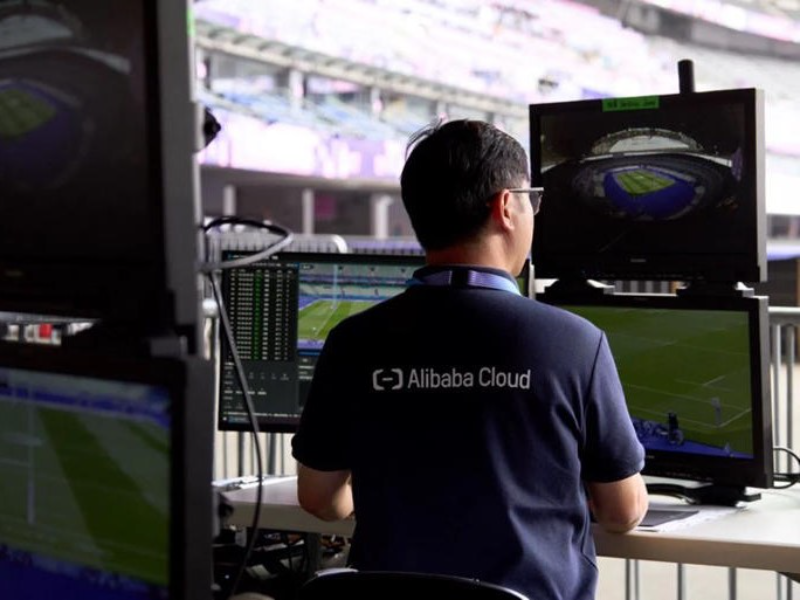
Bullet Time technology, popularised by “The Matrix,” uses an array of high-speed cameras and cloud computing to reconstruct and replay scenes from multiple angles. This technology creates a “slow-motion” effect, allowing viewers to see intricate details of athletes’ movements. It captures scenes at a fixed point in time from multiple perspectives, making athletes’ actions more detailed and vivid.
In Paris 2024
According to the Olympic Broadcasting Services (OBS), the Paris Olympics will implement Bullet Time systems in 14 venues, covering 21 sports, including rugby sevens, gymnastics, basketball, beach volleyball, and skateboarding. Whether it’s the intense collisions in rugby or the breathtaking flips in skateboarding, Bullet Time technology captures these fleeting moments, allowing viewers to appreciate the athletes’ skills and the excitement of the competitions from multiple angles.
The upgrade from Tokyo
1. Expanded application and scale
Paris 2024 will double the number of venues using Bullet Time from 7 in Tokyo to 14, providing more sports with this immersive viewing experience.
2. Increased efficiency and real-time capabilities
The generation speed of Bullet Time effects has significantly improved. While creating a few seconds of Bullet Time footage in movies used to take days, it was reduced to 20 seconds to a few minutes in Tokyo. In Paris, such footage will be presented to a global audience within seconds, thanks to advancements in cloud computing and AI.
3. Higher resolution and frame rates
Paris will upgrade from 4K to 8K cameras, capturing clearer and more detailed images. The frame rates will exceed 1000 frames per second, compared to Tokyo’s 300-1000 frames, capturing faster movement details and providing smoother and more accurate slow-motion replays.
Also read: Google withdraws Gemini AI Olympics ad after public outcry
Also read: Google’s Olympics AI ad sparks debate over authenticity
Digital Twin technology: Optimising operations and experiences
Technology overview
Digital Twin technology uses physical models, sensor updates, and operational history data to create virtual representations of physical entities. These models integrate multi-disciplinary, multi-physical, multi-scale, and multi-probability simulations, reflecting the full lifecycle of the corresponding physical equipment. Commonly used in manufacturing, aerospace, healthcare, and smart cities, this technology provides detailed virtual simulations.
In Paris 2024
Digital Twin technology will be used extensively in venue planning for the Paris Olympics. Planners will create virtual models of the stadiums, visualising every detail, including seating arrangements, lighting, and safety paths. This virtual environment allows for multiple simulations and adjustments to find the optimal layout.
In swimming, Digital Twin technology offers unprecedented training support. By equipping athletes with inertial measurement units, their acceleration, direction, and force can be captured in real-time, creating a digital twin model. Coaches analyse these models to identify technical flaws and develop targeted training plans. In track and field, the technology simulates different conditions, helping coaches devise precise tactics.
To enhance fan experiences, organisers will use Digital Twin technology to offer virtual tours and immersive experiences. Fans can “attend” the Games from home using smartphones or VR devices, experiencing the excitement and tension as if they were at the venue.
Upgrades from Tokyo
1. Wider application
While Tokyo applied Digital Twin technology to 8 venues, Paris will extend its use to multiple iconic locations like the Eiffel Tower, Concorde Square, and Les Invalides, making the overall layout and operations more efficient and coordinated.
2. Higher precision sensors
Compared with Tokyo, due to the higher accuracy of the sensors used in Paris (for example, the accuracy of the temperature sensor increased from ±0.5°C to ±0.1°C, the accuracy of the humidity sensor increased from ±3% to ±1%, and the air quality sensor increased the high-precision detection of a variety of air quality indicators such as PM2.5).
The data collection range is wider (full coverage of the whole venue and edge areas), covering more environmental and equipment parameters (increase noise, light, wind speed and direction, water quality, pH, chlorine content and other environmental parameters), thus reducing the number of sensors, simplifying deployment, and improving the efficiency and accuracy of data collection.
3. Stronger technical support
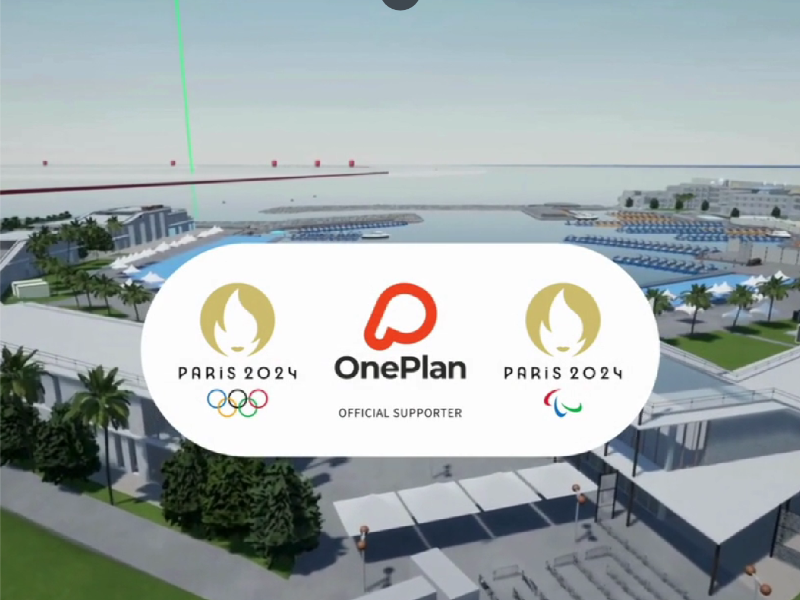
Paris has introduced OnePlan as the official Digital Twin software support provider. Combining Intel’s latest computing and processor technology, OnePlan has created 30 Digital Twin models, providing robust technical support for venue planning.
Intelligent sports equipment: Enhancing athletic performance
Technology overview
Smart chip technology is a significant innovation in modern technology, integrating advanced microelectronics, computer technology, and AI algorithms. These chips enable complex calculations and control functions in a compact form, powering various smart devices and applications.
In Tokyo 2020
Smart Clothing: At Tokyo 2020, smart clothing was widely used in several sports, particularly in athletics and cycling. For instance, the US track and field team used sensor-embedded compression garments to monitor muscle activity and fatigue, while the New Zealand cycling team used high-tech skinsuits to reduce air resistance and increase speed.
In Paris 2024
1. Upgraded smart clothing
More brands are participating in smart clothing development. Toray Industries and NTT co-developed the Hitoe smart garment, which can measure ECG signals and muscle activity. Nike’s smart clothing includes sensors to monitor heart rate and muscle activity, and Xenoma’s e-skin smart garments embed sensors to track movements and vital signs, providing detailed motion capture data for training and technical analysis.
Paris 2024 will use higher precision sensors based on advanced Micro Electromechanical System (MEMS) technology, offering greater sensitivity and accuracy. Data processing capabilities will be enhanced with more powerful cloud computing and AI technologies. For example, the OBS Cloud platform will use AI for real-time data processing and analysis, increasing data processing speed by 30% compared to Tokyo.
2. Expanded smart equipment
Smart shoes: Nike Vaporfly shoes, with carbon fiber plates and ZoomX foam technology, offer superior support and energy return, optimising training and competition strategies. On’s Cloudboom Strike LS shoes, featuring LightSpray™ technology, provide unprecedented lightweight performance.
Football inner ball chip technology: Paris 2024 will introduce high-tech chips in footballs, offering real-time data on ball trajectory, speed, and boundary crossings, aiding referees in making accurate decisions.

Smart mats: Taishan Sports’ smart mats, used in Paris 2024, embed chips to track athletes’ movement patterns, force, and frequency. These mats feature nano antibacterial coatings for hygiene and gradient energy absorption structures for protection and support.
“Our goal is to utilise these advanced technologies to provide a more immersive and accurate viewing experience for audiences worldwide.”
Jean-Michel Brun, OBS Chief Technology Officer
Pop quiz:
Which technology is used to create 3D models of athletes’ movements for accurate scoring?
- A) Digital Twin Technology
- B) Bullet Time Technology
- C) Smart Clothing
- D) AI Referee Systems
The correct answer is at the bottom of the article.
Smart referee systems: Ensuring fair play
Technology overview
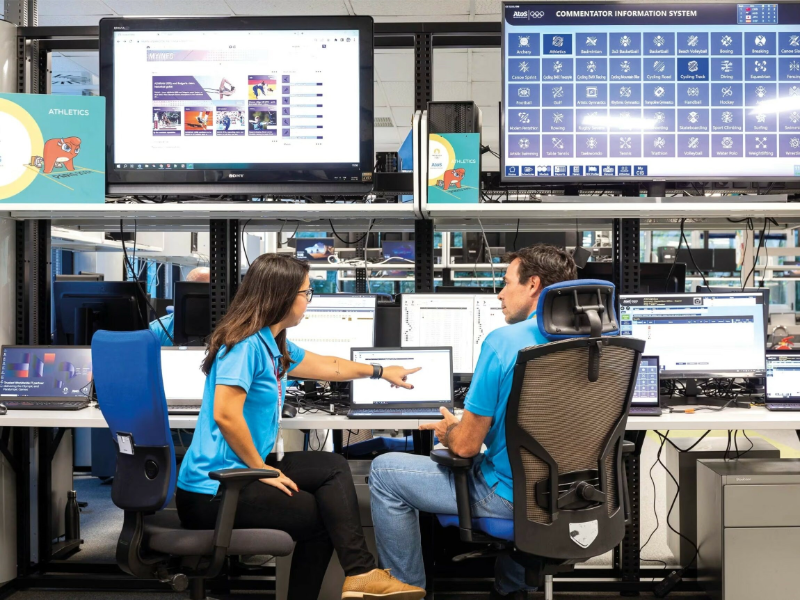
Smart referee systems, integrating video replay, computer vision, and machine learning, provide accurate, quick decision support in various sports. These systems monitor games in real-time, capturing athlete movements and analyzing data, aiding referees in making precise decisions.
In Paris 2024
1. Gymnastics: The Judging Support System (JSS), developed by Fujitsu and the International Gymnastics Federation (FIG), captures athletes’ movements with HD cameras, creating 3D models and assessing difficulty scores with AI.
2. Diving: Aliyun’s smart strobe analysis technology captures divers’ movements in real-time, assisting referees in making accurate judgments.
3. Other sports: In football, AI, aided by high-tech ball chips and HD cameras, captures every detail, ensuring accurate calls. AI also enhances decision-making in contact sports like fencing and boxing.
Advancements from Tokyo
1. Automated tracking technology
Bolt6: This technology, used in volleyball, combines with Hawk-Eye to track ball trajectories accurately, ensuring fair play.
2. AI decision-making
AI Motion Analysis: AI analyses athletes’ movements in real-time, reducing human error and enhancing accuracy.
3. Real-time data analysis
Smart surveillance: Although facial recognition is prohibited, AI analyses surveillance footage for anomalies, ensuring event security.
Instant data processing: AI processes game data instantly, providing real-time feedback to referees.
4. Technical collaboration
Intel’s AI platform: Intel’s AI platform supports athlete training analysis, real-time game decision-making, and audience engagement, enhancing the technological level and viewer participation.
5. Integrated applications
Multifaceted use: Smart referee technology integrates into various areas, improving event organisation efficiency and spectator experience.
Looking ahead: The future of Olympic technology
As we look toward the 2028 Olympics in Los Angeles, the technological innovations showcased in Paris set a high standard for future Games. We can expect further integration of artificial intelligence, real-time data analytics, and augmented reality to enhance both the athlete experience and viewer engagement. The use of smart fabrics and wearables will likely become more sophisticated, providing athletes with even more detailed insights into their performance and health.
Additionally, the expansion of virtual reality and immersive technologies will bring fans closer to the action, creating a more interactive and personalised viewing experience. With each iteration of the Olympics, technology continues to push the boundaries of what’s possible, promising an even more thrilling and connected global sporting event in 2028.
The correct answer is A, digital twin technology.