
Profile
Research
Research profile intelligence connects person, company, institution, and other entity coverage for readers comparing the subjects behind BTW.MEDIA reporting. The page helps compare public profiles, related events, evidence packs, role changes, operating footprints, governance exposure, organisational links, and market relevance while keeping organisation and people records distinct from ordinary news chronology. Readers can understand the subject behind the headline, the evidence supporting that profile, and the infrastructure or market relationships that make the profile relevant. They can see who or what the profile represents, which public sources support it, how it connects to companies, markets, governance bodies, or events, and what changes may deserve continued attention as the subject evolves.

Story
APNIC’s Office Sale Tests Its Reserve Strategy; the Net Return Is Not Yet Visible
In 2010, APNIC said it used part of its cash reserve to buy 6 Cordelia Street, aiming to lower future operating costs and diversify its investments. The 2026 sale converts that owner-occupied asset into proceeds and a lease plan, but the headline price cannot settle the return.

Europe and Middle East Institutional
SwissIX prices every port step and publishes no port's load
Between 22:41 and 22:42 UTC on 18 October 2026, four pages on the SwissIX website were captured and read: the homepage, the traffic statistics page, the entities page and the peering page. Together they hold a complete monthly price menu for port capacity and a set of four…

Story
APNIC Links Three-Month Temporary IP Fees to Immediate Reassignment on Return
APNIC prices a temporary assignment by three-month periods, while its policy gives returned resources an unusually short route back into the assignment pool: once they are returned before the end date, they skip ordinary quarantine and are immediately available for another…

Story
AFRINIC’s 2024 RPKI baseline cannot be rebuilt from its current daily export
AFRINIC’s 2025 annual report gives a precise four-number picture of RPKI at the end of 2024. Its public daily file now gives a different picture: two of those numbers sit together on 31 December, two others on 1 January, and no date in the downloaded history brings all four…
History
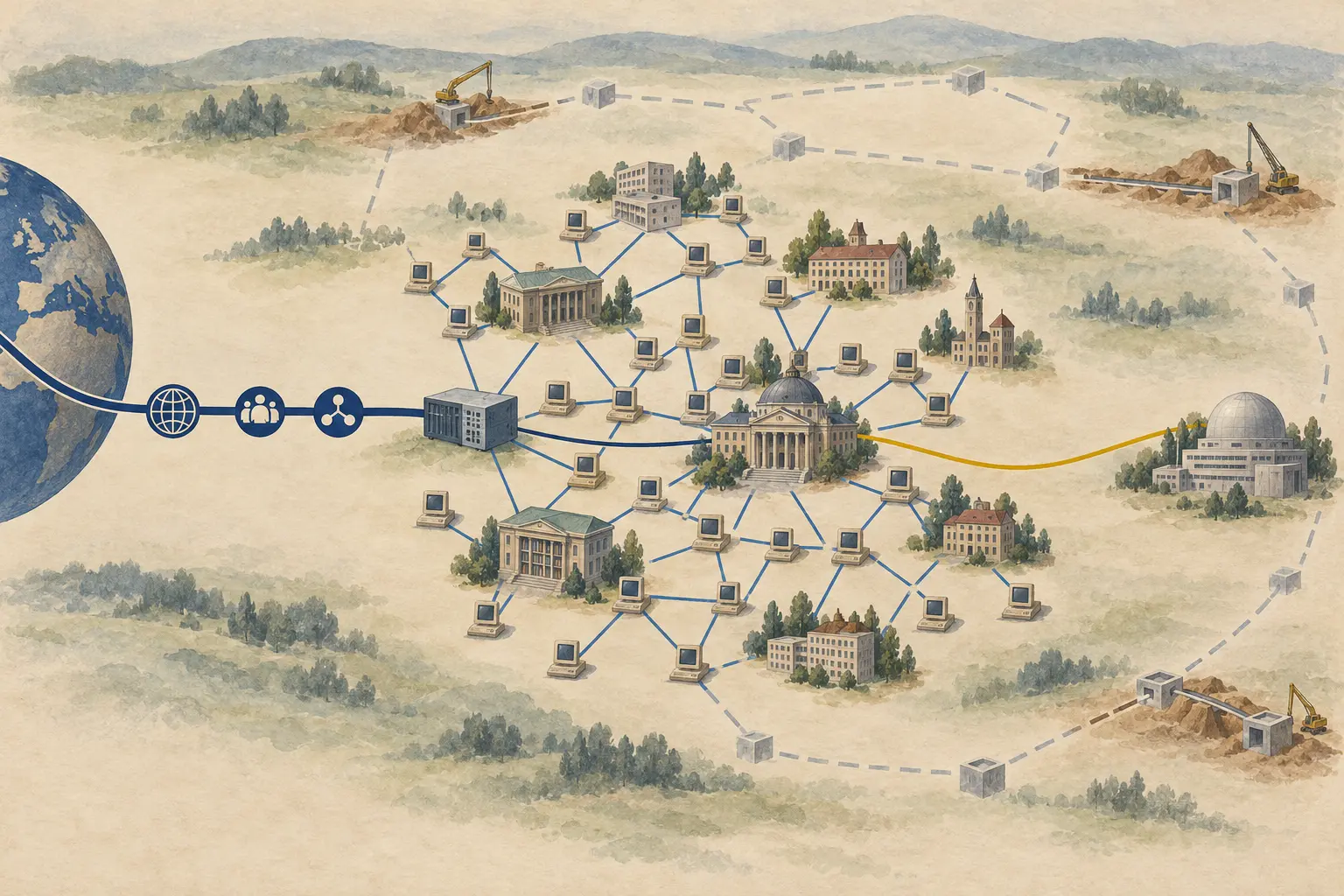
250 X.25 Access Points Were Not an Internet Backbone: Hungary, 1992
Hungary had a national packet network before it had a national IP backbone. In 1992, about 250 public X.25 access points helped smaller and medium-sized sites join wide-area networking, while international IP still depended on a 9.6 kbit/s Budapest–Linz line shared by EARN…

History
A Ping Reached a .cm Host. Nationwide Internet Access Was Another Question, 1997–98
One successful Internet probe in March 1997 made a Cameroonian host visible from London. It did not settle whether Cameroon had a finished international link, where people could buy access, or how far that access reached. The contemporary record keeps those questions apart.

History
A National Dial-In Number, One Node in Sana’a: Yemen’s Internet, 1996–1998
In 1996, TeleYemen advertised a number people across Yemen could dial to reach y.net. The equipment behind that national promise sat in Sana’a. Two years later, the company was still describing a customer base concentrated in the capital and a planned Aden router meant to remove…

ICANN
The Published Architecture and the Unread Record: IANA Naming-Function Oversight
Three consecutive articles in the ICANN Bylaws are headed Customer Standing Committee, IANA Naming Function Reviews and IANA Naming Function Separation Process. A contract repository, a committee charter, a service-level document and a report archive are published as well. This…

History
The Exchange Was Settlement-Free. The Connection Was Not: CIX, 1991
The Commercial Internet Exchange let participating providers exchange traffic without billing one another by volume. A router, private circuits and member boundaries still determined who could use that rule.

Leaders
Roque Gagliano’s RPKI Plan Put a Clock Inside the Trust Chain
RFC 6916 treats a change in RPKI cryptography as a multi-year migration across certificate authorities, repositories and relying parties. Co-authored by Roque Gagliano, the 2013 Best Current Practice makes readiness dates part of the trust mechanism—and leaves emergency…

History
Tunisia’s .tn Domain Went to a Research Institute Before ATI, 1991–96
The .tn namespace entered the global DNS through a research institute in 1991; five years later, its stewardship moved to a new national Internet agency as Tunisia’s backbone operations were being reorganized. These were linked institutional changes, but domain delegation…

History
Who Could Set the Price, and Who Could Keep the Centre Running? Timbuktu’s Community Telecentre, 1997–2002
Timbuktu’s multipurpose community telecentre made network access useful through a local institution: people could telephone, send a fax, learn computing, print documents and, sometimes, reach the Internet. Its history also shows why calling a facility “community-owned” did not…
History
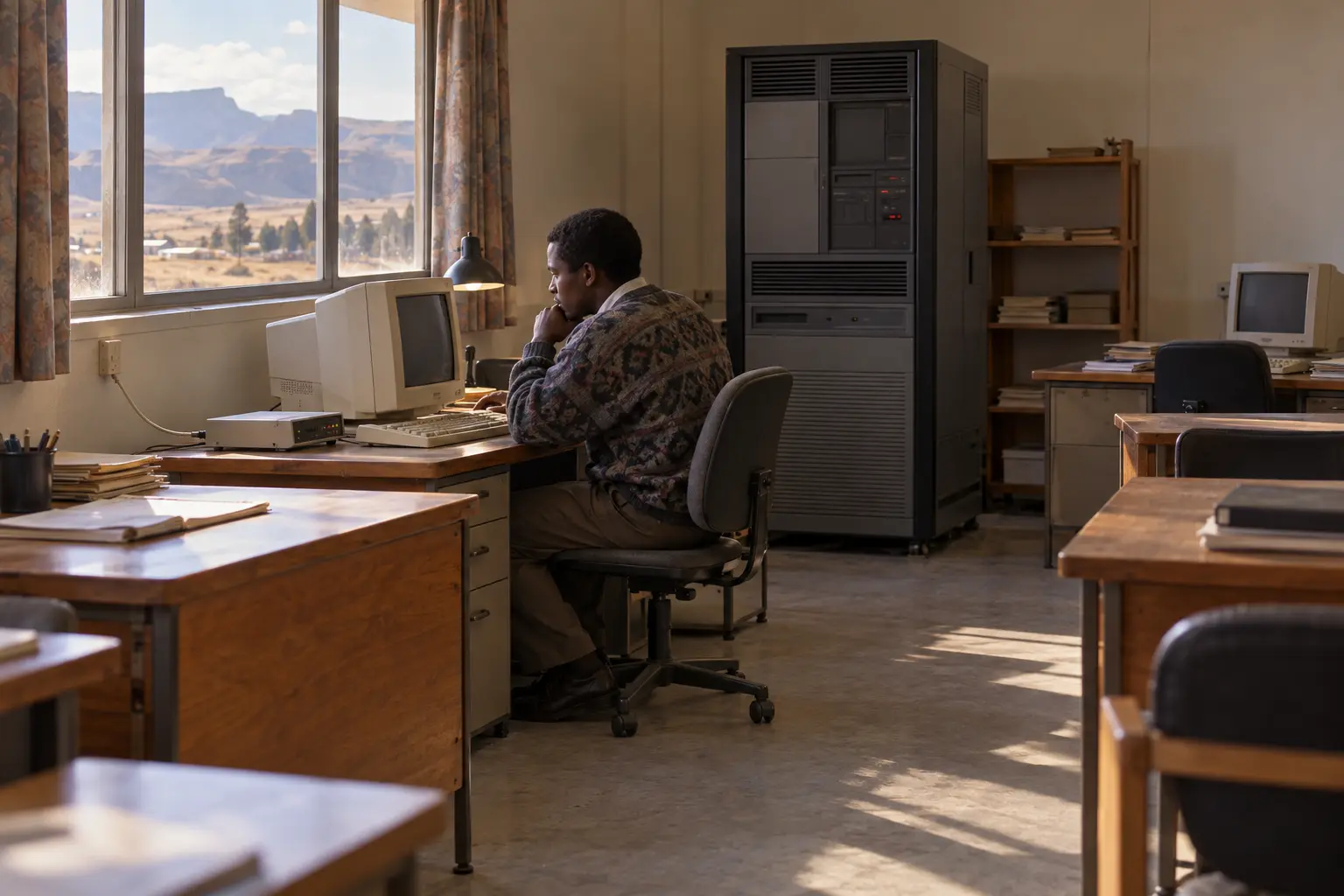
A Link Reached Roma; Campus Access Still Had to Be Built: Lesotho, 1996–99
A 9.6K terrestrial connection put the National University of Lesotho’s host online from Roma to Bloemfontein in December 1996. In the same week, the university said its campus network did not exist and planned dial-in access was not working. Three years later, a Maseru café sold…

CASE FILE
The cable in the water and the contract that rations it
A design capacity figure describes a manufactured entity. Who may use it, at what price, and who pays when it breaks are settled afterwards, by instruments. The public record behind Hawaiki Submarine Cable LP shows the gap between those two things — and shows exactly where the…

History
Tajikistan’s Email Network Crossed Regions Before Direct Internet Access, 1995–97
Tajikistan’s first public email nodes connected people across a country still emerging from civil war. Their messages could reach abroad, yet the server and telephone routes that carried them remained outside the country.

History
Fiji's Mail Link Ran Before Its Internet Route, 1992–94
At the University of the South Pacific, email already crossed the Pacific through a dial-up relay in 1992. A full Internet connection came later in the record, and even its date depends on which contemporary or retrospective account is used.

History
Akira Kato and the Privacy Rules Behind WIDE’s Open Traffic Archive
The MAWI archive’s own FAQ begins with a useful limit: port mirroring and ordinary capture hardware can miss packets, while timestamps may lose precision under congestion. That caveat changes what an open trace can prove. Akira Kato’s contribution to WIDE’s traffic-repository…

Europe and Middle East National Telecom Trends
Aventa’s Irish deal puts cable execution to the test
The offshore engineering group says its acquisition of Irish Sea Contractors adds nearshore installation and repair work. The strategic case is plausible, but the public record contains no price, backlog or measured evidence that the combination will lower project cost or repair…

IETF
Someone still has to sign: the company behind the IETF
Internet standards emerge from technical argument. Hotel contracts, staff salaries and intellectual-property consents need a different kind of authority. IETF Administration LLC provides it—and its published decisions reveal more about that job than an organisation chart does.

Global Cloud Services
Genesis Cloud's software moved on. Its old routing record cannot tell you where a GPU job will run.
Volta says it acquired Genesis Cloud technology this year. A network record frozen in April tells a different, narrower story—and neither document is a substitute for a usable cloud quotation.