
Summary
- SwissIX Internet Exchange is carried in the BTW directory as a RIPE NCC membership and number-resource holder, with a registered address at Badenerstrasse 569, 8048 Zurich recorded in the RIPE NCC member directory (RIPE NCC member directory).
- The operator publishes a physical-capacity claim: the largest Internet Exchange Point in Switzerland by port capacity and bandwidth, a not-for-profit association, present in 8 datacentres, offering 400G ports at three core sites after an infrastructure upgrade (SwissIX).
- The same operator text was captured three separate times on 17 October 2026 and returned byte-identical wording, so the capacity claim is a stable publication rather than a transient listing.
- The routing layer is not on the open surface. The exchange's own autonomous system number, route-server addressing and live participant list are not published, so no exchange ASN and no peer count can be established from public sources. That absence is a dated public-record fact, not a gap to be filled by inference.
An internet exchange is two things at once, and they can be checked to very different degrees. The physical layer is the fabric itself: switching capacity, the port speeds offered, and the buildings where ports are handed to members. The routing layer is what the fabric does: an autonomous system number, route-server addresses, and a participant list that maps named networks onto those ports. On 17 October 2026 the first layer was named, dated and verifiable. The second was not.
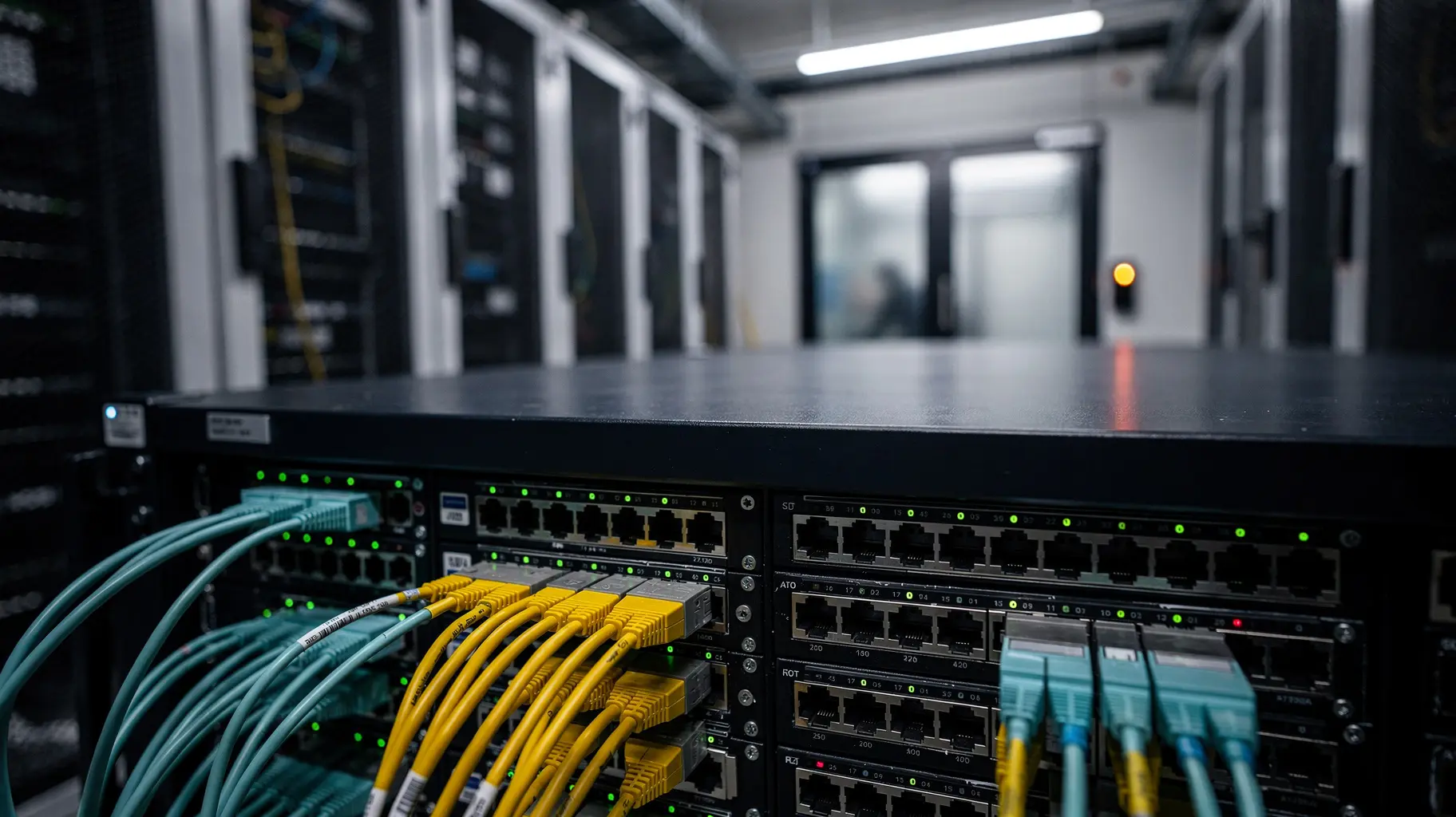
The physical claim is specific enough to be checkable in principle. The operator states that SwissIX is the largest Internet Exchange Point in Switzerland in terms of port capacity and bandwidth, that it is a not-for-profit association, that it is present in 8 datacentres across Switzerland, and that after an infrastructure upgrade it offers 400G ports at three core sites: Colozueri.ch, Digital Realty ZUR1 and Equinix ZH4 (SwissIX). Those are named facilities, not a generic national footprint, and port speed at three named core sites is the kind of commitment that appears in a procurement plan before it appears in traffic.
The registry side of the same name is narrower. The RIPE NCC member directory records SwissIX Internet Exchange with a registered address at Badenerstrasse 569, 8048 Zurich, in Switzerland (RIPE NCC member directory). That is an administrative record of membership and country, and the BTW directory card that imports it says so explicitly: it tracks RIPE NCC membership and number-resource governance context, and it does not establish that the entity sells ISP, IP transit, cloud, registry or managed-network services. The card goes further and instructs that ASN and IP resources be mapped from RDAP, WHOIS, IRR, BGP or RIR delegation data before any routing-footprint claim is made beyond membership. That instruction was not satisfiable from the exchange's open surface on the evidence gathered here.
What the open surface did establish is a boundary. The exchange's autonomous system number, its route-server addresses and its live participant list are not published for public inspection; that detail sits behind a restricted member portal. The practical consequence is concrete: a reader outside the membership cannot verify from public sources how many networks are connected, which of them take routes from a route server rather than a bilateral session, or whether the eight-site, three-core-400G footprint carries a proportionate share of Swiss domestic traffic.
Those questions are answerable in principle, and none of them is answered by the capacity claim.
This is the part of the record worth naming rather than smoothing over. Capacity claims are expensive to disprove: proving that an exchange is not the largest in its country would require port-level data held by a third party, and nobody publishes that. Routing artifacts are cheap to check: a public ASN with visible prefixes, route-server addresses reachable from outside, and a participant list cross-referenced against observed adjacencies would confirm or refute the operating layer within minutes.
Publishing the first while holding the second moves verification cost onto everyone outside the member community, and it is the asymmetry, not the port count, that shapes what a reader can conclude.
The five snapshot generations held here are internally consistent, and that consistency is itself the finding. Three separate captures of the operator page on 17 October 2026 at 05:12:35Z, 05:13:08Z and 05:14:54Z returned identical operator wording, so no numeric drift exists between evidence generations for the capacity claim. The RIPE NCC member record is likewise a single stable entry. Nothing in the SwissIX record moved during the window observed, which means the article does not need to reconcile competing versions of the same number and can report the published state as published.
One boundary deserves emphasis because the name invites an error. A separate directory identity, OUTREACH SwissIX Internet Exchange, is associated with autonomous system AS58115. That is a different row with a different name, and nothing in the public record examined here establishes that AS58115 is the exchange's own ASN. Attributing AS58115 to SwissIX would manufacture the very operating-layer evidence this article reports as absent, and it is excluded on that basis.
The falsifiable signal is therefore simple to state. If SwissIX publishes a publicly routable ASN, route-server addressing observable from outside, and a participant list that matches independent routing observations, the capacity claim becomes independently checkable and the exchange's operating layer moves from asserted to demonstrated. Continued absence leaves the claim exactly where it is: named, dated, self-described and unverified beyond the physical layer.
A partial release would be informative in its own right, since a participant list without a visible ASN, or an ASN without route-server addressing, would show where the boundary has moved.
The bounded conclusion for a reader today is that the directory record and the capacity claim describe two different layers of one name, and only one of them can be checked from outside. The physical footprint is real enough to be named in three facilities and stable enough to survive repeated capture across a single day. The routing layer is not on the record.
Neither statement should be stretched to cover the other, and the honest reading of the SwissIX card in the BTW directory is that it is a membership record plus a published capacity claim, in a country whose domestic interconnection market runs through infrastructure that outsiders can see the ports of but not the routes across.
Member Briefing
Deeper Profile Context
Sign in with the right membership level to unlock the full briefing and source notes.
Only for Strategic Circle
Strategic Circle
Open to all readers. Unlock profile briefings after joining and signing in.
Join Strategic CircleOnly for Leadership Alliance
Leadership Alliance
For qualified IP-asset owners and management; sign in to unlock alliance briefings.
Join Leadership Alliance