Summary
- Super Micro's stated remaining performance obligations were approximately $2,612.0 million at 30 June 2026 and approximately $5,665.7 million at 30 September 2026 — and at both dates those figures equal the company's current plus non-current deferred revenue once you add the two reported line items.
- The warehouse is financed by the company itself: inventory of $15,053,640 thousand against accounts payable of $2,727,379 thousand, with customer deposits of only $702,012 thousand and operating cash flow of negative $434.021 million for the quarter.
A server integrator does not run on revenue. It runs on working capital: components bought, racks built, machines shipped, cash collected — and the gap between paying a supplier and being paid by a cloud builder is where the whole business model lives or dies. Super Micro Computer, Inc. just disclosed a quarter in which that gap widened considerably, and the way the numbers line up tells you more about who carries the risk than any growth figure in the release.
Start with the sentence a reader is meant to notice. In the first-quarter fiscal 2027 report for the period ended 30 September 2026, filed 6 November 2026, the company states that remaining performance obligations were approximately $5,665.7 million (Form 10-Q). In the fiscal 2026 annual report for the year ended 30 June 2026, filed 31 August 2026, the same measure was approximately $2,612.0 million (Form 10-K). Both filings are public, both are dated, and both are retrievable from the commission's own archive (10-K index, 10-Q index).
Now read the liability side. At 30 June the balance sheet carried current deferred revenue of $1,578,005 thousand and non-current deferred revenue of $1,034,027 thousand. At 30 September the same two lines read $4,329,345 thousand and $1,336,365 thousand. Add them and you get $2,612,032 thousand and $5,665,710 thousand — my arithmetic on the filed figures, not a company measure, and equal in each case to the stated obligations once rounded to the nearest tenth of a million.
That equality is the story, and it is worth being precise about what it does and does not prove. Remaining performance obligations are a defined term: the transaction price allocated to work not yet done. Where nothing has been invoiced, an obligation can sit outside deferred revenue entirely — that is exactly what makes the measure interesting in a business with multi-year contracts. Where everything remaining has already been billed and collected, the obligation and the liability converge, and the number stops being a pipeline and becomes a restatement of cash already in hand.
Super Micro's filings put it in the second category, at two consecutive balance dates, four quarters apart. Nothing in that is a violation of anything. Deferring revenue and then reporting obligations equal to it is the conservative presentation: it books no order book beyond what has been invoiced, and it gives the reader no unbilled number to over-read. It also gives the reader no unbilled number at all.
So the $5.7 billion is not a demand signal. It is a service obligation already paid for. That distinction matters most when the same filing shows what the company did with the money.
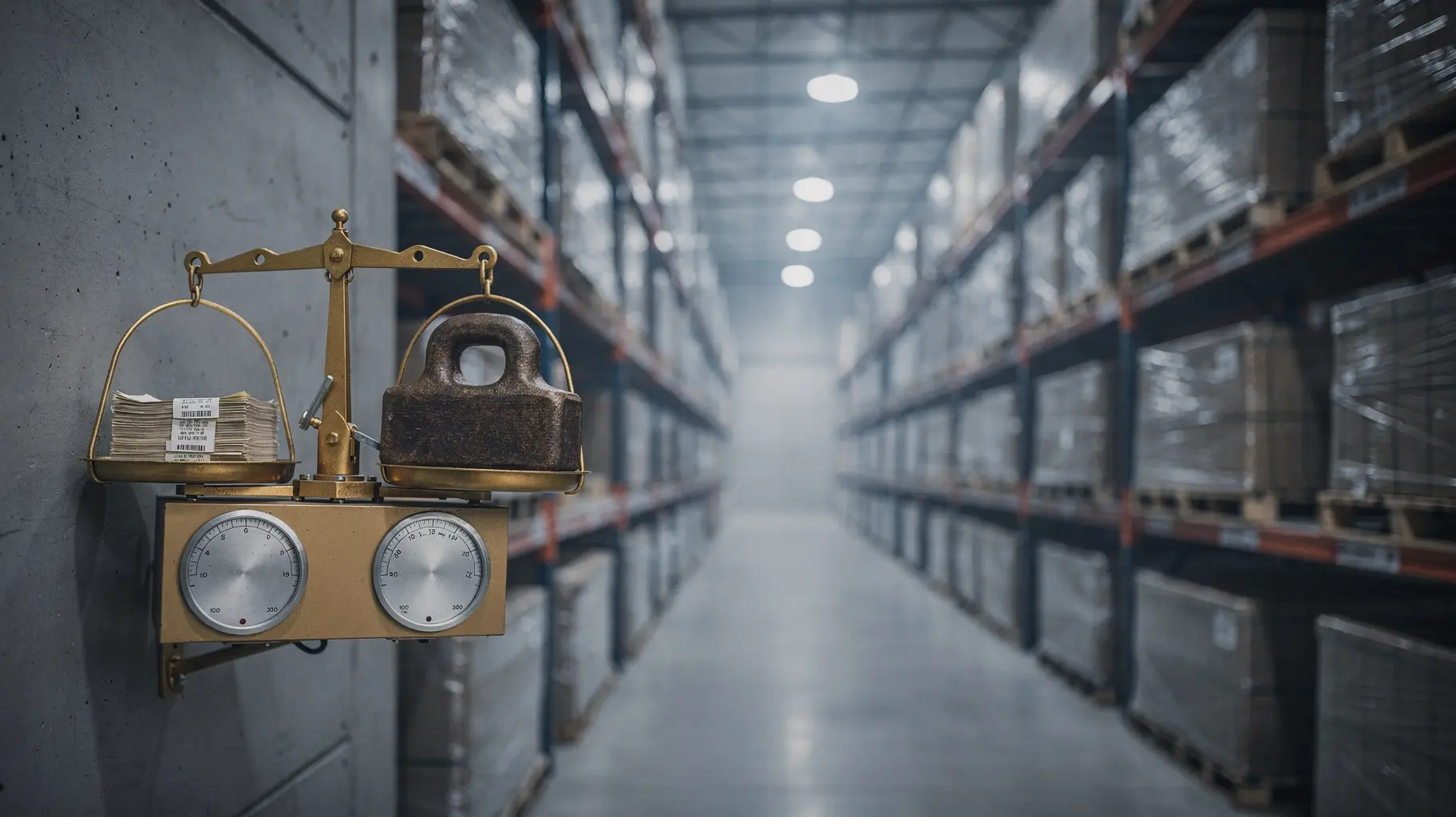
Inventory stood at $15,053,640 thousand at 30 September, up from $12,895,949 thousand at 30 June — a rise of $2,157,691 thousand in my arithmetic. Of the September balance, $11,591,231 thousand was finished goods: machines built and waiting, not parts on a shelf. Against that, accounts payable were $2,727,379 thousand. Set the two side by side and the inventory is roughly 5.5 times the payables; using the quarter's cost of sales of $17,404.789 million, ending inventory equals about 79.6 days while payables equal about 14.4 days.
Subtract payables and customer deposits from inventory and roughly $11.6 billion of goods is being carried on the company's own balance sheet.
The old integrator trick — let the suppliers fund the build, pay them in ninety days while the customer pays in forty-five — is not what happened here. The supplier leg shortened sharply while the inventory leg lengthened. A company in that position is financing its own warehouse.
And it says so, in cash. Net cash used in operating activities was $434.021 million for the quarter, with a $2,477.392 million working-capital outflow into inventory. Bank lines and term loans were repaid net: $162.236 million of proceeds against $244.168 million of repayments, a net repayment of $81.932 million. The company also took $43.376 million of net proceeds under its Receivables Purchase Agreement — selling receivables, which is another way of saying it converted paper into cash early.
Cash and equivalents ended at $6,897.497 million, against $3,977.071 million of credit lines and term loans and $4,668.946 million of convertible notes.
This is the part a customer, a creditor or a competitor needs to internalise. The customers have not prepaid the build. Deposits inside accrued liabilities rose from $314,665 thousand to $702,012 thousand — a real increase, and still less than a twentieth of the inventory on the books. The suppliers are not carrying it either, on the payables evidence. The residual exposure on machines that have been assembled and not yet delivered sits with Super Micro, and it sits there until the goods ship.
Concentration sharpens that. One customer represented 44.0% of total net sales for the quarter, against 28.1% of fiscal 2026 net sales. Two customers represented 49.0% and 16.8% of accounts receivable at 30 September, against three at 23.0%, 17.1% and 12.5% three months earlier — the two largest receivable positions now sum to 65.8% on my arithmetic. The filings do not name any of them, and they do not say whether the customer that is 44% of sales is also one of the two that hold half the receivables. That gap is not a scandal; it is a disclosure choice the rules permit.
But it means an outsider cannot tell whether the warehouse is built against one buyer's schedule or against a hope.
The honest summary is uncomfortable in both directions. Super Micro's stated obligation is real, contractual and already funded — a stronger position than a company with a big soft backlog and no cash. And because that obligation is fully billed, the filings give no independent evidence of what comes after it. Every rack in the warehouse beyond the invoiced work is a bet placed with the company's own money.
Evidence boundary. Every figure above comes from the two filings cited and is stated in the unit and period the filer used; the 10-K balance sheet is audited, while the first-quarter condensed statements are marked unaudited in the 10-Q. The day counts, ratios, differences and percentage sums are mine, computed on reported balances, and the filings print none of them. This reading did not obtain the segment note, any purchase-commitment schedule, a fiscal 2026 net sales total, or an inventory-turn figure published by the company, and asserts nothing about them. The absence of an unbilled component in the reported obligations is an observation about these two filings as read — not a company statement that no unbilled order book exists anywhere. The directory record for the company is here: Super Micro Computer, Inc..
Member Briefing
Read the full trend briefing
Members read the full briefing with the source notes behind every finding.
Strategic Circle
A daily briefing in your language, built from changes we have verified.
Join for USD 20/monthCancel anytime.
Members also get the full research library, a daily briefing on the networks they follow and the private forum.