
Summary
- Spitamen Bank's salary-card account is not priced only through a tariff sheet. It is priced through the avoided cost of cash payroll, the convenience of card and wallet payments, the depth of ATM and branch liquidity, and the trust needed to keep salary deposits inside the bank after payday.
- The bank has become a material Tajik retail-payments participant: its official history says it began in 2008, gained its banking license in 2014, runs 24 branches and 64 banking service centers, and reports 2.886 billion somoni of assets and 1.951 billion somoni of client funds on its public profile page (https://www.spitamenbank.tj/en/about/history/).
- National Bank of Tajikistan data make the competitive trade-off sharper. At March 31, 2026, the NBT financial-indicators workbook listed Spitamen with 2.943 billion somoni of assets, 705.9 million somoni of deposits, 104 ATMs, 33 retail POS terminals and about 1.714 million plastic cards, while Amonatbank had far more branches and POS terminals and Alif had a more ATM-heavy digital-bank profile (https://nbt.tj/en/banking_system/nishondihandaho/finance_bank_pokazatel.php).
- The final judgement is conditional: Spitamen can justify a salary-card relationship when payment reach and trust save employers, employees and merchants enough friction to offset the availability of cash, state-linked banks, wallet providers and larger substitutes.
The payroll account has to beat a cash envelope
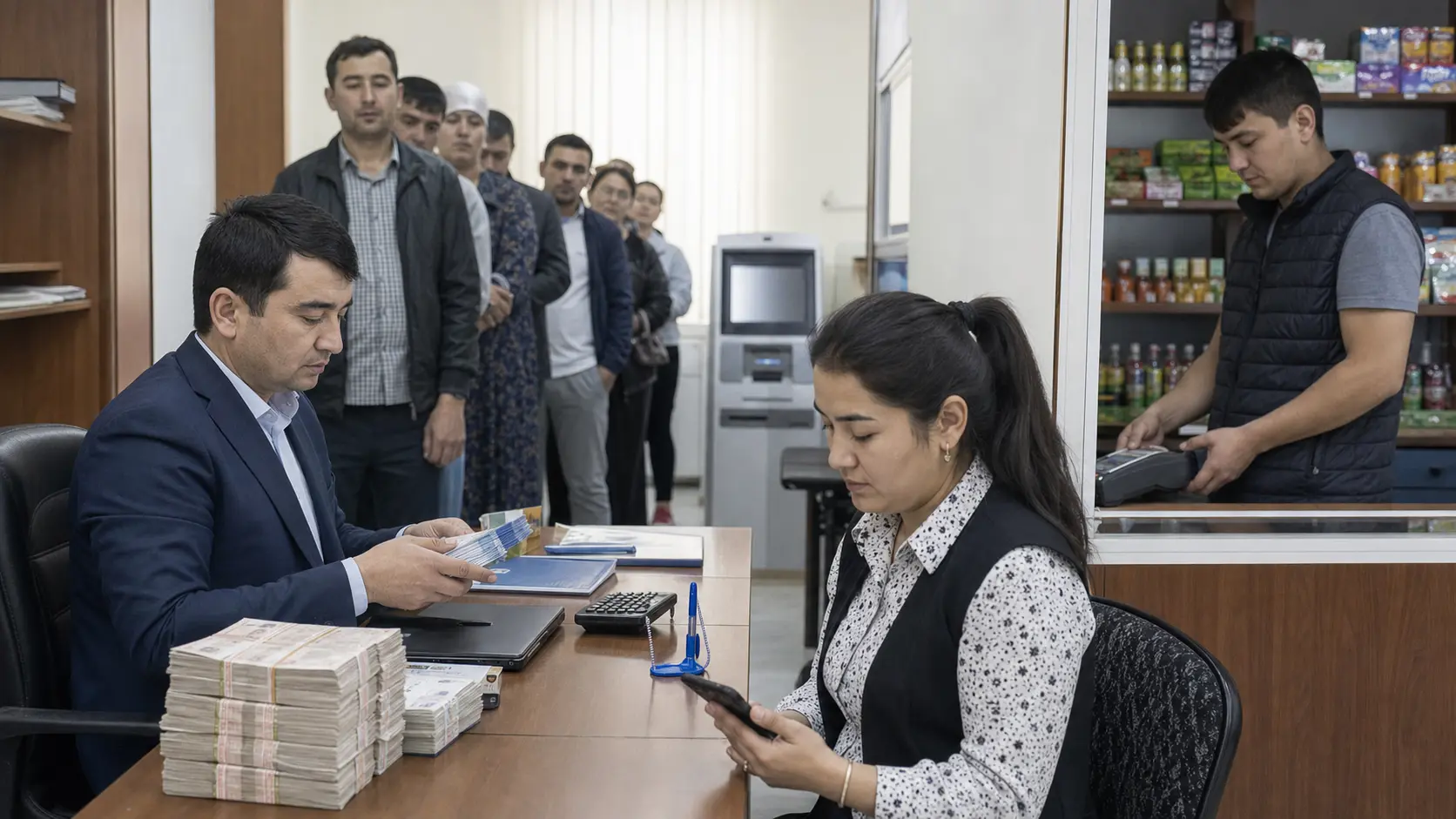
Imagine a payroll manager in Dushanbe with 240 employees, a cash-intensive sales force and a few regional shops. The manager can pay wages in cash, open salary cards at Spitamen Bank, split accounts across a larger state-linked bank, push employees toward a mobile wallet, or tell senior staff to keep a foreign card for travel and online payments. Each option has a price. Cash has counting, security, transport and reconciliation costs. A larger incumbent account has scale, branch reach and perceived official comfort. A wallet can feel faster for daily QR payments.
A foreign-card workaround may be attractive to executives who shop online or travel, but it is not a full payroll rail for the ordinary worker.
Spitamen's salary card wins only if it compresses that bundle of costs. The employer needs salary files to settle without drama. The employee needs to withdraw cash on payday, pay for groceries, move funds to relatives, check balances in an app and get a human answer when a card or terminal fails. The merchant needs settlement to arrive, not merely a terminal on the counter. A card that is free at issue but unreliable at cashout is expensive. A larger bank that is slower but trusted can be cheaper. A wallet that avoids a branch can be cheaper until a customer needs cash, account documentation, a complaint channel or a bank statement.
That is why the useful comparator is not another card brochure. It is cash payroll against a Spitamen account, Spitamen against Amonatbank's state-linked network, Spitamen against Alif's digital distribution, and all three against the remittance counter or foreign-card workaround. The National Bank of Tajikistan lists Spitamen as a licensed bank with its head office at Bobojon Gafurov 45 in Dushanbe, while its same public bank list gives Amonatbank's state savings-bank identity and Alif's newer bank profile (https://nbt.tj/en/banking_system/banks.php). The payroll manager is choosing between operating systems for trust.
The numbers explain the choice. Spitamen's Q1 2026 NBT workbook shows a bank with 2.943 billion somoni of assets, 705.9 million somoni of deposits, 24 branches, 64 banking service centers, 104 ATMs, 33 retail POS terminals and 1.714 million plastic cards (https://nbt.tj/files/banking_system/2026/eng/9_26_03_CJSC%20%E2%80%9DSpitamen%20Bank%E2%80%9D.xlsx). Amonatbank's equivalent workbook shows 12.335 billion somoni of assets, 9.919 billion somoni of deposits, 75 branches, 547 banking service centers, 381 ATMs, 3,943 retail POS terminals and 2.059 million cards (https://nbt.tj/files/banking_system/2026/eng/2_26_03_SUE%20%E2%80%9DAmonatbank%E2%80%9D.xlsx). Alif's workbook shows 3.074 billion somoni of assets, 1.954 billion somoni of deposits, only four branches and 18 service centers, but 446 ATMs, 566 POS terminals and 1.287 million cards (https://nbt.tj/files/banking_system/2026/eng/12_26_03_OJSC%20%E2%80%9DAlif%20Bank%E2%80%9D.xlsx).
Those comparisons should not be read as a league table alone. They show different costs of payment reach. Amonatbank can sell familiarity and physical reach. Alif can sell digital convenience and ATM breadth. Spitamen sits between those models: a private bank with a national branch-and-card base, enough cards to matter, and a salary-project pitch that has to turn payroll into deposits, card usage and relationship depth. Its task is not only to issue plastic. It must convince the employer that the first payday problem will not become a staff-relations problem.
A bank identity built around service density
Spitamen's official history is useful because it frames the bank as a migration from microfinance into banking. The bank says it began operations in 2008 as Spitamen Capital Microcredit Deposit Institution, received its National Bank of Tajikistan banking license in 2014, and connected Oracle FlexCube in early 2015 to improve service speed and product modification (https://www.spitamenbank.tj/en/about/history/). That history matters for the salary-card unit because payroll banking is a scale business. It rewards a bank that can keep many small accounts, automate repeated payments and support branch-level problems without making each transaction bespoke.
The same official page says Spitamen has more than 1,300 employees, 24 branches and 64 banking service centers across the country, and identifies Spitamen Insurance as the main shareholder (https://www.spitamenbank.tj/en/about/history/). A bank that sells payroll cards is selling more than a contract to the employer. It is selling a promise that thousands of workers can treat the bank as their everyday utility, even if their relationship began as a salary deposit rather than a voluntary savings choice.
The official bank-details page confirms the institutional rails around that utility. It gives the full name as Spitamen Bank Closed Joint Stock Company, the start of activity as June 30, 2008, the legal address in Dushanbe, the SWIFT code SPRBTJ22XXX, and correspondent arrangements in USD, EUR, CNY, TRY and KZT (https://www.spitamenbank.tj/en/about/details/). For a payroll manager, those details do not make the employee's card work in a village shop. They do, however, matter for a corporate treasurer deciding whether the bank is only a domestic cashout channel or also a viable account for foreign suppliers, currency receipts and business continuity.
The public product pages show the retail-facing proposition in plain terms. Spitamen's payroll-card page advertises 0% cash withdrawal in Tajikistan, a choice of international cards, and up to 24,000 somoni for goods-and-services payments (https://www.spitamenbank.tj/en/business/products/plastic-cards/). Its settlement-and-cash page advertises account opening, three currencies, internet banking and a minimum commission from 0.2% (https://www.spitamenbank.tj/en/business/products/settlement-and-cash-services/). The card pages advertise UnionPay/Korti Milli and Visa products with no-fee cash withdrawal in Tajikistan and service up to five years (https://www.spitamenbank.tj/en/personal/products/cards/).
This is a coherent salary-account bundle. The employer receives a payroll project. The employee receives a card, a cashout claim, an app, a domestic payment route and some international card functionality. The merchant receives the possibility of non-cash acceptance. The bank receives deposit float, transaction frequency, customer data, potential loan customers and cross-sell opportunities. The hard question is whether the bank receives enough fee, spread and loyalty to pay for the infrastructure that makes the offer credible.
The product is priced through access, not only through tariffs
Spitamen's salary-card economics start with a negative price signal: no-fee domestic cash withdrawal. The bank's UPI Classic Card/Korti Milli page says the card offers no-fee cashing in Tajikistan, free service up to five years, 1% cashing abroad, payment without percentage in shops, cafes, restaurants and hotels, PIN changes through ATMs, service centers or the Spitamen Pay app, and card issuance in three to five business days in Dushanbe or up to two work weeks in other regions (https://www.spitamenbank.tj/en/personal/products/cards/upi-classic-card-korti-milli). Its Visa Classic page gives a similar domestic cashout and shop-payment promise, and says Visa and UnionPay cards can be used abroad regardless of card-account currency (https://www.spitamenbank.tj/en/personal/products/cards/visa-classic-card).
That apparent cheapness is not free for the bank. Cash withdrawal requires cash logistics, ATM uptime, branch float, security and reconciliation. Card usage requires scheme fees, processing, fraud control, chargeback handling, merchant support and compliance. App usage requires software operations, security and customer support. Every salary project adds operational leverage only if many employees leave funds on account, make merchant payments, use related products or bring the employer's settlement flows with them. If the entire payroll leaves as cash at 9 a.m.
on payday, the bank has won account count but not necessarily account economics.
Spitamen's public tariff page is therefore best read as a window into an operating model, not only as a menu of fees. The page links separate tariffs for individuals, legal entities, bank cards, safe-deposit boxes and Spitamen Pay services (https://www.spitamenbank.tj/en/about/rates/). The existence of several tariff documents implies multiple revenue surfaces: account maintenance, cash services, card fees, transfers, merchant activity and app payments. But salary-card competition often pushes headline card costs down. The bank must recover value through retained balances, employer relationships, interchange-like income, foreign exchange, loans, merchant services and lower-cost deposit funding.
The retained-balance story is meaningful because Spitamen's Q1 2026 workbook shows loans, leases and overdrafts of 1.594 billion somoni against deposits of 705.9 million somoni and other liabilities of 1.473 billion somoni. It also shows cash of 504.6 million somoni, due from the NBT and credit financial institutions of 150.8 million somoni, equity of 429.1 million somoni, return on assets of 1.13%, return on equity of 7.77%, net interest margin of 10.3% and liquidity ratio K2.1 of 70.6% (https://nbt.tj/files/banking_system/2026/eng/9_26_03_CJSC%20%E2%80%9DSpitamen%20Bank%E2%80%9D.xlsx). Those figures describe a bank that must fund loan growth and service liquidity while carrying a large card base.
The ratio between cards and physical acquiring is especially telling. Spitamen's workbook reports 1.714 million plastic cards but only 33 POS terminals in retail and service outlets. That does not mean Spitamen cardholders cannot pay elsewhere; national card acceptance depends on shared rails, other banks' terminals, QR infrastructure and merchant integrations. It does mean Spitamen's salary-card economics are highly dependent on system-level acceptance. The bank can issue the card, but the value of the card is partly created by infrastructure outside its own estate.
Tajikistan's payment shift creates a tailwind and a burden
The National Bank of Tajikistan describes the national payment system as a core financial infrastructure that supports stable and efficient payments, monetary policy and economic development (https://nbt.tj/en/payment_system/overview.php). For Spitamen, that infrastructure is both opportunity and dependency. A salary card becomes more valuable as more shops accept non-cash payments, more employers submit payroll electronically, more employees trust account balances, and more public payments become digital. The same shift also raises expectations: once a worker learns to pay, transfer and check balances digitally, outages and poor support become more visible.
The NBT's January-March 2026 payment-system page says more than 212.5 million payments worth 989.3 billion somoni were made through various payment methods, up 15.9% in number and 25.2% in volume from the same period of the prior year. It also says credit institutions had opened 18.8 million client bank accounts by March 31, 2026, including 18.6 million accounts for individuals and 0.2 million for legal entities (https://nbt.tj/en/payment_system/nizomi_pardohti_tj.php). That is the macro case for a salary-card bank: accounts are spreading, payment volumes are rising, and account-based banking has more public legitimacy than it did a decade ago.
The card-market page sharpens the picture. As of the reporting date, credit institutions had installed 3,665 ATMs and 5,413 electronic terminals at cash-supply points, as well as 9,141 POS terminals at trade and service points and 31,090 QR codes in trade and service enterprises. The same NBT page says the cashless share of goods-and-services payments using electronic payment instruments reached 42.4%, up 11.8 percentage points from the same period in 2025, and that cashless transactions using electronic payment instruments rose 158.4% by number and 74.3% by volume (https://nbt.tj/en/payment_system/rushdi-bozori-kort-oi-pardokhtii-bonk.php). This is the strongest external tailwind for Spitamen's salary-card story.
Yet the tailwind comes with a historical warning. Tajikistan's National Financial Inclusion Strategy for 2022-2026 says that in 2020, 91.6% of operations with bank cards were cash withdrawals and only 8.4% were non-cash payments for goods and services, citing infrastructure gaps, uneven access-point coverage and the prevailing habit of using cash as payment (https://nbt.tj/files/program/national_srategy_en.pdf). Even if the 2026 data show rapid movement toward cashless transactions, salary-card economics still have to pass through a cash-heavy social habit. A worker who withdraws the entire salary every month is treating the card as a cash-delivery token, not a banking relationship.
The cash-in/cash-out intermediary channel shows why this is not only a branch question. The NBT says that as of September 30, 2025, credit institutions had engaged 1,348 bank payment representatives and 51 sub-representatives, and that these intermediaries can accept or issue cash, provide electronic payment means, identify customers and extend access in remote areas while reducing the cost of new branches or banking service centers (https://nbt.tj/en/payment_system/agenthoi-bonkii-pardokhti.php). For Spitamen, that model is an implicit competitor and possible complement. If third-party cash and payment points make cash-in, cash-out and payment services more convenient, they can help salary cards become useful beyond the branch. If a wallet provider or rival bank controls the better last-mile relationship, Spitamen risks being bypassed near the customer.
The avoided-cost math is larger than the card fee
The payroll manager's calculation starts before any employee touches an ATM. Cash payroll imposes a recurring operating routine: ordering cash, transporting it, guarding it, counting it, resolving shortfalls, recording acknowledgements, dealing with absent workers, and handling disputes when a worker says the envelope was wrong. In a larger business, that routine consumes accounting time and creates security exposure. In a smaller shop, it absorbs owner attention. A salary-card project promises to replace that routine with account files, card accounts and electronic confirmation.
The cost saved is therefore managerial time and control risk, not merely bank fee expense.
Spitamen's settlement-and-cash page is relevant because it connects the employer account to the employee card. A business can open accounts, operate in several currencies and manage through internet banking (https://www.spitamenbank.tj/en/business/products/settlement-and-cash-services/). The salary-card page then connects that business account to the worker's card and advertises domestic cash withdrawal at 0% (https://www.spitamenbank.tj/en/business/products/plastic-cards/). The bank's commercial job is to make this combined workflow feel cheaper than maintaining a cash payroll desk. If the employer still has to maintain parallel cash handling because employees distrust the card, Spitamen loses part of the avoided-cost argument.
The employee's calculation is different. A worker may value the card if wages arrive on time, the ATM has cash, the app confirms the balance, a shop accepts payment, and a family transfer can be sent without a long queue. The worker may reject the relationship if the card feels like a forced wage token that must be emptied immediately. This is where the bank's 1.714 million card count is not by itself enough. The question is active usefulness: how many of those cards are used for daily payments, how many are dormant, how many receive salary, and how much balance remains after the first payday withdrawal.
The merchant's calculation adds a third layer. A cardholder can want to pay electronically, but a shopkeeper may still prefer cash if settlement is slow, equipment is unreliable, tax visibility is uncomfortable or customer demand is thin. The NBT financial-inclusion strategy explicitly noted reluctance by entrepreneurs to switch to transparent activity, customers' cash habit and distrust in the banking system as barriers to non-cash adoption (https://nbt.tj/files/program/national_srategy_en.pdf). The merchant is therefore not a passive endpoint. Merchant trust decides whether salary-card money circulates digitally or returns to cash.
For Spitamen, the attractive case is circular. Payroll deposits arrive. Employees keep a portion in accounts because the app and cashout network work. Merchants accept payments because customers use cards and settlement is predictable. Employers stay because staff complaints are low and account administration is simpler than cash. The bank then earns not just a payroll-processing relationship but a recurring retail-payment franchise. The unattractive case is linear: payroll arrives, workers withdraw cash, merchants see little electronic demand, and the employer sees the bank as a necessary disbursement vendor rather than a financial partner.
This circular model explains why the bank must keep payment reach in view even when discussing deposits or credit. A salary-card bank may earn value through retained balances and lending, but those balances are retained because the payment experience is useful. It may cross-sell consumer loans, merchant services or foreign exchange, but those products are easier to sell when the account is already trusted. The economic unit is not a plastic card. It is the repeating salary-account relationship around the card.
Spitamen is neither the largest branch bank nor the pure digital challenger
Spitamen's strategic position is easiest to see through its two substitutes. Amonatbank is the physical-scale benchmark. The NBT list identifies it as the state savings bank of Tajikistan, and the Q1 2026 workbook shows a much larger deposit base, much larger branch/service-center footprint and thousands of POS terminals (https://nbt.tj/files/banking_system/2026/eng/2_26_03_SUE%20%E2%80%9DAmonatbank%E2%80%9D.xlsx). For a public-sector employer, a conservative payroll manager or a worker who equates state association with safety, Amonatbank is the obvious substitution threat.
Alif is the digital and ATM-density benchmark. It has far fewer branches than Spitamen but more ATMs and POS terminals in the NBT workbook, and its deposit base at March 31, 2026 was nearly three times Spitamen's reported deposit line even though its branch count was only four (https://nbt.tj/files/banking_system/2026/eng/12_26_03_OJSC%20%E2%80%9DAlif%20Bank%E2%80%9D.xlsx). For a young employee, an online merchant or a payroll manager who wants app-first adoption, Alif is the substitution threat. It suggests that physical branch count is not the only way to win payment reach.
Spitamen's position is therefore a hybrid. It has more physical banking surface than a pure digital challenger but lacks the state-linked scale of Amonatbank. It has a large card base, a public mobile-pay proposition, and international card products, but its own POS footprint is modest in the official workbook. That means it must compete on the combined experience: a card that works across networks, a branch or service center close enough when a problem occurs, an app reliable enough for everyday checks and transfers, and a compliance posture that lets businesses trust settlement.
This hybrid model can be attractive. Many salary-card users are not choosing a bank in an abstract fintech market. They are receiving wages from an employer and then deciding whether to keep using the account. A state bank may feel safer but slower. A digital bank may feel smoother but less personal. A wallet may be practical for small payments but less complete for salary documentation, cash-intensive family obligations or business banking. Spitamen's economic opportunity lies in turning that middle position into a practical convenience premium.
The vulnerability is that middle positions are expensive. If a bank wants to be present in branches, cards, ATMs, salary projects, wallets, international transfers and merchant payments, it carries many fixed costs. The cost base includes people, premises, cash logistics, core banking, cybersecurity, payment processing, compliance, correspondent banking, customer-service staffing and fraud controls. Scale helps only if the bank can keep each channel busy. A salary-card portfolio with high card count and low account retention can become an infrastructure burden.
Substitution pressure comes from five directions
The first substitute is cash, and cash is harder to defeat than it looks. Cash is anonymous, immediate and widely understood. It works during app outages and does not require a merchant to accept cards. For employers, cash is awkward and risky, but for workers it can feel like certainty. Spitamen's 0% domestic cash-withdrawal promise partly concedes this reality: the salary card must make cash access easy before it can persuade workers to leave money in the account. The bank is not replacing cash in one step. It is making the cash bridge convenient enough that workers tolerate the account.
The second substitute is Amonatbank. The state-linked bank's Q1 2026 footprint gives it a strong answer to the payroll manager who cares about physical reach. Its NBT workbook shows far more branches, service centers and POS terminals than Spitamen, plus a much larger deposit base (https://nbt.tj/files/banking_system/2026/eng/2_26_03_SUE%20%E2%80%9DAmonatbank%E2%80%9D.xlsx). For Spitamen, the answer cannot be "we are bigger." It has to be a narrower claim: we are responsive enough, modern enough and convenient enough for this employer and this workforce.
The third substitute is Alif, whose Q1 2026 figures show a different kind of reach. Alif's branch estate is small, but it reports more ATMs and POS terminals than Spitamen, as well as a higher deposit line (https://nbt.tj/files/banking_system/2026/eng/12_26_03_OJSC%20%E2%80%9DAlif%20Bank%E2%80%9D.xlsx). That is a direct warning to Spitamen: a bank can be physically small and still feel widespread if its digital and ATM distribution is strong. A salary-card user does not care who owns the branch if the phone works and the cash is available.
The fourth substitute is the wallet provider. The NBT's electronic-money data show a large wallet universe, and wallets can win habitual daily payments even when the salary arrives in a bank account (https://nbt.tj/en/payment_system/mablaghoi-elektroni.php). A wallet relationship can become the user's real financial interface, while the bank account becomes the place where wages briefly land. Spitamen Pay is the bank's defense against that leakage. It has to be good enough that salary recipients do not immediately move value to another app for ordinary life.
The fifth substitute is the cross-border workaround: remittance counters, foreign cards, foreign-currency cash and informal family channels. Tajik households often think across borders because labor migration, trade links and currency needs are part of daily economic life. Spitamen's SWIFT and correspondent details, Visa/UnionPay card options and money-transfer products help it answer that need (https://www.spitamenbank.tj/en/about/details/ and https://www.spitamenbank.tj/en/personal/products/transfers/). But international reach raises user expectations. If a card works domestically but disappoints abroad, or if a transfer route is unclear, the workaround returns.
These five substitutes force Spitamen to be precise about value. It does not need to be the largest bank in every statistic. It needs to be the bank whose salary account removes enough friction for a defined employer segment. A regional retailer may prize cash access and merchant settlement. A school may prize reliable mass disbursement and low staff complaints. A logistics company may prize cards, app visibility and branch problem-solving across districts. A trading business may prize currency and correspondence. The same card product must be credible across several use cases without pretending that all users value the same feature.
Spitamen Pay is a trust surface, not just an app
Spitamen's mobile and online payments surface matters because salary-card users increasingly judge a bank through the phone. The Spitamen Pay web page presents online payment categories including mobile communication, internet, transfers, banks, utilities, television/radio, foreign operators, electronic money and other services (https://pay.spitamen.com/). The Google Play listing says the app lets users check available funds on a bank card, make payments and transfers from accounts and cards, view transaction history, pay mobile operators, pay internet providers, pay utility services, transfer to other banks, transfer between own accounts, and view account or card details (https://play.google.com/store/apps/details?id=com.bank.spitamen.pay.spitamenpay).
The Google Play listing also gives two market signals that should be treated as bounded evidence, not as a full performance audit. First, it shows 500K+ downloads and an update date of March 5, 2026. Second, its "what's new" section says the update refined usability, fixed an issue that caused the app to freeze when navigating to the card-details screen, added contact selection, home-screen personalization, card-statement saving and an alternative interface theme (https://play.google.com/store/apps/details?id=com.bank.spitamen.pay.spitamenpay). The positive signal is that the app is active and has meaningful installation scale. The cautionary signal is that app reliability directly touches the salary-card promise.
For a payroll card, app trust is not decorative. A worker who cannot confirm whether wages arrived may go to the branch or call the employer. A merchant who cannot see settlement may stop accepting the payment route. A family member waiting for a transfer may return to a cash remittance counter. A salary account becomes sticky when the app reduces anxiety. It becomes fragile when the app creates it.
The NBT's electronic-money page shows the competitive environment around this point. As of December 31, 2025, 27 credit institutions had 17.7 million electronic wallets, up 46.4% from the previous year, and January-December 2025 wallet transactions reached 22.303 million worth 3.728 billion somoni, up 20.5% by number and 25.6% by value (https://nbt.tj/en/payment_system/mablaghoi-elektroni.php). Wallets are not only a feature category. They are a substitute for bank-card engagement when employees and merchants want quick daily payments without thinking about the bank behind the account.
This is why Spitamen's salary-card value proposition has to integrate card, account and app instead of treating them as separate products. If the employee receives salary into Spitamen, withdraws part in cash, pays utilities in Spitamen Pay, transfers to another bank, and keeps a balance for emergencies, the bank has an economic relationship. If the employee receives salary, withdraws all cash, and uses a rival wallet for daily payments, the bank has mainly provided an employer payroll utility.
International access improves the pitch but raises the compliance bar
Spitamen's card pages advertise Visa and UnionPay usage abroad, and its bank-details page lists foreign correspondent arrangements in USD, EUR, CNY, TRY and KZT (https://www.spitamenbank.tj/en/about/details/). That matters for businesses whose salary accounts sit inside a broader treasury relationship. A trading company, travel company, education provider or wholesale merchant may care less about a single employee card and more about whether the bank can handle settlement, currency movement and correspondence with partners.
The NBT's payment-infrastructure page says January-March 2026 operations were carried out for participants of the Automated System of Interbank Money Transfers, the National Processing Center Remittance, the national payment system Korti Milli and the international payment system Visa for domestic transactions within the TJNNSS project. It also gives interbank settlement tariffs and says ASIMT handled 379.9 billion somoni of payments in 1.3 million transactions during January-March 2026 (https://nbt.tj/en/payment_system/rushdi-infrasokhtori-nizomi-pardokhtii-bmt.php). For Spitamen, that infrastructure makes domestic salary settlement part of a national clearing environment rather than a stand-alone bank promise.
The same infrastructure also raises the trust threshold. A bank that promises international cards, correspondent routes, domestic settlement and mobile transfers must satisfy not only retail customers but also regulators, correspondents, payment schemes and counterparties. Compliance becomes part of the product. The ordinary salary-card user may not study sanctions, but a payroll manager or merchant acquiring client will care if cross-border settlement is impaired or counterparties hesitate.
Spitamen's April 24, 2026 official announcement says the European Union lifted previously imposed restrictive measures after an assessment, and the bank framed the decision as supporting international settlements, business relations and trust (https://www.spitamenbank.tj/en/news/restrictions-lifted-spitamen-bank-has-confirmed-its-resilience/). Because this is bank-produced communication, it should not be overread as an independent compliance review. It is still economically relevant: a bank that sells salary projects and business accounts has to keep trust with employers and partners, and any restrictive-measures episode is part of that trust history.
The Tajik banking market gives customers reason to remember trust, not only convenience. Eurasianet's 2021 account of the liquidation of Agroinvestbank and Tojiksodirotbank described two formerly major banks being wound down after years of failed restructuring and recapitalization, with deposit compensation routed through the state's savings insurance fund (https://eurasianet.org/tajikistan-long-struggling-banks-finally-liquidated). Spitamen is not those banks, and the evidence here does not suggest a comparable distress story. The point is market memory: Tajik depositors and payroll managers have lived through bank failures, so convenience has to be paired with institutional confidence.
What the balance sheet says about the salary-card bargain
Spitamen's Q1 2026 balance-sheet snapshot is encouraging in one respect: assets, loans, equity and cash were materially larger than in earlier years, and the bank's official public profile reports capital adequacy of 17.3% and liquidity coverage ratio of 88.36% (https://www.spitamenbank.tj/en/about/history/). The NBT workbook gives a slightly different regulatory indicator view through K2.1 liquidity at 70.6%, but both public data points show a bank that presents itself as liquid and capitalized rather than merely promotional (https://nbt.tj/files/banking_system/2026/eng/9_26_03_CJSC%20%E2%80%9DSpitamen%20Bank%E2%80%9D.xlsx).
The harder point is deposit mix. The NBT workbook's reported deposit line of 705.9 million somoni is much smaller than the bank's public "clients' funds" figure of 1.951 billion somoni on its history page, which likely reflects different reporting categories, dates or definitions rather than a contradiction that can be resolved from public pages alone (https://www.spitamenbank.tj/en/about/history/). For salary-card economics, the distinction matters. Payroll deposits are valuable when they are stable, low-cost and retained. They are less valuable when they are transient pass-through balances or offset by higher-cost liabilities.
Loan funding also matters. The workbook shows loans, leases and overdrafts of 1.594 billion somoni, which are more than twice the reported deposit line. That structure does not automatically indicate weakness, because the workbook also reports other liabilities and interbank/NBT-related lines. But it means the bank's salary-card franchise should be judged partly by whether it can deepen deposit funding over time. A salary project that captures thousands of balances can lower funding cost. A salary project that produces cashout spikes can raise liquidity-management costs.
Card count is the other double-edged number. A base of about 1.714 million plastic cards is commercially useful in a country where NBT data show rapid growth in electronic instruments. But cards also create support obligations. Spitamen's card FAQ talks about PIN changes, blocked cards, cards stuck in ATMs, erroneous terminal credits and three-business-day resolution after an electronic application in some terminal-credit cases (https://www.spitamenbank.tj/en/personal/products/cards/visa-classic-card). These are ordinary retail-banking details, but they reveal the labor behind payment reach.
For the employer, those details become indirect costs. If card issuance outside Dushanbe can take up to two work weeks, onboarding employees in other regions requires planning. If terminal-credit errors require call-center or chat applications, the bank's support quality affects employee satisfaction. If cards can be blocked after repeated PIN errors, the employer may need to field payroll complaints that are actually banking-service issues. A salary-card program outsources payroll cash handling to the bank, but it also imports the bank's service quality into the employer's staff relationship.
What would change the judgement
The most important missing proof category is merchant acceptance quality. Public NBT data show national POS and QR growth, while Spitamen's own workbook shows a modest direct POS count. The open question is how often Spitamen salary-card holders successfully pay at third-party terminals and QR merchants, how quickly merchants receive settlement, and whether failures cluster by region or scheme. A bank can have many cards and still lose daily-use share if acceptance feels uncertain.
The second missing proof category is salary-project retention. Public pages show products and infrastructure, but not the number of payroll employers, payroll-account balances, active salary-card users, average retained balance after payday, churn by employer size, or the share of cardholders who use Spitamen Pay after receiving wages. These are decisive economics. A cardholder who keeps 30% of salary in the account, pays utilities through the app and uses merchant payments is a different customer from one who withdraws all wages immediately.
The third missing proof category is service reliability. Google Play update notes provide a useful bounded market signal around app maintenance, but they are not a full uptime record. Public pages do not disclose ATM uptime, cashout failure rates, call-center response times, complaint volumes, fraud losses, disputed transactions, or settlement delays. Those facts would change the judgement quickly because payment reach is experienced through reliability, not through installed-base statistics.
There are also macro facts that could change the assessment. Faster national QR integration would make Spitamen cards and app balances more useful even without a large proprietary POS estate. A serious cash shortage, sanctions complication, correspondent interruption or widely reported app failure would damage trust. A stronger employer-payroll push from Amonatbank, a more aggressive wallet campaign, or Alif expanding payroll features could compress Spitamen's middle-market opportunity. A public-sector digitization wave could either help Spitamen participate in account growth or push volume toward state-linked rails.
The watchpoints sit at the boundary between trust and operations
The first watchpoint is payday liquidity. A salary-card bank can look healthy in quarterly figures and still disappoint workers if certain ATMs are empty at the wrong hour. Spitamen's reported cash position, ATM count and branch/service-center estate are helpful evidence, but payday is an operational stress test. The employer sees the result indirectly through complaints. The worker sees it directly at the machine. The bank sees it as a liquidity and logistics problem that repeats every month. This is why branch liquidity is part of the salary-card price.
The second watchpoint is dispute handling. Spitamen's card FAQ describes what happens when a terminal deposit is not credited correctly, when a card is blocked, when a PIN is wrong, or when a card is retained by an ATM (https://www.spitamenbank.tj/en/personal/products/cards/upi-classic-card-korti-milli). These details are not glamorous, but they are where trust is repaired or lost. An employee can forgive a rare failure if the correction is quick and legible. A slow or confusing correction pushes users back toward cash, because cash failure is easier to understand.
The third watchpoint is merchant confidence. The NBT's 42.4% cashless share for goods-and-services payments is a national milestone, but it does not guarantee that each merchant category accepts each card smoothly (https://nbt.tj/en/payment_system/rushdi-bozori-kort-oi-pardokhtii-bonk.php). If merchants see settlement risk, terminal friction or weak customer demand, the card's daily value falls. Spitamen's own payment reach therefore depends partly on national interoperability and partly on how well it can persuade merchants, employers and workers to reinforce each other.
The fourth watchpoint is compliance communication. The April 2026 Spitamen announcement about lifted EU restrictions is important because trust events do not stay in the treasury department (https://www.spitamenbank.tj/en/news/restrictions-lifted-spitamen-bank-has-confirmed-its-resilience/). Payroll managers and business owners may not track every regulatory detail, but they notice if a bank is discussed in terms of restrictions, correspondent routes or international settlements. Spitamen's public communication tries to turn the lifting of measures into a resilience story. The market will judge that story through continued service continuity.
The fifth watchpoint is whether cards become account relationships. This is the most important commercial test. Card issuance can be pushed through employers. Relationship usage cannot. The worker decides whether to keep the account open, leave money in it, use the app, pay merchants, receive transfers and trust the bank with savings. The employer can launch a salary project, but only the employee can make the account economically deep.
The sixth watchpoint is data locality and user confidence. The app-store listing says Spitamen Pay may collect personal information, that data is encrypted in transit, and that users can request deletion (https://play.google.com/store/apps/details?id=com.bank.spitamen.pay.spitamenpay). Those are standard app-store disclosures, but they matter in a banking market where digital adoption depends on confidence. A salary account creates a data relationship around wages, transfers, card details and transaction history. If the app is trusted, data becomes part of service quality. If it is not trusted, users reduce digital behavior and return to cash.
These watchpoints are practical rather than abstract. They can be measured in ATM cash availability, app crash rates, settlement timing, complaint closure, active card usage, retained balances and payroll-client renewal. They also determine the bank's intangible asset: whether Spitamen feels like a safe place for salary money or merely a route to cash. The bank can advertise products, but repeated operations decide trust.
The management implication is disciplined focus. Spitamen does not need to copy every large-bank advantage or every digital-bank feature at once. It needs to identify where its salary-card base is most defensible, then make those corridors visibly reliable and visibly trusted: employers whose workers already use Spitamen branches, markets where merchants can be persuaded to accept card and QR payments, districts where ATM cash can be kept available, and customer segments that value both an app and a branch. Payment reach is most profitable when it is dense enough to be noticed.
Thin national coverage can satisfy a marketing map but still fail a payday queue.
Final judgement: payment reach has to earn trust
Spitamen Bank's salary-card relationship is economically plausible because Tajikistan is moving from cash-heavy card usage toward broader electronic payments, and because Spitamen has assembled a credible bundle of payroll cards, domestic cashout, Visa/UnionPay/Korti Milli products, business accounts, mobile payments, transfers, branches and service centers. The bank is not a niche card issuer. It has become a visible private participant in salary and retail payments, with a card base large enough to matter and official financial data that show real scale.
But the bank's advantage is not automatic. A payroll manager can still choose cash, Amonatbank, Alif, a wallet-led workflow, a remittance counter or a foreign-card workaround for particular employees. Each substitute attacks a different weak point: cash attacks trust in banks, Amonatbank attacks perceived safety and physical reach, Alif attacks app convenience and ATM density, wallets attack daily-payment friction, and foreign cards attack international usability. Spitamen's answer has to be an integrated account that works at payday, at the ATM, in the shop, inside the app and when a problem needs support.
The final test is whether convenience converts into trust. If Spitamen's salary card mostly delivers cash withdrawal, the bank is carrying payment-reach costs for a thin relationship. If it becomes the account workers keep using after payday, the employer trusts for settlement, and merchants accept without anxiety, then the costs of branch liquidity, card rails, app operations and compliance can be justified. In that outcome, Spitamen is not merely replacing cash payroll with plastic. It is pricing a bank relationship around payment reach and earning the trust needed to keep that relationship alive.