Summary
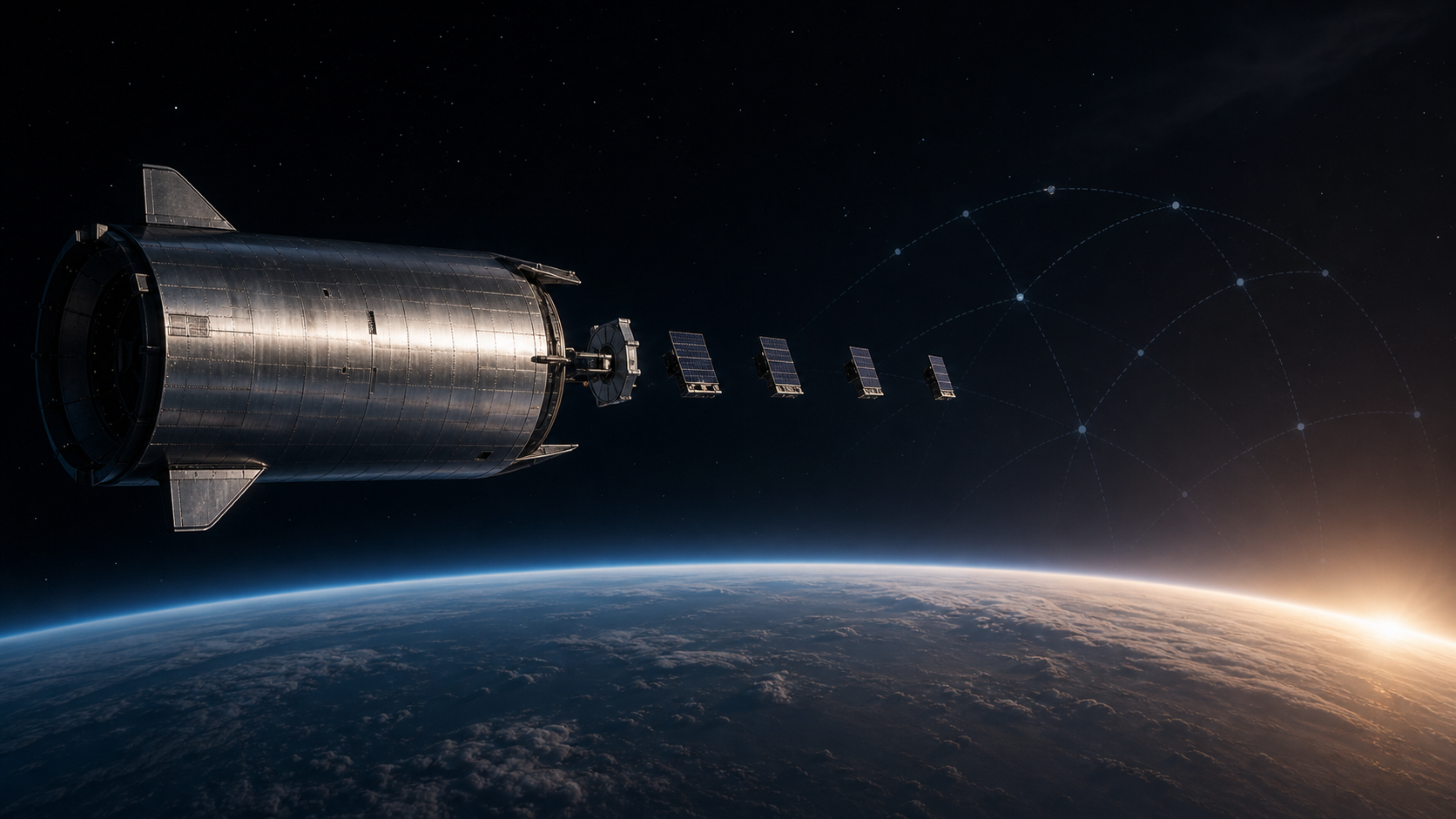
- Elon Musk said during SpaceX’s 4 August earnings call that Flight 14 is tentatively scheduled for the end of August and is intended to take Starlink V3 satellites to operational orbit.
- SpaceNews describes it as Starship’s first orbital launch attempt; every prior flight, including Flight 13 on 24 July, followed a suborbital profile.
- Flight 13 deployed 20 production V3 satellites for brief tests, but they reentered and did not join the operational constellation.
- SpaceX also intends to attempt the first tower catch of a Starship upper stage on Flight 14, subject to regulatory approval.
- Company disclosures describe each V3 satellite as designed for 1Tbps of downlink capacity and a Starship as capable of carrying up to 60, potentially 20 times the capacity increment of a Falcon 9 Starlink launch.
- None of those design figures is yet a Flight 14 result: launch, deployment, checkout, network integration and customer-visible capacity are still future evidence.
The destination changes the meaning of the flight
Previous Starship missions could be judged largely as tests of the vehicle. Flight 13 demonstrated a production V3 payload, an in-space engine relight and a surviving upper-stage splashdown. Its 20 satellites nevertheless returned with the suborbital trajectory. They proved that Starship could release real spacecraft in flight; they did not add a persistent layer to Starlink.
Flight 14 is meant to cross that boundary. Reaching an operational orbit would make the payload capable of remaining in space for checkout and possible admission to the network. That is why “orbital” is more than a change in altitude. It would turn a rocket-development event into the first attempted delivery by the system on which SpaceX bases its next capacity step.
A schedule is not a launch window
Musk gave the end of August as a tentative date. It is useful for understanding management’s sequence, but it is not evidence of a completed vehicle, a regulator-approved flight profile or a fixed launch window. Hardware testing, range preparation and licensing can still move the mission.
The planned ship catch needs its own label. SpaceX wants the returning upper stage to be captured by the launch tower for the first time, and Musk made that attempt conditional on regulatory approval. The source material does not publish the full authorization state for every other mission objective. It would therefore be wrong either to describe the entire flight as licensed or to assume that refusal or delay of the catch automatically cancels payload deployment.
Flight 13 retired one uncertainty and preserved another
The filed quarterly release gives Flight 13 unusual evidentiary value. SpaceX says the mission met its stated objectives, released 20 production V3 satellites, relit a Raptor in space and achieved its softest Starship splashdown. SpaceNews reports that the ship survived and remained afloat for recovery and analysis.
The booster result was weaker. Its boostback burn ended early and it failed to complete a controlled splashdown, the second such miss in succession. Flight 14 therefore inherits an asymmetric record: the ship and payload sequence improved, while the booster return remains unresolved. A successful orbital payload mission would not erase that engineering issue, just as a booster failure would not automatically prove that the satellites failed.
Sixty satellites is a design envelope
SpaceX’s prospectus says a V3 satellite is designed to deliver 1Tbps of downlink capacity. It also says Starship is expected to carry up to 60 V3 satellites and that one such launch could add about 20 times the downlink capacity of a Falcon 9 Starlink launch.
Those numbers describe the intended system, not the manifest or measured output of Flight 14. “Up to 60” is a ceiling, not a disclosed payload count. One terabit per second is a satellite design claim, not a customer speed test. Twentyfold compares potential capacity added per launch; it does not promise 20 times the service quality in every cell, because gateways, spectrum, demand, routing and terminals also shape performance.
The first accountable number is therefore the actual Flight 14 manifest. The second is how many satellites separate into the intended orbit. Only after checkout can the count move from launched hardware to accepted network assets.
The economic unit is admitted capacity
SpaceX ended the second quarter with 12 million Starlink subscribers. Connectivity produced $4.291 billion of revenue, $1.656 billion of operating income and $1.367 billion of capital expenditure during the quarter. Those figures explain why a larger launch vehicle matters: the payload system is tied to an already large operating service, not a hypothetical market.
Starship remains an investment burden before it becomes a delivery advantage. The Space segment spent $1.174 billion in capital expenditure, mainly on Starship development, and posted a $542 million operating loss. The economic promise is that more capacity per mission can lower the cost of adding useful bandwidth. The relevant denominator is not tonnes lifted or satellites released alone. It is capacity accepted into service per unit of launch, satellite and ground-network cost.
One thousand is a milestone estimate, not a forecast fact
Musk said a “critical mass” of roughly 1,000 V3 satellites could make a notable difference to Starlink service and estimated that the company might reach it around the second quarter of 2027. That statement supplies a useful scale: one successful batch would begin a deployment campaign rather than complete it.
It is also a management estimate containing several hidden dependencies. Reaching the threshold requires repeated Starship missions, satellite production, orbital approvals, successful checkout and enough ground and spectrum capacity to use the fleet. The 2027 timing should be tested against cumulative operational satellites, not against announced launch cadence or spacecraft waiting on the ground.
The control surface extends beyond the rocket
SpaceX controls the vehicle, satellites and much of the Starlink network, which can reduce handoffs between payload design and launch integration. It does not remove external constraints. Regulators govern flight and spectrum permissions; ranges and weather affect timing; gateways and ground links influence usable throughput; user terminals and local congestion determine what customers experience.
That means Flight 14 can succeed at one layer and remain incomplete at another. Liftoff is not orbit. Orbit is not deployment. Deployment is not checkout. Checkout is not commercial traffic. Each transition should produce evidence of its own rather than borrowing credibility from the step before it.
Sources
Member Briefing
Deeper Profile Context
Sign in with the right membership level to unlock the full briefing and source notes.
Only for Strategic Circle
Strategic Circle
Open to all readers. Unlock profile briefings after joining and signing in.
Join Strategic CircleOnly for Leadership Alliance
Leadership Alliance
For qualified IP-asset owners and management; sign in to unlock alliance briefings.
Join Leadership Alliance