
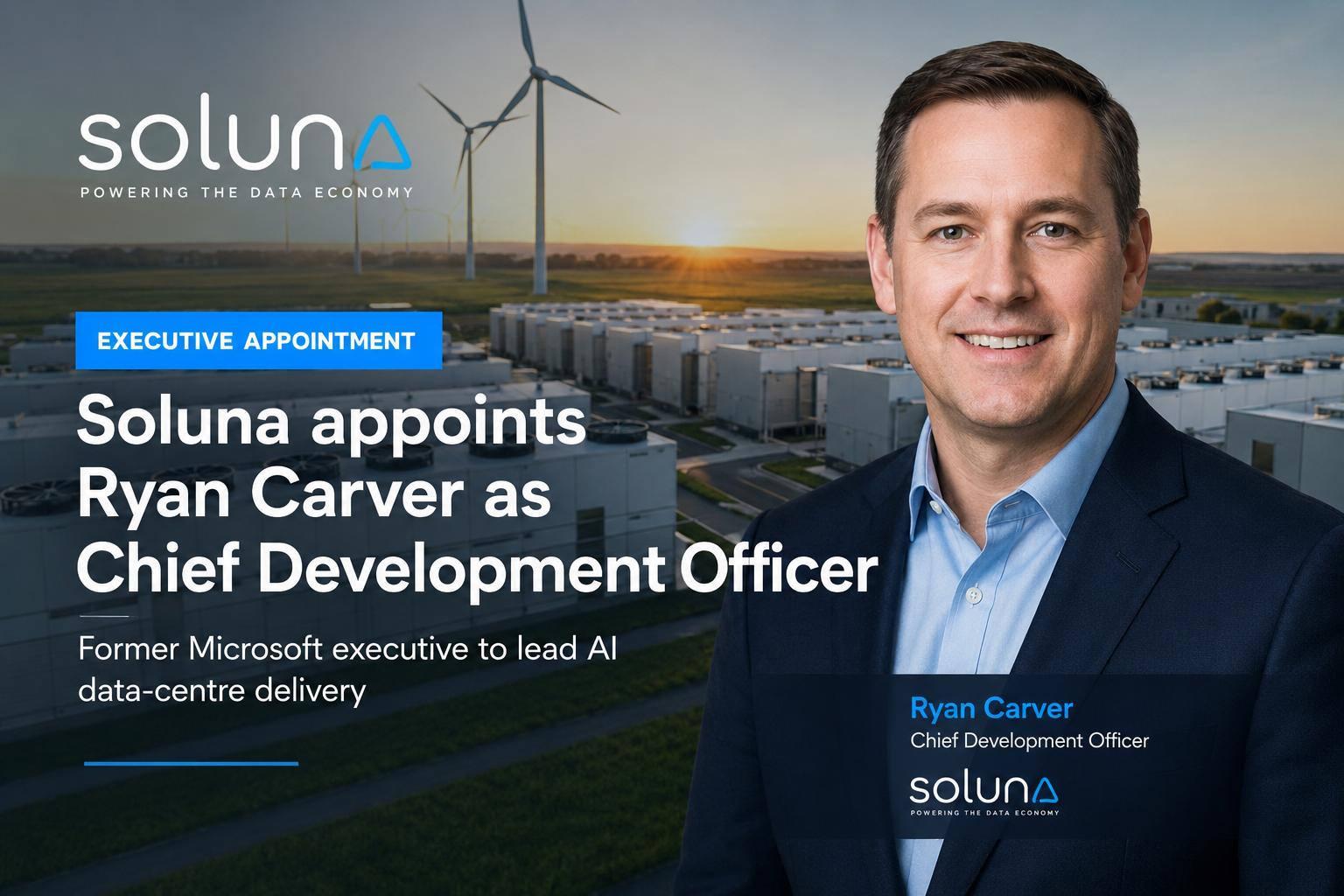
•Carver will oversee Soluna’s projects from site and power planning through construction, commissioning and operations
•He joins as Kati 2 advances through design and tenant talks, with first-phase scope and timing still undecided
The fact
Soluna has appointed former Microsoft executive Ryan Carver as chief development officer. The US company develops and operates data centres alongside renewable generation. Carver will oversee site development, power procurement, design, construction, commissioning and operations across its AI and high-performance computing business.
Carver previously led AI construction and site development at Microsoft, including the construction programme for its Fairwater campus in Wisconsin. He joins as Soluna advances Kati 2, a planned 350MW-plus AI and HPC campus. Detailed design is about 50% complete, a general contractor is being onboarded and agreements with electrical equipment suppliers have been signed. Soluna is also negotiating commercial terms and a lease with one potential tenant following a letter of intent.
The assessment
Kati 2 is now at a stage where customer requirements have to be matched with the design, equipment orders and construction plan. Soluna is still negotiating with a potential tenant while completing the design and onboarding its contractor. Until the first-phase specification is settled, the equipment package and construction sequence may still need to change.
Carver's role is to align tenant requirements with design, equipment orders and the construction plan. None of those decisions are settled. The lease is not binding, first-phase design is not final and construction has not started. Soluna must still translate a letter of intent into a defined scope, equipment package and build timetable.
What to watch
The next milestones at Kati 2 are a binding lease, a completed first-phase design and the start of construction. They would establish the scope and timetable of the initial build. Until then, the 350MW-plus figure describes the campus at full scale. The first-phase capacity and delivery date remain undisclosed.