
Summary
- A second international submarine cable, ACS-1, is being financed through the Australian Infrastructure Financing Facility for the Pacific with a reported package of about AU$104m — an AU$71.9m grant plus a AU$31.9m loan — and an additional AU$1.8m for off-grid generation and storage at the landing infrastructure.
- The retained record names one owner-operator for both the new cable and the existing Coral Sea Cable System, and states no tariff, no capacity figure, no landing-point count and no restoration obligation, so what is documented is a second route rather than a contracted continuity guarantee.
Every number in this briefing comes from one snapshot generation captured on 18 October 2026 between 12:33Z and 12:43Z. Within that generation, one dated trade item supplies the financing and physical parameters; two Australian government homepages supply a facility-level commitment and a boundary. Nothing here is a measurement of the network itself, and no document was read at clause level.
What the record actually states
The Adamasia Cable System 1, reported as ACS-1, is described as the Solomon Islands' second international submarine telecommunications cable, the first being the Coral Sea Cable System, rendered as CS². The same item reports the new branch at 1,015 km, connecting the country directly to the larger Bulikula regional network, which it places within Google's Pacific Connect initiative connecting Guam to Fiji. It states that ACS-1 is owned and operated by the Solomon Islands Submarine Cable Company.
In a summary field rather than a quoted passage, it also describes that company as owning and operating CS² — a distinction worth holding, because the dual ownership claim is the load-bearing one for this article and it is reported, not read from a corporate record.
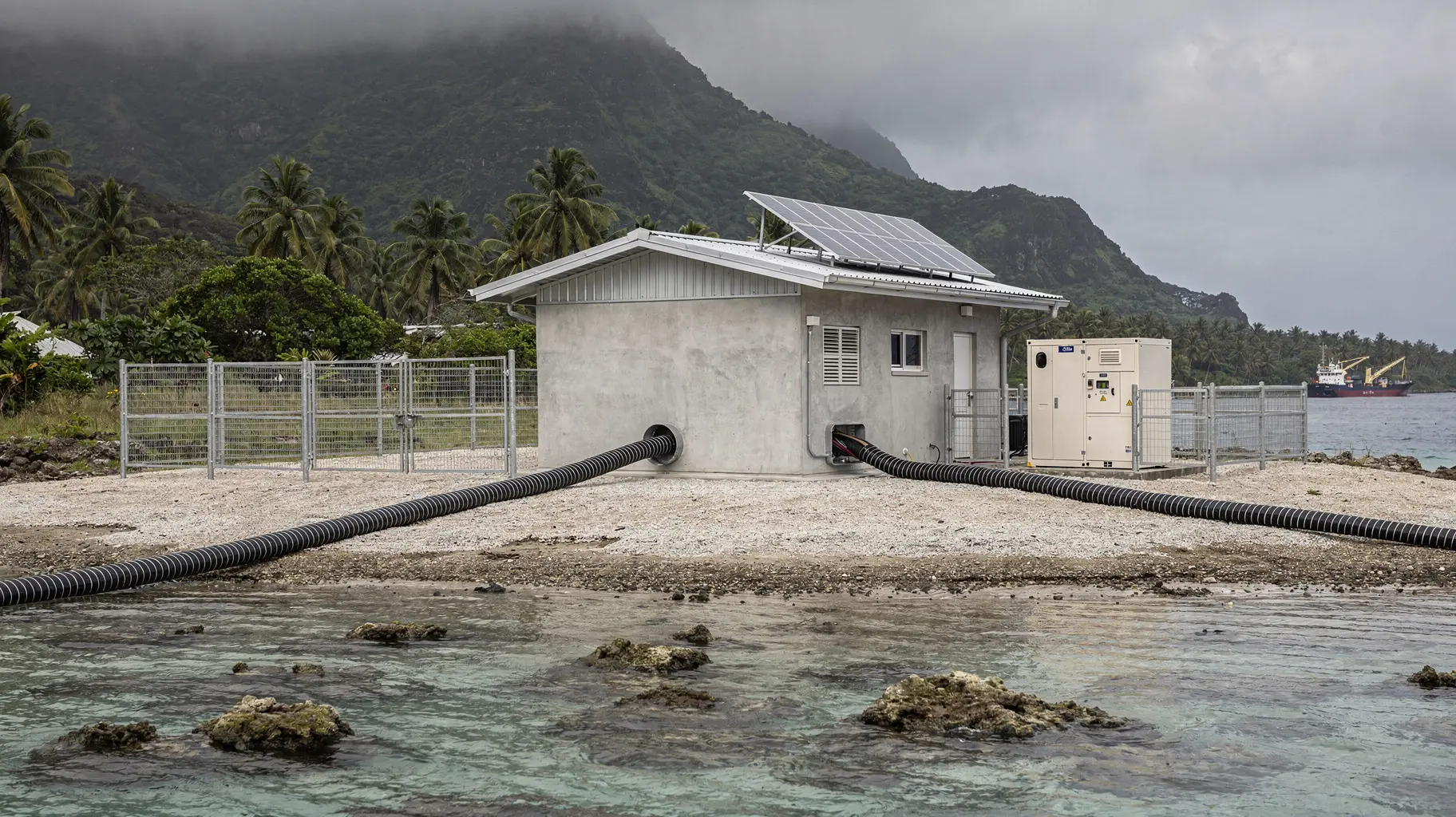
The financing is the strongest material in the record. "It is being funded through the Australian Infrastructure Financing Facility for the Pacific (AIFFP), consisting of a grant and loan package of approximately AU$104m (US$72.8m), comprising a AU$71.9m (US$50.33m) grant and a AU$31.9m (US$22.33m) loan," the item reports (Data Center Dynamics, 4 August 2026). The components close: 71.9 plus 31.9 is 103.8, which is 104 to the precision stated. A second passage reports a further AU$1.8m from AIFFP's Pacific Climate Financing Partnership "to support off-grid electricity generation and storage capacity, to ensure infrastructure climate resilience." The landing station itself is reported as contracted to DXN for AU$1.2m, with delivery due by April 2027.
The two government sources do less than they appear to. The AIFFP homepage states that Australia, through the Pacific Climate Infrastructure Financing Partnership, "will contribute at least $350 million in climate infrastructure for the Pacific region" (AIFFP) — a facility-level commitment that does not state this project's tranche, conditions or disbursement schedule. The DFAT portal homepage, as retained, carries no project particulars at all (DFAT). Neither page was a project document, and neither was read as one.
Where the money goes, and what it does not buy
The package is legible as two purchases. The grant and loan buy steel, survey, landing works and the branch itself. The AU$1.8m buys something narrower and more revealing: generation and storage at the shore end, sized to keep the landing infrastructure alive off-grid. That line item is an admission about where the fragility sits. A submarine cable is a wet plant that fails rarely; the landing station fails on power, cooling, permits, access roads and the staff who maintain them. A financier that adds a dedicated off-grid power line to a cable project has identified the terrestrial feed as the recognised weak point and paid to isolate it.
That still leaves the harder question. What has been purchased is a second route. Route diversity is a physical property: two paths that do not share a fault domain. Service continuity is a different asset, and it is contractual — a restoration obligation, a maintenance arrangement with defined response, a capacity commitment, a published tariff that makes the second path usable by someone other than its owner. The retained record contains none of those instruments.
No tariff, no capacity figure in gigabits or terabits, no landing-point count, no access condition, no restoration agreement and no corporate registration appears in any of the three sources. The absence should be stated as a limit of the record, not as a finding about the company; a financing schedule that was never retrieved cannot be said not to exist.
The organisational detail matters more than it usually would. If one company owns and operates both cables, the diversity is at the cable-segment layer and not at the decision layer. Faults in a corporate, financial or administrative condition do not have to respect a route. That is a structural observation about single-operator systems, not an allegation: the record says the operator is the same, and it says nothing about how the two systems are held, financed or maintained.
The shore end is the new single point
There is a plainer way to see the risk. Before ACS-1, the country's international traffic depended on one cable. After ACS-1, it depends on two cables that converge on landing infrastructure which, on the record, is being built for the second system and powered by a purpose-built off-grid supply. Convergence is the whole problem. Two routes that enter through one building, one power feed and one maintenance crew do not fail independently at the shore end even when they fail independently at sea.
The April 2027 delivery date is therefore the date to watch, and not because a cable will be lit. It is the date after which the landing station becomes the country's shared international gateway, and the date after which the absence of a documented restoration arrangement stops being a gap in a project file and starts being an operating condition.
What would change this assessment
Four artefacts would move the picture. A published AIFFP project page or signed financing schedule stating the package and its conditions would convert the reported figures into read ones, and would show whether access or reporting obligations attach to the grant. A published tariff or wholesale-only undertaking would establish whether operators other than the owner can build service on the second path. A named restoration arrangement involving a party other than the cable owner would convert route addition into service continuity.
A Solomon Islands appropriation or debt document carrying the AU$31.9m loan would show the fiscal incidence on the state, which the retained record does not describe at all.
The negative version is equally specific. If the record after April 2027 still consists of a launch, a landing-station contract and a donor announcement — with no tariff, no capacity figure, no restoration instrument and no operator accounts — then the country will hold two cables and one decision-maker, and the resilience read into the second cable will be an assumption rather than a purchased obligation.
For readers tracking the operator rather than the cable, the directory entry is the handle: Solomon Islands Submarine Cable Company.
Member Briefing
Deeper Profile Context
Sign in with the right membership level to unlock the full briefing and source notes.
Only for Strategic Circle
Strategic Circle
Open to all readers. Unlock profile briefings after joining and signing in.
Join Strategic CircleOnly for Leadership Alliance
Leadership Alliance
For qualified IP-asset owners and management; sign in to unlock alliance briefings.
Join Leadership Alliance