Summary
- SkyView's operators reported blank image outputs after storage filled over weekends in April and May 1995; the May entry identified a crashed cleanup job.
- The service constructed images from existing surveys. Interpreting an empty result required knowing what happened to both the data and the processing.
The universe had plenty of room. SkyView's disk did not. On 3 April 1995, the virtual observatory's operators reported that output storage had filled over the weekend. Some requests could have returned blank images. On 1 May, they recorded a recurrence: the scheduled job that removed old files had crashed, the disks filled and new images could no longer be stored. Users received blank pictures. Cosmic emptiness had found an administrative assistant.
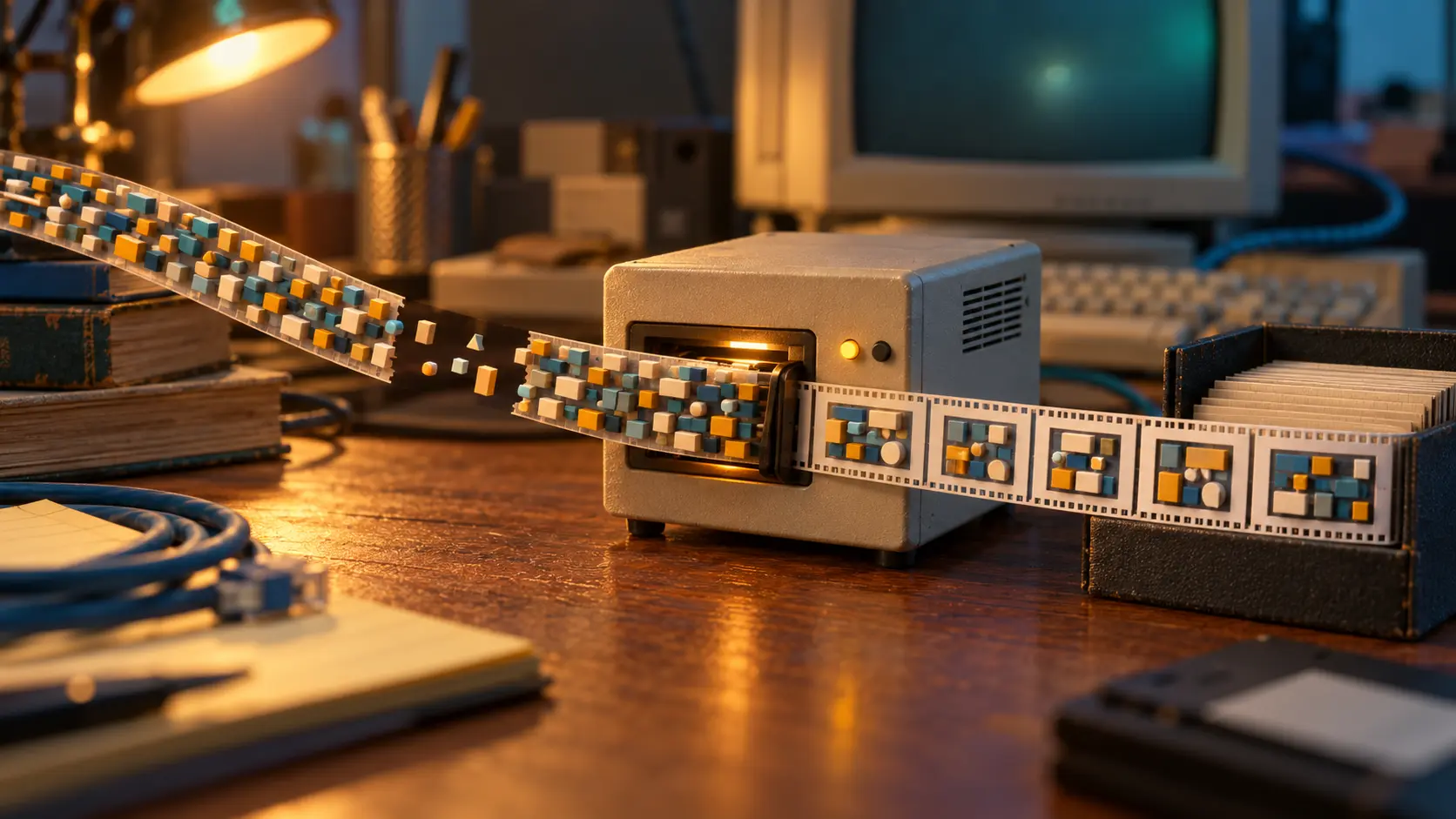
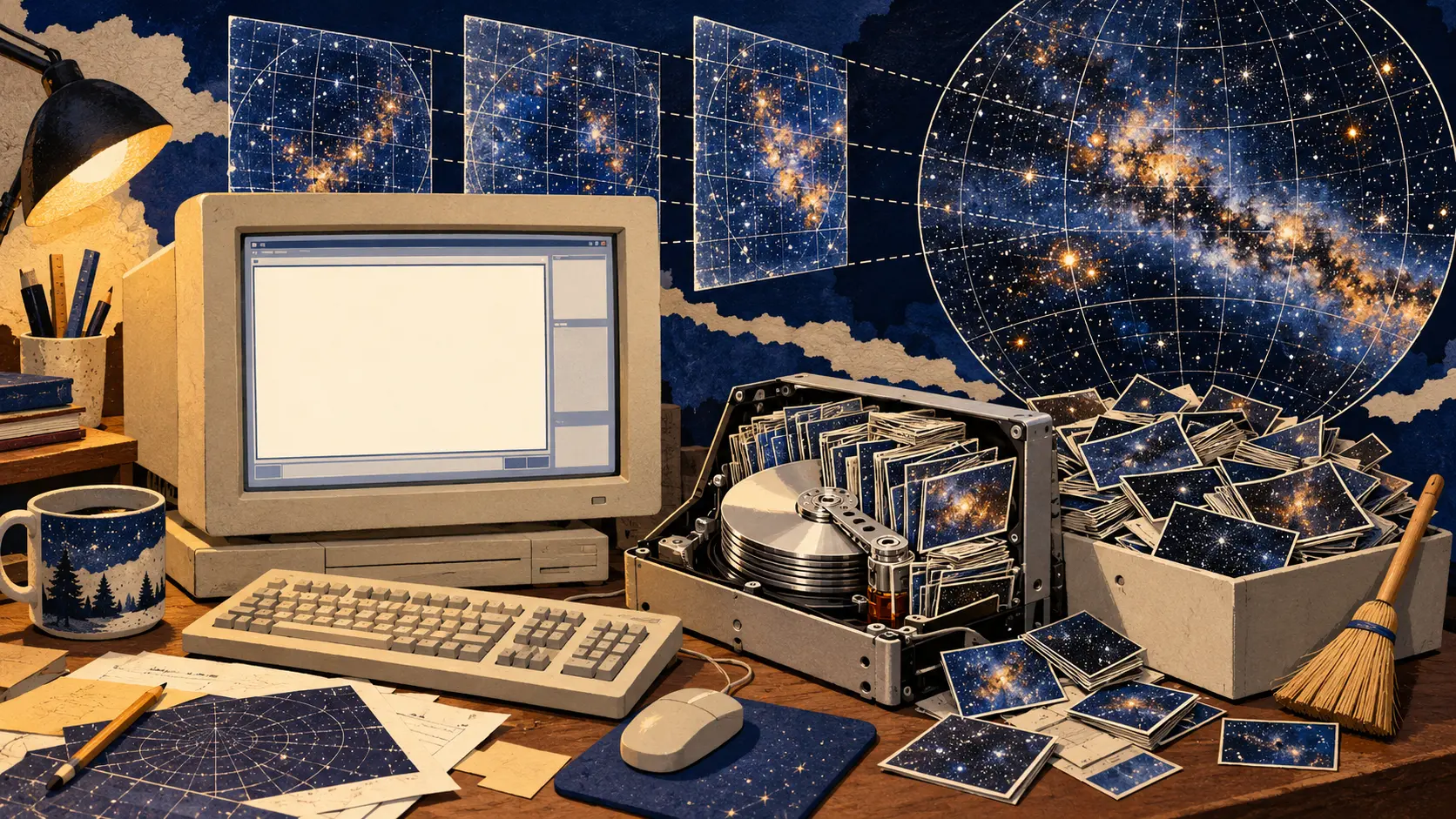
SkyView did something more ambitious than offer a directory of photographs. Its February 1994 technical paper described a network service that took a position in the sky and built an image from existing surveys. The user chose coordinates, projection, scale and size. The system joined survey pieces and resampled them into the requested frame, then supplied a usable output such as a FITS file. Much of the fiddly geometry moved from the researcher's desk to a shared service.
That was particularly useful when comparing different wavelengths. Survey collections arrived with different coordinates, projections and pixel scales. Preparing them for comparison could become a substantial job before the astronomy began. SkyView made a chosen patch of sky the starting point and handled much of that preparation behind the interface.
By November 1994, the team was describing the system as an archive that produced data to order. Mosaic brought its interface to professional and public users. A test capability assembled ROSAT pointed observations: a requested position could return an image, or a blank field when there had been no observation. In that example, emptiness carried information about coverage.
The 1995 disk incidents supplied another route to a blank result. A failed storage operation could also put an empty picture in front of the user. The distinction mattered at the point where an image became evidence. A survey without an observation and a service unable to save its output called for different next steps.
Temporary storage was part of the bargain. On 5 December 1994, the operator log announced automatic deletion of web-generated files more than two hours old. The service needed room for the next person's request. Images could represent distant astronomical objects while holding a very short lease on a local disk. Downloading the result was part of finishing the job.
The logs made these dependencies visible. They named the full disk, the failed housekeeping and the affected output, giving readers a place to look beyond the picture. Such operational detail belongs beside the elegant geometry engine. A virtual observatory still needs someone to empty the tray.
SkyView's early promise was a useful one: ask about a place in the sky and receive data arranged for that question. Delivering it made the archive responsible for a transformation as well as a collection. The recipe, the input surveys and the completion of the job all helped explain what appeared on the screen. Even a picture of nothing had a production history.
Member Briefing
Deeper Profile Context
Sign in with the right membership level to unlock the full briefing and source notes.
Only for Strategic Circle
Strategic Circle
Open to all readers. Unlock profile briefings after joining and signing in.
Join Strategic CircleOnly for Leadership Alliance
Leadership Alliance
For qualified IP-asset owners and management; sign in to unlock alliance briefings.
Join Leadership Alliance