Summary
- The public world map's unit reads "Reported Unique IPs (log. scale)" — an address count on a logarithmic scale, not a count of devices, victims or organisations.
- The per-address record, one address on one port at one UTC timestamp, is not public: it goes to subscribers who can establish network ownership, verified ideally through someone listed in whois for the network.
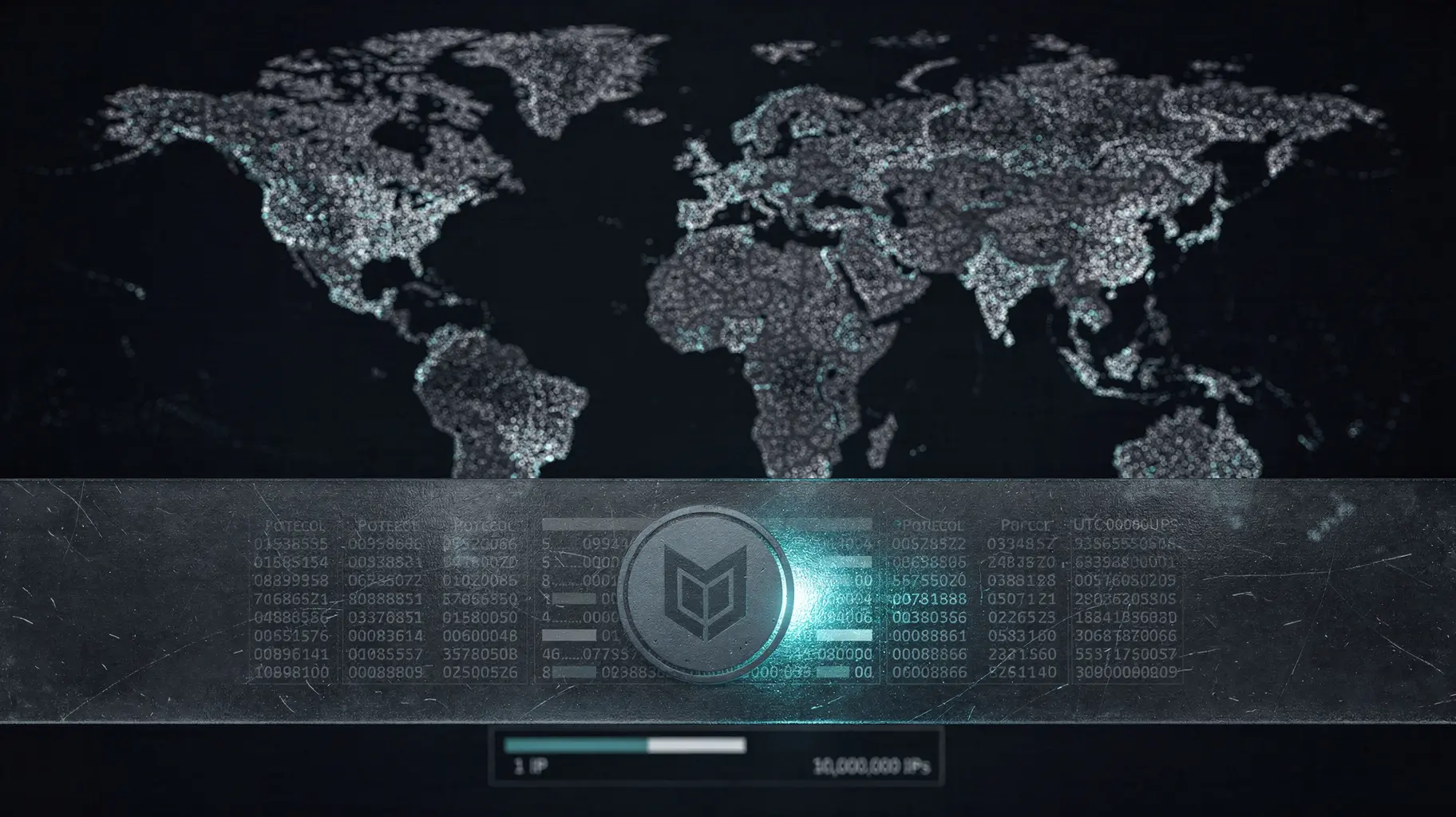
Start with the legend. At the bottom of the public world map, the scale settles what a reader is actually looking at: Reported Unique IPs (log. scale), running from "1 IP" to "10,000,000 IPs" (world map). Not devices. Not victims. Not organisations. Addresses, and on a logarithmic scale, so the gap between a country with a thousand and a country with ten thousand compresses into neighbouring shades of blue.
The metering behind that map is documented to a standard that would embarrass a good deal of the measurement industry. The foundation says it performs daily port scanning of the entire IPv4 Internet from computers physically located in the USA (is scanning legal). It says it reaches 3.7 billion of the roughly 4.3 billion IPv4 addresses and gets to IPv6 through compiled hitlists of /128 addresses rather than by sweeping it (IPv6 scanning). It says the reports run every morning for the previous 24 hours in UTC, delivered as CSV with timestamps in UTC+0 (common questions). It says the shared data includes at minimum the IPs, the timestamps and the incident metadata needed to act, with command-and-control data stretched to seven days (report contents). It publishes the collection mix — scans, sinkholes, honeypot sensors, sandboxes, blocklists — and notes that some reports carry information partners reported to it rather than material its own probes produced (network reporting).
It also publishes the shape of a row. The sample header for the Device Identification Report keys each line to ip, protocol, port and timestamp, alongside asn, geo, region, city, sector and device fields (device identification). That is the detail most people mean when they complain that an aggregate cannot be checked: here one line, in one file, on one day, describes a probe that a recipient can reproduce. Testability is not missing from this instrument. It is installed, and it points at a person.
Because the next sentence is the one that turns a method document into a distribution policy. "We decided not make our scan data available for public searching," the foundation writes. Instead it notifies vetted network owners subscribed to the free daily reports, and the appropriate National CERT or CSIRT, for remediation (is scanning legal). The dashboard help page repeats the boundary in its own words: the reports contain detailed IP level information concerning a particular network or constituency, the dashboard "does not allow for this level of granularity", and the high-level statistics exist to give the wider community situational awareness "while preserving the anonymity of any involved parties" (dashboard help). Anonymity here is not the accident of an aggregate. It is the stated purpose of the aggregate.
Who gets the row is settled by a test the foundation states with unusual economy. "To ensure that everyone gets only the information that's relevant to their needs, we use a very strict, simple criterion: network ownership" (entitlement). The subscription form asks for the ASNs, CIDRs or domains an applicant controls, or, for a National CSIRT, the country it represents, and for the name and contact details of one or more people in the organisation — "ideally someone listed on the whois for your network space", which "will help us verify your identity" (subscribe to reports). There is no published checklist of documents behind that word, verify; the reference to a whois contact is the closest the reviewed pages come to describing the evidence.
Now put a number on the gate. The reporting page says the daily reports go to more than 10,000 vetted subscribers, including 135 national governments and 201 National CSIRTs covering 175 countries and territories, and lists 151 report types (network reporting). The 2025 year in review, published on 7 September 2026, adds the figure that matters most for reading the map: subscribers represented 70 per cent of North American, 67 per cent of European and 57 per cent of global IPv4 space by ASN directly (2025 review).
Fifty-seven per cent is a coverage statement, and coverage statements invert cleanly. If 57 per cent of global IPv4 space by ASN is reached directly, the remainder is not reached directly, and the map does not say so on any country panel. The statistics page offers two years of aggregated country-level data, free to use with attribution for research, policy and journalism, and prohibits scraping and resale (dashboard statistics). Two years of colour by country, and no field anywhere in the reviewed set that reads: on this day, in this country, this many reported addresses had no owner-level recipient subscribed. The unit is published. The window is published. The vantage is published. The complement is not.
One more discipline, because the publisher's own pages disagree with each other. The overview page still says daily reports go to "over 8,000 vetted subscribers" (what we do), while the reporting page and the 2025 review say more than 10,000; the catalogue lists 151 report types while an FAQ block on the subscription page says 76. Neither divergence is a scandal, and neither is evidence that any figure is wrong. Both are revision facts: a reader who wants the current count has to know which page he is standing on, which is exactly the burden an access-controlled register puts on the public.
My own prior coverage measured, on 19 November 2026, three instruments that failed differently. The MANRS conformance register printed a per-participant percentage whose unit, window and computing body no reviewed page of nine stated. ICANN's Domain Abuse Activity Reporting printed a tally whose base was other people's abuse reports. The IANA Numbering Services Review Committee printed percentage verdicts with no per-transaction identifier. In each, a publisher counted conduct it did not itself observe. The delta here is structural: the sensor, the aggregate and the method belong to one organisation, the method is printed, and the per-address evidence is not withheld — it is assigned. The asymmetry in this instrument runs between documented and addressed. (The Shadowserver Foundation in the BTW directory.)
So the cheapest repair is not transparency about the method, which already exists, and not publication of addresses, which would hand attackers a list. It is one field: for each country and each reporting day, the count of reported addresses for which no owner-level recipient is subscribed. That number converts the map from a numerator into a coverage reading, and it lets a reader see where the instrument is blind without exposing a single host. Until it exists, the colour over your country is a measurement taken by people who can see your address and will not show you the line unless you can prove the address is yours.
Member Briefing
Read the full trend briefing
Members read the full briefing with the source notes behind every finding.
Strategic Circle
A daily briefing in your language, built from changes we have verified.
Join for USD 20/monthCancel anytime.
Members also get the full research library, a daily briefing on the networks they follow and the private forum.