
Summary
- Setilait's displayed business ladder charges UAH390 for 100 Mbit/s with a static IP, UAH590 for 500 Mbit/s with reserve power, and UAH1,000 for 1,000 Mbit/s with reserve power. A separate 1,000-Mbit/s dedicated-line card at UAH1,500 carries the same power wording.
- The distinction is commercially useful only if customers can see what equipment and sites remain powered, the tested load and runtime, who owns each dependency, and what remedy follows a shortfall. Public routing visibility cannot answer those questions.
Power is part of the tariff, not a footnote
The most revealing part of Satellite Ltd's public offer is not its highest speed. It is the small phrase attached to selected business cards: power reserved.
On the Setilait home page captured on 31 August, a business customer could see a 100-Mbit/s plan with a static IP for UAH390 a month. The next card offered 500 Mbit/s with a static IP and reserve power for UAH590. The 1,000-Mbit/s business card paired the same power wording with a UAH1,000 price. A separate dedicated-line ladder ran from UAH490 for 100 Mbit/s to UAH1,500 for 1,000 Mbit/s; only the top dedicated card displayed the reserve-power phrase.
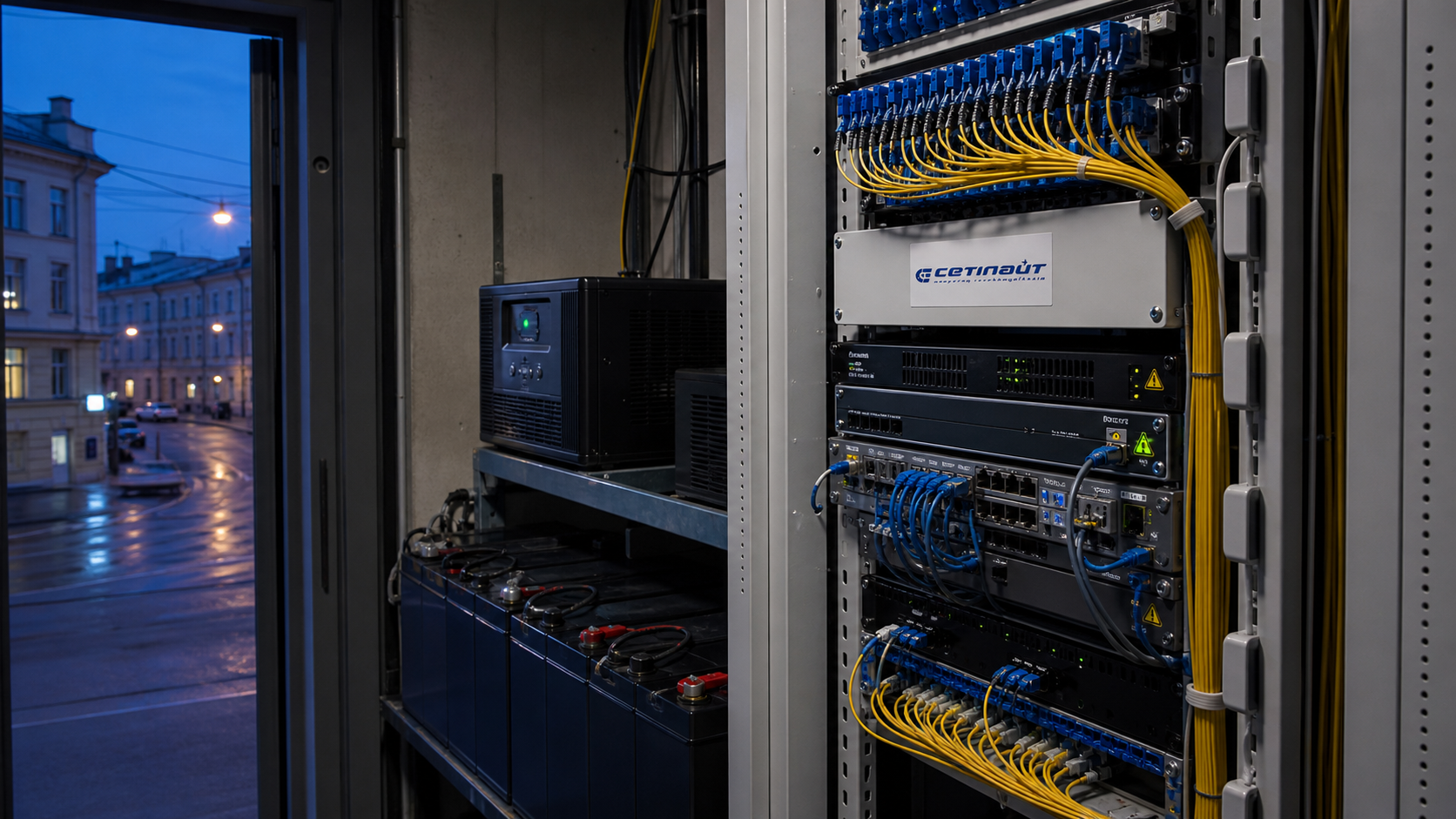
Those cards do not prove availability or runtime. They do something more modest but still important: they show that the operator treats power coverage as a differentiating commercial attribute. The customer is not merely being told that the network is reliable. The customer is being invited to choose a tariff in which power forms part of the visible product description.
That creates an accountability test. If reserve power helps justify the move from UAH390 to UAH590 or UAH1,000, the buyer should be able to identify the protected chain. Is the promise limited to an access switch? Does it include an optical-line terminal, aggregation, transport and core equipment? Does it cover the customer's optical terminal and router? What load was used in the runtime test, and what happens when mains power remains unavailable longer than the tested window?
None of those answers is published in the reviewed source set. The tariff ladder is therefore evidence of product design, not proof of delivered continuity.
A passive segment is not an end-to-end power guarantee
Setilait's about page distinguishes FTTB and gPON. It says gPON can keep subscribers connected during blackouts for up to 72 hours and describes the passive distribution segment as not depending on operator generators or batteries.
The technical idea has a sound boundary. Passive optical splitters do not need electrical power in the field. Removing an active building switch from one part of the access path can eliminate one failure point. But the service still depends on powered equipment elsewhere: the optical-line terminal, aggregation and transport nodes, the operator's core, upstream connectivity, the customer's optical terminal, and usually the customer's router or Wi-Fi access point.
An article about Satellite Ltd must therefore preserve three different statements. First, gPON changes where active equipment sits. Second, the operator publishes an up-to-72-hour claim. Third, the reviewed public material does not provide the asset inventory, test protocol, load, observed results or address-level scope needed to verify that runtime. Turning those statements into “the internet works for 72 hours without power” would exceed the evidence.
The business-services page makes an even stronger first-party representation. It markets guaranteed power using the operator's own reserve-power sources. Again, the useful response is not to accept or dismiss the wording. It is to translate it into a schedule of covered assets, measured runtime and customer remedy.
The product ladder mixes several control dimensions
Setilait offers home access, business Internet, dedicated lines, connectivity between offices and branches, additional IP addresses and speeds advertised up to 10 Gbit/s for larger organisations. Its home cards also distinguish ordinary and xPON products, while some business cards bundle a static IP.
These features solve different problems. Speed sets a nominal traffic ceiling. A static IP makes a service easier to address from outside. A dedicated line may change sharing or contractual treatment. gPON changes the access architecture. Reserve power changes one class of operational dependency. None automatically implies the others.
That separation matters in procurement. A customer may need a static address but tolerate an ordinary restoration target. Another may need lower speed but a tested power window. A third may need two physically separated services and clear escalation rather than a larger headline bandwidth. A tariff ladder is most valuable when each control dimension can be selected and verified independently.
The first-party pages do not publish minimum speeds, utilisation, outage distributions, restoration times or service-credit outcomes. They also do not disclose which addresses can order each product. Prices and maxima should therefore be read as displayed commercial terms, not as a performance sample.
Public routing data describes another layer
RIPE NCC lists Satellite Ltd as a Ukrainian member. Organisation ORG-SL209-RIPE names the company, identifies it as an LIR and gives a Kremenchuk address. AS21310 is assigned to the organisation under the name ASN-SATELLITE.
The aut-num object contains registered import and export statements involving AS35320, AS3255 and several other networks. RIPEstat's 30 August routing-status response showed AS21310 visible at all 328 returned IPv4 RIS peers and 320 of 321 IPv6 peers. Its announced-prefixes endpoint returned nine recent records, including an IPv6 /32 and overlapping IPv4 entries. The neighbour endpoint returned AS3255 and AS35320 on one side of observed paths and AS48081 and AS58055 on the other.
These are useful control-plane observations. They can trigger questions about route intent, address governance and dependency changes. They do not prove live commercial sessions, circuit capacity, physical separation, power autonomy, customer availability or repair performance. A broad route can remain visible while a particular building, access node or customer router is dark.
The captured PeeringDB query returned no matching network object. That is a directory observation, not evidence that Satellite Ltd lacks peering or exchange presence.
What a failure map should contain
For each critical customer site, the map should start with the installed product and access technology. It should identify the customer router and optical terminal, building switch where applicable, passive distribution, OLT, aggregation, transport, core and upstream dependencies. Each active element needs a power owner, tested load, runtime, last demonstration date and escalation contact.
The same map should mark shared ducts, entrances, facilities, generators, batteries and operating teams. Two tariffs or two upstream route relationships may still converge on the same physical or organisational dependency. Redundancy becomes meaningful only when the common points are named.
Finally, the operational record should keep separate times for symptom, detection, triage, return of power, return of routing, return of customer traffic and customer confirmation. A route announcement, an illuminated access node and a working application are different recovery milestones.
Sources
- BTW Media directory: Satellite Ltd
- Setilait official home page and displayed tariffs
- Setilait about page
- Setilait services for business
- RIPE NCC members offering services in Ukraine
- RIPE Database: ORG-SL209-RIPE
- RIPE Database: AS21310
- RIPEstat routing status for AS21310
- RIPEstat announced prefixes for AS21310
- RIPEstat observed neighbours for AS21310
- PeeringDB lookup for AS21310
Member Briefing
Deeper Profile Context
Sign in with the right membership level to unlock the full briefing and source notes.
Only for Strategic Circle
Strategic Circle
Open to all readers. Unlock profile briefings after joining and signing in.
Join Strategic CircleOnly for Leadership Alliance
Leadership Alliance
For qualified IP-asset owners and management; sign in to unlock alliance briefings.
Join Leadership Alliance