
Summary
- Rocky View County announced four autumn open houses to inform a strategy for future technology and energy development, including data centres.
- Agricultural fragmentation and neighbouring farm operations sit alongside the footprint of a proposed facility; the consultation does not approve individual projects.
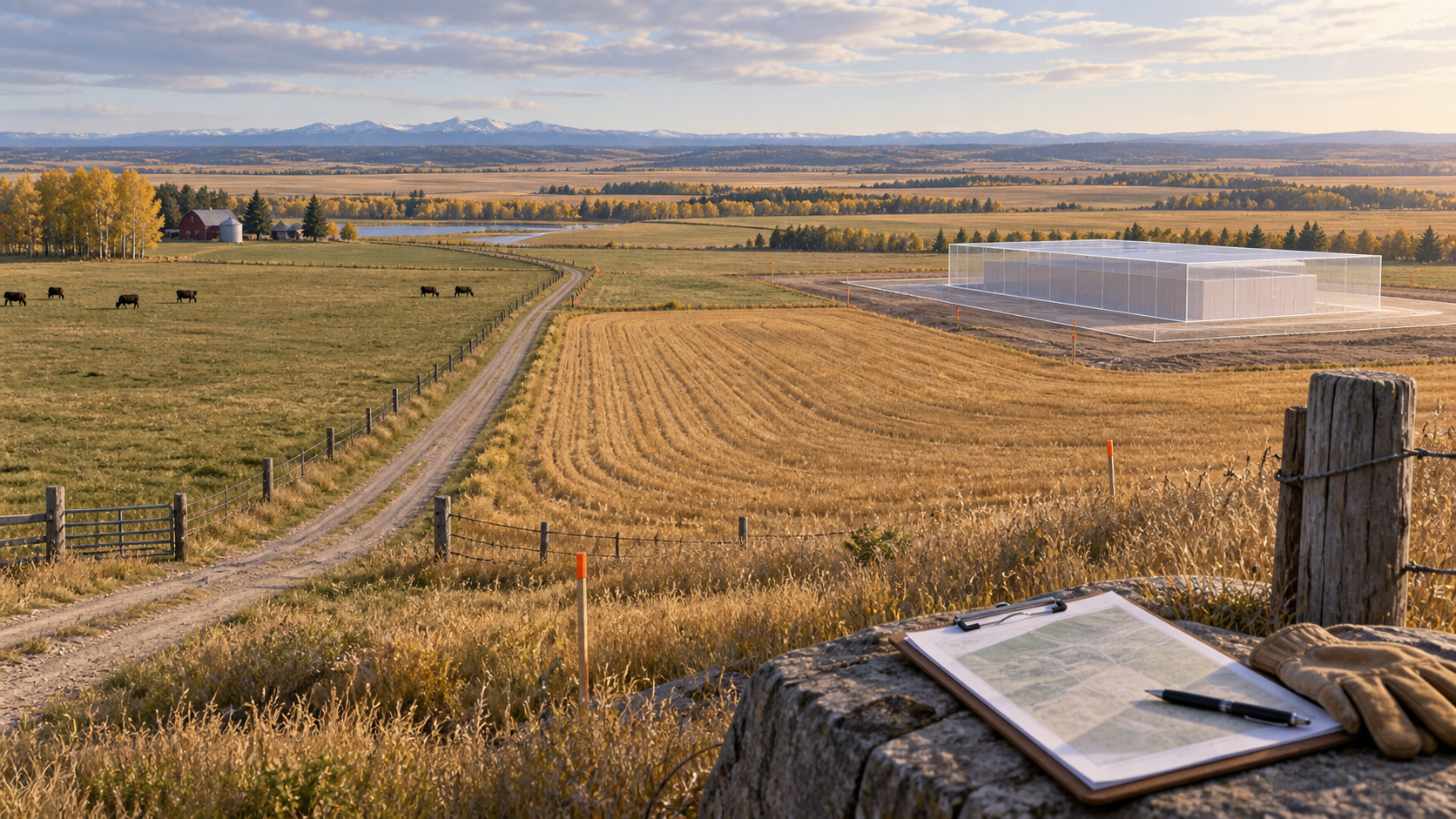
A field can remain outside a data-centre boundary and still become harder to farm. Access, the shape of adjoining parcels and compatibility with a new industrial neighbour matter as well as the hectares directly converted. That is the useful commercial question in Rocky View County's forthcoming consultation: what evidence makes a large piece of available land a workable development site?
The Alberta municipality announced on September 11 that it would hold four open houses for its Emerging Sector Strategy – Technology & Energy. The exercise concerns a framework for evaluating future proposals, not decisions on particular applications. It is neither an announced moratorium nor a general permission to build.
The footprint is only part of the site
A consultant report dated August 14, prepared by EXP Services Inc. and Urbanics Consultants Ltd., discusses agricultural land conversion alongside fragmentation, disruption to access and effects on neighbouring farming. Those distinctions widen the siting question beyond the proposed building and its immediate boundary. A layout that fits within an acquired parcel can still leave unresolved questions about the agricultural landscape around it.
The report considers a data-centre-specific agricultural impact assessment as a possible policy tool. That is a recommendation for consideration, not evidence that a new county-wide filing rule has taken effect. There is also an important existing-process distinction. The County's explanatory project page says that, where a new or amended area structure plan is required, preliminary agricultural and environmental impact assessments and a servicing report are required before Council initially decides whether planning should proceed. The page explicitly says that this direction is not project approval.
These are different propositions: the published process already describes preliminary agricultural evidence in a particular planning route, while the consultant discusses a possible sector-specific tool. Presenting the latter as the first appearance of agricultural assessment would obscure the former. Neither source establishes that every possible application now faces an identical new requirement.
A public timetable, not a consent timetable
The open houses are scheduled for September 29 at Balzac Community Hall; October 1 at Khalsa School in Conrich; October 6 at The Track Golf Course in Langdon; and October 8 at Irricana Lions Community Hall. Each runs from 4 p.m. to 8 p.m. local time. The project page schedules an online survey from September 29 to October 27. As of September 15, that survey period has not begun.
Feedback will be provided to Council and summarised in a What We Heard Report. Administration will combine it with research in developing an Options Report for Council. The consultant's work is therefore an input to the process, not an adopted strategy. Attendance or a survey response is not a vote granting consent to a facility.
Nor does municipal consideration settle the whole approval question. The County identifies land use, servicing and local compatibility—including noise, light, visual effects and traffic—as municipal responsibilities. Provincial authorities address electricity and water or environmental permissions. Other necessary approvals can come before, during or after municipal approvals; they should not be pictured as one universally fixed sequence. Construction still requires the applicable approvals and permits.
What the evidence does not establish
The report is a high-level synthesis of public information and professional judgement, not a site-specific engineering study, capacity assessment or legal opinion. It cannot establish available power or water at a chosen parcel, or validate a particular design. This article draws on its introductory scope and agricultural-siting discussion, not a technical audit of the entire report.
For the market, the emerging distinction is between land that can be assembled and land whose surrounding operations and servicing can be explained convincingly. That is an analytical implication of the published process, not a County finding that any named project has failed the test.
Sources
The September 11 announcement sets out the engagement; the County's project page describes the timetable and planning route. The August 14 consultant report, particularly its scope and agricultural-siting sections, supplies the land-use analysis.
Member Briefing
Deeper Profile Context
Sign in with the right membership level to unlock the full briefing and source notes.
Only for Strategic Circle
Strategic Circle
Open to all readers. Unlock profile briefings after joining and signing in.
Join Strategic CircleOnly for Leadership Alliance
Leadership Alliance
For qualified IP-asset owners and management; sign in to unlock alliance briefings.
Join Leadership Alliance