Summary
- Launched in October 2012 with images of 125,000 works, Rijksstudio let visitors save details, crop pictures and download files for their own use.
- The museum recorded 27,000 personal studios by year end; its early account also admitted that product orders had fallen short of expectations.
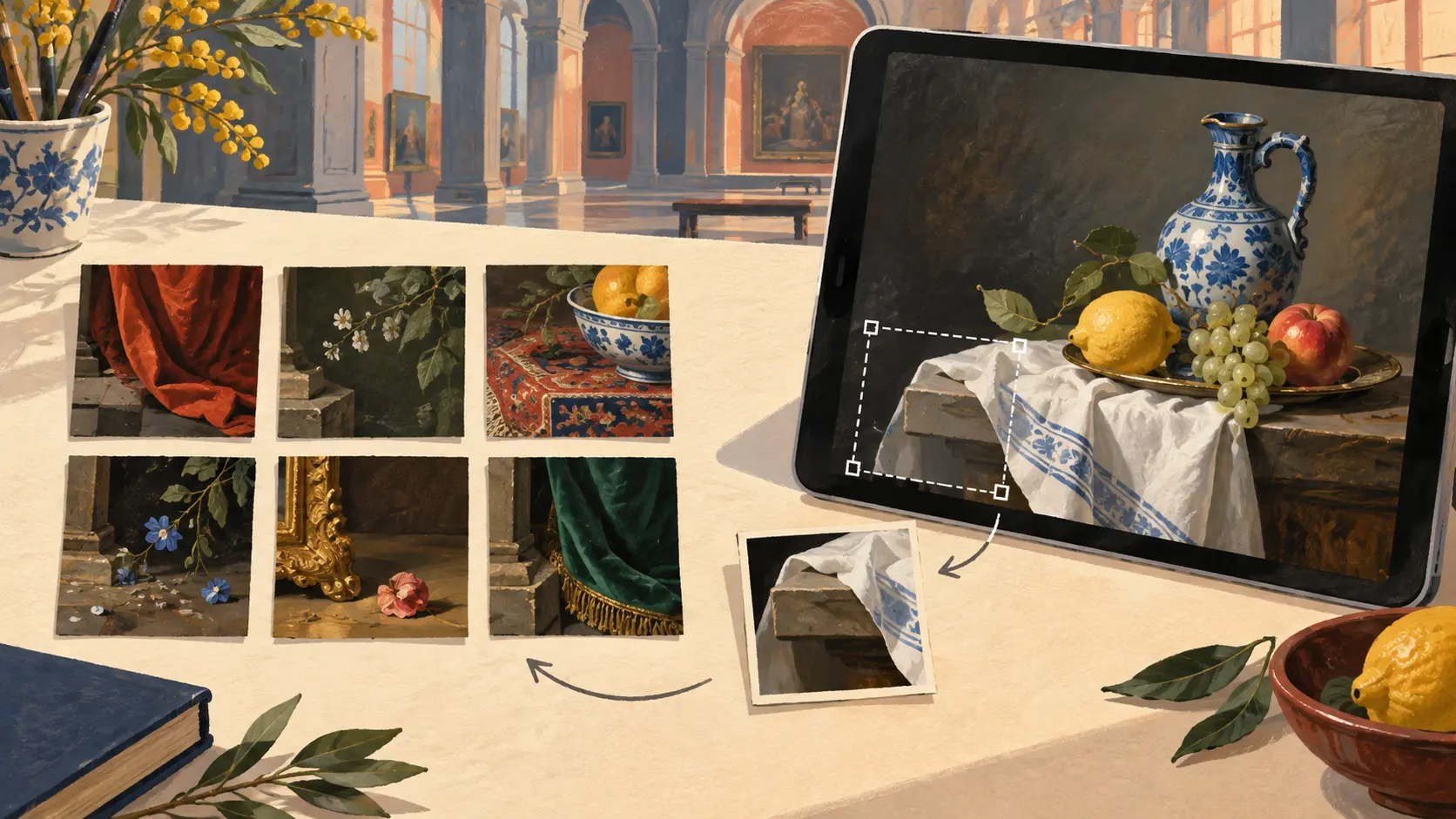
Given access to a museum full of art, Mark Creegan collected the bottom-left corners. He assembled fragments from different paintings into a new composition called “Bottom Lefts.” Rijksmuseum had supplied the masterpieces. A visitor had found a rather specific use for the margins.
The example appears in Peter Gorgels's 2013 account of Rijksstudio, written from inside the museum project. It captured a practical change in what an online collection could offer. A visitor could take an image apart, save a detail and arrange a collection according to a private enthusiasm. The museum had provided a crop tool and a place to keep the results. Someone had promptly discovered an exhibition theme that fitted in a corner.
Rijksstudio launched on 30 October 2012, ahead of the main building's April 2013 reopening, with images of 125,000 works. Its design favoured a tablet held close to the viewer: large controls, large images and room for fingers. A painting could initially appear as a selected detail filling the screen. Zooming out revealed the whole. Looking closely had become the starting position.
The invitation came with tools
Visitors could save whole pictures or fragments into personal sets. They could download high-resolution JPEG files, or crop an image for a printed product. These actions gave substance to the invitation to reuse the collection. A person interested in a patch of fabric could select that patch and take a copy away. Their project could continue after the museum tab closed.
The 2012 annual report, printed page 36, recorded 27,000 Rijksstudios at 31 December. Gorgels's early account described an abundance of personal collections, alongside one commercial disappointment: orders for products were below expectations. The site had persuaded people to collect and play. Getting them through a checkout was another task, with its own friction and its own bill.
The museum also widened access to the files themselves. In Europeana Foundation's 2014 study, page 13, Joris Pekel reported that in October 2013 Rijksmuseum stopped charging for the highest-quality images of already-digitized public-domain works. Interviews with museum staff described a preference for funding whole digitization projects over administering many individual image transactions.
That sequence gave the online collection a different social shape. Rijksmuseum still held the objects and supplied their records. Visitors could choose what deserved attention, move the frame and carry copies into work of their own. “Bottom Lefts” made the arrangement beautifully legible. The institution offered the entire picture; the public was allowed to have other plans.
Member Briefing
Deeper Profile Context
Sign in with the right membership level to unlock the full briefing and source notes.
Only for Strategic Circle
Strategic Circle
Open to all readers. Unlock profile briefings after joining and signing in.
Join Strategic CircleOnly for Leadership Alliance
Leadership Alliance
For qualified IP-asset owners and management; sign in to unlock alliance briefings.
Join Leadership Alliance