Summary
- RFC 9531 builds a path label on the reverse journey of a Content/Data message and lets a later Interest reuse the recorded sequence of forwarding choices.
- The label can lead to a producer or a forwarder cache, can become invalid when interfaces or FIB state change, and can be displaced by fallback or Pending Interest Table aggregation.
- Consequential use needs a joined receipt for discovery, label lifecycle, forwarding state, responder and content validation, local policy and observed outcome.
The first packet returned with what looked like a receipt. Each forwarder had added the label needed to reach it in reverse, leaving the consumer with a compact description of the path that had just carried the Data message home. The consumer placed that label into a second Interest. The network accepted it.
That is evidence that a forwarding mechanism ran. It is not evidence of who produced the content.
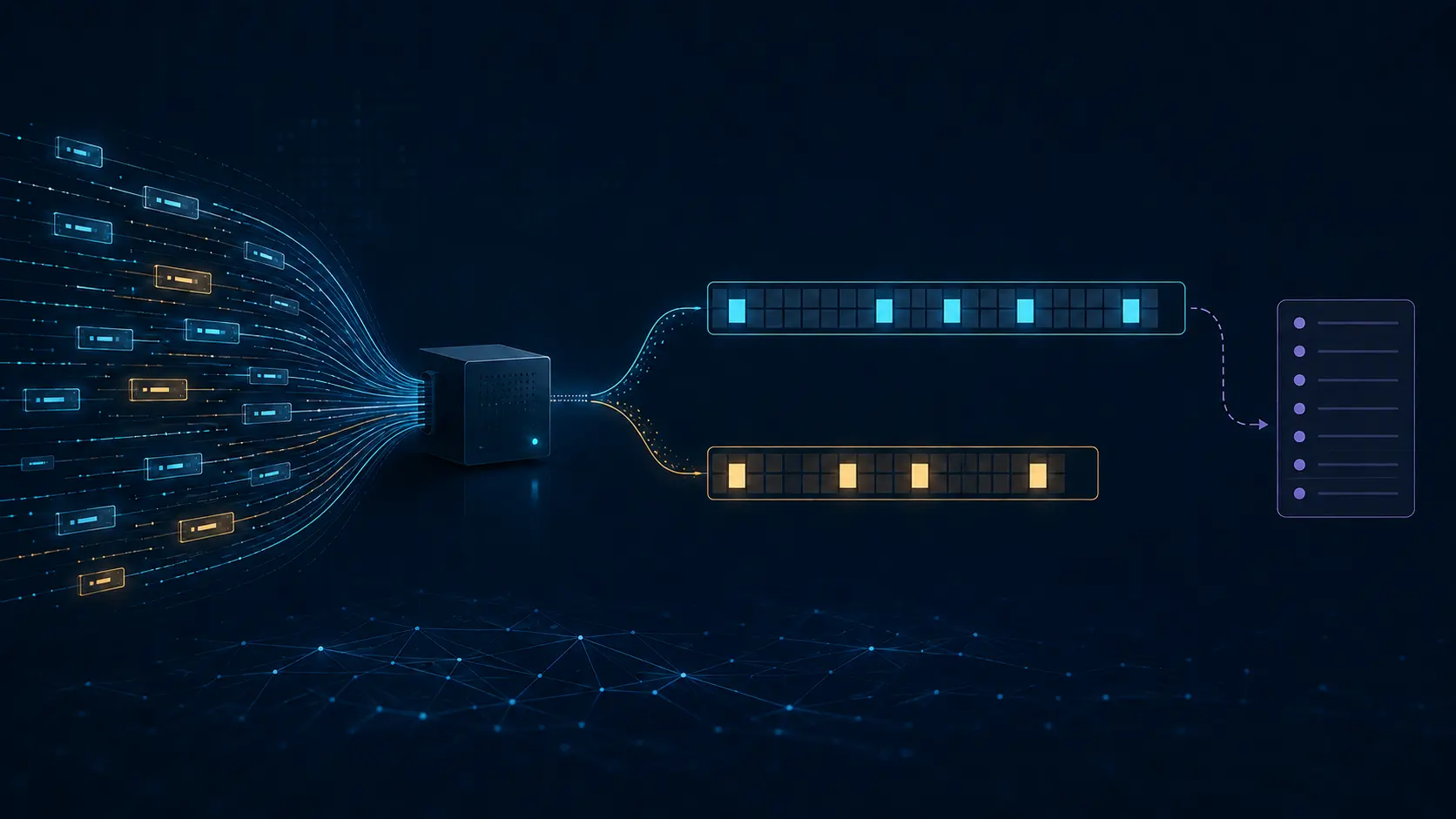
RFC 9531 defines experimental path steering for Content-Centric Networking and Named Data Networking. An ordinary Interest can request discovery. As the response travels back, forwarders assemble a path label. A subsequent Interest presents that label, and each participating forwarder reads the active Nexthop Label while also checking the name through longest-name-prefix matching in its FIB.
The mechanism is more careful than the phrase “source route” suggests. A label does not let the consumer demand an arbitrary interface. The named route still has to expose the selected nexthop as feasible. Nor is the document an Internet Standard: it is an Experimental product of the IRTF Information-Centric Networking Research Group, published to support implementation and evaluation.
The last hop may be a cache
RFC 9531’s definition contains the first authority limit. A path label identifies a route from the consumer to either a producer or a forwarder cache that can answer with the requested item. Those are operationally different responders, yet the path label does not authenticate or even necessarily distinguish them.
That is normal in ICN. RFC 8569 separates named content from a fixed network endpoint. A FIB entry can point to a local application, a local Content Store or a remote system. Content legitimacy belongs to the Content Object and its validation chain: a signature, MAC, hash relationship, weaker integrity check or, in some cases, no protection. An Interest can restrict an acceptable response by signer KeyId or object hash. Trust in that signer remains a separate decision.
The path label therefore answers a narrow question: which hop-by-hop choices were encoded for an exchange? It does not answer whether the final response came from the origin producer, which cache served it, whether the key was trusted, whether the payload was current or whether the application accepted it.
The path is observed, not advertised
Unlike a system that publishes explicit properties for a path, RFC 9531 piggybacks discovery on the Data exchange. Latency, loss, congestion and other properties are known only through observation. The label does not say “low delay”, “trusted jurisdiction” or “free of poisoned caches”. A consumer can associate measurements with a label; that association is its own evidence, measured over a particular interval and workload.
The RFC lists serious uses: multipath diagnostics, repeatable measurement, multipath congestion control and attempts to bypass poisoned caches. It also leaves decisive questions open. Will steered ping and traceroute measurements be more accurate? Will multipath performance and robustness improve? The correct status is experimental because those claims require running results, not architectural confidence.
This is where a dashboard can overstate the receipt. “Same label” is easy to display. “Same measured conditions” needs timestamps, sample size, Data identity, responder evidence and an account of what changed between exchanges.
Forwarding state can revoke the receipt
Interfaces and FIB entries move. A Nexthop Label that was feasible during discovery can later point to no valid nexthop for the requested prefix. RFC 9531 defines an invalid-path-label InterestReturn/NACK for that case. The returning error is itself updated along the reverse path so the consumer can identify which label has stopped working.
The default failure is informative but not the only behaviour. A consumer may set fallback mode, asking a forwarder to use ordinary FIB lookup when the recorded choice is invalid. Data may still return. If the consumer compares the label sent with the one returned, it can notice divergence and retire stale state.
Success under fallback is not proof that the labelled path survived. It proves that the request found another permitted forwarding action. An operations record that stores only “Data received” erases the distinction between exact steering and recovery.
Label lifetime is also a security control. The specified Nexthop Label has only 12 bits. RFC 9531 says computational hardness is not a workable defence at that size and recommends changing labels at least every few minutes. Rotation limits malicious guessing, but it also makes permanence an explicit non-goal. A token designed to expire should never become a durable identity.
Aggregation can override the consumer’s intent
Pending Interest Table aggregation creates a subtler limit. Two matching Interests can be aggregated even if their path-label TLVs or discovery modes differ. Arrival order then matters. If a discovery Interest arrives first, another Interest carrying a chosen path can be absorbed and its steering intent ignored. If the steered Interest arrives first, a later discovery request can be absorbed and fail to discover anything new.
Several simultaneous discovery attempts may therefore return one path from one Data packet rather than the independent set the callers expected. RFC 9531 recommends unique name suffixes for management applications that need to avoid this aggregation.
The lesson is not that aggregation is defective. It is that a consumer request, a forwarder’s accepted state and an observed Data return are three records. The label in the outbound Interest is not, by itself, proof that every node followed it.
Protecting the label protects steering
The security analysis considers consumers guessing Nexthop Labels to steer traffic outside paths selected by routing. An invalid-label NACK may reveal the hop at which a guess failed, improving diagnostics while helping an attacker focus the next search. Rotation and optional suppression of the hop count trade diagnostic value against that signal.
RFC 9531 also describes hop-by-hop symmetric encryption. Each forwarder can conceal the remaining stack while exposing only the active top label. No inter-router key negotiation is required in the design because each node uses its own non-shared key.
That encryption defends the steering structure. It does not authenticate the producer, validate the returned object or declare the path’s business properties. Confusing those purposes would turn a confidentiality and integrity control around a forwarding token into authority it was never built to carry.
Build the decision from separate evidence
A defensible operational receipt begins with the discovery exchange: consumer, Interest name and restrictions, discovery mode, returned Data identity, validation result, raw path-label bytes and time. It then records label protection, hop count, known rotation epoch, invalid-label or fallback events and whether PIT aggregation could have altered intent.
Responder evidence comes next. Was the item returned by a producer, local application or Content Store? Which key or object hash was checked? What trust rule connected the signer to the name? Measurement evidence follows with the sample window, RTT or loss method and enough repeated traffic to support the claimed property. Finally come local policy, decision owner, action and application outcome.
This follows Heng Lu’s separation of reality layers. A configured capability is not a packet. A packet is not an accepted forwarding choice. A returned label is not a stable path. A stable path is not a producer identity. A validated object is not authorization for an application action. The receipt becomes stronger when those layers are joined without being collapsed.
It also preserves the value of a minimum shared specification. RFC 9531 defines a portable mechanism and bounded failure behaviour. Local systems can decide how much evidence is required for diagnostics, congestion control or security without forcing one universal policy into every forwarder.
What the sources do not establish
The closed sources do not prove that a named vendor, operator or public network deploys RFC 9531. They provide no adoption count, production performance result, exploit report or evidence that path steering has prevented a real cache-poisoning incident. The academic design paper and RFC explain and evaluate a mechanism; examples remain protocol illustrations unless tied to separately observed deployments.
The boundary is the article’s conclusion, not a weakness to be edited away. RFC 9531 can preserve an executed forwarding context and make a later request more controllable. Leadership fails when that useful token is promoted into a statement about identity, persistence or outcome that the network never made.
Sources
- RFC Editor information for RFC 9531
- RFC 9531 — Path Steering in CCNx and NDN
- RFC 9531 — plain text
- RFC 9531 — XML source
- RFC Editor errata for RFC 9531
- IETF Datatracker history for RFC 9531
- Moiseenko and Oran — Path Switching in Content Centric and Named Data Networks
- RFC 8569 — CCNx Semantics
- RFC 8609 — CCNx Messages in TLV Format
- RFC 8793 — ICN terminology
- RFC 9217 — Open Questions in Path-Aware Networking
- RFC 9507 — ICN Traceroute
- RFC 9508 — ICN Ping
- RFC 7945 — ICN Evaluation and Security Considerations
- NDN Packet Format Specification
- Heng Lu — Running-Code Primacy
- Heng Lu — Minimum Initial Specification and Localized Future Decision
- Heng Lu — Reality Layers and Symbolic Power
Member Briefing
Deeper Profile Context
Sign in with the right membership level to unlock the full briefing and source notes.
Only for Strategic Circle
Strategic Circle
Open to all readers. Unlock profile briefings after joining and signing in.
Join Strategic CircleOnly for Leadership Alliance
Leadership Alliance
For qualified IP-asset owners and management; sign in to unlock alliance briefings.
Join Leadership Alliance