
Summary
- RFC 7147 placed iSCSIProtocolLevel in the attributes for an individual session, preserving the scope of the initiator–target negotiation.
- A level-2 value is protocol-state evidence, not a receipt for a successful SCSI task or an application result.
A device did not negotiate with itself
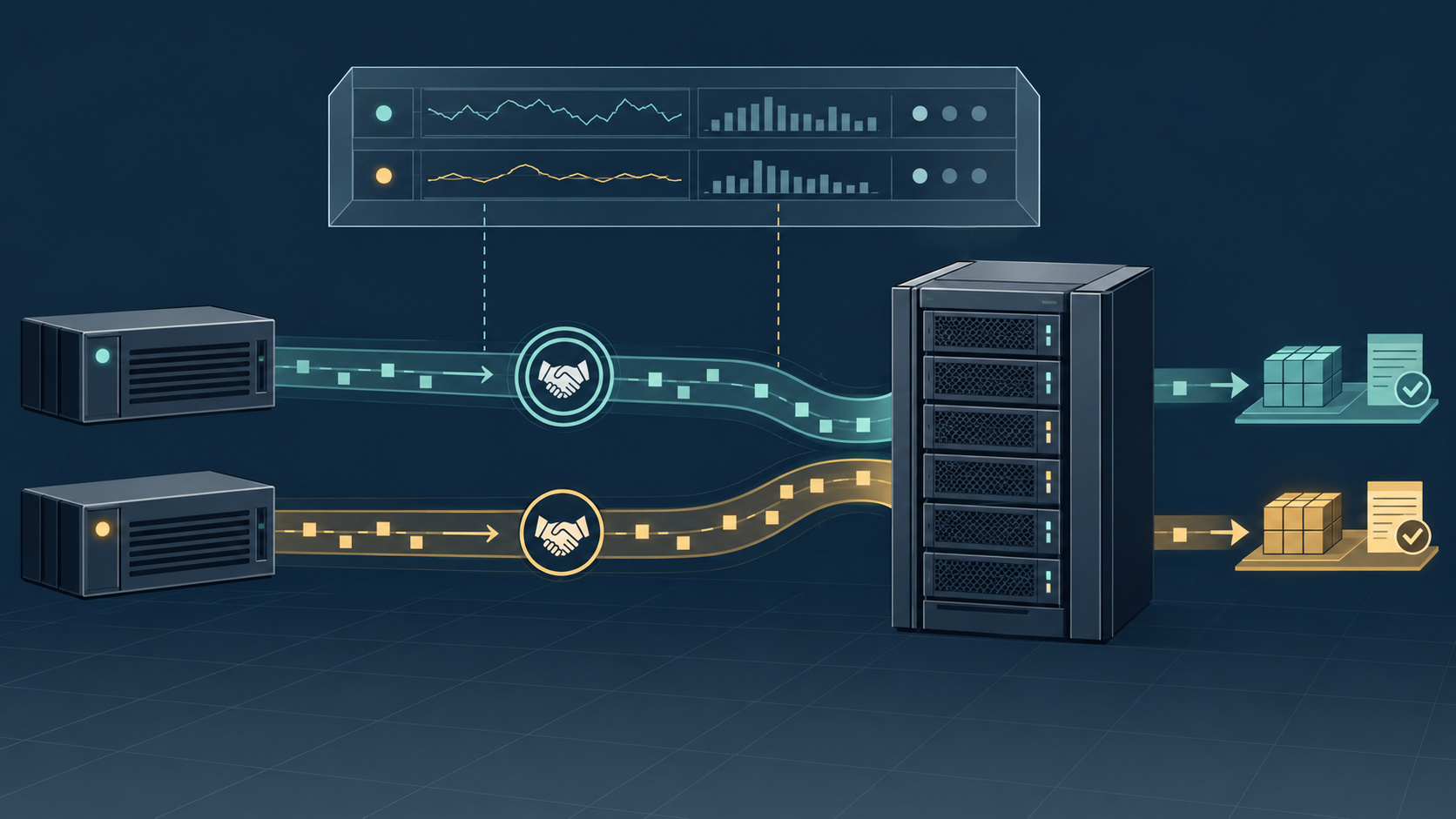
A storage dashboard often wants one reassuring label: supported, current, compatible. But an iSCSI-capable system is not one conversation. It may contain multiple instances, nodes, portals, sessions and TCP connections. Each session joins an initiator and a target. The peers negotiate protocol keys on that relationship; a different session can have a different peer, history or negotiated state.
That distinction is the useful story in RFC 7147. Published in April 2014, it replaced RFC 4544’s iSCSI management information base with an update aligned to RFC 7143 and RFC 7144. The update added two attributes to the session table: iscsiSsnProtocolLevel and iscsiSsnTaskReporting. Both are read-only. The first describes the iSCSI protocol level negotiated for that session. The second records the task-completion reporting semantics negotiated from the SCSI target.
The row is more than a convenient place to store a number. It preserves who agreed with whom. A value attached to a whole appliance would blur one initiator’s session into another’s and turn a relationship into a product claim. RFC 7147 instead follows the protocol’s own boundary: the key was negotiated for a session, so the management object is indexed with that session.
The level was an agreement, not a feature list
RFC 7144 gives level 2 a specific role. Its iSCSIProtocolLevel key must be negotiated to use the features described there. But the RFC also draws the limit explicitly: negotiating level 2 is necessary, not sufficient, for using the related SCSI capabilities. A target can still reject a particular task-management function. The initiator has to evaluate the SCSI response; a management read cannot stand in for it.
This is easy to lose when a negotiated value becomes a dashboard badge. “Level 2” can sound like a device-wide promise that every feature works. In the protocol, it is narrower: both ends of one session have agreed to the relevant protocol level. The agreement opens a path to use certain features; implementation support, the request actually sent, the target’s response and the consumer’s interpretation remain separate facts.
RFC 7147 makes the same caution visible in its second new attribute. TaskReporting is a set of negotiated reporting semantics, including the RFC 3720 baseline, ResponseFence and FastAbort. It says how task completion is to be reported. It does not say that a particular task completed, that data became durable, or that an application accepted the result.
The management tree kept the boundaries visible
The MIB starts with an iSCSI instance, then relates nodes, portals, sessions and connections. Each non-scalar object is indexed first by an instance. That instance may represent a physical or virtual partition, useful in a large or hierarchical storage system. RFC 7147 is careful that an instance does not replace an SNMP context; it offers a simple way to map a partition to one or more contexts without repeating the mapping for every row.
The architecture separates several questions that an operations team might otherwise combine. The session table can report negotiated iSCSI state. The TCP MIB describes transport connections. The SCSI MIB can cover SCSI-layer attributes. A host or application still owns its own success criteria. One management plane can help an operator move between these records, but the existence of the records does not collapse them into one proof.
That is running-code primacy at a small, practical scale. A specification matters because an initiator and target implement it, negotiate it and exchange commands. A MIB matters because it lets an operator observe defined state in that running system. Yet observation remains an observation of a specific layer at a specific time. To claim an operation worked, follow the evidence to the response and the consumer that needed it.
What the number can support
For an operator, a session-scoped level can explain why two paths to the same storage system behave differently. It can support compatibility investigation, change review and incident triage. It can also expose a mismatch between what a configuration expected and what a live session negotiated. The number is useful precisely because it does not pretend to summarize the entire device.
The limit matters just as much. RFC 7147 defines management objects; it does not report how many vendors implemented them, how frequently they were polled or whether customers relied on them. A collected value also needs its session identity and observation time. If the session has been replaced, a past sample is not proof about the current path. No RFC field can substitute for a correlated SCSI response, host record or application-level test when the question is whether a storage operation succeeded.
The durable lesson is modest and important: protocol level belongs to the agreement that created it. RFC 7147 gave that agreement a row of its own—and left the next evidence question open.
Sources
Member Briefing
Deeper Profile Context
Sign in with the right membership level to unlock the full briefing and source notes.
Only for Strategic Circle
Strategic Circle
Open to all readers. Unlock profile briefings after joining and signing in.
Join Strategic CircleOnly for Leadership Alliance
Leadership Alliance
For qualified IP-asset owners and management; sign in to unlock alliance briefings.
Join Leadership Alliance