
Summary
- Londrina’s official municipal journal records a 9 July 2014 engagement between CMTU-LD and Radioscan Telecom for radio-frequency use authorization and ANATEL station licensing, and names Renato César Barbiero as Radioscan’s partner-administrator and signatory. [1]
- The stated scope covered one repeater, one fixed central station, two mobile radios, and 30 portable radios. Those quantities define the engagement; they do not prove that authorization, installation, commissioning, coverage, or reliable operation followed. [1]
- A 2007 federal judiciary procurement record separately names Renato as a Radioscan partner-owner signatory in a purchase involving portable transceivers and accessories, supporting a dated company and radio-equipment identity without establishing a technical outcome. [2]
- Network records associate Radioscan with AS264520, list Renato as the responsible person and RCB342 as routing and abuse contact, and show an IPv4 and an IPv6 resource. A registry contact is an accountability pointer, not proof of every routing decision. [3][4]
- The durable leadership lesson is to preserve the chain of responsibility: a named signature establishes a legal act, a registry entry identifies a recorded resource holder and contact, and only separate operating observations can show what the network actually did.
Begin with the two documented roles
The strongest account of Renato Barbiero begins with two narrow, verifiable roles. In the 2014 Londrina municipal record, he appears as the partner-administrator who signed for Radioscan Telecom in an engagement concerning radio-frequency authorization and station licensing. In the number-resource record for AS264520, he appears as the responsible person associated with the organization. The first role belongs to a dated legal and commercial act. The second belongs to a registry that identifies an autonomous system holder and its contacts. [1][3][4]
Those roles are related because they attach the same person and company to two parts of communications infrastructure. Licensed radio work requires a defined applicant or contractor, a regulatory process, equipment within a stated scope, and accountable parties. An autonomous system record requires a holder, unique number resources, and contacts through whom routing or abuse matters can be addressed. Both are ways of making responsibility visible. Neither, by itself, describes the entire technical system.
This boundary matters because public infrastructure records invite inflated verbs. A signature can be rewritten as “designed,” a contract as “deployed,” a registry contact as “operated,” and an assigned resource as “delivered connectivity.” The documents examined here do not support those transformations. They support saying that Renato signed on behalf of Radioscan in the stated engagements and appears as the responsible person in the AS264520 record. They do not establish who designed the radio plan, who completed filings, who configured routers, who maintained sites, or what service users experienced.
Restrained attribution does not make the record trivial. Signatures and responsible-person fields are the points at which organizations can be asked to explain a decision, correct an entry, or route an operational question. They are especially important where public authorities, regulated spectrum, company obligations, and shared Internet resources meet. The leadership value lies in understanding what each record can answer and what evidence must come next.
What the 2014 municipal record establishes
Londrina’s official journal describes a contract dated 9 July 2014 between CMTU-LD and Radioscan Telecom. Its stated subject concerns authorization for radio-frequency use and licensing of stations with Brazil’s telecommunications regulator, ANATEL. The equipment scope is concrete: one repeater, one fixed central station, two mobile radios, and 30 portable radios. Renato César Barbiero is named as Radioscan’s partner-administrator and signatory. [1]
The equipment counts also constrain the scale of the claim. A repeater can receive and retransmit radio signals to extend or support communications over a defined operating area. A fixed central station can serve as a stationary point in a radio system. Mobile and portable radios support different patterns of use. The record’s quantities describe what the engagement covered. They should not be generalized into an account of every radio asset operated by CMTU-LD or Radioscan.
The words “authorization” and “licensing” describe regulatory objectives, not completed results. An authorization process may require technical information, spectrum coordination, applications, fees, inspections, corrections, or other steps under the applicable rules. Station licensing similarly depends on the regulator’s records and the actual status of the stations. The municipal publication establishes that the parties contracted for the stated work. It does not supply a final ANATEL decision, an installation certificate, a commissioning record, an acceptance test, or an operating log.
This distinction is essential for readers assessing public procurement. A contract is a real institutional action: money, scope, parties, and authority have been committed. It is not yet the same as regulatory approval or functioning infrastructure. A useful accountability chain therefore keeps at least four states separate: contracted, authorized, installed, and operating. Later states should be claimed only when later records show them.
Renato’s supported contribution sits at the first of those states. As Radioscan’s named partner-administrator and signatory, he can be credited with the documented act of entering the engagement on behalf of the company. The sources do not identify him as the engineer who selected frequencies, designed coverage, prepared every technical attachment, installed the equipment, or secured the regulator’s final approval. Any of those things might have involved Radioscan personnel or other parties, but the record does not assign them to him.
Why ANATEL authorization is not a ceremonial step
ANATEL is Brazil’s national telecommunications regulator. Radio systems operate in a shared physical environment: transmissions can interfere with one another even when organizations have separate equipment and purposes. Authorization and station licensing create a recorded basis for who may use which frequencies, with what equipment and under what conditions. That process is not merely paperwork attached after deployment. It is part of coordinating a scarce and interference-sensitive resource.
The operating reality remains separate. A valid licence does not ensure that equipment is powered, correctly installed, adequately maintained, or available during an incident. Conversely, equipment can emit signals before its record is complete, which creates regulatory and operational risk rather than proof of success. Good governance connects the two layers: the record should match the installed system, and the installed system should behave within the authorized parameters.
For Renato’s article, that relationship supplies a clear but limited analytical point. His signature belongs to the recorded authorization pathway. It does not substitute for a regulator decision or technical measurement. The next evidence would have to come from ANATEL status records, station identifiers, technical acceptance, maintenance history, or other dated observations. Without those, the responsible conclusion is that an engagement was signed for a defined regulatory purpose.
The 2007 procurement record adds chronology, not an outcome
A separate federal judiciary procurement record from 2007 names Renato Cesar Barbiero as a partner-owner signatory for Radioscan in a transaction concerning portable transceivers and accessories. This predates the Londrina engagement by several years and places the same person and company in another documented radio-equipment setting. [2]
It still has a strict ceiling. A procurement record can identify what an institution acquired, from whom, under which transaction, and who signed for a supplier. It does not automatically prove that every item was delivered on time, met specification, was accepted, remained in service, or produced a particular operational benefit. Those conclusions would require delivery receipts, acceptance tests, maintenance records, inventories, or user reports.
Nor should the two transactions be merged into one continuous project. The 2007 federal procurement and the 2014 municipal engagement involved different public institutions, dates, and scopes. One concerns portable transceivers and accessories; the other concerns authorization and station licensing for a specified radio system. Their proper connection is the repeated identity of Renato and Radioscan in public communications-related acts, not a claim that the later contract extended the earlier purchase.
This chronological restraint protects both accuracy and significance. The public record supports describing Renato as a company signatory across multiple dated radio-related transactions. That is a meaningful responsibility pattern. It does not support an uninterrupted biography of technical work between the dates, and it does not prove a continuous role after them. Where the record becomes silent, the narrative should become silent too.
The company and person identity bridge
Identity is the first hard problem in any person-level infrastructure account. Names can be shared, shortened, misspelled, or carried into aggregators without context. Here, the bridge rests on repeated combinations rather than on the name alone. The municipal record names Renato César Barbiero and Radioscan. The federal procurement record names Renato Cesar Barbiero and Radioscan. The corporate record associates the company’s CNPJ, 01.560.301/0001-32, with Renato as a partner-administrator.
The number-resource material identifies Radioscan as the holder of AS264520 and points to Renato through the responsible-person and RCB342 contact fields. [1][2][3][4][5]
The corporate aggregator is the weakest source family in the set for public-impact claims. Its appropriate use is narrow: confirming the legal company identifier and the listed partner-administrator relationship. It should not be treated as an independent account of Renato’s technical contribution or as proof of the company’s current operating performance. [5]
The official municipal and federal records carry the dated signatory acts. The network registries carry the current or retrieved number-resource fields. Keeping those functions separate prevents circular reasoning. A company directory should not be used to prove the contents of a public contract, and a routing registry should not be used to prove that a municipal licence was granted. Each record contributes one part of the bridge.
This is also why person-level publishing should link to the exact directory entry rather than rely on a name search. The link identifies the person discussed here. The article then shows readers the public acts that justify the subject choice. The result is not certainty about every aspect of a career; it is a reproducible explanation of why these particular documents belong to the same person and organization.
What AS264520 records
An autonomous system is a network or group of networks operated under a common routing policy and identified on the Internet by an autonomous system number, or ASN. AS264520 is recorded under Radioscan Telecom. The registry material gives a creation date of 16 December 2014, lists Renato as the responsible person, and uses the handle RCB342 for routing and abuse contact functions. It also associates the organization with the IPv4 prefix 132.255.248.0/22 and the IPv6 prefix 2804:20e8::/32. [3][4]
An IPv4 prefix represents a block of addresses in the older, widely deployed Internet Protocol address space. An IPv6 prefix represents a block in the much larger successor address space. The prefix lengths describe the size and routing boundary of each block; they are not counts of active customers, devices, sites, or services. An allocation or registration establishes a unique recorded resource relationship. It does not say how much of the block is in use or what performance it delivers.
The ASN also has a precise function. Networks use BGP, the Border Gateway Protocol, to exchange information about which address prefixes they can reach and through which paths. The ASN identifies the routing domain in those announcements and policy relationships. A registry entry makes the number and holder discoverable. It does not reveal every route announcement, upstream agreement, filter, outage, or internal configuration.
The creation date sits several months after the 2014 municipal engagement. That timing allows a chronological observation: public records place Renato in a signed radio-authorization engagement in July and place Radioscan’s autonomous-system registration in December. It does not support a causal claim that the municipal contract led to the ASN, that the same equipment carried Internet routes, or that one project financed the other. The two records show different responsibility surfaces within the same company context.
That distinction is more useful than a speculative connection. Radio systems and Internet networks can intersect through backhaul, service delivery, management, or organizational capability, but the documents here do not describe such an architecture. What they do show is that a named company representative appears in both a regulated-radio engagement and a number-resource registry. The article can analyze the accountability pattern without inventing a technical topology.
Responsible person, routing contact, and abuse contact
A responsible-person field answers a basic administrative question: whom does the registry associate with the organization or resource? A routing contact is a person or role through which questions about routing information can be directed. An abuse contact is a route for reports concerning harmful or unauthorized activity associated with network resources. These fields support coordination. They are not evidence that the named person personally performs every task that may arrive through them.
The distinction is practical in any organization. A responsible person may have authority to ensure that information remains correct without configuring routers. A routing contact may triage a report to an engineer. An abuse contact may receive complaints that require investigation by security, operations, legal, or customer-support teams. One individual can appear in several fields while work is distributed across a company.
For that reason, the RCB342 entries should be described as recorded contacts, not as a complete operations chart. They support saying that the registry points to Renato for responsibility, routing, and abuse coordination. They do not support saying that he originated every route, responded to every abuse report, selected every upstream carrier, or was on call for every incident. [3][4]
The fields are still consequential. Stale or unreachable contacts can slow incident response, complicate transfers, and leave other operators uncertain about whom to notify. Accurate contacts reduce that coordination cost. They also establish an audit trail when a resource changes hands or a contact is replaced. The registry’s value lies in maintaining a usable ledger, not in claiming authority over how the holder runs its network.
An accountable organization should therefore treat contact accuracy as an operating obligation. It should verify addresses and handles, define internal escalation, preserve change history, and ensure that reports reach people capable of acting. External observers should test only what the record promises: whether the resource and contact are accurately recorded and reachable through appropriate channels. They should not infer invisible work from the existence of the field.
Registry as ledger, not operator
Internet number registries help maintain uniqueness. Two unrelated networks cannot safely use the same public ASN or announce overlapping address resources as if both were the sole legitimate holder. The registry records who holds a number, which contacts are attached, and how changes are administered. That ledger function is foundational because routing coordination depends on stable identifiers.
The registry does not operate AS264520. It does not configure Radioscan’s routers, negotiate transit, maintain radio stations, or guarantee service continuity. Those functions belong to the resource holder and its technical and commercial relationships. Confusing the ledger with the operator leads to two opposite errors: assigning the registry credit for operating outcomes it did not create, or treating a registry entry as proof that the holder’s network is functioning well.
Running evidence is needed for operating claims. Route-collector observations can show that a prefix was visible from selected vantage points at a selected time. Looking-glass tests can show paths from particular networks. Service measurements can show latency, loss, throughput, or availability under defined conditions. Incident records can show response and restoration. None of those observations is contained in the registration fields alone.
The same logic applies to licensed radio. ANATEL records can show authorization or station status. They do not prove continuous signal quality or maintenance. A site inspection, spectrum observation, acceptance test, or incident history would be needed for those claims. Recordkeeping and operation work together, but they answer different questions.
Renato’s documented path sits at the interface. His signature makes a company obligation visible in the municipal record. His registry role makes a responsible contact visible for AS264520. The evidence stops before operating outcomes. That stopping point should be treated as useful information rather than a narrative defect: it identifies exactly where additional evidence must be produced.
From a signed engagement to number-resource continuity
Continuity is the ability of a communications service or operational function to remain available, recover, and preserve accountability through change. It depends on physical equipment, spectrum status, power, maintenance, routing, upstream connections, security, people, and records. No single signature or registry field can establish it.
Signatures nevertheless matter because continuity failures often expose unclear responsibility. If a station’s regulatory status is incomplete, who was responsible for the filing? If equipment differs from the authorized record, who approved the change? If a prefix is unexpectedly announced, who can investigate? If an abuse report is ignored, where should it escalate? Named roles make those questions tractable even when they do not answer them in advance.
The 2014 engagement shows a public customer buying a defined authorization and licensing service. That arrangement should, in principle, create deliverables, accountable parties, and a path to regulator records. The AS264520 entry shows a company attached to unique Internet number resources and named contacts. Read together, they illustrate two administrative supports for continuity: regulatory legitimacy for radio stations and accurate resource records for Internet routing. [1][3][4]
The actual continuity result remains unmeasured. The sources do not disclose whether the radio system was authorized, how it performed, whether the ASN was visible, which prefixes were announced, whether redundant paths existed, or how incidents were handled. A reliable assessment would need dates, methods, and observations for those layers.
This is where precise person-level attribution improves institutional analysis. Crediting Renato with a documented signature and registry responsibility does not reduce accountability; it points it toward the right next questions. Inflating the record into a claim of successful engineering would do the opposite. It would allow organizations to substitute biography for evidence and make it harder to identify who actually controlled each operating state.
The evidence needed to close the operating loop
For the radio engagement, the next useful records would be the corresponding ANATEL authorization and station licences, including status, dates, station identifiers, and the equipment or parameters covered. A completion or acceptance record from CMTU-LD could show whether the contracted work was delivered. Technical tests could show whether stations operated within authorized conditions. Maintenance and incident records could show continuity over time.
For AS264520, the next evidence would include dated routing observations, the prefixes actually originated, upstream relationships, reachability from several vantage points, and changes over time. Registry history could show when contacts or resources changed. Operational records could show incident handling, while independent measurements could test availability or routing behavior. The current registry snapshot should not be asked to supply those missing observations.
For person-level attribution, later documents would need to name Renato in a specific decision, implementation act, or result. A role title alone would not be enough. A dated technical filing signed by him, an institutional record assigning him an operational decision, or independent reporting on a defined action could extend the account. The evidence would still have to distinguish his action from that of Radioscan’s teams, customers, regulators, and upstream networks.
The absence of those records in this source set does not imply that the actions did not occur. It means they cannot be claimed here. This is a core discipline of infrastructure reporting: unknown is not the same as failed, and contracted is not the same as completed. Each state needs its own evidence.
Leaders can make that evidence easier to produce. Contracts can define documentary deliverables. Regulators can expose status with appropriate safeguards. Network holders can keep registry contacts current and preserve change history. Public customers can publish acceptance records. Operators can document incidents and corrective actions. These practices turn a chain of names into a chain of accountable states.
Reading dates without inventing causation
The public chronology has three visible points: a 2007 procurement signatory record, the July 2014 municipal engagement, and the December 2014 creation date associated with AS264520. [1][2][4] The sequence shows repeated Renato-Radioscan responsibility in communications contexts. It does not show that one event caused the next.
The temptation to infer causation is strong because the July and December 2014 dates are close. A company engaged in radio authorization work may also operate an Internet network, and an ASN may support a telecom business. Yet the records do not connect the municipal equipment to AS264520, describe a network architecture, or state that the contract prompted a number-resource request. A careful account therefore uses “later” rather than “because.”
This language preserves analytical value. The chronology shows an organization moving across or participating in multiple communications responsibility surfaces. It invites questions about how licensed radio operations, Internet routing, corporate accountability, and public procurement interact. It does not answer those questions with a causal story that the documents never tell.
Dates also prevent current fields from rewriting earlier roles. A current or retrieved registry contact cannot be projected backward to prove that Renato controlled routing in 2007 or July 2014. Conversely, a 2014 signature cannot prove his present employment or responsibility beyond what current records state. Each claim should carry the date and source that support it.
Image disclosure
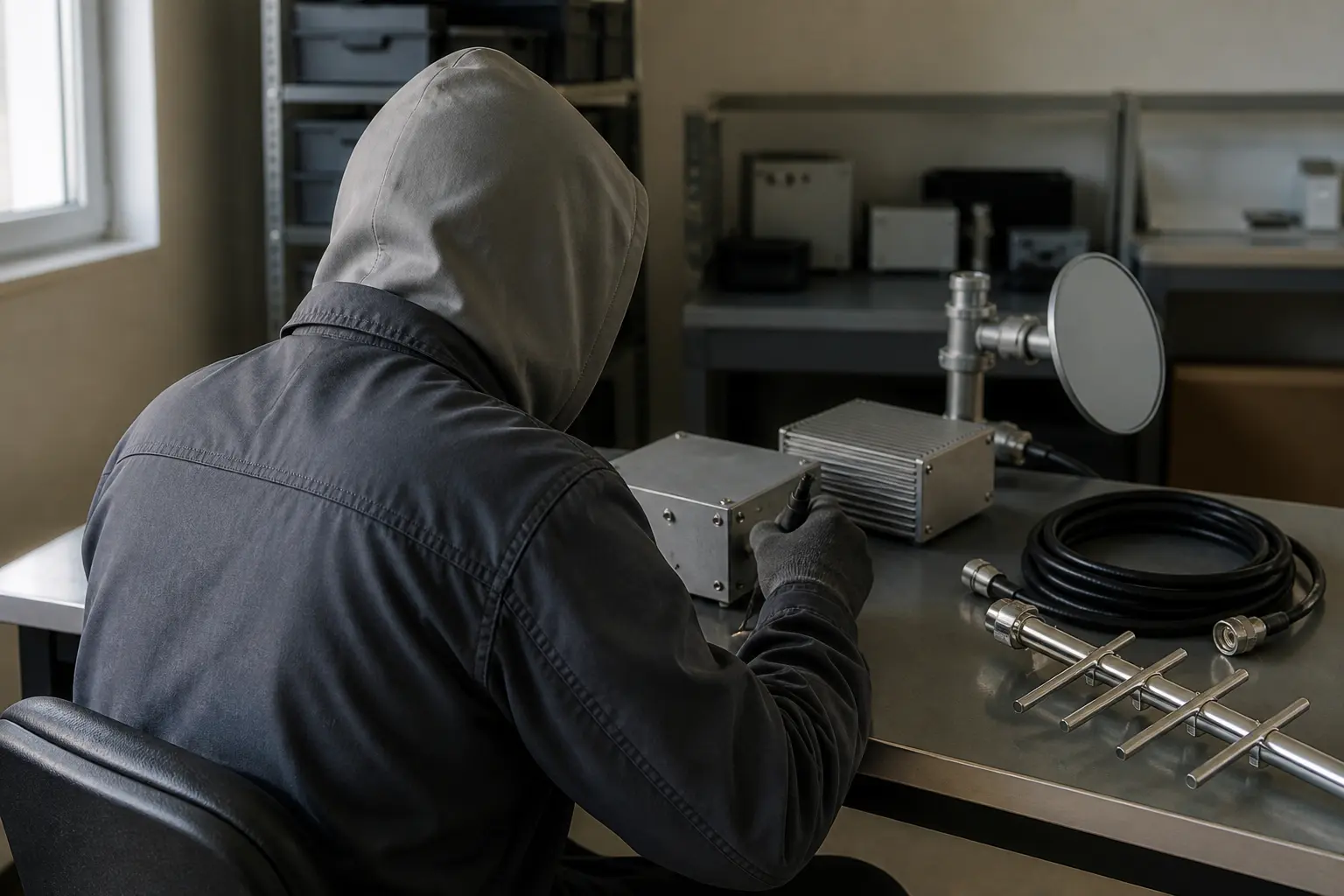
The accompanying image is an AI-generated photorealistic editorial scene of a fully concealed anonymous worker viewed from behind at an unlabeled radio-frequency workbench. It is not a photograph or likeness of Renato Cesar Barbiero, and it does not document the 2007 procurement, the 2014 engagement, an ANATEL procedure, the operation of AS264520, or any other real event. Its purpose is only to illustrate a generic radio-frequency planning context without making a claim about Renato’s appearance or a specific workplace.
Sources
- Município de Londrina, Jornal Oficial 2477, contract record concerning CMTU-LD and Radioscan Telecom, 2014. https://www2.londrina.pr.gov.br/jornaloficial/images/stories/jornalOficial/jornal_2477_assinado.pdf
- Tribunal Regional do Trabalho da 10ª Região, federal judiciary procurement publication naming Renato Cesar Barbiero in a Radioscan transaction, 2007. https://docs.trt10.jus.br/docs/pub/pub000001424.pdf
- RDAP.org, AS264520 registration record. https://rdap.org/autnum/264520
- IPGeolocation, AS264520 registry mirror and resource fields. https://ipgeolocation.io/browse/asn/AS264520
- CNPJ.biz, Radioscan Telecom corporate record, CNPJ 01.560.301/0001-32. https://cnpj.biz/01560301000132
Member Briefing
Deeper Profile Context
Sign in with the right membership level to unlock the full briefing and source notes.
Only for Strategic Circle
Strategic Circle
Open to all readers. Unlock profile briefings after joining and signing in.
Join Strategic CircleOnly for Leadership Alliance
Leadership Alliance
For qualified IP-asset owners and management; sign in to unlock alliance briefings.
Join Leadership Alliance