Summary
- RFC 1459 let an IRC prefix name a message's protocol source, but the receiving server had to resolve that name in its own database and verify that it belonged behind the incoming link.
- A nickname, a registered client record, a matching server-tree branch and an admitted message were distinct facts. None of them identified the human who typed the text or proved that a remote reader saw it.
- The rule was enforced locally and often silently. It protected the distributed source graph while making missing-message diagnosis depend on state and timestamps outside the message itself.
The most important evidence was not in the line
The message could be perfectly formed. It could begin with the expected colon, carry a legal nickname, name a valid command and end within the protocol's 512-character limit. Those facts established syntax. They did not establish provenance.
RFC 1459, published as an Experimental protocol in May 1993, described an Internet Relay Chat network as a tree of servers. Clients connected to one server; servers relayed messages to one another; each server kept enough shared state to locate clients and route traffic through the tree. The design had grown from a BBS chat system into a worldwide network. Its apparently simple text lines therefore traveled through a distributed identity system.
The optional prefix sat at the front of a line. Its grammar admitted a server name or a nickname, possibly accompanied by user and host components. The specification called this the message's origin. But it did not instruct the receiving server to believe any name appearing after a colon.
If a message arrived without a prefix, the server inferred that it came from the connection carrying it. If a client supplied a prefix, that prefix could only be the client's registered nickname. Most importantly, the server had to compare the named source with its internal database. An unknown source, or a source registered behind a different link, made the message inadmissible. RFC 1459 required the server to ignore it silently.
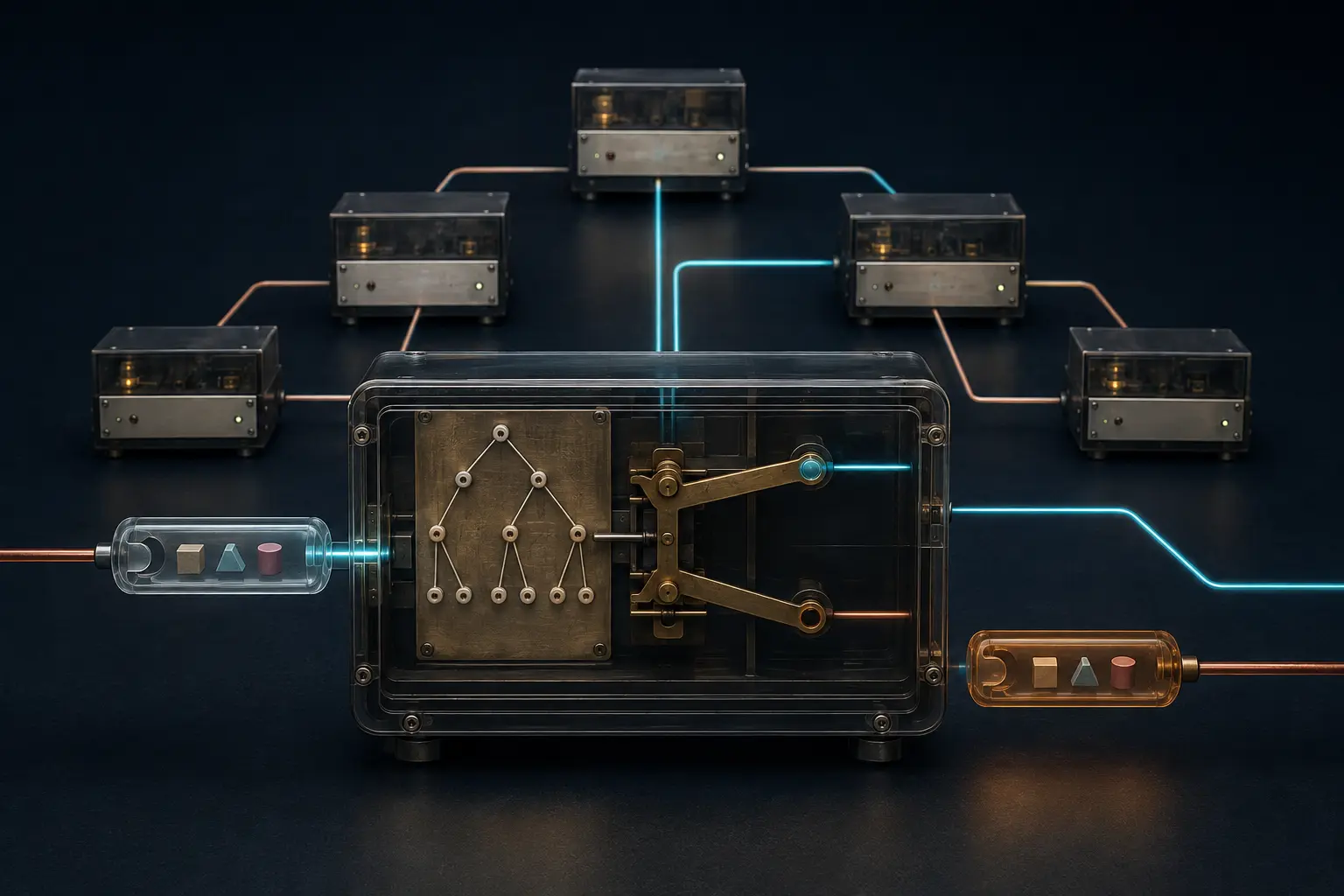
That one comparison separated three records. The first was the sender's inscription in the message. The second was the server's current record of which source names existed. The third was the topological relation between each registered source and the server link behind which it was known. Only when the records aligned could the prefix do useful routing work.
“True origin” meant a bounded protocol fact
The phrase can be read too broadly. RFC 1459 did not offer a universal proof of authorship. It checked whether the protocol source named in a message was consistent with the receiving server's IRC state and the connection from which the message arrived.
That is valuable. A client on one socket could not merely place another registered nickname in the prefix and expect the server to relay the line. A neighboring server could not safely project a known source from the wrong branch. The check defended the server tree's source graph.
Yet the graph ended well before the human. A nickname was an identifier assigned inside the current IRC network state. The server also held a username, host information and home-server relation, but RFC 1459 acknowledged the limits of learning who was at the other end of a network connection. Hostname checks, optional connection passwords and Ident lookups supplied additional signals. They did not turn the nickname into a permanent civil identity or a cryptographic signature over each message.
The honest reading is therefore narrow: the prefix could identify the message's registered IRC source under the server's current view. It did not prove who sat at the keyboard, whether an account or host had been compromised, whether the text remained confidential or whether a reader interpreted it as intended.
A unique nickname was maintained state, not ownership
RFC 1459 required each client to have a nickname unique across the network. That uniqueness was operationally necessary because servers used nicknames to locate clients and route replies. It was also fragile.
When a server learned an identical nickname for another client, the specification called it a collision. The response was not to decide which person had a stronger claim to the name. Servers removed all instances of the nickname and propagated a KILL so that the conflicting state disappeared across the network. A directly connected client could receive a local collision error instead.
This reveals what uniqueness meant. It was a property of the replicated namespace at a moment in time. It was not proof of long-term possession, human continuity or priority outside the protocol. A user could change nickname or leave. A later user could appear under the same string. A WHOWAS query searched recent nickname history, but a historical row did not turn the name into an identity certificate.
The protocol even retained nickname-change history for a limited operational reason: commands such as KILL, MODE and KICK could race with a change and otherwise affect the wrong client. The history reduced risk but did not eliminate it. RFC 1459 explicitly recognized that the wrong client could still be affected.
The tree made local knowledge consequential
An IRC server did not consult a single central registrar for every line. It used its own view of the distributed network. That made the prefix check fast and enforceable at the receiving hop. It also made state consistency part of the trust boundary.
If two server regions split, each side continued with a smaller view. Channels and membership could differ. When the link returned, servers exchanged what they believed about users, channels and modes. A prefix arriving during or after such a transition was judged against a local database whose history mattered.
The message alone could not explain the decision. To reconstruct a silent discard, an operator would need the arrival time, the incoming connection, the prefix, the local source record, the link behind which that source was registered and the action taken. A later database snapshot might show a perfectly consistent network and still fail to reproduce the earlier mismatch.
That is the deeper significance of the rule. Provenance was relational. The name was acceptable not because it had an intrinsically trustworthy spelling but because it matched a live relation in the receiving server's topology model.
Later documents separated the same mechanism more sharply
In 2000, the IRC specification family was divided into architecture, client and server documents. RFC 2810 described a distributed model in which every server maintained a copy of global state and called that replication a serious limit on network size. The admission test depended on that state; scaling the network meant scaling the evidence needed to apply it.
RFC 2812 retained the client-side rule. Servers used the prefix to indicate origin, absence meant the current connection, and a client that supplied a prefix could use only its registered nickname. It preserved the distinction between a line's optional source field and the connection that supplied default provenance.
RFC 2813 made the server consequences explicit. If the receiver could not find a prefix in its database, the message had to be discarded; an unknown server prefix could cause the link itself to be dropped. If the prefix named a source registered behind another link, the message was discarded in every case, while the protocol could also KILL the client or close the offending link. The source claim did not merely decorate a chat line. It could change the fate of a network relationship.
The later server document also exposed identifier scope elsewhere. Server tokens were unique only on one point-to-point peering connection, not across the world. A number could be correct on one link and meaningless on another. The prefix check followed the same discipline: interpret an identifier inside the relation that gives it force.
A maintained erratum changed one byte, not the model
RFC 1459 printed the colon's hexadecimal value as 0x3B, which is the semicolon. The character itself and the grammar made the intended delimiter clear, and verified erratum 4091 corrected the value to 0x3A.
The error is small but instructive. A static document can carry a mistaken numeric statement while interoperating software uses the intended character. The maintained erratum is a separate record. Neither the original text alone nor deployed parsing alone tells the complete history. Protocol evidence includes specification, correction and running behavior, each with its own date and authority.
Encryption would protect another boundary
RFC 1459's connection checks were modest. Passwords were optional for clients and recommended for inter-server links; the document noted the difficulty of reliably determining who was on the other end without them. The later server specification observed that PASS and OPER traveled in clear text and suggested a stream-encryption layer. RFC 7194 eventually registered a default port for IRC over TLS.
None of that makes transport protection irrelevant. Encryption can protect credentials and message contents against observers on the covered connection, while peer authentication can strengthen the identity of the endpoint. But it answers a different question from the prefix rule. A protected link can still carry a prefix inconsistent with the server's database. A correct prefix can travel over an unprotected connection. An assigned TLS port does not prove that any particular network enabled TLS, verified a certificate or delivered one message.
RFC 1459's durable lesson lies in preserving those differences. The prefix was a claim. The database supplied a named object. The incoming link supplied custody. The local server made an admission decision. The tree performed forwarding. The client might receive and display the text. A human might read it. Collapsing that chain into “the sender was verified” would erase the very control the protocol implemented.
Member Briefing
Deeper Profile Context
Sign in with the right membership level to unlock the full briefing and source notes.
Only for Strategic Circle
Strategic Circle
Open to all readers. Unlock profile briefings after joining and signing in.
Join Strategic CircleOnly for Leadership Alliance
Leadership Alliance
For qualified IP-asset owners and management; sign in to unlock alliance briefings.
Join Leadership Alliance