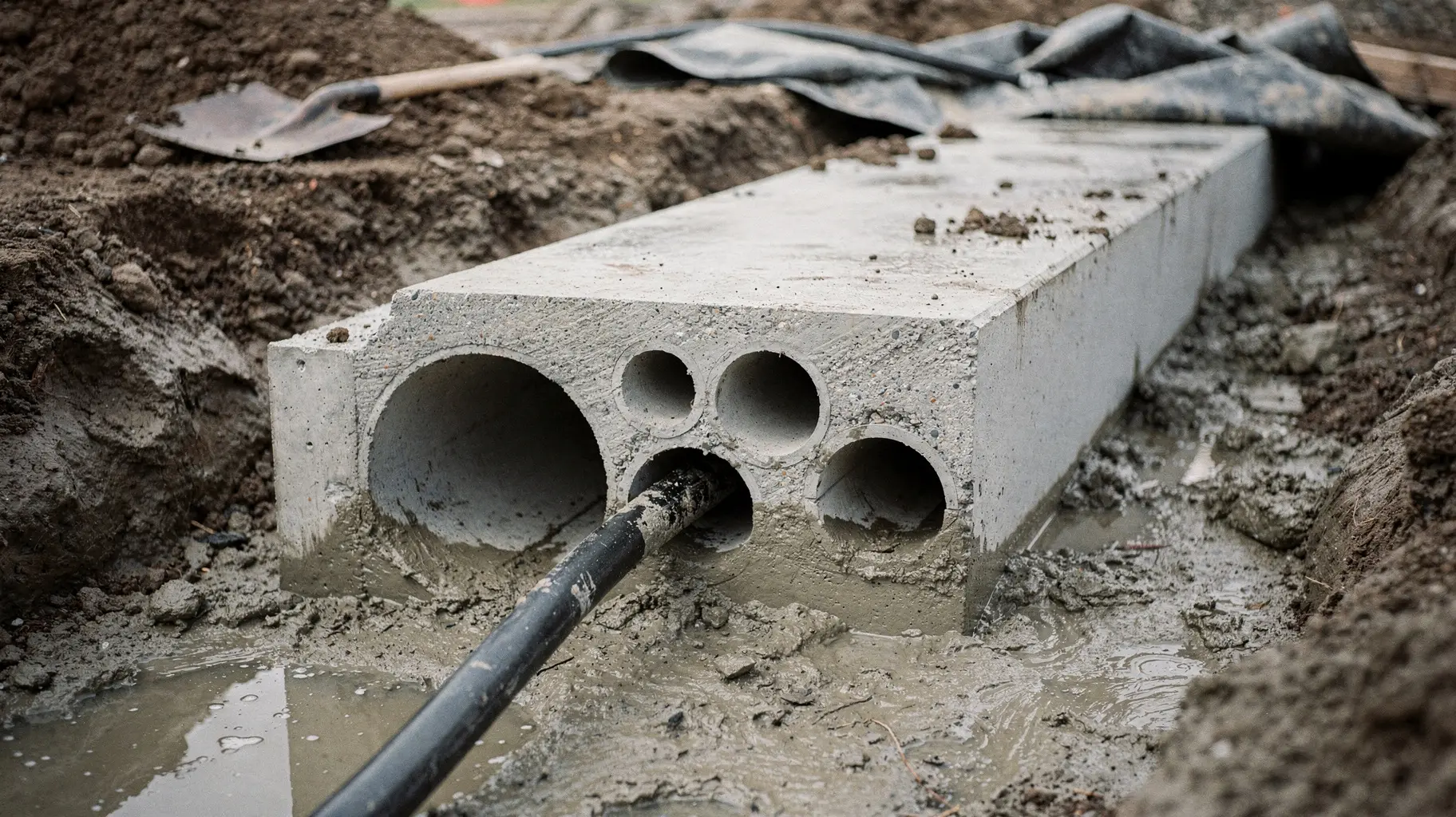
Summary
- Openreach prices spine duct at £0.37 per metre per annum on a single-bore route, £0.26 on a two-bore route and £0.18 on a route of three or more bores, all operative from 1 April 2024 with a five-year minimum licence period — and the bore count is a fact about the route that the rate card cannot supply.
- The July 2024 PIA conditions start the fee clock at the Licence Completion Date for spine duct and poles, calculate fees from the Network Plans, and bill monthly in advance; the section headed "Forecasts and capacity" sets customer forecast thresholds at more than 25 kilometres of spine duct and any pole, and states no test for whether a duct can take another cable.
Britain rents out the physical layer of its telecoms network by the metre. Openreach (Openreach) publishes the schedule as two product tables, one for duct and one for poles, and the duct table gives three annual rates for the same metre of spine duct: £0.37 where the route holds a single bore, £0.26 where it holds two, £0.18 where it holds three or more. Every one of those rows carries an operative date of 01/04/2024, an empty end date, and a minimum licence period of five years (Duct Products).
The metre is measured on the buyer's cable
The unit is not the duct. The notes attached to those rows define the rental unit as a metre of direct cable, blown fibre tubing or sub-duct up to 25 millimetres. What Openreach charges rent on is the buyer's own apparatus, measured where it sits inside the duct.
Then there is the band. The notes state that the two-bore rate applies to a route containing two bores and the three-plus rate to a route containing three or more. So the metre being priced is the buyer's cable, and the rate applied to that metre is set by the route the cable runs through. Two cables of the same length in the same duct can pay different rents per metre, because the band is a property of the route and the unit is a property of the cable.
That is the whole of the published variation inside a duct price. Nothing else separates the three rows: not the cable type, not the customer, not the term, not the volume. The term is five years on all three.
One line quietly changed what it was counting
The lead-in line is where the schedule stops pricing length. "Facility in Lead-in duct per metre" carries an operative date of 01/07/2021 and a charge of Withdrawn. What replaced it is "Simplified Underground PIA Lead-in" at £11.64 per annum per end-customer connection, operative from 01/04/2024 (Duct Products).
Read those two rows together and the unit of sale has moved: a metre of duct in the ground became a premises at the end of it. A metre and a connection are not the same quantity, and the schedule prints no conversion between them. Spine duct is still sold by length. The lead-in is now sold by the customer it reaches.
A pole is four prices and a sum
The pole table prints four annual charges, all operative from 01/04/2024: £6.60 for a multi-end-user attachment with a five-year minimum licence period, £2.58 for a single-end-user attachment with no minimum period stated, £1.94 for pole-top equipment with a five-year minimum, and £1.29 per cable up a pole, also with a five-year minimum (Pole Products).
The notes add that a separate charge is levied for each cable running down or up a pole. So one pole carrying one cable and a multi-end-user attachment is £6.60 plus £1.29, which is £7.89 a year — my addition, not a figure the schedule prints. Multiply the attachment alone across its five-year minimum and £6.60 becomes £33.00, again my arithmetic.
There is no single licence price anywhere on the page. The schedule states that the Licence Fee per annum is calculated by adding together the relevant Duct and Pole Products with the Ancillary Fees, and gives Customer Apparatus In-line Splice hosting and distribution joints as an example of the latter. A licence is a sum of lines, assembled per route.
The clock starts on a completion date, not an order
The conditions that govern the product are a separate document from the price, and they carry the timing (Conditions, July 2024). Clause 19.4 puts two different triggers in one sentence: licence fees commence on the Licence Completion Date for Spine Duct and Poles, and from the Customer's use for Lead-in Duct and drop wires from Poles. Clause 19.5 says fees are calculated from data in the Network Plans at those commencement points, or may be amended under the missing-inventory process before those dates.
Around that sit the mechanics. Clause 19.1(c) puts fees on BT's billing cycle, payable monthly in advance, with BT sometimes billing in arrears. Clause 19.3 makes the customer liable for charges on work it orders. Clause 11.12 bars work until the customer has given the required notice and information and holds a valid, complete order for that location that BT has received and acknowledged. Clauses 19.13 and 19.14 let BT require a deposit, guarantee or advance payment amounting to the greater of three months' estimated charges or the reasonable cost of removing the customer's apparatus — and refuse orders until it is provided.
So the tariff prints an annual rate and a five-year minimum, while the contract prints the date the annual rate begins and a process by which the estimate behind it can be amended for missing inventory. Both documents are Openreach's. They are not reconciled to each other here.
The word capacity belongs to the buyer
The conditions contain a section headed "Forecasts and capacity." Its operative provisions are customer forecasts and thresholds: more than 25 kilometres of spine duct, and any pole. In the retrieved text there is no method for determining whether an individual duct has capacity for an additional cable, no one identified as making that determination, and no capacity-insufficiency ground for refusing access. The refusal mechanisms the retrieved text does locate concern breach, Ofcom suspension, unsuitable personnel, and advance-payment or credit-vetting matters.
The buyer therefore receives a precise rent for a metre of occupancy, and the question that decides whether the occupancy is possible at all — will it fit — sits outside the four corners of what was read. That is not a small gap in a schedule. It is the gap between a price and a purchase.
The arithmetic, and what it does not say
The difference between the single-bore and three-plus rows is £0.19 per metre per year; the three-plus rate is 48.6% of the single-bore rate, or 51.4% lower. A kilometre of spine duct costs £370, £260 or £180 a year across the three bands, a spread of £190 per kilometre per year. One metre held for the five-year minimum comes to £1.85, £1.30 or £0.90. The multi-end-user pole attachment is 2.56 times the single-end-user attachment.
All of that is arithmetic on printed figures, and none of it is a published rate of change, a margin or a cost of connecting anything. The bands tell you that a route with more bores is cheaper per metre. They do not tell you who pays which band until someone has counted the bores.
What this record does not establish
Both price tables could not be opened on 13 November 2026 — the pages timed out or returned HTTP 503 — so every rate above is Openreach's search-indexed table text rather than text read off a fetched page, and the footnote numbers printed beside the rows were not resolved to their footnote text. The July 2024 conditions parsed to 1,854 lines with the main text available; later schedule pages exposed headings without substantive text, so schedule content is unread, and only that version was read, with no earlier or later version compared. No Product Description, survey specification, ordering system, price-change notice or regulatory statement was read. Nothing here establishes that any buyer was refused, delayed or mischarged, or that capacity is being withheld. No comparison is drawn with any other country's duct or pole regime, no annual per-metre rate is converted into a connection cost, a build cost or a margin, and no route length is assumed beyond the one-kilometre illustration labelled as arithmetic. The five-year minima are what the tariff rows print and the fee-commencement rule is what the conditions print; the two instruments are not reconciled here. The pricing index displays an issue date of 06/12/2022 for both product entries while the linked tables carry rows operative from 01/04/2024, both reported as printed (Pricing index). The absence of a capacity test is scoped to the retrieved text of the July 2024 conditions and to the schedule pages that could not be read. No revenue, volume, duct-kilometre total, customer count or market-share figure is asserted.
The price of a metre of spine duct is published to the penny, in three bands, with the term printed beside it. The fact that decides which band a buyer pays — how many bores run between two points — is not on the page, and in the conditions the word capacity is a forecast the buyer owes, not a finding the seller makes. Britain has published the rent on its ducts. It has not published the room.
Member Briefing
Read the full trend briefing
Members read the full briefing with the source notes behind every finding.
Strategic Circle
A daily briefing in your language, built from changes we have verified.
Join for USD 20/monthCancel anytime.
Members also get the full research library, a daily briefing on the networks they follow and the private forum.