
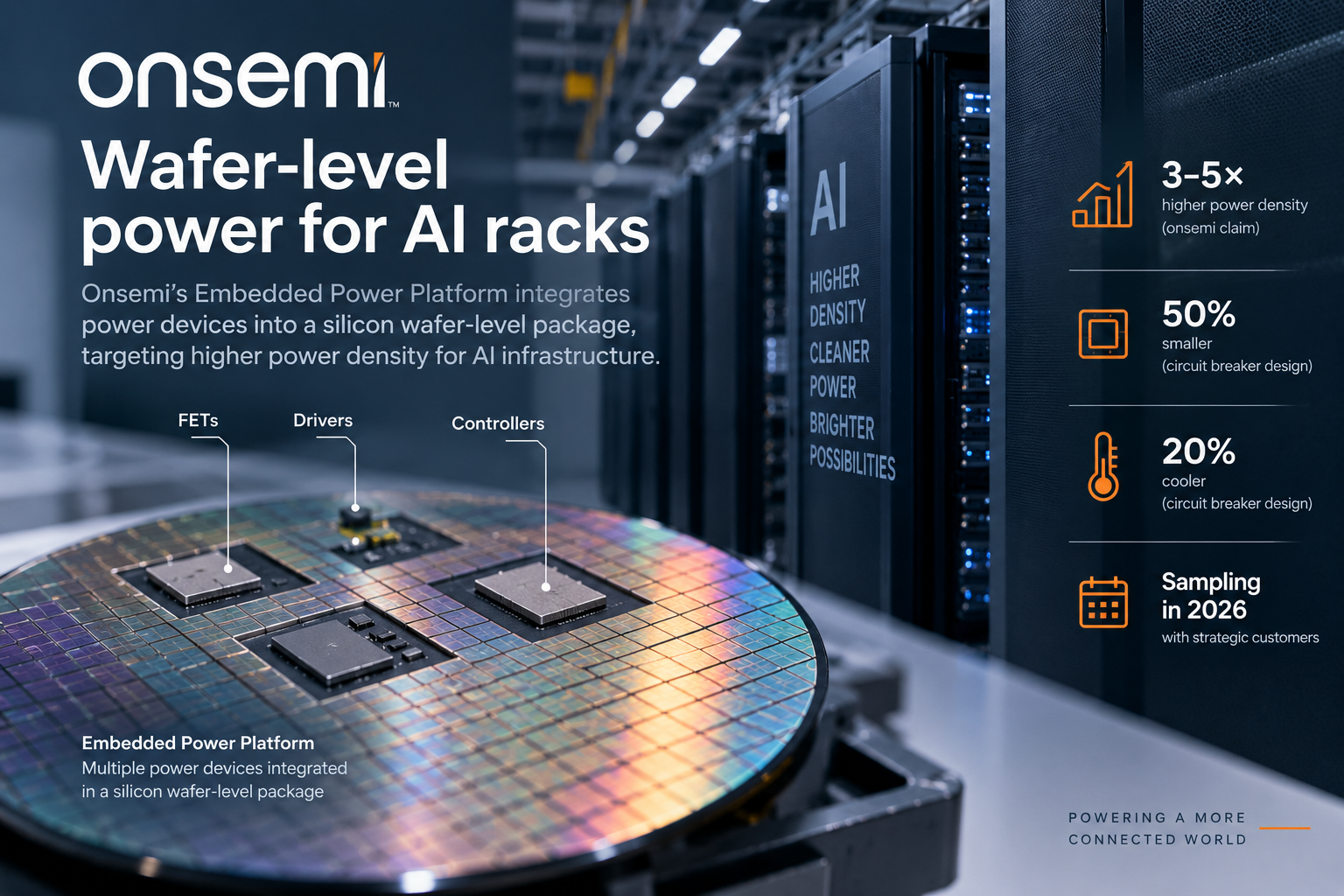
- Onsemi has introduced an Embedded Power Platform that integrates multiple power semiconductor devices within a silicon wafer-level package
- The company says the architecture can increase power density as AI servers require more electricity and leave less space for power-delivery hardware
The fact
Onsemi has introduced its Embedded Power Platform, or EPP, a packaging architecture designed to integrate power semiconductor devices more tightly for AI, automotive and other high-power applications.
The company creates cavities in a silicon platform and embeds semiconductor dies within them, allowing devices including FETs, drivers and controllers to be combined in the same structure. Wafer-level redistribution layers replace conventional wire-bond connections, which onsemi says reduces electrical parasitics and improves thermal performance. The architecture can incorporate silicon, silicon carbide and gallium nitride devices.
Onsemi claims EPP can deliver three to five times greater power density than conventional approaches. Its first disclosed EPP-based solid-state circuit-breaker design is about 50% smaller and runs 20% cooler than existing designs, according to the company. Sampling with selected AI, automotive and ecosystem partners is expected during 2026.
The assessment
The immediate problem for AI infrastructure is not simply supplying more electricity to the rack. As rack power rises, the converters, protection devices and controllers handling that electricity also consume board space and produce heat.
EPP attempts to reduce that overhead by packing several power functions more tightly and shortening electrical connections inside the power module. That could give server and power-system designers more room to handle higher rack densities, but onsemi has not yet demonstrated the resulting efficiency or space savings in a production AI rack.
The effect on data-centre operators is therefore indirect. They cannot retrofit the packaging architecture into existing servers; it has to be designed into future power systems and computing platforms. For BTW readers, EPP matters only if server and power-system manufacturers turn its package-level density gains into smaller or cooler rack power hardware. Onsemi's current results do not yet establish that outcome in production AI systems.
What to watch
Watch for named AI server or power-system design wins as EPP samples during 2026, followed by production availability and measured efficiency under realistic loads. Rack-level thermal tests will matter more than package-density claims alone, particularly if vendors show that smaller power hardware allows more compute within the same electrical and cooling envelope.
Member Briefing
Deeper Profile Context
Sign in with the right membership level to unlock the full briefing and source notes.
Only for Strategic Circle
Strategic Circle
Open to all readers. Unlock profile briefings after joining and signing in.
Join Strategic CircleOnly for Leadership Alliance
Leadership Alliance
For qualified IP-asset owners and management; sign in to unlock alliance briefings.
Join Leadership Alliance