
Summary
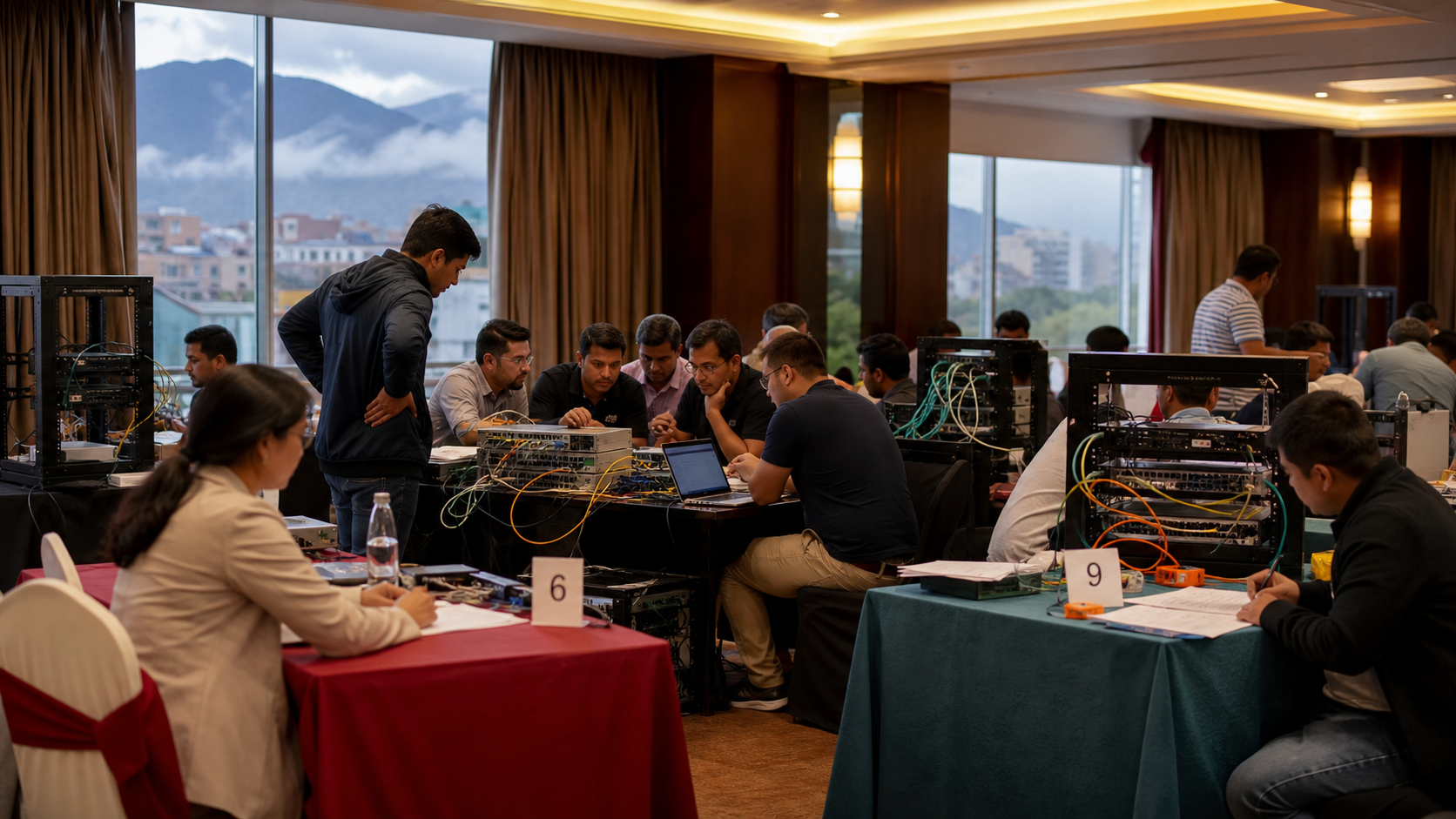
- The evidence describes one hybrid week at the Kathmandu Marriott: workshops from 18 to 21 July and a conference on 22 July 2022, not two competing events.
- Contemporary SANOG pages called the Nepal component “npNOG 9”, while npNOG’s history, APNIC and a local post-event report support “npNOG6”. Edition 6 is the stronger intended label, but no official correction of the SANOG record was found.
- Published responsibilities were distributed: SANOG’s Programme Committee had the clearest programme-change authority; NPIX and npNOG were identified as hosts; NPIX handled the clearest local interface; the online-registration surface sat under the SANOG domain; and fellowship decisions had a separate committee surface.
One room, two ledgers
The simplest fact is also the most important. The surviving schedules, venue material and reports describe one programme: four workshop days followed by a conference day in Kathmandu. Participants could reasonably regard this as a single week of training, exchange and regional networking. Nothing reviewed supports a second July event running alongside it.
The number attached to the Nepal component is less settled. SANOG’s contemporary archive repeatedly presents “npNOG 9”. npNOG’s own retrospective chronology calls the same week “npNOG6”; APNIC’s wrap and NepaliTelecom’s report do the same. That convergence makes edition 6 the best-supported intended label. It does not turn “9” into a proven typo, because the reviewed material contains no published SANOG correction. The disagreement is therefore a disputed institutional record, not a licence to choose whichever number is convenient.
Authority was layered
The public pages expose a co-production rather than a merger. SANOG’s Programme Committee was the clearest published authority for programme changes. The SANOG footer named NPIX and npNOG as hosts. NPIX provided the local registration and venue contact and was described in reporting as lead host, while online registration ran through rego.sanog.org. Fellowship selections appeared under a separate SANOG committee, and sponsor tiers were published separately.
Those interfaces matter because “host” is not a complete governance description. A participant may encounter one badge, one venue and one timetable while different bodies control the agenda, applicant decisions, payment collection, personal data and later corrections. The record lets us see several of those surfaces; it does not reveal the contracts beneath them.
NPIX says it is a Nepal-registered non-profit company. No independent registry extract was reviewed, and that self-description cannot be transferred to npNOG or SANOG. The evidence does not identify the legal persons behind those names, the venue signatory, the final payee or merchant of record, the revenue split, refund and liability allocation, or the controller and processor of participant data.
Access was priced; support was bounded
The published schedule priced the full week at USD 200 or NPR 20,000, the workshop at USD 150 or NPR 15,000, and the conference at USD 50 or NPR 5,000. It advertised a 15% early-bird discount and, after the deadline, a 10% discount for named members. These figures establish an access structure, not who ultimately received or retained the money.
Seven first-round fellows were listed. The published package capped airfare support at USD 500 and excluded registration and visa fees. The record does not establish actual payments, attendance by every named fellow, later rounds, the applicant denominator or scoring, or subsequent professional outcomes. APNIC’s listing as both Diamond and Fellowship Sponsor proves a declared sponsorship role, not agenda influence or institutional capture.
Attendance is similarly bounded. One workshop page stated a maximum of 30 delegates; APNIC later reported more than 40 participants. The figures may describe different measures, and neither is total attendance for the week. The attendee page says it is partial, while the old API now returns an empty dataset. That present response cannot reconstruct the 2022 audience or prove why records changed.
Useful engineering, unproved deployment
The programme documents substantive work on IPv6, RPKI, MANRS, peering, automation, monitoring and security. It is reasonable to infer that pooled sponsors, external trainers and a shared venue widened access to expertise. No reviewed source, however, proves that the week caused a specific production deployment or network outcome.
Fine-grained attribution matters when it changes who could alter the programme, admit or fund participants, collect money or data, correct the record, or bear liability. It is not an argument against joint events. The Kathmandu week shows that a coherent participant experience can be produced by overlapping institutions; it also shows why durable records should state which institution owns which decision.
Sources
- https://npnog.org.np/
- https://www.sanog.org/sanog38/
- https://www.sanog.org/sanog38/program.html
- https://www.sanog.org/sanog38/reg.html
- https://www.sanog.org/sanog38/fellowship.html
- https://www.sanog.org/sanog38/footer.html
- https://www.sanog.org/resources/sanog38/SANOG38_Conference-Rupesh_SANOG-Update.pdf
- https://www.sanog.org/sanog38/venue.html
- https://www.sanog.org/sanog38/attendee.html
- https://rego.sanog.org/api/v1/attendee/list/sanog-38/
- https://lists.npnog.org.np/pipermail/npnog/2022-May/000160.html
- https://blog.apnic.net/2022/08/03/event-wrap-sanog-38-npnog-6/
- https://nsrc.org/calendar/helpfiles/workshop_info_main.php?id=2158
- https://nsrc.org/workshops/2022/sanog38-riso/sponsors.html
- https://www.nepalitelecom.com/2022/07/sanog-38-with-npnog-6-conference-held.html
- https://techsathi.com/south-asian-network-operators-group-sanog-38-meeting/
- https://www.fiscalnepal.com/2022/07/18/9788/international-workshop-and-conference-on-information-and-technology-in-kathmandu/
- https://www.npix.net.np/about
- https://npnog.org.np/npnog7/committee/
- https://www.sanog.org/sanog38/nmms.html
Member Briefing
Deeper Profile Context
Sign in with the right membership level to unlock the full briefing and source notes.
Only for Strategic Circle
Strategic Circle
Open to all readers. Unlock profile briefings after joining and signing in.
Join Strategic CircleOnly for Leadership Alliance
Leadership Alliance
For qualified IP-asset owners and management; sign in to unlock alliance briefings.
Join Leadership Alliance