Summary
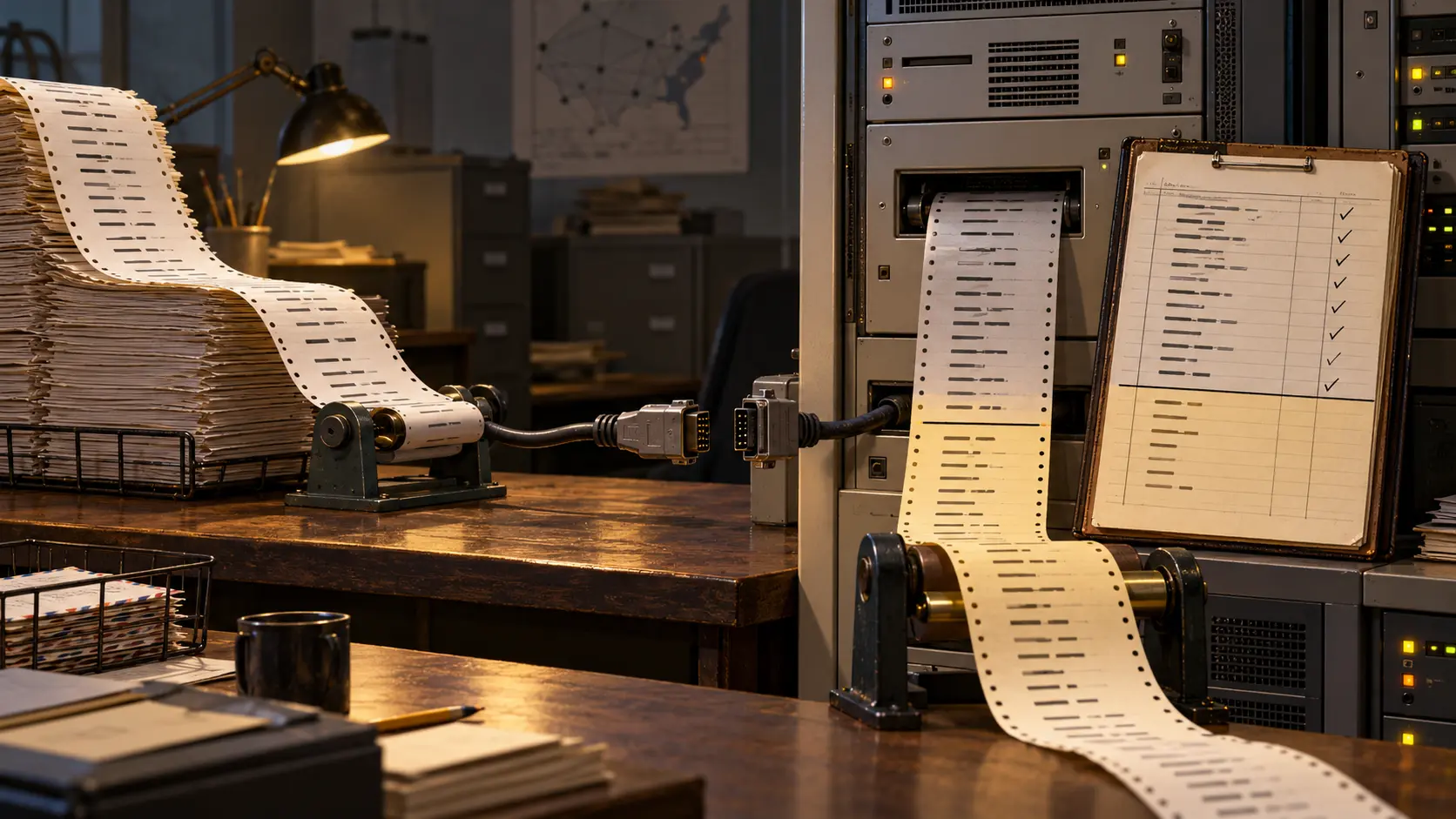
- RFC 1153 documented a mailing-list digest format already established by moderators of busy lists. One ordinary outer mail message enclosed a preamble, one or more messages and a trailer, reducing repeated delivery and header work.
- For each inner message, the format retained specified headers such as
Date,From,SubjectandMessage-ID, while directing the digest builder to discard other headers, especiallyReceived. The outer digest acquired its own transport trail; the original inner trail was pruned from the copy.
The mailroom bought one large envelope
High-traffic mailing lists appeared on the network in the mid-1970s, according to RFC 1153. Their moderators found a plain economy. Several submissions could travel inside one composite message rather than demand a separate round of mailing to every subscriber. The document says the reduction in mailer load followed the number of messages bundled, while trimmed headers saved network bandwidth. By April 1990, Frank Wancho was describing a de facto format, an elective experimental practice already in use. He was writing the recipe for a mailroom that had been operating for years.
The recipe began with an outer message. It had normal mail headers and a body made from three parts: a preamble, at least one enclosed message, and a trailer. The preamble usually offered a table of contents made from the messages' subjects, and could include administrative notices. A line of 70 hyphens, followed by a blank line, marked the end of that front matter. Between enclosed messages, the delimiter was shorter: a blank line, exactly 30 hyphens, another blank line. At the bottom, the trailer announced the end of the digest and underlined itself with asterisks. The different fences let programs take the bundle apart again.
A mailbox full of discussion was being packed as a little publication.
Each inner message kept a recognizable face. If present in its original headers, Date, From, To, Cc, Subject, Message-ID and Keywords had to be retained, then rearranged into the RFC's stated order. Summary was optional. These fields let readers and separation programs recognize who said what, when, and under which subject. The format then made a sharper cut: other inner headers were to be discarded, with Received singled out. The route stamps collected during the original message's passage did not ride inside its digest copy.
That cut is easy to miss when looking at a delivered digest. The outer envelope has its own mail headers and its own route through the network. A reader can see the digest's journey and still lack the earlier Received chain of a particular submission enclosed within it. The two trails describe different trips. Bundling many messages into one outer message made the mailing operation lighter; it also changed which transport evidence survived inside the published bundle. The editor had not merely stapled complete original messages together.
The body's bytes could change too. RFC 1153 allowed leading and trailing blank lines around an enclosed message body to be removed. If a body contained a line of exactly 30 hyphens—the same shape as an inner-message separator—the digest builder could blank its first character so a parser would not mistake text for a fence. A human may barely notice the change. A program comparing exact bytes would. The format's job was compatible digestion and separation, not a perfect photographic archive of every submitted octet.
RFC 1153 also drew a line around the moderator's work. A moderator could choose to reject a submission, edit punctuation, add commentary or reflow paragraphs; those editorial acts sat outside the format rules. The specification fixed how an accepted set of messages was enclosed, which headers survived and where the separators stood. It did not turn the moderator into a neutral photocopier. Readers received a curated issue assembled under a common wrapper.
The memo gave a typical digest size of about 15,000 characters, while explicitly leaving size unfixed and noting that intermediary gateways might impose limits. It also located itself among other mail formats. RFC 934 described generic message encapsulation; RFC 1153 said the digest format predated that work and remained a particular choice for list digests. A practice built by moderators became a written grammar without claiming to replace every other way to enclose mail.
The old digest was both a bandwidth trick and a publishing decision. A table of contents helped the reader. One wrapper spared the mailer repeated work. Selected headers carried the speaker's identity into the bundle. The discarded Received lines left the route of each original submission outside the copy. The large envelope solved a real delivery burden by choosing exactly what to carry onward.
Member Briefing
Deeper Profile Context
Sign in with the right membership level to unlock the full briefing and source notes.
Only for Strategic Circle
Strategic Circle
Open to all readers. Unlock profile briefings after joining and signing in.
Join Strategic CircleOnly for Leadership Alliance
Leadership Alliance
For qualified IP-asset owners and management; sign in to unlock alliance briefings.
Join Leadership Alliance