Summary
- Olivier Bonaventure is a professor at UCLouvain and, at the time of research, dean of the Louvain School of Engineering. His documented record spans ATM/TCP/IP integration, routing convergence and traffic engineering, Multipath TCP, open networking education, QUIC, protocol extension via eBPF, and secure BGP transport.
- The most accurate description of his role in MPTCP is as one of its chief academic architects, co-author of IETF standards, research group leader, and institution builder. Alan Ford, Costin Raiciu, Mark Handley, and Bonaventure co-authored RFC 6824; Christoph Paasch later joined the authors of RFC 8684. The architecture, congestion control, security, application interfaces, and Linux implementation were developed by overlapping but non-identical groups.
- UCLouvain’s contribution extended beyond specification writing to producing runnable code and deployment guides. Sébastien Barré began the main Linux implementation lineage; Paasch, Gregory Detal, Fabien Duchêne, and others contributed. The 2012 NSDI paper tested the design against middleboxes and diverse paths; Apple used the protocol for Wi‑Fi‑to‑cellular continuity; Tessares turned it into hybrid‑access solutions; the Linux community later took over mainline responsibility.
- The lasting takeaway is not that MPTCP solved multi‑homing everywhere. It delivers resilience, capacity aggregation, or mobility only when endpoint policy, path management, congestion control, middlebox compatibility, operator incentives, and data‑plane capabilities align. Bonaventure's broader legacy is a deployability method: preserve useful interfaces, build implementations, measure failure, refine standards, create an adoption path, then hand off maintenance to institutions that outlive the first research team.
A connection fails even though another network remains available
A phone’s Wi‑Fi may drop while cellular coverage remains available. A home may have a slow fixed line and a mobile path that could be used, or a server may have several paths inside a data centre. Yet a conventional TCP connection is normally bound to a single address‑and‑port pair; if the chosen path disappears the application session can break even though an alternative path is still valid.
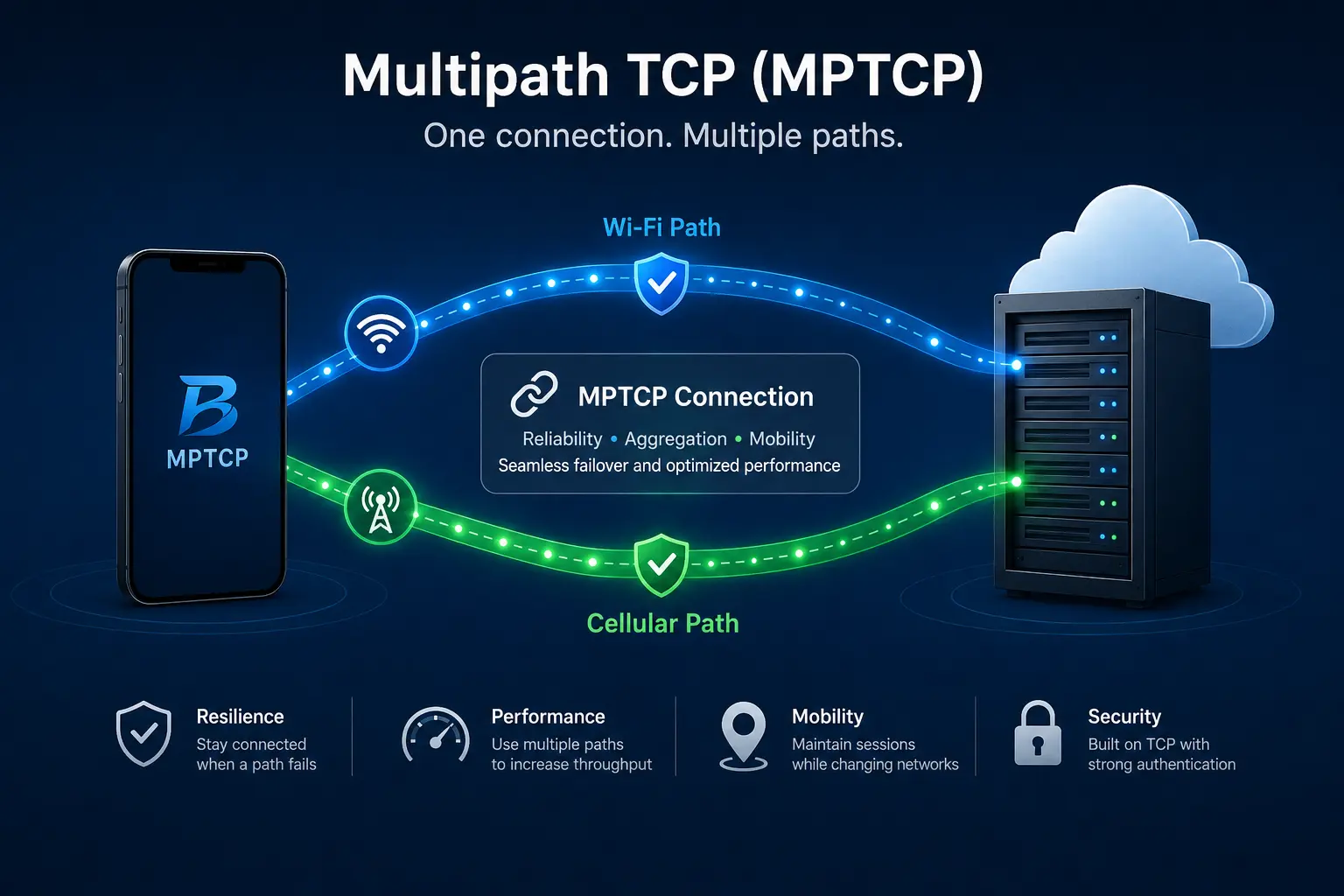
Multipath TCP was designed to address this mismatch. It preserves a single reliable, ordered byte stream as the application sees it, while creating several TCP sub‑flows beneath. They can be used for session continuity, capacity aggregation, or policy‑driven traffic migration. The difficulty was not imagining that two paths might be better than one, but making them appear as a single service without replacing applications, servers, and middleboxes all at once.
This is a protocol lifecycle story, not a lone‑inventor story
The simplified narrative that names Bonaventure the inventor of MPTCP and draws a straight line from idea to deployment is not supported by the evidence. The protocol grew from collaboration among researchers and engineers at UCLouvain, University College London, University Politehnica of Bucharest, Cisco, Apple, the IETF, and the subsequent Linux community. The author lists of the architecture, protocol, congestion control, security, and application‑interface documents are not identical.
Bonaventure stood out by persisting through multiple phases: specification, operational experience, the UCLouvain research‑and‑implementation environment, lessons learned, open educational resources, and commercialisation via Tessares. The more accurate summary is that he connected rings that often separate: design and working code, code and field evidence, and then evidence, review, maintenance, and retirement.
University of Liège and the problem of adding new capabilities beneath TCP/IP
Bonaventure earned a computer‑science engineering degree from the University of Liège in 1992 and completed a PhD thesis in 1999 on integrating ATM beneath TCP/IP to provide a guaranteed minimum bandwidth. The topic straddled two cultures: ATM with its virtual circuits, service classes, and quality‑engineering, and the Internet with its packets, end‑to‑end control, and incremental deployment.
The thesis topic reveals more than the degree alone. It placed him early before the question that would return later: how do you add a new capability to a widely deployed system without a global flag day, without rewriting applications, and without assuming every operator has the same equipment and incentives? Putting multiple paths under a familiar byte stream was a later, more visible version of that question.
Research engineering experience before the traditional academic track
Between 1992 and 1997 Bonaventure worked as a research engineer in the networking team led by André Danthine at the University of Liège. Public sources are limited public evidence to reconstruct every project or responsibility, but the sequencing matters: he worked in an environment where implementation and measurement were part of research before he became a professor in the conventional sense.
That helps explain his later insistence that a protocol is not complete until software exposes its assumptions. A paper can describe the desired behaviour; a real system adds timers, buffers, kernel interfaces, hardware characteristics, and recovery mechanisms. For that reason the UCLouvain group advanced code, tests, and educational materials in parallel with standards work.
A short industrial period at Alcatel‑Bell
Bonaventure worked at Alcatel‑Bell from 1997 to 1998. The public record does not state an exact title or specific products; for that reason details should not be invented. The safe formulation is that it was a short industrial interval between university research and later academic positions.
Its significance is limited but real: telecom engineering is constrained by product cycles, interoperability, and customer support—constraints that differ from the laboratory model. Later choices cannot be attributed to undisclosed projects, but his career had already crossed the boundary between research and commercial networking before MPTCP.
Namur, UCLouvain, and building a long‑term institutional base
Bonaventure became an assistant professor at FUNDP, which became the University of Namur, in 1998, and moved to UCLouvain in 2002. He was promoted to professor in 2006 and to full professor in 2011. At the research date the university listed him as a professor and dean of the Louvain School of Engineering.
At UCLouvain he built an environment that brought together protocol design, student‑led implementation, IETF participation, open‑source release, and operator collaboration. The impact of MPTCP did not rest on a single paper but on an institutional capability that allowed successive generations of researchers to carry code, measurement, and standards into companies and maintenance communities.
Routing as a living system, not a static algorithm
Before MPTCP became the centre of his public profile, Bonaventure worked on routing, traffic engineering, and convergence. A routing protocol cannot be freely swapped out in a network carrying production traffic. Change must be introduced while preserving reachability, limiting temporary loops, and respecting the distributed control among operators.
That approach connects the routing research to the later transport research: preserve the service interface, add capability underneath incrementally, and provide a safe fallback upon failure. OSPF, BGP, MPTCP, QUIC, and xBGP differ technically, but the deployability question is the same.
Hitless OSPF reconfiguration was a forerunner of staged change
Bonaventure contributed to research that won a best‑paper award at INFOCOM 2007 on hitless OSPF topology reconfiguration. Changing link weights or the structure can cause temporary loops or black‑holes if routers adopt the new state at different times.
The significance lies in making the transition path itself a design concern, not merely asserting that the final state is correct. MPTCP applied the same logic to mismatched endpoints, middleboxes, and failing paths. Deployment is not an afterthought to a specification; it is part of its engineering.
BGP’s resilience reveals a conservative inter‑domain boundary
Bonaventure also contributed to research on faster recovery from BGP link failures. BGP carries policy, economic relationships, and trust, not merely reachability. Its slow change reflects the risk that a mistake can propagate to distant networks.
The later xBGP and secure BGP transport work can be read as a return to the same problem: enabling an operator to add a capability without waiting for long standards and vendor cycles, while keeping the extension verifiable and interoperable. It is the same balance between local freedom and a stable common layer.
TCP’s single‑path identity and the cost of an old assumption
TCP offers applications a reliable, ordered stream and identifies a connection in practice by the pair of endpoints’ addresses and ports. When a phone moves from Wi‑Fi to cellular those values change, and existing connections do not automatically shift to the new path.
Multi‑homing was not new. The problem was using it beneath the familiar TCP socket, without requiring every application to manage multiple connections. MPTCP kept the TCP service and added diversity underneath instead of discarding it.
Resilience, capacity aggregation, and policy are different outcomes
MPTCP can be used for three different aims. The first is keeping a session alive when a path fails. The second is aggregating capacity across more than one link. The third is adding or removing paths according to cost, quality, mobility, and operator policy.
Not every deployment achieves all three. Apple used Wi‑Fi as the primary and cellular as backup; hybrid‑access systems used two paths simultaneously to boost speed; data centres may benefit from several equal‑cost paths. The protocol provides the mechanisms; path management, scheduling, and congestion control determine the actual behaviour.
Compatibility with the existing Internet became the hardest requirement
If a new transport were designed from scratch one could assume a new protocol number and middleboxes that understand it. MPTCP did not have that freedom. Firewalls, NATs, load‑balancers, detection systems, and TCP optimisers had accumulated assumptions about ordinary TCP; they may strip unknown options, alter packets, or modify payloads.
MPTCP therefore used TCP options and ordinary‑looking flows, and fell back to standard TCP if negotiation failed. That helped incremental deployment, but it constrained the option space, handshake, security, and operational visibility. Compatibility is not free; it transfers network diversity into endpoint complexity.
Modern Multipath TCP was born collectively
The authorship record refutes the lone‑inventor story. The authors of architectural RFC 6182 are Alan Ford, Costin Raiciu, Mark Handley, Sébastien Barré, and Janardhan Iyengar. The authors of experimental RFC 6824 are Ford, Raiciu, Handley, and Bonaventure; Christoph Paasch later joined the authors of standards‑track RFC 8684.
Raiciu, Handley, and Damon Wischik wrote the coupled congestion control document; the application‑interface and threat‑analysis documents have different authors. Bonaventure’s centrality comes not from owning every piece but from long‑running leadership across specification, research, implementation, education, and commercialisation.
Architecture, wire protocol, and algorithms are separate responsibility layers
The architecture document sets goals and deployment assumptions. The wire specification defines options, keys, sub‑flows, data mapping, and failure behaviour. Congestion control handles fairness, while security documents analyse tokens, paths, and attackers. Implementers turn all of this into kernel state, interfaces, and operational policies.
Separating the layers also helps locate failure. The architecture may be sound yet the handshake needs adjustment; an algorithm may be fair but slow on dissimilar paths; an implementation may match an RFC yet remain hard to interpret. Bonaventure’s strongest role was in connecting these layers and feeding operational evidence back into the standards.
Experimental status let MPTCP v0 learn in public deployment
RFC 6824 was published in January 2013 as an Experimental specification; it defined MPTCP v0 and TCP option number 30. “Experimental” did not mean the design was superficial; it acknowledged that extending a deeply deployed transport needed evidence from implementations and networks before becoming stable infrastructure.
Evidence came from research kernels, middlebox tests, data centres, Apple, and operator systems. Problems in the handshake, security, path management, and operations emerged that could not be resolved by textual review alone. The experiment was also an institutional process: implement, measure, review, then decide what deserves to advance to the next generation.
RFC 8041 brought operational experience back into the standards record
Bonaventure, Paasch, and Gregory Detal wrote RFC 8041 on use cases and operational experience, covering data centres, Wi‑Fi and cellular, proxies, middleboxes, congestion control, path management, scheduling, restricted gateways, and distributed server farms.
Its importance is that it did not treat the first RFC as final truth. When working code and measurement conflict with an earlier assumption, the standard should be adjusted rather than requiring the Internet to conform to elegant text. That is a clear application of the primacy of operational reality.
RFC 8684 moved to Standards Track and broke compatibility with v0
RFC 8684 was published in March 2020; it obsoleted RFC 6824 and specified MPTCP v1 on the Standards Track. It revised theMP_CAPABLEexchange and clarified behaviour based on implementation experience. It also stated that v1 is wire‑incompatible with v0.
That shows maturity may require a deliberate break with an earlier design. Backward compatibility is important, but carrying experimental options forever can harm security and reliability. The decision made migration harder, but it allowed operational evidence to overcome the temptation to freeze the interface permanently.
An upper‑layer socket hides several ordinary TCP flows
An application sees an MPTCP connection as a single reliable byte stream. Underneath, each sub‑flow has its own sequence numbers, congestion window, retransmission, RTT, and failure state. The MPTCP layer coordinates these flows and preserves the logical connection’s ordering.
The price of application transparency is endpoint complexity. Sequence numbers must be mapped between sub‑flow space and connection space; data arriving on different paths must be re‑ordered; a byte must be retransmitted on a path other than the one that carried it first. A slow path must not become application latency or unbounded buffer consumption.
MP_CAPABLEnegotiates multi‑path capability but does not force its use
The first sub‑flow begins with a regular TCP handshake carrying theMP_CAPABLEoption. Both ends declare they understand MPTCP and exchange key material to identify and authenticate the connection. If the other end or a middlebox does not support the option, the connection can continue as plain TCP.
That fallback is essential for incremental deployment, but it can hide failure. The application may work, yet multi‑path may not be active. Therefore production systems must distinguish between successful negotiation, fallback, sub‑flow creation, and actual path use.
MP_JOINattaches a new path to the existing connection
Once an MPTCP connection exists, either end can open an additional TCP flow viaMP_JOIN. The handshake carries a token that identifies the existing connection and uses an HMAC derived from the key material, proving that the new path belongs to the session without resending the full key.
The wire protocol does not decide when a path should be added. A phone may open the cellular path when Wi‑Fi degrades, hybrid‑access may use fixed and mobile together, and a data‑centre server may discover additional addresses. The mechanism provides a documented capability; policy decides when it is worth using.
Address advertisement and path management turn transport into policy
Endpoints can advertise additional addresses, withdraw them, and designate a backup flow. A local address may not be reachable from the other end, advertisements may expose topology the operator does not wish to reveal, and NAT, privacy, and server farms interfere with the decision.
Upstream Linux added Netlink and user‑space management, letting a privileged programme create and remove sub‑flows according to device or operator needs. That is an example of general‑protocol maturity: keep the common layer thin and leave cost, mobility, and quality to local decisions.
Two sequence spaces keep a single stream over different paths
Each TCP sub‑flow has ordinary sequence numbers, while the logical connection has a Data Sequence Number space. The DSS signal maps the bytes carried in a particular sub‑flow onto the overall stream and carries connection‑level acknowledgements. Data originally sent over Wi‑Fi can therefore be retransmitted over cellular without changing the application’s order.
Two kinds of re‑ordering appear: within a single path and across paths with different delays. The receiver must distinguish loss from late arrival, buffer early data, and prevent buffer growth. That is why you cannot add two theoretical link speeds and assume the application gets the sum.
The scheduler is operational policy, not an implementation detail
The scheduler picks which sub‑flow carries new data or retransmissions. A lowest‑RTT policy may reduce latency but starve slower capacity. A redundant policy may send the same byte on two paths to improve resilience at the expense of bandwidth. A backup policy may keep the cellular path idle until Wi‑Fi fails.
The objective differs between a voice assistant, a large file, and hybrid rural access. MPTCP did not abolish trade‑offs; it made them programmable at the transport layer. The scheduler is where protocol capacity turns into service policy.
Coupled congestion control prevents unfair capacity grabs
If each sub‑flow runs independent congestion control, a single MPTCP connection could obtain the share of several TCP connections at a shared bottleneck. Coupled control aimed to pool resources without being more aggressive than an ordinary TCP on its best path.
The principal authors of RFC 6356 are Raiciu, Handley, and Damon Wischik, not Bonaventure. This distinction matters because fairness underpins a protocol’s legitimacy on a public network. Moreover, apparently distinct paths may share a radio or a hidden link, so an algorithm alone cannot detect every bottleneck.
Closing a sub‑flow does not close the logical connection
A TCPFINcan close a sub‑flow while the MPTCP connection continues on another path. ADATA_FINcloses the byte stream at connection level, while reset and fast‑close handle abrupt failures. This separation is necessary so that a vanishing path does not become an application‑session collapse.
It adds state complexity, however: one must know whether a path ended cleanly, whether unacknowledged data remains, and where it should be retransmitted. Upstream Linux continued adding reset, fast‑close, socket options, and accounting after the initial merge, showing that completeness is the result of long maintenance, not a single release moment.
Middleboxes made the existing Internet part of the effective specification
There is no neutral pipe between two endpoints. NATs change addresses and ports, firewalls inspect state, load‑balancers distribute flows, TCP optimisers may alter segmentation or payloads, and intrusion‑detection systems may assume they see every byte on a single path. These devices may pass, strip, alter, or drop an unknown option.
Middlebox behaviour therefore had to be treated as a design input. A protocol that works only in a clean research network will not deploy. The NSDI paper centred on the difficulty not being imagining multiple paths, but coexisting with assumptions that had built up over decades in the Internet.
Fallback protects service but complicates diagnosis
IfMP_CAPABLEis stripped or blocked, the connection can succeed as plain TCP. That protects the user, but it can make the loss of resilience or aggregation invisible. The user sees a successful connection while the intended service is not functioning.
Negotiation success, fallback reasons, sub‑flow creation, path failures, and scheduler usage must all be measured. An uninterrupted connection is not sufficient evidence that the promised transport mode is working. Deployability includes both service continuity and failure interpretability.
MPTCP authenticates sub‑flows but does not replace TLS
MPTCP exchanges keys, derives tokens, and uses HMAC to bind a new sub‑flow to an existing connection. Threat analysis covered token guessing, denial of service, address advertisement, flow hijacking, and on‑path and off‑path attackers. The v1 revision incorporated some of that experience.
Nevertheless the protocol does not provide application‑content confidentiality; TLS or another security layer remains required. Stronger authentication consumes TCP option space and handshake bytes, so security remains a trade‑off between protection and compatibility.
The UCLouvain Linux tree turned the specification into a testable system
Project history recounts that Sébastien Barré began the main Linux implementation around 2009, building on earlier shim6 work. It was then extended by Christoph Paasch, Gregory Detal, Fabien Duchêne, and others, becoming the basis for experiments, tutorials, and early deployments.
Bonaventure was the research leader, co‑designer of the protocol, supervisor, and co‑author who contributed limited code—not the principal day‑to‑day kernel programmer. Building the institution, attracting collaborators, framing the questions, and providing a shared experimental platform are all forms of infrastructure construction.
The main developers’ names should remain visible in the record
The 2019 ACM SIGCOMM Networking Systems Award honoured the Linux MPTCP implementation and named Paasch, Barré, and Detal as lead developers, acknowledging the wider community. That is the clearest attestation of implementation credit.
Mentioning these names changes the understanding of the achievement. A protocol pipeline needs architects, kernel engineers, experimentalists, operators, and maintainers. Bonaventure helped create the environment that brought them together, but the lasting code relied on their direct engineering work.
“How Hard Can It Be?” put deployability at the centre of research
The 2012 NSDI paper “How Hard Can It Be? Designing and Implementing a Deployable Multipath TCP” was authored by Costin Raiciu, Christoph Paasch, Sébastien Barré, Alan Ford, Michio Honda, Fabien Duchêne, Bonaventure, and Mark Handley. The title was deliberately ironic: the difficulty was not in imagining multiple paths, but in making them appear as a single connection inside an Internet full of legacy assumptions.
The paper tested TCP options, payload modification, delay‑bandwidth disparity, re‑ordering, buffer limits, and web‑server behaviour. USENIX gave it the NSDI Community Award. It was a turning point because it made the deployed environment, not a clean model, the benchmark for judging a design.
An out‑of‑tree research kernel evolves quickly but is not easily a permanent institution
The out‑of‑tree UCLouvain kernel allowed path managers, schedulers, and congestion controllers to be tried faster than the upstream Linux release cycle. It burdened users, however, with carrying patches, chasing kernel releases, and merging security fixes themselves.
The significance of upstreaming was therefore not just easier installation. It transferred responsibility to a stable review, release, testing, and maintenance system that could outlive the lab. The out‑of‑tree model was good for generating evidence but costly as a long‑term foundation for a widely deployed product.
Linux 5.6 deliberately began with a limited foundation before full multi‑path operation
Initial MPTCP support entered Linux 5.6 in March 2020, but it focused on connection creation, options, namespace setup, and self‑tests. Creating and concurrently using multiple sub‑flows was not yet complete. To say that Linux 5.6 added full MPTCP is therefore an overstatement.
The limited start was a feature of upstream engineering: merge a reviewable core, then add path management, transmission, and recovery. The movement from research to the kernel was not a single event but a phased programme.
Netlink and later merges made mainline MPTCP usable
The upstream community added a path manager via Netlink, letting a privileged programme manage addresses and sub‑flows from user space. Concurrent transmission, connection‑level re‑ordering, tests, and reset and fast‑close mechanisms followed.
This subsequent work was led by engineers including Matthieu Baerts, Mat Martineau, and Paolo Abeni, with contributions from Tessares engineers. There is continuity with the university tree, but the current mainline implementation is a new community system with its own decisions and responsibilities.
Current maintainers bear operational responsibility today
Current Linux documentation lists Matthieu Baerts and Mat Martineau as MPTCP maintainers, backed by reviewers and the networking maintainers. Bonaventure is not a current maintainer, and merge authority or day‑to‑day bug handling should not be attributed to him.
This separation is a sign of institutional success. The protocol can live without the original researcher remaining a permanent gatekeeper. A record should distinguish historical impact from current authority and name the people who now hold operational responsibility.
Apple made MPTCP a visible part of mobile infrastructure
Apple used MPTCP in iPhone and iPad so that Wi‑Fi is the primary path and cellular is a backup. If Wi‑Fi becomes unavailable or unresponsive, traffic can move without creating a new logical session; Siri is the most public example.
Apple documentation does not say that every app always aggregates Wi‑Fi and cellular. Apple wrote its own implementation, set product policy, and ran the servers itself. Bonaventure’s role is upstream research and standards influence, not iOS code implementation or service operation.
Mobile handover shows that “seamlessness” still contains policy and delay
UCLouvain studied iOS handovers and noted that the switch from Wi‑Fi to cellular is not instantaneous and that path policy can be improved. Session continuity does not mean the user will not notice a short pause.
The device must also balance battery, cost, signal quality, and application priority. MPTCP provides the capability to switch, but it does not automatically know the best moment. The Apple case illustrates that product policy matters as much as the protocol mechanism.
Multi‑path motivations differ in data centres
Data centres often have multiple physical routes or ECMP paths between servers. MPTCP can exploit diversity to improve utilisation and resilience without changing the application. Here the goal is usually capacity aggregation or path balancing, not merely a cellular backup.
Flows may still share a hidden bottleneck, and a slow path can increase re‑ordering and completion time. Value therefore depends on topology, load‑balancing, congestion control, and application objective, not merely on the existence of two links.
Proxies and transport converters widen deployment but create points of concentration
Most Internet servers do not support MPTCP. A client can use it up to an operator‑controlled proxy, and the proxy then completes the connection to a plain‑TCP server. That delivers incremental benefit without waiting for every public server.
The converter, however, becomes a concentration point for state, capacity, monitoring, and failure. RFC 8803 defines a 0‑RTT converter for deploying TCP extensions without a separate tunnel or extra round‑trip; Bonaventure co‑authored and edited it with Mohamed Boucadair and others. It is an acknowledgement that end‑to‑end purity may lose out to practical deployability.
Hybrid access turned multi‑path into a broadband product
Hybrid access combines a fixed line such as DSL with a mobile link such as LTE. The fixed link provides a stable baseline and the cellular adds capacity or continuity. The model has been attractive in areas where copper loops are long and fibre replacement is not immediate.
The architecture typically places an MPTCP‑capable endpoint in the customer gateway and another at the operator, then returns traffic to plain TCP toward servers. Quality depends on the path manager, scheduler, proxy, and support, not on the open specification alone.
Tessares was founded to cross the boundary between research and commercial telecom
According to a VIVES announcement, Tessares was founded in March 2015 by Olivier Bonaventure, Gregory Detal, Sébastien Barré, Denis Périquet, and Sopartec as a UCLouvain spin‑off. The founders brought together research, standards, implementation, management, and university technology transfer.
Bonaventure is a co‑founder, but that does not automatically make him the current CEO or controlling shareholder. Operator materials identified Denis Périquet as CEO; public sources did not disclose Bonaventure’s shareholding, compensation, or current operational role. The company marketed software and operational expertise built on an open standard; it did not own the protocol itself.
Proximus provided the first clear operator‑named evidence
Proximus reported a nine‑month trial in Frasnes‑Lez‑Anvaing that combined DSL and 4G/LTE for rural customers. It reported high satisfaction and speed increases of up to 20 Mbps for some users, and then qualified the solution for wider testing and potential deployment.
That is strong evidence of leaving the lab, but the figures come from a party to the transaction and are not an independent audit. Results vary by line, radio, and traffic. Deployment should be proved without turning specific numbers into a universal guarantee.
Funding and customers showed commercial traction, not a full financial picture
In 2018 Tessares announced a €3 million round from Proximus, VIVES II, and SRIW, and cited contracts with Proximus, KPN, and Telia covering about 15,000 households in three countries. In 2021 it announced a €3.5 million round led by the EIC Fund and Sagemcom.
These data points confirm relationships and dated funding as announced by the company and investors. They do not reveal the current customer count, revenue, profitability, or valuation, and a historical employee figure should not be projected to 2026.
BT Hybrid Speed Boost clearly showed product boundaries
In 2022 BT launched Hybrid Speed Boost for small businesses, saying it combined copper broadband with EE’s 4G network using Tessares MPTCP technology. It reported an average download increase of 20 Mbps and upload speeds around 10 Mbps—figures from the product provider.
Importantly, the service applies to TCP web traffic and does not usually accelerate UDP traffic used in gaming; there are also restrictions on certain VPNs. Combining two networks does not accelerate every packet or application. The exceptions illustrate the real boundaries of the product’s value.
Wavenet maintenance reveals that commercial infrastructure lives beyond launch
Digital Wallonia describes Wavenet as a maintenance and support partner for the Tessares hybrid solution since 2024, and Wavenet states it deploys and maintains MPTCP systems for major European operators. At the same time, Tessares remained an active Belgian legal entity at the research date.
The evidence shows a shift in operational support, not a Wavenet acquisition of Tessares, not a transfer of all IP, and not a cessation of the company. The safe formulation combines entity continuity with Wavenet’s role and does not invent an undisclosed deal.
The open book extended impact beyond a single protocol
Bonaventure wrote “Computer Networking: Principles, Protocols and Practice”, first released in 2011 and later revised. The book was published under an open licence and used at UCLouvain and other universities, allowing teachers and students to inspect, modify, and redistribute it. It received a 2012 award from the Saylor Foundation for open educational work.
The educational project aligns with the software philosophy: networking should not be taught as idealised layers divorced from packets, code, and operational failure. The book did not publish MPTCP, but it helped build the human capacity needed to understand and maintain protocols after their first authors have left.
Teaching, tutorials, and reproducibility were part of protocol production
Bonaventure served as ACM SIGCOMM Education Director from 2010 to 2016 and held editorial and academic roles. His group published code, virtual environments, experiments, and tutorials, and continued to offer hands‑on training on multi‑path transport.
Reproducibility turns a claim into something another engineer can test and refute. Students learn from packets and code the difference between a clean model and a middlebox‑constrained path. The process also creates future maintainers; students and engineers moved on to Apple, Tessares, Linux, and other institutions.
QUIC moved transport evolution to a more programmable environment
QUIC runs over UDP and places transport logic in user space with encryption and TLS. It takes a different route to bypass kernel and middlebox ossification than MPTCP’s TCP‑options strategy. Bonaventure and colleagues worked on extension‑enabled QUIC, Multipath QUIC, and transport‑converter research.
That does not mean abandoning MPTCP, but broadening the question: how can transport evolve rapidly while maintaining interoperability and security? User space shortens the update cycle but does not remove UDP blocking, congestion, path differences, or implementation bugs.
eBPF and extensible transport stacks shift focus from protocol to change platform
Work on extensible Linux stacks and path‑aware TCP via eBPF investigated modifying transport behaviour without adding a fixed API for every future idea. A constrained execution platform can host local logic while keeping the common boundaries thin.
The idea moves future decisions closer to the operator, but it can generate fragmentation, attack surface, or proprietary extensions. The MPTCP lessons have not disappeared: verification, monitoring, safe fallback, and clean common interfaces are still needed.
xBGP and secure BGP transport re‑apply the same method to routing
xBGP proposed a vendor‑neutral mechanism to extend BGP using eBPF and verified interfaces, with support in FRRouting and BIRD. Other work studied BGP over TLS/TCP or opportunistic authentication while preserving familiar operational interfaces.
This is research and drafts, not evidence of widespread deployment. Its significance is that it re‑designs the change path: enabling an operator to try a feature before the vendor‑and‑standards cycle completes, provided the extensions stay verifiable and interoperable.
Switched‑homing, address‑family selection, and Flexicast continue the deployability theme
Recent UCLouvain work includes adaptive selection between IPv4 and IPv6, switched‑homing, and Flexicast QUIC. Flexicast tries to combine multicast efficiency with unicast fallback, while switched‑homing swaps paths according to performance and policy without assuming that permanent aggregation is better.
These projects are in various research stages and should not be described as established infrastructure. They show, however, that Bonaventure’s agenda in 2025–2026 still asks how to use available capacity on some paths without losing compatibility with the rest of the system.
MPTCP’s limits are as useful as its deployments
MPTCP did not replace plain TCP, and its global deployment is uneven. v0 and v1 are incompatible, many servers do not enable it, middleboxes force fallback, and dissimilar paths can increase memory and delay. Using Wi‑Fi and cellular together can raise power or cost, proxies concentrate transport state, and products may accelerate only selected traffic.
These limitations do not invalidate the protocol; they define where it creates value. The central claim is not that it solved multi‑homing everywhere, but that its development created a durable method for evaluating protocol change. Working systems, operator incentives, and maintainer capacity—not the mechanism alone—determine whether a capability becomes infrastructure.
The end of the original IETF group did not end governance
The dedicated MPTCP working group concluded its task in March 2020 after completing its chartered document set. But protocols do not stop needing interpretation when a group closes. Bugs, interoperability questions, extensions, and maintenance moved to the TCP Maintenance and Minor Extensions (TCPM) working group, whose scope includes MPTCP.
That is an important maturity transition for the infrastructure. A focused, research‑driven group can carry the protocol through architecture, experiment, and standards review; then a permanent maintenance body takes on smaller changes and its relationship to the TCP system. Bonaventure remains in the historical record, but long‑term authority rests with consensus processes that do not depend on the original team meeting forever.
Measurement over time shows why endpoint counts need interpretation
Independent studies have tried to measure MPTCP‑capable systems across the Internet. They can reveal version support, option responses, and trends, but they are susceptible to false positives, middlebox behaviour, and points that respond to a survey without offering a useful application service. A responsive option signature does not equal active production deployment.
A kernel may contain MPTCP without any application using it; a server may negotiate a version the client does not expect; a middlebox may reflect or alter the option. Active measurement must therefore be combined with documentation of named products, application releases, and traffic evidence, not present a single survey number as a count of working multi‑path connections.
Energy, radio use, and data cost constrain phone multi‑path policy
A mobile device does not evaluate paths by latency and bandwidth alone. Keeping the cellular radio active consumes battery, and sending data on a metered network can cost the user or the operator. Wi‑Fi may be fast but unstable; cellular may be reliable but expensive. Maximising throughput can therefore conflict with battery life, tariff, or user preference.
That explains Apple’s focus on backup rather than permanent aggregation. The value was session continuity, not a permanent race between interfaces. Policy can become more adaptive, but it will need cost, energy, and application‑priority signals. The protocol can move the data, but it does not decide what the user is willing to pay.
Proxy location turns protocol choice into service architecture
A Transport Converter or MPTCP proxy must be placed somewhere in the operator’s network. Location determines latency, failure scope, capacity concentration, logging requirements, lawful interception, and how far the traffic stays multi‑path. A central anchor simplifies management but widens a failure’s impact; distributed anchors shorten the path and increase the number of operating conditions.
The public server may never know that MPTCP was used, while the access operator bears the responsibility for stateful conversion. Capacity planning must cover fixed and cellular traffic, connection state, and recovery. The service cannot be judged by the RFC alone; its quality depends on architecture, placement, software lifecycle, and the ability to diagnose both sides of the conversion.
Hybrid access was an economic bridge, not a replacement for every fibre build
Its appeal is greatest where copper is constrained and fibre extension needs time or large capital. Cellular capacity can be added to an operator’s own assets to improve service before rebuilding the physical access network. The software and gateways provided an earlier transition tool.
Spectrum and backhaul are not free, however; customer equipment must be installed and supported, and the boundaries of qualifying traffic limit the benefit. When fibre arrives, the case for aggregating DSL and LTE may weaken. Tessares should be understood as a transition and improvement tool, not proof that software eliminates physical investment.
Faculty leadership extends the institution‑building story beyond the lab
At the research date, UCLouvain identified Bonaventure as dean of the Louvain School of Engineering. The position is time‑bound and not a permanent identity, but it broadens the institutional‑leadership evidence to include programmes, coordination, and representation, not a single‑protocol repository.
Perhaps the most important fruit of the academic track is the environment that allows many researchers to build and critique systems. MPTCP students and engineers carried the experience into Apple, Tessares, upstream Linux, and new research. The deanship does not make Bonaventure responsible for their outcomes, but it supports that he built paths through which work continues beyond his own code and papers.
Version discontinuity is a warning about a hidden installed base
The Standards Track generation is wire‑incompatible with MPTCP v0. That improved the specification, but devices, proxies, kernels, and applications do not all speak at the same time. Different generations may persist in products with long support cycles, and fallback to plain TCP hides the absence of multi‑path compatibility.
An operator needs a version inventory and feature‑policy map, not merely a configuration toggle. One must know the endpoint, the version, the proxy upgrade impact, and whether fallback changes the service promise. A version number is a technical field; migration is an institutional process, and the risk grows when the old application’s vendor differs from the current common‑layer maintainer.
What the public record cannot prove
The evidence supports Bonaventure’s academic roles, RFC authorship, group leadership, open book, Tessares co‑founder role, and current work. It does not, however, prove a birth date, nationality, wealth, compensation, founder shareholding, Tessares ownership schedule, or current financial performance. It also does not measure his personal contribution to Apple’s implementation or operator results.
These gaps should remain visible. A technical profile does not need to invent private details or attribute team outcomes to an individual. The strong record already exists in the protocols, papers, code, institutions, operator announcements, and education, and it allows impact to be explained without turning association into ownership.
What Bonaventure actually built
He did not invent MPTCP alone, did not write the architecture document or the congestion‑control RFC, did not implement Apple’s stack, and is not a current mainline Linux maintainer. He should not be described as the current CEO of Tessares without evidence. These boundaries are part of accuracy, not a diminishment of significance.
His defensible legacy is the pipeline. He co‑authored the experimental and standards‑track specifications, led a group that produced software and critical deployment research, turned operational experience into an RFC, co‑founded a company that moved the technology into telecom products, built open educational resources, and continued research on extending protocols while preserving interoperability. That connected institutions that normally stop at their own boundaries.
Why BTW tracks Olivier Bonaventure
BTW tracks those who change the behaviour of digital infrastructure. Bonaventure’s career shows that protocol infrastructure is not born at the moment an RFC is published, but when code matches, failures are measured, an operator finds an incentive, the user receives a service, the maintainer inherits responsibility, and the design can be amended or retired without claiming that the original authors still control the network.
The lasting lesson of MPTCP is institutional. A thin, shared mechanism preserves one connection, while local policies decide whether paths are active, backup, or unavailable. Adoption is proved by a working system, not by announcement. Bonaventure helped build a chain sufficient to carry a research idea into phones, broadband, and Linux—and then to continue without him.
Member Briefing
Deeper Profile Context
Sign in with the right membership level to unlock the full briefing and source notes.
Only for Strategic Circle
Strategic Circle
Open to all readers. Unlock profile briefings after joining and signing in.
Join Strategic CircleOnly for Leadership Alliance
Leadership Alliance
For qualified IP-asset owners and management; sign in to unlock alliance briefings.
Join Leadership Alliance