
Summary
- Olivier Bonaventure is a professor at UCLouvain and was Dean of the Louvain School of Engineering at the time of research. His documented career spans from ATM, TCP/IP, routing convergence and traffic engineering to Multipath TCP, open computer networking education, QUIC, eBPF-based protocol extension, and secured BGP transport.
- His most well-documented MPTCP role is that of a leading academic architect, IETF co-author, research group leader, and builder of institutional structures. RFC 6824 was authored by Alan Ford, Costin Raiciu, Mark Handley, and Bonaventure; RFC 8684 added Christoph Paasch. The architecture, congestion control, security, application APIs, and Linux implementation were carried by overlapping but non-identical groups.
- UCLouvain’s contribution went beyond specifications. Sébastien Barré started the principal Linux implementation line, which Paasch, Gregory Detal, Fabien Duchêne, and many others extended. The 2012 NSDI work tested MPTCP against middleboxes and unequal paths; Apple deployed it for Wi‑Fi/cellular resilience; Tessares turned it into Hybrid Access; a later community embedded a new implementation in upstream Linux.
- The durable lesson is not that a protocol solved multihoming everywhere. MPTCP delivers resilience, bonding, or mobility only when endpoint policy, path management, congestion control, middlebox compatibility, operator incentives, and the data plane align. Bonaventure’s broader legacy is a deployability method: preserve a useful interface, build code, measure faults, revise the standard, create adoption paths, and hand maintenance to institutions that outlast the first research group.
The connection that fails when another network is still available
A smartphone can have cellular reception while Wi‑Fi collapses. A broadband customer can have a slow fixed line and a usable mobile path at the same time. A server can have multiple data-centre paths while one becomes congested or fails. Classic TCP, however, usually binds a connection to one address–port pair. If that path disappears, the application can lose its session even though another network access exists.
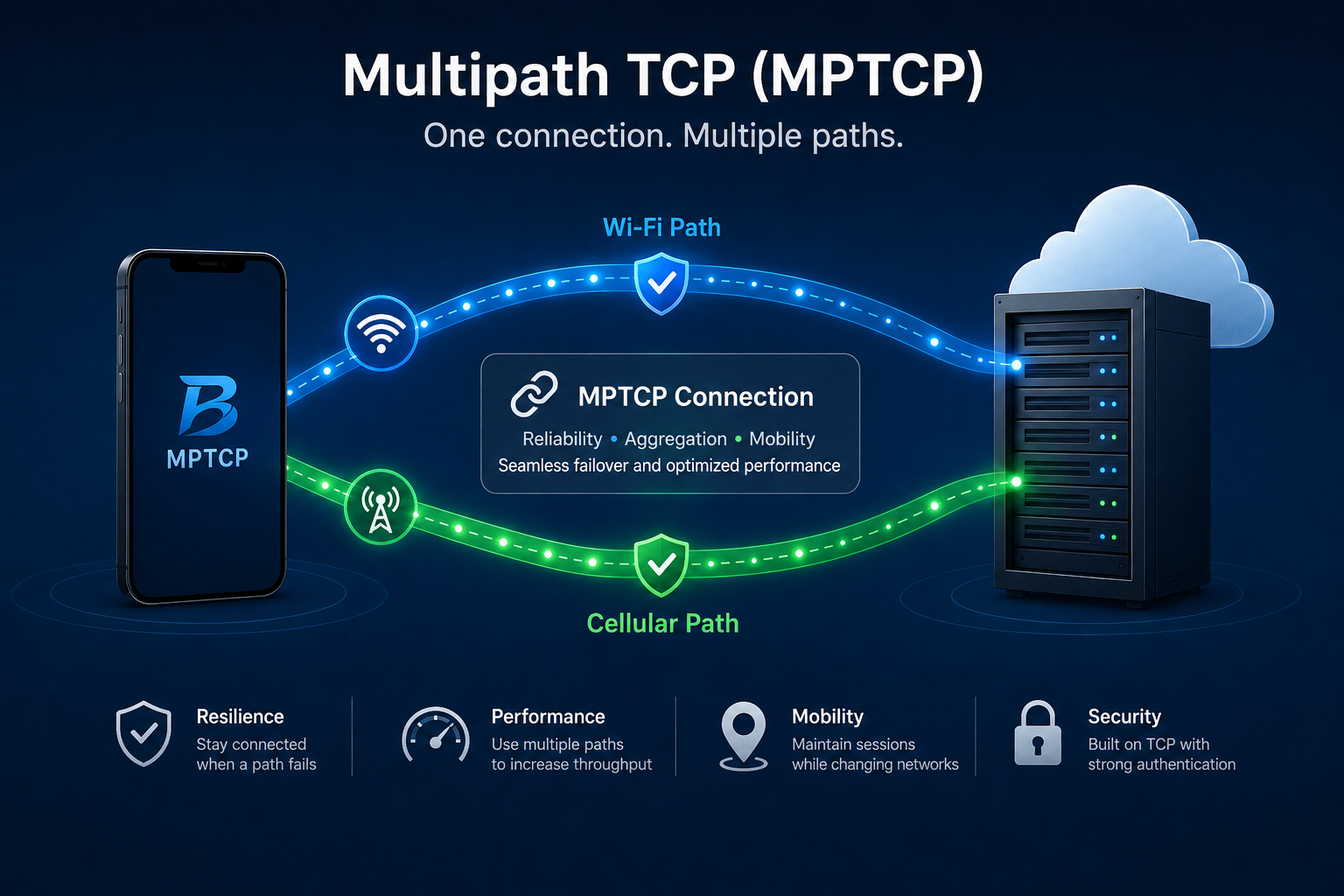
Multipath TCP was designed for this contradiction. It preserves the reliable, ordered byte stream for existing applications while creating multiple ordinary TCP subflows underneath. That allows the connection to survive, pool capacity, or move traffic according to local policy. The hard task was not the idea of multiple paths, but making them look like a single service without having to replace applications, servers, and middleboxes simultaneously.
A story of the protocol life cycle rather than an inventor legend
A simplified portrait would declare Bonaventure the sole MPTCP inventor and draw a straight line from lab to production. The sources show a distributed project involving UCLouvain, University College London, the Polytechnic University of Bucharest, Cisco, Apple, the IETF, and later the Linux community. Architecture, wire protocol, congestion control, security, and APIs have different author lists.
Bonaventure’s special role is continuity across these boundaries. He appears in specifications, operational experience, the UCLouvain research and implementation environment, tutorials, open teaching materials, and commercialisation through Tessares. That supports a stronger thesis: he helped connect design, running code, deployment evidence, revision, maintenance, and sunsetting—phases that normally lie in separate institutions.
The University of Liège and inserting new network capabilities under TCP/IP
Bonaventure graduated in computer engineering from the University of Liège in 1992 and worked there as a research engineer before obtaining his PhD in 1999. His dissertation examined integrating ATM under TCP/IP with guaranteed minimum bandwidth. The topic sat at the intersection of virtual circuits and service classes on one side and packet-switched internet, end-system control, and incremental deployment on the other.
The topic says more than the degree. It confronted him early with the question of how to insert a new network capability into an installed protocol world that does not go away. The same structure would recur later: new capabilities without a flag day, without rewriting all applications, and without assuming uniform operator interests. MPTCP is a later, more visible answer to that integration problem.
Research engineering before the classical professorship
From 1992 to 1997 Bonaventure worked as a research engineer in André Danthine’s networking group. The public record does not allow reconstruction of every project, but it shows an education in which implementation, measurement, and real network behaviour preceded the professorship.
That explains the later stance that a protocol cannot be fully assessed until software makes its assumptions visible. Paper models describe intended behaviour; real systems add timers, buffers, kernel interfaces, device peculiarities, and restart. His group therefore repeatedly combined standards work with code, reproducible experiments, and failure analysis.
A brief industry interlude at Alcatel-Bell
Between 1997 and 1998 Bonaventure worked at Alcatel-Bell. The sources examined give neither a precise function nor concrete products, so this phase should not be embellished. What is certain is a short industry interval between university research and academic posts.
In the chronology it remains relevant. Telecom products are subject to different life cycles, compatibility obligations, and support duties than a research prototype. No later philosophy can be deduced from undocumented projects, but Bonaventure had already crossed the boundary between research and commercial network operation before MPTCP, via operator pilots and Tessares, reached that same boundary again.
Namur, UCLouvain, and building an institutional base
In 1998 Bonaventure became an assistant professor at FUNDP, now the University of Namur. In 2002 he moved to UCLouvain, becoming a professor in 2006 and a full professor in 2011. At the time of research the university also listed him as Dean of the Louvain School of Engineering.
This long institutional base enabled what a short project cannot do. MPTCP needed students, implementations, repeated experiments, IETF work, operator relationships, and years of maintenance. UCLouvain created an environment in which these functions reinforced one another. Neither the university nor Bonaventure owned the protocol; but the group created a durable link between idea, software, and external users.
Routing as a running system rather than a static algorithm
Before MPTCP, Bonaventure worked on routing, traffic engineering, and convergence. Routing protocols are not changed in a closed model: topology and policy change while traffic flows, neighbours hold their own state, and transitional inconsistencies can create loops or loss.
Already visible here is the deployability motif. Not only must the target state be correct; the transition must also not damage the network more than the original problem. The same logic appears later in transport fallback, subflow setup, protocol revision, and incremental Linux integration.
Hitless OSPF reconfiguration as a probe for staged change
Bonaventure co-authored a 2007 INFOCOM award‑winning paper on hitless OSPF topology reconfiguration. It dealt with changing weights and parameters while minimising transient disruption. Reconfiguration was understood as an operational procedure, not a one‑off calculation.
The connection to MPTCP is methodological. OSPF must change distributed control states without breaking forwarding; MPTCP must preserve an application stream while subflows appear or disappear. In both cases the path between valid states is part of the design.
BGP resilience and the conservative inter‑domain boundary
Bonaventure also worked on faster recovery after BGP peering-link failures. Inter‑domain routing is especially conservative because technical policy, economic relationships, and security assumptions are embedded in it. No single operator can force all neighbours to upgrade.
Later work on xBGP and secured BGP transport continues this question. It does not try to replace the entire system but to create controlled extension points or stronger protection within familiar operational structures. MPTCP was thus part of a longer engagement with change under installation constraint.
TCP’s single‑path identity and the cost of an old assumption
TCP delivers a reliable ordered stream and binds the connection to addresses and ports. The model suited hosts with one dominant interface. Mobile devices, multihomed servers, and data‑centre fabrics made the limitation visible.
Applications could open multiple connections, but then had to carry complexity and restart themselves. MPTCP preserves the socket semantics while the transport layer knows about multiple addresses and subflows. Application compatibility is therefore a central design condition.
Resilience, bonding, and policy are different outcomes
MPTCP is often described as bandwidth bonding. Resilience keeps a session alive when a path fails, bonding uses several links, and mobility or policy adds or removes paths according to radio quality, price, energy, operator rules, or application value.
These goals can collide. A phone holds cellular only as backup, a hybrid gateway uses DSL and LTE simultaneously, a server distributes over equal paths. The protocol provides mechanisms; path managers, schedulers, and congestion control determine the actual service.
Compatibility with the installed internet became the hardest requirement
A clean‑slate transport could assume that every middle component understands it. MPTCP could not. NATs, firewalls, load balancers, IDS, and TCP optimisers had developed expectations of normal TCP. Unknown options could be stripped, and stateful connections treated as single‑path.
That is why MPTCP uses TCP options, ordinary subflows, and fallback to TCP. This aids incremental deployment but constrains the handshake, option space, security, and observability. Apparent compatibility shifts network diversity into endpoint complexity.
The collective origin of modern Multipath TCP
RFC 6182 was authored by Alan Ford, Costin Raiciu, Mark Handley, Sébastien Barré, and Janardhan Iyengar. RFC 6824 is by Ford, Raiciu, Handley, and Bonaventure. RFC 8684 added Christoph Paasch.
Other layers had other authors. RFC 6356 on coupled congestion control belongs to Raiciu, Handley, and Damon Wischik. Michael Scharf and Ford dealt with APIs; Marcelo Bagnulo and others with security. Bonaventure’s centrality lies in sustained academic and institutional work, not sole authorship.
Architecture, wire protocol, and algorithms were separate responsibilities
The architecture defined transparency, resilience, resource pooling, and incremental deployment. The specifications defined options, keys, subflows, and mappings. Congestion control dealt with fairness, security documents with attacks, implementations with concrete kernel state.
This separation improves attribution and analysis. A good architecture can contain a faulty handshake; a fair algorithm can perform badly on highly unequal paths. Bonaventure is especially visible where operational experience feeds back into standardisation.
Experimental status let MPTCP v0 learn in public
RFC 6824 appeared in January 2013 as Experimental, using TCP option 30. That did not mean low seriousness, but acknowledged that a TCP extension needed real implementations before it could become stable.
Research kernels, middlebox tests, data centres, Apple, and operators provided insights that document review alone does not generate. The experiment was institutional: implement, observe, revise, and select.
RFC 8041 made operational experience part of the standards stock
RFC 8041 by Bonaventure, Paasch, and Gregory Detal documented data centres, Wi‑Fi/cellular, proxies, middleboxes, congestion control, path management, captive portals, and server farms. It did not treat the first specification as final truth.
When operational experience enters the IETF corpus, flaws and limits become part of governance. A document gains authority when mechanisms can be tested in running systems. If reality contradicts an assumption, the standard must learn.
RFC 8684 moved to Standards Track and broke with version 0
RFC 8684 appeared in March 2020, replaced RFC 6824, and defined MPTCP v1. It revisedMP_CAPABLE, clarified behaviour, and declared v1 wire‑incompatible with v0.
The break shows that maturity sometimes demands giving up early decisions. Preserving every legacy choice would have frozen weaknesses. The community accepted migration costs because operational experience mattered more than unlimited handshake compatibility.
The meta‑socket hides several ordinary TCP subflows
The application sees one reliable stream. Underneath, each subflow has its own sequence numbers, congestion window, retransmits, RTT, and error state. MPTCP coordinates them at the connection level.
This preserves compatibility but shifts complexity to the endpoints. Local and global sequences must be mapped, data reordered across different paths, and if necessary retransmitted elsewhere. A slow path can turn extra capacity into extra delay.
MP_CAPABLEnegotiates multipath without forcing it
The first subflow uses the normal TCP handshake withMP_CAPABLE. The option signals support and exchanges key material. If it is not supported or is stripped, the session can continue as TCP.
Fallback eases adoption but can hide faults. The application works even though multipath is not active. Operations teams must separately measure successful negotiation, fallback, subflow creation, and actual path usage.
MP_JOINmakes another path part of the same connection
After the first connection,MP_JOINadds a subflow with a token and key‑derived HMAC. This binds the path without revealing the full key.
When the path emerges is not decided by the mechanism. Path managers and local policy decide. A mobile device can set up a backup path only when Wi‑Fi is poor; Hybrid Access can use both at once. The protocol enables, the implementation decides.
Address signalling and path managers turn transport into policy
MPTCP can announce addresses, withdraw them, and mark paths as backup. This interacts with NAT, privacy, and server farms. A local address can be unreachable from a distance, and full address advertisement can reveal topology.
Path management therefore became the policy surface. Upstream Linux added Netlink and userspace control so that privileged software manages subflows according to cost and mobility. The shared layer remains thin; local decisions stay local.
Two sequence spaces preserve a stream over unequal paths
Each subflow has TCP sequences; the connection has a Data Sequence Number space. The DSS maps bytes to the global stream and carries its acknowledgements. A byte sent over Wi‑Fi can be retransmitted over cellular.
This creates reordering within and between paths. The receiver must distinguish delay from loss and bound memory. The sum of nominal link rates therefore says little about application performance.
Scheduling is an operational decision, not a side detail
The scheduler picks paths for new data and retransmits. Lowest RTT can be fast but leave slower capacity unused. Redundancy raises resilience and bandwidth use. Backup keeps cellular in reserve.
The right choice depends on the service: continuity for voice, throughput for large transfers, combined capacity for rural access. The scheduler turns protocol capability into product policy.
Coupled congestion control protects against unfair bonding
Independent subflows could demand more capacity at a shared bottleneck than one TCP connection. Coupled algorithms aim to use resources without being more aggressive on the best path. The authoritative RFC is by Raiciu, Handley, and Wischik.
Fairness is part of legitimacy. Seemingly separate paths can share radio or backhaul. An algorithm cannot know every physical and economic dependency; measurement and operator policy remain necessary.
Closing a subflow is not the same as closing the logical connection
A TCPFINterminates a subflow,DATA_FINthe global stream. Reset and Fast Close handle abrupt errors. A path can disappear while the application continues running.
That increases state complexity. Data can be outstanding, retransmits need another path, and closure occurs at two levels. Linux added these details over years; completeness came through maintenance.
Middleboxes made the installed internet part of the specification
NATs rewrite, firewalls inspect, load balancers distribute, and security devices often expect the entire stream on one path. Unknown options can disappear or be altered.
MPTCP had to treat this behaviour as a design input. The 2012 NSDI work showed: multi‑path on paper was easy, coexistence with the real internet was not. Middleboxes belong to the effective architecture.
Fallback preserves service and complicates diagnosis
IfMP_CAPABLEis stripped, the TCP connection persists. That is crucial for incremental deployment but can hide missing resilience.
Metrics on negotiation, fallback cause, subflows, and errors are needed. Without them, a product can promise multipath while traffic stays single‑path. Running code must make visible which mechanism is actually operating.
MPTCP authenticates subflows but does not replace TLS
Keys, tokens, and HMAC bind new subflows. Analyses treat token rates, DoS, address advertisement, and hijacking. Version 1 incorporated lessons from them.
MPTCP does not encrypt application data; TLS remains responsible. Transport binding and confidentiality are different. Stronger authentication also competes for option space and handshake bytes.
The UCLouvain‑Linux tree made the protocol testable
The project history names Sébastien Barré as the initiator of the main Linux implementation around 2009. Christoph Paasch, Gregory Detal, Fabien Duchêne, and many others expanded it. The tree carried experiments, tutorials, and early deployments.
Bonaventure led the group, contributed to the design, supervised researchers, co‑authored, and made occasional code contributions. That does not, however, make him the kernel’s principal developer. His contribution was also creating the institutional setting for a shared platform.
The principal developers must remain visible in the portrait
The 2019 ACM SIGCOMM Networking Systems Award named Paasch, Barré, and Detal as main developers and recognised the wider community. That is the strongest short attribution source.
Infrastructure needed architects, kernel developers, experimenters, operators, and maintainers. Bonaventure amplified their work through the lab; their direct contributions remain their own.
“How Hard Can It Be?” put deployability at the centre
The 2012 NSDI paper was authored by Raiciu, Paasch, Barré, Ford, Honda, Duchêne, Bonaventure, and Handley. It tested middleboxes, unequal paths, buffers, and real servers.
The ironic title captured the insight: splitting data was easy on a diagram, but a system problem in the installed internet. The Community Award recognised reusable code and evidence.
An out‑of‑tree research kernel innovates quickly but is not durable infrastructure
The UCLouvain tree could absorb schedulers, path managers, and experiments quickly. Users had to carry patches, track kernel versions, and handle security outside distributions.
Upstreaming is not a copy but a handover of responsibility to review, compatibility, tests, and succession. A fork proves an idea; shared infrastructure must survive the lab.
Linux 5.6 began deliberately before full multipath operation
The first merge in March 2020 supported handshake, options, namespace control, and self‑tests, but not yet simultaneous use of multiple subflows. “Full MPTCP” would be overstated.
Staged integration reduced risk and established interfaces. It also shows that “MPTCP support” must name version, path manager, scheduler, and feature scope.
Netlink and later merges made upstream MPTCP operable
Afterwards came Netlink path management, true parallel transmission, connection‑level reordering, and userspace policy. Matthieu Baerts, Paolo Abeni, Mat Martineau, and others became central. The new upstream code was not a simple copy of the research branch.
The sequence brought MPTCP into normal Linux governance. Shared code lies upstream, local path policy with devices and operators. That is more sustainable than permanent university dependence.
Current maintainers carry today’s responsibility
Current Linux documentation names, among others, Matthieu Baerts and Mat Martineau as maintainers. Bonaventure is not a present‑day Linux‑MPTCP maintainer. Historical influence does not mean current merge or security responsibility.
Succession is a mark of success. Infrastructure becomes mature when new maintainers can handle regressions and set priorities without needing the original research group.
Apple made MPTCP visible mobile infrastructure
Apple describes Wi‑Fi as the primary path and cellular as backup on iPhone and iPad; Siri is the standard example. If Wi‑Fi fails, the logical session can continue. Network administrators should allow TCP option 30 and expect fallback.
That proves resilience in large‑scale consumer deployment, not constant bonding of every app. Apple wrote and ran its own implementation. Bonaventure influenced the protocol, not the internal iOS code.
Mobile handover shows that “seamless” still contains policy and delay
UCLouvain researchers examined Apple’s transitions and broader APIs in iOS 11. The switch was not instantaneous and offered room for better policy. A session can survive and still show pauses or reordering.
Radio, NAT, server support, and path validation remain relevant. MPTCP lowers the cost of switching but does not make Wi‑Fi and cellular identical.
Data centres use multipath for a different reason
Data centres offer several physical or ECMP paths. MPTCP can use them for load spreading and resilience without the application managing multiple sockets.
Paths can share bottlenecks, and too many subflows can burden fairness or switch tables. Fabric design, scheduler, and congestion control must fit together.
Proxies and transport converters expanded deployment and created anchors
Because many public servers do not use MPTCP, an operator can terminate MPTCP at a proxy and continue with TCP. Hybrid Access becomes possible without changing every destination server.
The proxy concentrates state, traffic, and failure impact. RFC 8803 formalises a pragmatic converter. The intermediary eases adoption but itself becomes an operational responsibility.
Hybrid Access translated multipath into a broadband product
DSL provides a stable base, LTE extra capacity. Where fibre takes a long time, the combination can use existing assets.
Customer gateway and operator anchor form the system. Not all traffic benefits: TCP, UDP, VPN, and gaming have limits. The value lies in the operated whole architecture.
Tessares was founded to cross the commercial boundary
Tessares was created in March 2015 with Olivier Bonaventure, Gregory Detal, Sébastien Barré, Denis Périquet, and Sopartec. The group combined research, implementation, management, and technology transfer.
Commercialisation required integration, sales, and support. Bonaventure is a co‑founder, not automatically the current CEO or controlling shareholder. Denis Périquet was named publicly as CEO; current stakes are unknown.
Proximus provided the first named operator evidence
Proximus reported on a nine‑month pilot with DSL and 4G/LTE in a rural area, high satisfaction, and up to 20 Mbps extra speed for some users. These are operator statements, not independent audit.
Still, they prove real customers, network integration, and support. MPTCP moved from a research protocol to an operational obligation in a telecom product.
Funding and named customers showed traction, but not the whole business
In 2018 a round of €3 million was announced, together with Proximus, KPN, Telia, and nearly 15,000 households. In 2021 a round of €3.5 million followed, led by the EIC Fund and Sagemcom.
The figures are historical and must be attributed. They name no current revenue, profit, valuation, installed base, or churn. Capital and customer relationships are evidence but not a full business picture.
BT’s Hybrid Speed Boost made the product boundary visible
BT launched a service for small businesses in 2022 that combined copper and EE 4G with Tessares technology. Alongside median improvements, BT published exclusions.
The boost applied to TCP web traffic; typical UDP gaming traffic and some VPNs did not benefit. Joining two networks does not mean accelerating every packet. The clear boundary is part of responsible product description.
Wavenet’s support role shows how infrastructure outlives the startup phase
At the cut‑off date Tessares was an active Belgian legal entity. Wavenet and Digital Wallonia stated that Wavenet has supported the hybrid solution and MPTCP systems of European operators since 2024.
That proves neither acquisition nor dissolution. It proves a support transition. Installed systems need expertise even when the original startup is less visible.
The open textbook extended impact beyond a single protocol
“Computer Networking: Principles, Protocols and Practice” first appeared in 2011 and was developed further under an open licence. It was used at UCLouvain and elsewhere and received the 2012 Saylor Foundation award.
Open teaching links theory, code, packets, and faults. It allows material to be updated and translated, and it trains the people who will maintain systems after the original authors.
Education, tutorials, and reproducibility were part of protocol production
Bonaventure was ACM SIGCOMM Education Director from 2010 to 2016. His group published code, virtual environments, tutorials, and experiments, including a multipath tutorial in 2020.
Reproducibility lets others run results and dispute them. It also creates successors. Group members moved to Apple, Tessares, Linux, and other organisations. Mentoring is thus part of infrastructure continuity.
QUIC moved transport evolution into a more programmable environment
QUIC runs over UDP, integrates encryption and reliability, and lives in userspace. It sidesteps some kernel and middlebox ossification, though UDP can be blocked. Bonaventure worked with others on pluginised QUIC, Multipath QUIC, and transport converters.
The basic question remains: how do you evolve transport without a flag day? Userspace accelerates updates but removes neither network policy, congestion, nor implementation bugs. Deployability remains necessary.
eBPF and extensible transport stacks shift focus to a platform for change
Work on extensible stacks and path‑aware TCP investigates verifiable, loadable logic instead of a fixed kernel API for every function. The shared layer defines security and interfaces; local systems choose policy.
Flexibility can fragment behaviour and widen the attack surface. It needs observability, audit, and exit paths. That is the MPTCP lesson in a more generic platform.
xBGP and secure BGP transport bring the same method back to routing
xBGP proposed verified eBPF extensions in FRRouting and BIRD. Further work examines BGP over TLS/TCP or authentication inside familiar operational models.
These are research works, not universal deployments. Their significance lies in shortening the time between operator need and available feature, without sacrificing interoperability.
Switched‑homing, address‑family selection, and Flexicast keep the topic present
Recent work covers adaptive IPv4/IPv6 selection, switched‑homing, and Flexicast QUIC, which joins multicast efficiency with unicast fallback. They seek continuity where network capability is unequally available.
These projects are not universally productive. They show, however, that Bonaventure remained active in 2025 and 2026 and that his programme extended beyond MPTCP.
MPTCP’s limits are as informative as its deployments
MPTCP did not replace TCP. Versions are incompatible, many servers do not support it, middleboxes force fallback, unequal paths increase buffering, and multiple radios cost energy. Proxies concentrate state.
These limits define the value. The story supplies a method: running code, incentives, support, and maintainability determine whether an innovation becomes infrastructure.
The end of the original IETF working group did not end governance
The MPTCP working group closed in March 2020 after fulfilling its charter. Errata, maintenance, and minor extensions moved to TCPM.
That is a healthy institutional handover. A specialist group brings the protocol to maturity; a permanent forum maintains it. Authority need not remain with the original authors.
Long‑term measurements demand an interpretation of endpoint numbers
Independent studies measure support and versions, but hit false‑positives, middleboxes, and systems that respond to probes without providing a usable service.
A detected option is not a deployment. A kernel can contain MPTCP without any application using it. Adoption numbers need measurement, product documentation, versions, and real traffic.
Energy, radio use, and data costs constrain mobile policy
Paths differ not only in RTT and bandwidth. Cellular activity costs battery and potentially money. A maximum‑throughput scheduler can work against a tariff or energy target.
That is why Apple stressed backup rather than constant bonding. The protocol carries but does not decide what the user wants to pay. Policy needs economic and energetic signals.
Proxy placement turns a protocol choice into a service architecture
A central or distributed proxy changes latency, failure domain, capacity, logging, and the length of the multipath segment.
It shifts responsibility to the access operator. The operator must size state, both links, and failover. Quality is determined not only by the RFC, but by architecture, software life cycle, and diagnostics.
Hybrid Access was an economic bridge, not a replacement for every fibre rollout
Where copper was slow and fibre delayed, cellular capacity could improve service with existing assets.
Spectrum, backhaul, customer devices, and support cost money, and not all traffic benefits. With fibre, the business case changes. Tessares expanded options but did not eliminate physical infrastructure.
Faculty leadership extends the institutional story
UCLouvain listed Bonaventure as Dean of the Louvain School of Engineering. The mandate is time‑limited but encompasses programmes, staff, and representation beyond a single lab.
Academic influence creates environments in which others build and critique systems. That does not make their work his, but shows continuity beyond his own commits and papers.
The version break warns of invisible installed bases
MPTCP v1 is wire‑incompatible with v0. Devices, proxies, and kernels can keep old generations for a long time, while TCP fallback hides the missing multipath interoperability.
Operators need inventories of version and policy. They must know what each endpoint negotiates and how migration changes the service guarantee. Signalling is technical; migration is institutional.
What the public record cannot prove
The sources prove academic roles, RFCs, group leadership, textbook, Tessares co‑founder status, and current research. They do not prove date of birth, nationality, wealth, compensation, founder share, full cap table, or current finances. Nor is his personal share of Apple or operator outcomes quantified.
These gaps must remain visible. A technical portrait does not need an invented biography or personal appropriation of team results.
What Bonaventure actually built
He did not invent MPTCP alone, did not author the architecture or congestion‑control RFCs alone, did not implement iOS, and does not maintain today’s Linux subsystem. Without evidence he is also not to be called the current Tessares CEO.
His legacy is the chain: experimental and standards‑track specifications, research group, code and tests, operational RFC, spin‑off, open education, and later extensibility. He connected institutions that would otherwise stop at their own boundary.
Why BTW tracks Olivier Bonaventure
BTW tracks people who change the behaviour of digital infrastructure. A protocol does not become infrastructure when an RFC is published, but when code interoperates, faults are measured, operators find incentives, users receive service, maintainers take over, and the design can be revised or withdrawn.
The lesson is institutional. A lean shared layer preserves the connection, while local implementations decide paths and costs. Adoption exists when systems run. Bonaventure helped build the chain far enough that the idea reached phones, broadband products, and Linux, and continued without him.
Member Briefing
Deeper Profile Context
Sign in with the right membership level to unlock the full briefing and source notes.
Only for Strategic Circle
Strategic Circle
Open to all readers. Unlock profile briefings after joining and signing in.
Join Strategic CircleOnly for Leadership Alliance
Leadership Alliance
For qualified IP-asset owners and management; sign in to unlock alliance briefings.
Join Leadership Alliance