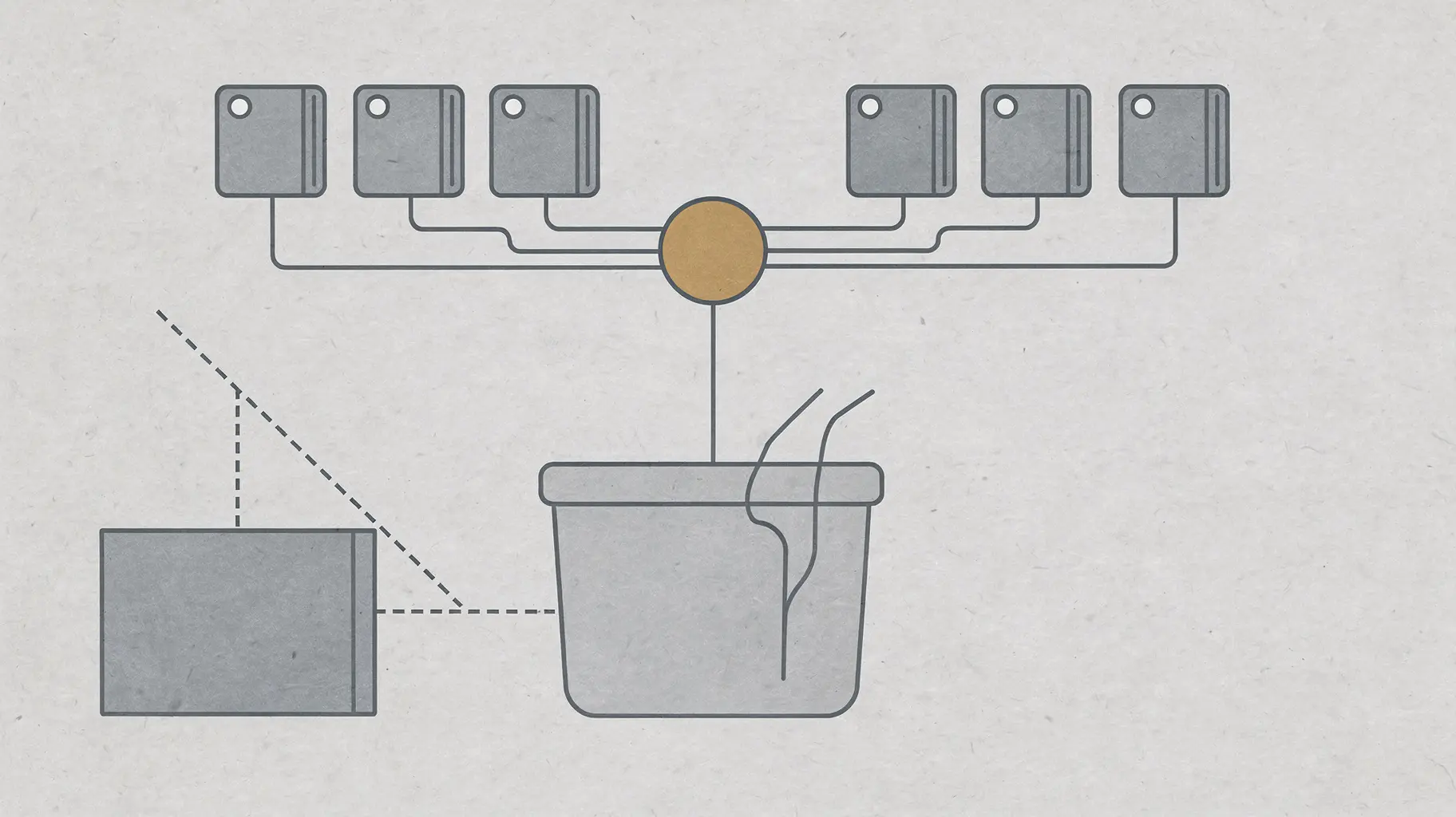
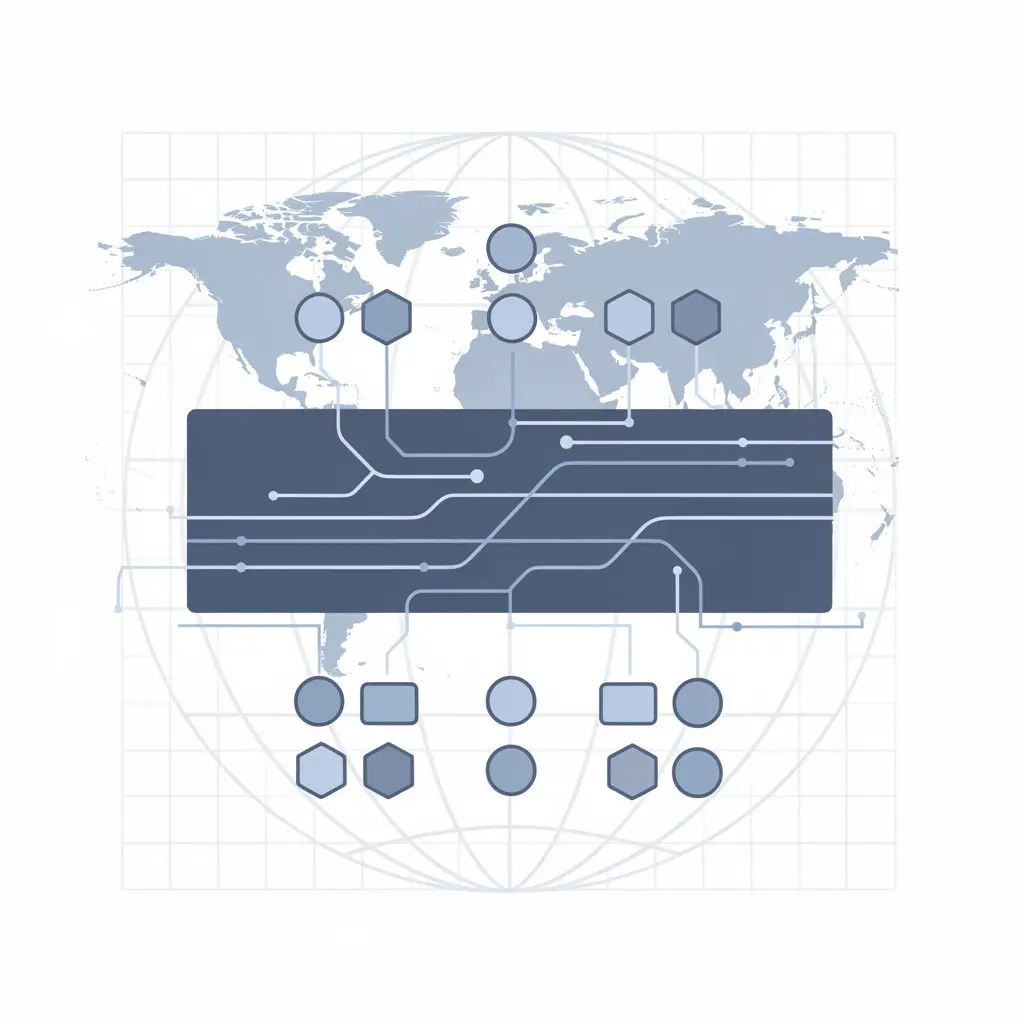
In brief
- NVM Express, Inc. is a non-profit industry consortium that manages the NVMe specification family. The protocol itself is implemented by manufacturers of controllers, drives, network adapters, operating systems and storage platforms.
- NVMe replaced the assumptions of the hard-disk era with multiple submission and completion queues placed in memory and built for flash parallelism and multi-core processors.
- NVMe over Fabrics moves the controller and namespace model onto the network. NVMe/TCP runs over ordinary IP networks, while NVMe/RDMA aims to reduce CPU load and latency through remote data placement.
- The NVMe 2.4 specification set, published on 4 August 2026, separates the base architecture, PCIe, RDMA and TCP transports, management, boot, and the NVM, Zoned Namespace, Key Value, Computational Programs and Simple Log Memory command sets.
- NVMe gives local and remote storage a common protocol language. It does not define data durability, file-system semantics, network topology, application consistency or the order of recovery after a fabric failure.
A storage request can leave the server without changing the core command language
A local NVMe drive and a remote NVMe subsystem can accept broadly similar commands, even though one sits behind PCI Express and the other is reached over an Ethernet or RDMA fabric. The host still sees controllers, namespaces, queues and completion statuses. The transport changes, but most of the storage model remains.
This continuity is the main strategic achievement of NVMe. Flash first needed a protocol designed for parallel media and multi-core hosts. Then NVMe over Fabrics carried the same architecture into disaggregated storage, where capacity no longer has to sit in the same PCIe root as the application server.
A common language makes it possible to pool capacity, build composable infrastructure and move resources between compute nodes. At the same time the failure boundary changes: a local PCIe error becomes a matter of packet loss, discovery, authentication, congestion and path recovery. NVMe did not turn storage into 'just a network service'; it made storage semantics portable between local and networked transports, and made the network part of the storage system.
Flash needed a protocol for parallelism, not mechanical latency
Older interfaces were shaped around hard disks, shallow queues and almost sequential processing. Flash could perform far more operations at once, but protocol overhead and lock contention kept the host from using that potential fully.
Industry work on a new interface for non-volatile memory began around 2009, and NVMe 1.0 was released in 2011. Submission and completion queues were placed in host memory, the number of queues and their depth increased sharply, and work could be pinned to individual CPU cores instead of one shared bottleneck.
Low latency still does not happen automatically. It depends on controller firmware, the media itself, interrupts, polling, NUMA placement and PCIe topology. Operating-system and vendor support expanded in 2012–2013, and the NVM Express consortium was incorporated in 2014. This history explains why NVMe is not just a faster connector but an architecture that expresses parallel data handling.
The consortium separates protocol governance from product competition
NVM Express, Inc. is not a drive maker or a storage system vendor, but a non-profit industry consortium. Its members include companies building processors, controllers, media, network adapters, switches, operating systems and complete platforms.
At the time of the research cut-off, the president was listed as Amber Huffman of Google, the treasurer as Curtis Ballard of AMD, and the secretary as David Allen of Microchip; the board included thirteen promoter-level representatives. Working groups develop changes and agree releases, while vendors choose which versions and features to implement. Testing, interoperability workshops, product lists and trademark rules create a verifiable basis for market claims.
This model lets competitors agree on one protocol while continuing to differentiate in hardware, firmware, management and services. But influence is unevenly distributed: the largest companies can commit more engineers and early implementations. Voting on a specification does not force a product to reach the market; real power appears where the document meets drivers, firmware, tooling and customer demand.
NVMe 2.0 turned one growing document into a modular family
When NVMe grew beyond the local block device to cover fabrics, management and specialised media, maintaining one monolithic specification became difficult. In 2021, version 2.0 split the common architecture, command sets and transports into documents with independent versioning.
The Base Specification describes controllers, namespaces, queues, capabilities, logs and common semantics. The transport documents tie that model to PCIe, RDMA and TCP. Separate command sets define NVM, Zoned Namespace, Key Value, Computational Programs, Simple Log Memory and other operations; NVMe-MI and Boot cover management and boot.
Modularity allows one layer to change without rewriting the whole family. The price is a more complex version matrix. The phrase 'supports NVMe 2.4' says little without a list of the base specification, transport, command set and optional features. This structure reflects the market: NVMe is no longer a single host-to-drive protocol but a set of compatible contracts for different media and topologies.
Submission and completion queues tie storage work to CPU cores
The host places commands in submission queues in memory, the controller processes them and writes results to the associated completion queues. Doorbell registers tell each side that a queue position has changed.
Multiple queue pairs let work be spread across cores, reduce shared locks, batch commands, tune interrupts or use active polling. But the number of queues by itself does not guarantee good results: too few creates contention, too many consumes memory and complicates fair service. Latency is affected by interrupt affinity, NUMA and the controller's internal policy.
The protocol offers mechanisms, not one ideal setting. A database, a virtual-machine node and an AI checkpoint writer need different depths and priorities. The importance of the model is that parallelism became part of the storage interface and could later be carried across the network without creating a separate network command language.
Controllers, subsystems and namespaces separate the protocol service from the media
An NVMe subsystem can contain one or more controllers, which provide one or more namespaces. A namespace is a logical address space or specialised storage service presented to the host.
One physical system can present several logical capacities, and one namespace can be reachable through different controllers and paths. An array hides the internal media layout behind a common protocol endpoint. A namespace is not a file system, a durability guarantee or a ready-made tenant boundary: inside there may be RAID, erasure coding, replication or no redundancy at all.
The host discovers capabilities, attaches to namespaces and reads status logs. Shared namespaces are suitable for clusters only with correct coordination. The decoupling between logical service and physical device makes storage composable, but raises the cost of accurate identification, discovery and access control.
Administrative commands are as important as reads and writes
NVMe separates administrative queues from I/O queues. Through administrative commands the host identifies controllers and namespaces, configures features, obtains logs and changes subsystem state. Ordinary work operations run on the queues of the selected command set.
The separation simplifies monitoring and management, but makes the administrative path especially privileged. A single command can change a namespace configuration, activate firmware or move a controller into another state. In a networked environment this channel needs protection at least as strong as the data path.
The protocol also allows asynchronous events that require path switching, resets or operator intervention. NVM Express describes messages; the operating system, platform and administrators decide who may send them and how to coordinate potentially destructive actions.
The PCIe transport keeps the local path close to memory and hardware
With local NVMe, controller registers and queues are mapped through PCI Express. The host writes commands, rings doorbell registers and receives completions through interrupts or polling. This path reduces the number of software layers between the application and the device.
'Local' does not mean 'simple'. PCIe switches, IOMMU, hot-plug, power-saving states and NUMA all affect behaviour. A drive may logically belong to one server but physically sit closer to another CPU socket. A firmware reset can disrupt a queue, and a topology far from the CPU can add inter-socket traffic.
NVM Express defines the storage binding, while PCI-SIG defines the electrical and link foundation of PCIe itself. This is a clear example of standards composing: NVMe sets the semantics, PCIe provides the local transport, and other documents carry the same base architecture onto the network.
NVMe over Fabrics turns controller communication into a network service
NVMe over Fabrics 1.0 and NVMe-MI 1.0 were published on 9 June 2016. NVMe-oF carries commands and responses in capsules and creates queue pairs over network connections.
The host connects to a remote subsystem, negotiates controller properties and maps I/O queues onto the fabric. The target server presents namespaces in the same common model as a local drive. This makes it possible to separate compute and capacity, upgrade them independently and place them in different failure zones.
But the network becomes part of storage latency and availability. Connection loss, route changes, congestion and switch maintenance now affect I/O. Timeouts and retries must not turn a brief network fault into data corruption or a long application outage. NVMe-oF's achievement is semantic continuity, not a promise that a remote path will behave like local PCIe.
Discovery services make a dynamic fabric manageable
The host needs to learn which NVMe subsystems are available, which transports they support and at which addresses to reach them. A discovery controller issues records with addresses, transport types and identifiers.
Automation can poll such a service and set up connections to selected controllers – important in a composable environment where capacity and paths change. But the catalogue becomes a sensitive part of the control plane. A stale record sends a host to an unreachable target, and a forged one to the wrong storage. Redundancy, authentication, change auditing and admission policy are required.
Discovering that a subsystem exists does not grant the right to attach. NVMe makes the format standard enough for automation, but operators still own the source of truth, the record lifecycle and how records relate to zoning and access control.
NVMe/TCP brought fabric storage onto ordinary IP networks
NVMe/TCP packs commands and data into its own protocol data units and sends them over reliable TCP streams. This allows remote NVMe storage to be deployed on a routable Ethernet network without a separate RDMA fabric.
The main advantage is a familiar operating model. An organisation can use ordinary IP addressing, routing, monitoring and familiar security tooling. An existing data-centre network can already carry the service, and kernel or user-space implementations rely on a mature TCP stack.
This choice has costs. Segment loss and retransmission can increase tail latency, and an ordered stream creates head-of-line blocking. Data may pass through more copies and consume more CPU than with RDMA. But operational simplicity and broad hardware support often matter more than a few microseconds. NVMe/TCP expanded the NVMe-oF market: disaggregated storage stopped being only a specialised HPC construct and became an ordinary network-engineering task.
NVMe/RDMA cuts overhead at the price of stricter fabric discipline
The RDMA transport uses queue pairs and remote data placement. A network adapter can place data directly into a registered buffer, reducing copies, context switches and CPU load.
This is attractive for HPC, databases and AI systems where microseconds matter and the application needs the CPU. But the operating model is more demanding: memory registration, NIC firmware, congestion control, loss and network isolation must be designed together. RoCE may depend on priority flow control or newer congestion-management mechanisms; iWARP and InfiniBand have different prerequisites.
A network that looks healthy for ordinary TCP can behave badly under synchronous RDMA writes. Tail latencies, propagation of pause frames and recovery from partial failures all need separate measurement. The protocol provides the storage binding; the operator provides the fabric discipline.
Multipath access turns redundant connections into a host decision
An NVMe host can reach one namespace through multiple controllers and paths. Asymmetric Namespace Access states show whether a path is optimised, non-optimised, inaccessible or transitioning.
The operating system selects active paths, distributes I/O and switches over after a controller or link failure. This improves availability and lets parallel infrastructure be used. But redundancy must be real: two cables converging on the same switch, controller, rack or power supply can fail at the same time.
Slow failover will still cause an application timeout, and balancing across paths with different latency will hurt results. Stable namespace identity is also needed so that multiple controllers do not look like duplicate disks. The standard provides states and mechanisms; architecture and testing determine whether the service survives a real incident.
Reservations limit access to shared storage but do not replace cluster consensus
NVMe Reservations let hosts register keys and manage access to a shared namespace. Cluster software can acquire, release, preempt or verify a reservation.
The mechanism is useful for fencing. If one node has failed, another can prevent the old node from continuing to write. But a reservation does not decide who should own the resource: consensus, cluster membership and recovery remain with an external system.
A wrong key or split brain can cause either downtime or conflicting writes. A reservation executes a decision made elsewhere but does not make it correct. The protocol therefore cannot be presented as a ready-made high-availability system.
Authentication and TLS become mandatory once you cross the PCIe trust boundary
A local drive is physically close to the host and often inherits the platform's trust. A remote subsystem is reachable through a shared network, so host and controller need verifiable identities, an access policy and a protected channel.
The NVMe Fabrics specifications include in-protocol authentication and TLS mechanisms for TCP. They can verify the parties and protect selected traffic, but a feature existing in a product is only the start. Operators must issue and rotate keys or certificates, choose algorithms and bind identities to specific namespaces.
Encryption may need extra CPU or an accelerator and complicate diagnostics. Disabling protection for performance brings back the risk of interception. NVMe did not create this problem: the disaggregated architecture simply showed that a physical connection can no longer be the main trust boundary.
NVMe-MI gives management systems a path independent of application I/O
The NVMe Management Interface describes messages for inventory, status, configuration and management. A BMC or a separate management controller can poll the drive and subsystem without using the main application path.
Out-of-band visibility helps when the host driver is not working. Fleet tools get information about firmware, status and device capabilities. But transport bindings and vendor behaviour differ: firmware updates, resets and access rights often require product-specific logic.
NVMe-MI can run over the broader DMTF stack, including MCTP and Redfish. This underlines the layered nature of infrastructure: NVM Express defines storage-management semantics, while DMTF and platform vendors connect it to server management. No single consortium controls the whole path.
Zoned namespaces pass some media constraints to host software
A Zoned Namespace divides capacity into zones in which writes must generally proceed sequentially. The host explicitly opens zones, writes to them, resets them and queries their state.
For suitable media and workloads this can reduce internal address translation and garbage collection. File systems, entity stores and databases get more control over data placement and erasure behaviour.
The benefit does not appear without support higher up. You cannot attach ZNS as an ordinary block disk to a random-write workload and expect a speed-up. Software must manage zone state and recovery. ZNS moves part of the complexity from the controller into the host stack: this can make behaviour more predictable, but it increases developer responsibility.
Key Value and Simple Log Memory expand the very idea of a namespace
The NVMe family includes commands beyond reading and writing logical blocks. Key Value addresses entities by key, and Simple Log Memory describes an append-only record model.
Such interfaces can reduce the number of translations between the application model and a block device. The controller performs operations closer to the workload's needs. But specialised semantics require support in the host, libraries and products.
If every vendor implements only its own subset, the common standard can hide a new fragmentation. Performance depends on media, controller and scenario. The modular architecture allows experimentation without breaking the base NVM, but success must be measured in interoperable products and portable software, not in the number of specification pages.
Computational Programs move selected processing closer to data
NVMe 2.4 includes the Computational Programs command set. The general idea is that a controller can offer programs or operations that process data next to the drive, instead of constantly shipping every byte to the central processor.
For suitable workloads this reduces data movement and host load. For AI pipelines, analytics and compression, the cost of moving large datasets is often comparable to the cost of computing.
The security boundary is especially important here. Code next to storage requires isolation, quotas, versioning, verifiable results and clear failure behaviour. The host must discover capabilities and handle their loss correctly. Publishing a command set does not yet create a market: compatible controllers, operating systems and applications are needed. The feature should therefore be treated as an evolving extension, not as a standard property of all NVMe devices.
Conformance testing gives useful evidence but does not certify the whole service
The consortium organises conformance tests, workshops and product lists. Vendors can demonstrate support for selected capabilities and use trademarks under the program rules.
This reduces ambiguity and helps find bugs between hosts, controllers and transports. Multi-vendor events are especially useful because they surface rare sequences missed in a single vendor's lab.
A listing is not a benchmark or a reliability guarantee. It does not prove that two products support the same options, perform well under a specific workload or recover from any fabric failure. Buyers need to know versions, transport and command sets, and then test their own topology and failure scenarios. Compliance checks the protocol boundary; production quality remains a property of the whole system.
NVMe changed storage economics by decoupling capacity from the server
The disaggregated architecture lets capacity be pooled and attached where it is needed. A compute server can be replaced without moving physical drives, and a shared pool reduces idle capacity locked to individual nodes.
Savings are not guaranteed. The fabric, network adapters, switches, controllers and software layer require capital and operating costs. Remote storage needs extra redundancy and security measures, and the most latency-sensitive workloads may still prefer local devices.
The common protocol creates space for specialisation: media, controller, network and software-platform vendors compete around one model. But it does not make products interchangeable. NVMe moves part of the cost from a closed interface into orchestration, reliability and fabric operations.
AI clusters make storage-fabric behaviour visible at whole-complex scale
Training and inference move large datasets, model state and checkpoints. If storage cannot feed data fast enough, or a synchronous checkpoint write saturates the network, expensive accelerators sit idle.
NVMe/RDMA and NVMe/TCP allow scalable flash pools to be attached, and multipath and disaggregated placement help spread capacity. In the future, specialised and computational commands may reduce data movement.
But not every NVMe capability is automatically useful for AI. Access pattern, caching, object storage, data preparation and contention with inter-accelerator traffic all matter. The strategic connection is that storage has become part of the overall AI fabric: a compatible protocol helps, while performance is determined by the whole cluster architecture.
NVMe exists alongside SCSI, CXL and object storage rather than simply displacing them
SCSI and SAS remain in many systems and have mature management tooling. NVMe dominates many flash and high-performance projects, but it does not erase the installed base with a single specification release.
CXL addresses coherent memory and device interconnect, not the same set of storage commands. In composable systems it can complement NVMe. Entity protocols work at a higher semantic level and often use NVMe underneath.
PCI-SIG defines PCIe, different ecosystems define RDMA transports, SNIA covers storage architecture and management, DMTF covers platform management, and UEC covers Ethernet fabrics for AI and HPC. NVM Express's role is narrower and more precise: one model of controllers, namespaces, queues and commands across different transports.
The NVMe 2.4 release shows the breadth of the family and the pressure of versioning
The NVMe 2.4 set was ratified on 31 July and published on 4 August 2026. It includes the Base Specification, PCIe Transport 1.4, RDMA Transport 1.3, TCP Transport 1.3, NVMe-MI 2.2, Boot 1.4 and several command sets.
The breadth signals maturity, but complicates the implementation matrix. A product can support Base and NVM without Computational Programs, a particular security feature or one of the transports. Marketing claims of 'supports NVMe 2.4' must therefore be accompanied by a precise list of components and versions.
The consortium's main task is to keep a recognisable architecture while letting transports and specialised command sets evolve independently. The operator's main task is not to confuse a general release number with the readiness of the whole host, controller and management chain.
NVMe made storage composable, but did not make the service simple
The protocol changed access to flash, then carried the same queues, controllers and namespaces into the network environment. This made pools, multiple paths and specialised media models practical.
At the same time, responsibility moved into discovery, networking, security, drivers and operations. NVMe does not describe data durability, file-system consistency, backup or application recovery. A fast, formally compliant controller can sit inside a badly designed service.
The consortium's long-term value is a common language. The final result is determined by the system built on top of it.
Doorbell registers, interrupts and polling turn shared memory into real work progress
Queues live in host memory, but the controller and CPU need to know when new entries appear. Doorbell registers report the new position, and interrupts or polling notify the host of completed work.
Small details have a large effect. Frequent interrupts consume CPU; constant polling reduces latency but occupies a core even when idle. Interrupt coalescing improves efficiency but can delay individual operations. Controllers also distribute work across queues differently.
There is no universal mode. A general-purpose server may prefer power saving, while a latency-critical path may use a dedicated polling core. Any serious comparison must state queue depth, interrupt mode, CPU affinity and workload.
Queue priorities and arbitration decide who gets low latency under contention
Multiple queues allow traffic to be split across cores, tenants or tasks. But the controller still has to allocate the shared media and internal channel resources.
NVMe provides ways to express priority and arbitration. A platform can serve sensitive operations ahead of background ones. But policy depends on the implementation: two controllers with the same interface may interpret fairness differently, and deep queues often raise throughput at the cost of tail latency.
A noisy tenant can consume internal resources even with separate host queues. In networked storage, controller arbitration combines with fabric congestion. Isolation is possible, but service quality is proven only through tests under competing load and telemetry.
Controller logs and telemetry make hidden firmware state observable
Through administrative commands a controller can report temperature, media errors, wear indicators, firmware slots and other health signals. This data helps predict replacement and distinguish a network timeout from an internal device fault.
Completeness depends on the vendor. A reset can destroy context, and important information may remain on vendor-specific pages. Correlating timestamps with host and network logs can also be difficult.
The protocol makes observability portable, but not complete. Operators should keep logs outside the device, understand trigger conditions, and not treat a single green summary value as proof that every internal path is healthy.
Firmware activation is a storage availability event
NVMe defines controller firmware download and activation; a device can have multiple slots and apply an update immediately or after a reset. Standard commands simplify fleet maintenance but do not reduce its risk to the level of an ordinary user package.
A bad image can disable the controller, and activation can interrupt I/O. Multipath hides one controller's update only when the alternate path is genuinely independent and tested. Signed images, model checking, staged rollout and rollback are needed.
The work may be performed by NVMe-MI or a BMC, so the chain of responsibility runs through the protocol, device vendor, platform firmware and operator. A common command reduces friction but does not guarantee recovery.
ANA describes path quality, not just a working/broken state
In a multi-controller subsystem, different paths to the same namespace may have different proximity to the media. One path is optimised; another is for redundancy and runs slower.
ANA lets a path be reported as optimised, non-optimised, inaccessible, persistently lost or transitioning. The host can choose a route sensibly, but must receive state changes promptly. Stale information sends traffic down a slow or failed path, and different operating systems may switch over at different speeds.
ANA reveals part of the internal topology without disclosing all of it. Two 'optimised' paths are not necessarily equal in latency and independence. Transitions should be tested during controller and fabric maintenance.
TCP framing adds storage checks to a familiar transport
NVMe/TCP sends command capsules and data in protocol data units over TCP. Depending on configuration, headers and data may carry digest checks, adding another layer of integrity checking.
TCP already guarantees reliable, ordered delivery, and the NVMe binding explains how commands, data placement and connection state fit into that byte stream. Ordering creates head-of-line blocking: losing one segment delays later data on the same connection. Multiple queues and connections reduce concentration, but do not remove congestion control and retransmission from the picture.
Digest settings, segmentation offload and the number of copies affect CPU. A benchmark where they are disabled or unstated may not describe a production security configuration. The transport's strength is deployability; its behaviour must be assessed as a storage protocol running inside a TCP system.
RDMA is several transports with different prerequisites, not one fabric
NVMe/RDMA can run over RoCE, iWARP and InfiniBand. All support remote data placement, but they use different link models and different ways of handling loss and congestion.
NVMe keeps the common queue and capsule semantics, but operations are determined by the chosen network. RoCE usually requires especially careful loss and congestion tuning; iWARP builds on TCP; InfiniBand has its own architecture. A given product may support only part of the family.
So the phrase 'NVMe over RDMA' does not reveal the NIC, switches, transport type or fabric policy. The diversity helps organisations with existing HPC networks, but complicates compatibility and support. Documentation and testing should always name the exact RDMA environment.
Centralising the discovery service simplifies attachment and creates a critical dependency
A central or hierarchical discovery service gives hosts an up-to-date list of available subsystems. Automation can add and remove capacity without manually configuring every server.
Discovery then becomes part of the control plane. A bad record connects a host to someone else's namespace or removes access to a healthy target. A service failure can block new connections even while established ones continue.
Redundant controllers, authenticated records and change auditing are needed. Host-side caching improves resilience but trades off freshness. NVMe standardises the storage record; the reliability and management of the catalogue remain the operator's job.
NVMe Boot brings the network dependency into the moment a server starts
The NVMe Boot specifications describe booting from NVMe, including a remote fabric-attached resource. A server can get its root volume from a shared subsystem instead of a local disk.
This is convenient for diskless and composable systems and simplifies compute-node replacement. But before the OS starts, the network, discovery, authentication and remote storage must already work. Diagnostics become harder because the familiar host tools are not yet available.
Firmware, NIC and fabric must provide independent means of observation. A fallback local path or recovery media can be decisive. NVMe here becomes not just an application channel but a condition for the machine being able to start at all.
Media wear and behaviour stay below the protocol abstraction
NVMe can report health and remaining endurance, but different memory types have different write limits, latencies and failure modes. The controller manages wear levelling, error correction and internal placement.
A common NVM interface does not make all flash identical. A read-oriented device can exhaust its endurance quickly under heavy writes while remaining formally protocol-compliant.
Media qualification, workload matching and replacement policy are needed. ZNS exposes more placement detail to the host; an ordinary drive hides it internally. The abstraction frees the application from knowing every NAND property, but becomes dangerous if a buyer takes an identical connector to mean identical endurance.
Data protection sits above and below NVMe, not inside one command set
NVMe provides metadata, logs and features useful to a storage system, but does not define a universal RAID, erasure coding or replication scheme. A namespace can rest on a single disk, mirrored controllers, distributed media or a cloud service.
The host often cannot infer the durability level from the protocol. File systems and applications still need crash consistency, checksums and backup. A successful completion means the controller accepted the command by its own rules; actual persistence depends on cache and settings.
This matters for benchmarks. Disabling barriers or write protection improves numbers but weakens durability. Protocol speed cannot be separated from the settings under which data is considered durable.
Reservations require hard fencing after a host failure
A cluster registers keys and uses reservations to manage shared capacity. After one node fails, another can preempt its key and continue.
The problem is that a 'failed' node can come back with old state or keep access through a partitioned fabric. Fencing must guarantee that after ownership changes it can no longer write data.
Reservations provide a hardware-enforced mechanism, while membership, coordination and power-off remain outside the protocol. In practice they are combined with network and server fencing. Testing must include a late-returning host, partial network loss and controller failover, not only a clean planned switchover.
NVMe-MI and Redfish bring drives into the platform management loop
NVMe-MI can be carried over platform mechanisms and mapped into Redfish resources. A BMC gets inventory, status and the ability to coordinate firmware even when the main OS is not running.
This improves fleet maintenance and ties the drive into the server lifecycle, but creates another privileged path. Access rights must be coordinated across BMC, Redfish, MCTP and NVMe-MI: a user restricted in the OS should not unexpectedly get broader control through firmware.
Version mapping can also be incomplete: a Redfish may show a capability the lower layer only partially supports. NVM Express defines device semantics, DMTF defines the common management language; compatibility depends on both standards and the vendor implementation.
IP and membership rules affect who can implement the protocol
An industry consortium needs clear rules for contributions, patents and use of specifications. NVM Express provides the institutional framework in which competitors agree common documents and implementation terms.
Widespread adoption depends on predictable rights. Unclear essential claims or unequal access would undermine the common market. At the same time, membership determines who sees early proposals and can commit engineers to discussion. Promoter representation gives large organisations formal weight, while users and smaller developers have fewer resources.
Public documents and compliance programs reduce opacity, but do not reveal all the informal power over the agenda. The consortium's legitimacy rests on a stable, implementable contract for the whole chain, not on the advantage of any single controller architecture.
Disaggregation changes lines of responsibility as much as topology
A traditional storage team could run an array as a relatively autonomous system. An NVMe fabric requires continuous work with network, server, platform and security teams.
Tail latency can originate in the controller, NIC, switch, routing, NUMA placement or an application queue. Diagnosis requires shared telemetry, and boundaries drawn along the org chart slow recovery. Adding capacity consumes fabric buffers and bandwidth; network maintenance becomes a storage event, and certificate rotation becomes a condition of data access.
The protocol makes components compatible. The organisation must make teams, processes and responsibilities compatible.
Local NVMe performance is still determined by the surrounding PCIe topology
A direct-attached drive is often seen as the simplest form of NVMe, but the physical path from CPU to controller can pass through PCIe switches, retimers, IOMMU and power-saving states. The device logically belongs to one host, but physically it may sit closer to one socket than another.
This matters when application threads are pinned to cores and expect memory locality. Inter-socket traffic adds latency and consumes internal interconnect bandwidth. Hot removal requires stopping new commands, completing or cleanly rejecting outstanding ones, updating OS state and not corrupting data.
The protocol defines registers, queues and state transitions, while platform firmware and drivers handle coordination. A meaningful benchmark should therefore state CPU socket, PCIe generation, presence of switches, interrupt mode and power state, not just the drive model.
Connection recovery translates a network failure into storage semantics
When an NVMe-oF connection breaks, the network sees a lost connection and the application sees delayed or failed data access. The host must decide whether to reconnect, move to another controller, retry the command or return an error upward. Both availability and the risk of performing an operation twice hang on that decision.
Timeouts are therefore not just a network setting. A short value speeds failover but turns a brief fault into an application error. A long one preserves a chance to restore the session but leaves tasks hanging. The hardest case is when a write reached the target but the completion was lost: such a command cannot automatically be treated as not executed.
The specification provides a framework for associations, queues and statuses. Resilience rests on tested reconnect, application retry policy and partial-failure exercises, not on one dramatic cable pull.
Namespace identity must persist while capacity moves
The advantage of disaggregated storage is that logical capacity can move independently of the server. This creates an identity problem: after maintenance, the host must recognise the same resource, not a different volume that happened to get a familiar local number.
NVMe provides identifiers and discovery records, but the surrounding control plane must keep them accurate across controller replacement, path additions and namespace moves. A stale cache or a reused identifier can attach a server to someone else's data.
In a multi-tenant environment, presentation, access and host identity must line up. Network segmentation by itself does not prove a namespace is the right one, and a correct identifier does not prove the right to access. An authoritative inventory is needed, tying protocol identity to owner, replication and recovery procedure.
Thin provisioning moves the risk of capacity shortage into measurement and policy
A namespace can present a logical size not backed one-to-one by physical media. The platform allocates blocks as needed, shares the pool among tenants and returns freed regions. NVMe carries the commands, but it does not decide how aggressive overcommit may be.
This improves economic efficiency, but the risk stays hidden until several workloads use their promised capacity at the same time. A host can see free space while the shared pool is already close to a physical limit.
Telemetry must separate logical size, actual consumption, real headroom and failure reserve. The buyer must know in advance what happens when the pool fills, which writes are served first, how warnings propagate and whether capacity is truly reserved for failover. Elasticity stays reliable only with honest accounting.
Quality of service runs through queues, controllers and the whole network
NVMe provides multiple queues and arbitration mechanisms, and a platform can add tenant policy and service classes. In a fabric environment, final latency also depends on NIC queues, switch buffers, congestion control, the chosen path and the target scheduler.
High priority on the host does not guarantee low latency in a congested network. Network prioritisation will not help if the controller is saturated. Several independent QoS mechanisms can even conflict if each reacts to congestion in its own way.
Joint measurement of command latency, queue depths, retransmission, path state, controller load and application progress is therefore required. An average can look fine while tail spikes break a checkpoint or transaction log. A credible QoS promise explains the layer at which it is enforced and what happens under overload.
Data integrity must be protected at every boundary a command crosses
A command passes through host memory, PCIe or a network transport, controller memory, firmware and physical media. Corruption or misdirection is possible at every stage. Digests, media ECC, metadata and upper-level checksums protect different segments.
One mechanism is not enough. TCP reliability does not prove a write went to the correct logical block. Media health does not confirm host memory correctness. An application checksum will detect a problem, but will not identify its source.
The architect must decide in advance where verification happens, which errors are retried, which are surfaced upward, and whether end-to-end protection survives offload or special commands. Encryption and authentication protect confidentiality and identity, but do not replace detection of accidental corruption. NVMe carries the interface; the complete integrity model is left to the system.
In practice, the driver and firmware matrix becomes part of the protocol
Specifications move on one timescale, while OS drivers, controller and NIC firmware, switch software and management tools move on another. A capability can exist in a document long before the whole chain supports it reliably.
A controller can advertise a feature an older driver ignores. A host can request an option that a particular firmware implements incorrectly. A management tool shows only the fields it knows. The more optional features there are, the wider the combination matrix.
Operators often certify a narrow set of versions and update it gradually. This is not backwardness but a way to protect data access from untested interactions. The consortium helps with precise capability reports, errata and interoperability events; vendors should publish supported combinations, and buyers should treat driver and firmware qualification as part of the architecture.
Multi-vendor testing finds what a conformance list cannot show
A conformance test asks whether one implementation meets selected requirements. A multi-vendor event asks whether independently built hosts, controllers and transports can work correctly together.
Differences show up in discovery, timeouts, optional authentication, log interpretation, namespace state and error recovery. A product can pass internal tests and then break on a legal but rare sequence of peer behaviour. This may point to ambiguous text, an limited public evidence test, or an implementation shortcut.
The value of a workshop lies in recurring problem categories, not in a photo of connected stands. Public, anonymised error types, errata and version guidance would strengthen trust. But even a successful lab does not replace testing on a routable fabric, real congestion and your own recovery tooling.
Fibre Channel and NVMe show that a new protocol rarely erases accumulated operational experience
NVMe over Fabrics is sometimes described as the mandatory replacement for all earlier storage networks. In practice, organisations keep the skills, zoning, monitoring and reliability procedures built around Fibre Channel, iSCSI and SCSI.
The comparison is not simply 'old versus new'. A mature infrastructure may value predictable recovery and support over smaller theoretical overheads. A new AI or cloud cluster may choose Ethernet or RDMA from the start because its scale and software are being designed anew.
Migration happens workload by workload. NVMe's common command model narrows the gap between local and remote media, but the chosen fabric still defines the team's tools and skills. Storage changes layer by layer, not through a clean technological reset.
AI checkpoints turn storage latency into compute cost
Large training jobs periodically write checkpoints so that all work is not lost after a failure. When many accelerators write at once, a synchronous burst forms. Latency leaves expensive compute idle, and a failed checkpoint extends recovery time.
NVMe fabrics are attractive because parallel queues and remote namespaces connect a large flash pool to many hosts. But the outcome depends on metadata services, congestion, the target scheduler and the application. The peak IOPS of one server say nothing about a cluster-wide checkpoint.
What should be evaluated is checkpoint duration, recovery, job completion and accelerator idle time, including parallel reads, background compaction and a path or target failure. The CPU spent on transport also has a cost. AI makes the protocol's boundaries visible: the economic benefit appears only when the whole compute, network and storage pipeline stays productive.
Specialised command sets create a new test of software portability
The modular architecture lets Zoned Namespace, Key Value, Simple Log Memory and Computational Programs develop alongside ordinary block NVM. A new media type or operation does not have to be forced into a single read/write pair.
The benefit depends on the software above. File systems, databases, libraries and orchestration must discover the capability and understand it the same way. If each vendor implements its own subset, a standard name hides a new lock-in.
When a controller performs computation, the security review changes too: code identity, resource isolation, diagnostics, updates and verifiable results are all needed. The consortium's modularity is sensible – it defines a capability without forcing it on everyone. The market test is multi-vendor host support and portable applications.
The protocol lowers one switching cost and leaves others in place
Common commands and transport make controllers comparable and avoid being locked into a proprietary attachment method. This is a real increase in competition, but not full interchangeability of the storage service.
Data placement, replication, snapshots, encryption, management APIs, support and behaviour under load remain product-specific. Moving a namespace can require copying a huge volume and translating policies, even when both targets speak NVMe.
Standards do not deliver operational independence automatically. Lock-in can move from the array into orchestration or a cloud that controls discovery and identity. The buyer keeps the standard as leverage by demanding a precise capability matrix, export, independent recovery and verified replaceability of implementations.
Member Briefing
Deeper Profile Context
Sign in with the right membership level to unlock the full briefing and source notes.
Only for Strategic Circle
Strategic Circle
Open to all readers. Unlock profile briefings after joining and signing in.
Join Strategic CircleOnly for Leadership Alliance
Leadership Alliance
For qualified IP-asset owners and management; sign in to unlock alliance briefings.
Join Leadership Alliance