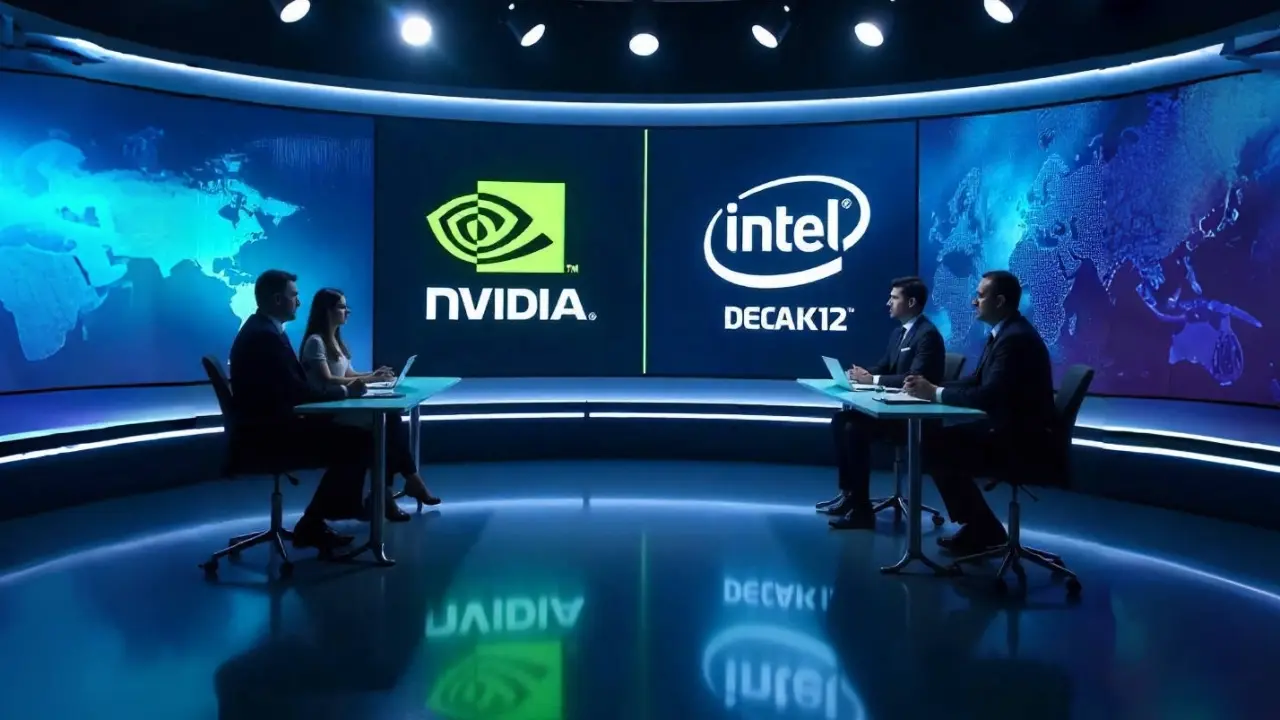
- Nvidia invests $5 billion in Intel following the US government’s acquisition of a 10% stake, enabling tighter cooperation on chip architectures.
- The deal supports joint development of CPUs and AI infrastructure platforms under regulatory review.
What happened: Nvidia invests in Intel following government stake
Nvidia is committing $5 billion to acquire an equity stake in Intel after the US government, under President Donald Trump’s administration, acquired a 10% ownership of Intel. The deal is subject to regulatory approvals. It involves collaborative work between the two firms to “seamlessly connect” their architectures, with Intel producing custom CPUs that Nvidia will use in its AI infrastructure platforms in data centres.
Additionally, Intel will build chips for PC products that integrate Nvidia technology.
Jensen Huang, CEO of Nvidia, said this “historic collaboration tightly couples NVIDIA’s AI and accelerated computing stack with Intel’s CPUs and the vast x86 ecosystem – a fusion of two high-capacity platforms.” The announcement follows President Trump’s earlier acquisition of his stake, which was made despite criticisms over Intel CEO Lip-Bu Tan’s alleged “questionable links to China.” Intel confirmed that its leadership under Mr Tan met with President Trump, Commerce Secretary Howard Lutnick, and Treasury Secretary Scott Bessent to discuss the company’s renewed commitment to US tech leadership.
Also read:Nvidia UK AI investment to boost data centres
Also read:OpenAI, Nvidia CEOs to announce UK data centre investments
Why it’s important
This collaboration represents a pivotal moment in the AI hardware industry. As demand for accelerated computing and AI workloads increases globally, companies like Nvidia and Intel must adapt or risk falling behind. By combining Nvidia’s AI stack with Intel’s CPU architecture, the industry could see more efficient performance, reduced duplication of effort and potentially new CPU-AI hybrid products.
Moreover, from a geopolitical perspective, the US government’s stake underscores national concerns around technology sovereignty and domestic manufacturing. Stakeholder scrutiny—especially around regulation, security, and supply chain dependencies—will be intense. This deal may inspire similar approaches elsewhere, such as increased state involvement or public-private partnerships in semiconductor industries.
From a positive standpoint, this partnership could drive innovation, improve AI infrastructure, and strengthen US leadership in technology. However, there are risks: regulatory approval is not guaranteed, and integration of hardware/software stacks is a complex engineering challenge. Overall, this move suggests the future of AI hardware lies in deeper cooperation between traditional chip makers and AI specialists.