
Summary
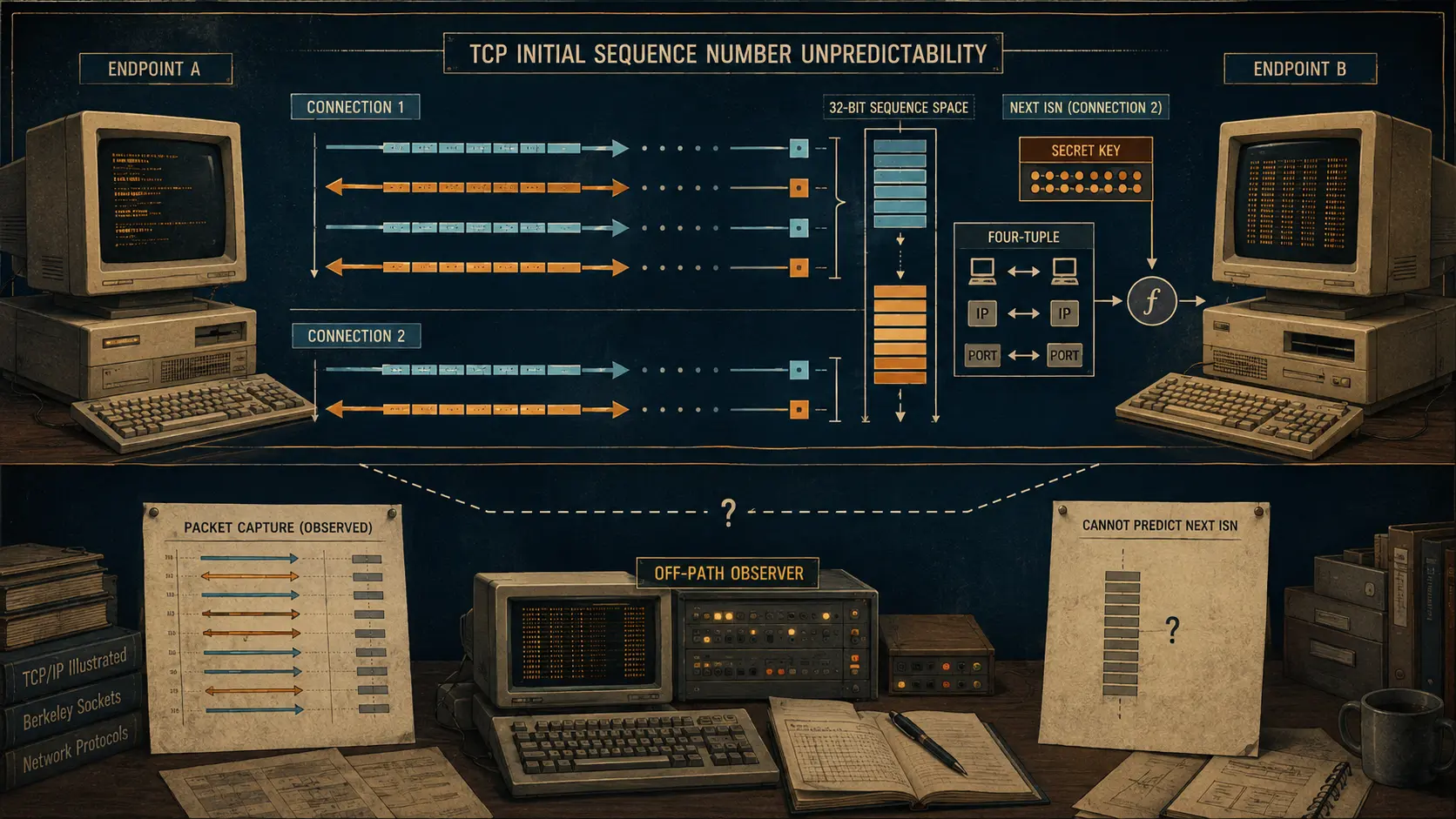
- TCP kept a moving clock component but added a secret-keyed offset bound to the connection four-tuple.
- The result frustrates off-path prediction; it does not authenticate either endpoint. An attacker did not need to read a victim's traffic if a server's next initial sequence number could be forecast from a recently observed one. The blind spoofing described in RFC 1948 exploited precisely that gap: the attacker sampled the target's sequence behaviour, forged a SYN under another source address, and guessed the acknowledgement needed to make the unseen reply appear accepted.
The proposed repair kept TCP's timer-like progression, which helps separate old and new incarnations of a connection, but changed what could be learned across connections. The starting number became M + F(four-tuple, secret). Even when the public timer component advanced predictably, a different source address, destination address, source port or destination port selected a secret-dependent offset that an outside observer should not be able to compute.
RFC 6528 turned that proposal into a Standards Track algorithm, and RFC 9293 incorporated it into the current TCP specification. Nothing new had to be carried on the wire. The control change lived inside the endpoint's choice of the 32-bit number placed in its SYN.
Member Briefing
Deeper Profile Context
Sign in with the right membership level to unlock the full briefing and source notes.
Only for Strategic Circle
Strategic Circle
Open to all readers. Unlock profile briefings after joining and signing in.
Join Strategic CircleOnly for Leadership Alliance
Leadership Alliance
For qualified IP-asset owners and management; sign in to unlock alliance briefings.
Join Leadership Alliance