Summary
- RFC 8020, November 2016, states that an NXDOMAIN response means "the domain name which is thus denied AND ALL THE NAMES UNDER IT do not exist", clarifies RFC 1034 and modifies part of RFC 2308.
- The gap it closed was in caches, not in theory: iterative resolution already stopped at the first authoritative NXDOMAIN, but "in most known existing resolvers today, a cached nonexistence for a domain is not considered 'proof' that there can be no child domains underneath", because RFC 1034 "failed to distinguish Empty Non-Terminal (ENT) names from nonexistent names".
The tree argument nobody had written down
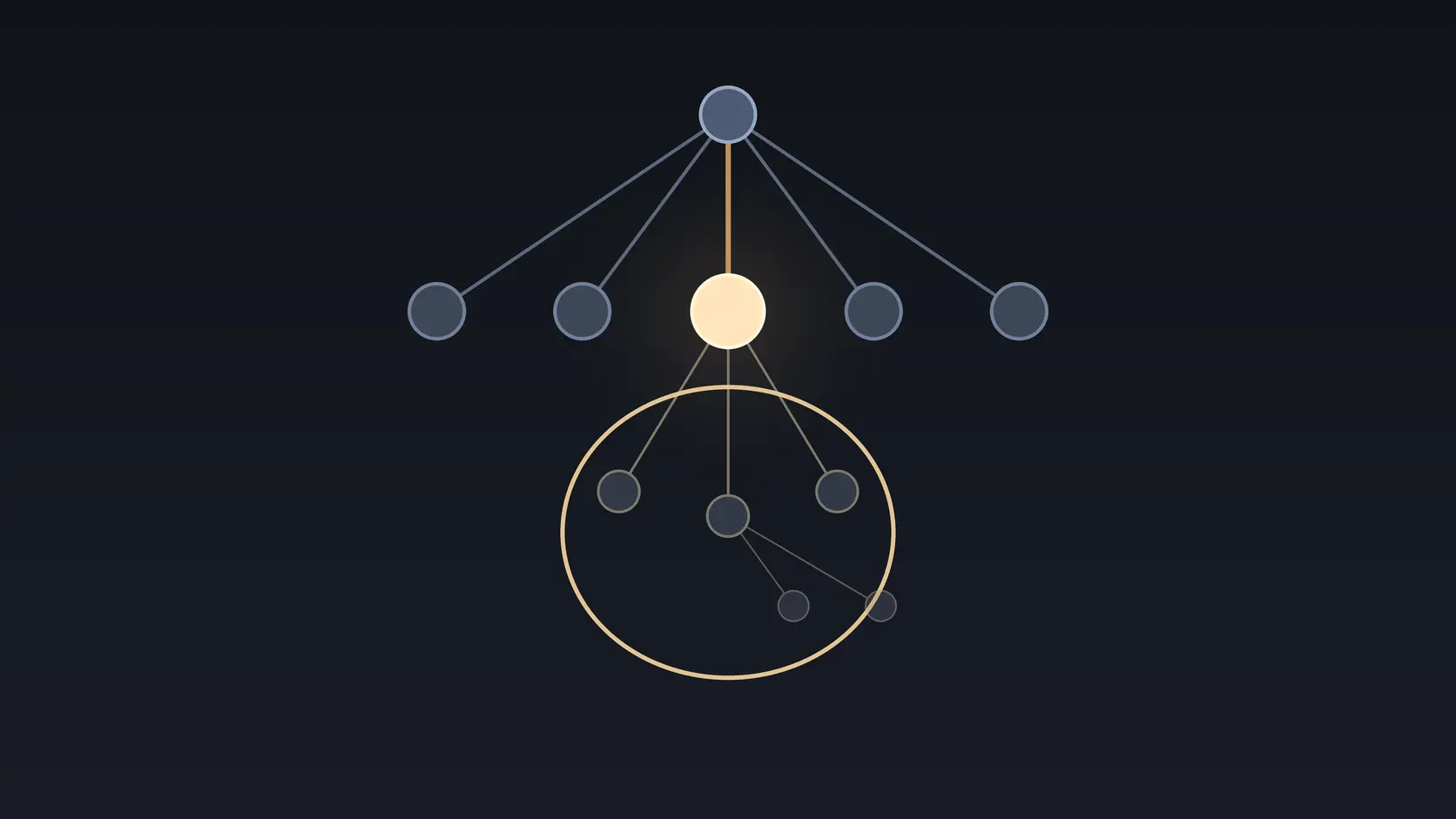
Domain names are a tree, so a node that does not exist cannot have descendants. The memo says this in one sentence and then spends its introduction explaining why an obvious consequence needed a specification. The reason is that DNS has two different kinds of nothing.
A name can be absent because nothing was ever defined there. Or it can be an empty non-terminal: a name that holds no records of its own but has children that do. If a resolver confuses the two, a "no" at one node stops being a statement about the subtree and becomes a local fact, and the safe move is to ask again for every name below.
That confusion was survivable while absence was only a caching question. It stopped being survivable when DNSSEC needed to prove absence, because a proof of non-existence has to be precise about what exactly is being denied.
What the rule changes
Section 2 gives the behaviour in three SHOULDs. An iterative caching resolver should store the NXDOMAIN, should consider all names and record sets at or below that node unreachable, and should answer later queries for those names with NXDOMAIN rather than forwarding them.
The memo's own example shows the saving. Two queries arrive, first for foo.example and then for bar.foo.example. "Many resolvers today will forward both queries." Under the rule, the second is answered from what the first taught the cache.
Then come the exceptions, and they are the interesting part. A resolver that already has cached data underneath the denied name "MAY continue to send it as a reply" until that data's TTL expires, because dropping a usable answer to honour a newer denial costs work and gains nothing. And a validating resolver "MAY decide to implement the 'NXDOMAIN cut' behavior ... only when the NXDOMAIN response has been validated with DNSSEC", which is a way of saying that a denial from an unsigned zone is a weaker claim than a proven one.
A denial that expires
The memo is careful about time. "The fact that a subtree does not exist is not forever": RFC 2308 §3 already says how long an NXDOMAIN may be cached, and RFC 8020 does not touch that number. It only changes what the cached answer is about — one name, or everything under it.
That is a strange kind of specification work. The duration was known, the scope was not, and the missing half is what a resolver needs before it can skip a query. A cached absence is a claim with an address and an expiry; RFC 8020 added the sentence that says which names the address covers.
The chain warning
One paragraph is a trap for implementers. If the query followed a chain of CNAME or DNAME records, "the name that does not exist is the last of the chain ... and not the QNAME", so the denial is cached for the name that failed, not for the name that was asked. Get that wrong and the cut is applied at the wrong node, which turns a correct denial into a wrong answer for a subtree that may well exist.
The paragraph exists because the rest of the memo makes the mistake expensive. Once a denial is inherited by everything below, applying it one node too high wipes out a branch.
Why this took until 2016
The behaviour was already the intended reading of the iterative algorithm. What was missing was a sentence saying so about caches, and the reason it was missing is that the two kinds of nothing had never been separated in the base specification. DNSSEC forced the separation in authoritative servers; RFC 8020 carried the consequence into recursive ones.
The result is a document whose main content is a single inherited negative. It defines no packet, no option and no new record. It tells software that a "no" it already stores has a wider meaning than the software assumed, and it puts a clock on that meaning.
Member Briefing
Read the full trend briefing
Members read the full briefing with the source notes behind every finding.
Strategic Circle
A daily briefing in your language, built from changes we have verified.
Join for USD 20/monthCancel anytime.
Members also get the full research library, a daily briefing on the networks they follow and the private forum.