
Summary
- IUSN said much of its Wi-Fi equipment was restored soon after Cyclone Heta struck Niue on 5 January 2004.
- The operator’s first-hand report says the island remained disconnected from the worldwide Internet until Telecom Niue replaced a destroyed satellite antenna ten days later.
- A local access network and an international route were separate operational layers; repairing one could not substitute for the other.
On 5 January 2004, Cyclone Heta hit Niue with destructive winds and waves. The storm damaged homes and public infrastructure, but its effect on connectivity was not a single, island-wide switch being turned off and on. The account that makes the distinction clearest came from the people operating the network.
The Internet Users Society–Niue (IUSN) was a private nonprofit provider. In 1997, the organisation began offering free email, according to its later account; it said full Internet service followed in 1999. In June 2003, IUSN announced a free Wi-Fi service and described it as nationwide. That announcement also said one government office was already connected, with other offices expected to join when they had suitable equipment. The announcement records an ambition and a launch, not proof that every village or household had continuous coverage. IUSN’s 2003 announcement
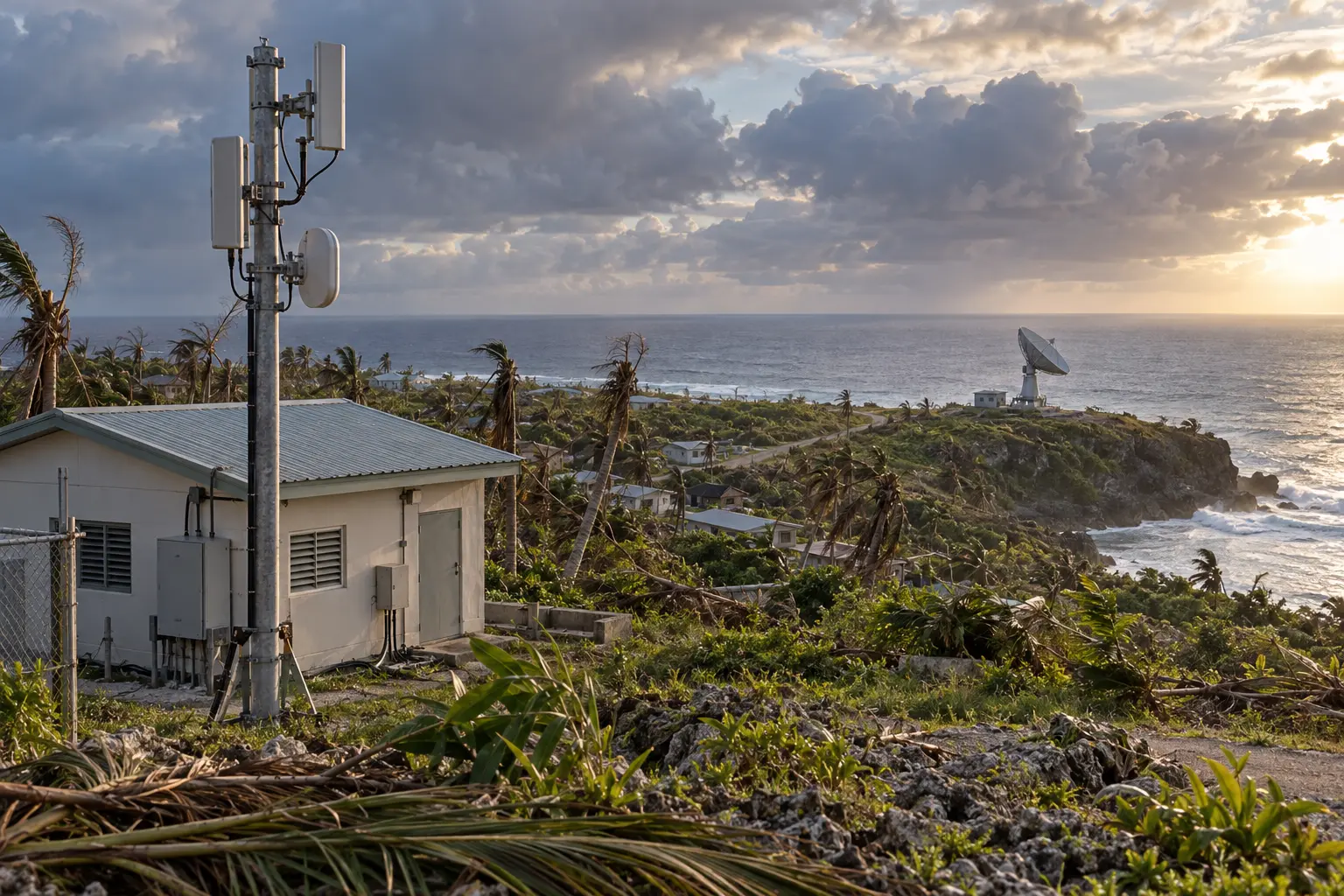
A first-hand report by IUSN technical manager Richard St. Clair, published after the cyclone, describes two recovery problems. The team had protected much of the local connectivity and Wi-Fi equipment and was able to bring equipment back into operation quickly. But the satellite antenna used by Telecom Niue for the upstream link to New Zealand had been destroyed. The report says it took ten days for the telecom provider to find a replacement antenna; until then, Niue was not back on the worldwide Internet. St. Clair’s first-hand report
The wording matters. “Wi-Fi was back” describes radio access within reach of an access point. It does not establish that a user could reach a server overseas. Conversely, an operating satellite link would not by itself restore the local wireless equipment, power, devices or service arrangements that let residents connect. The path depended on both layers, with different organisations responsible for parts of it.
The government’s later record helps bound the claim. Niue’s Second National Communication to the UNFCCC names the Telecom Department and Information Systems Office on the government side and IUSN in the private sector. It describes Wi-Fi coverage as full in Alofi, Hakupu and Liku, partial in seven villages, and not yet implemented in Toi, Hikutavake and Namukulu. It dates the government’s Wi-Fi introduction to “sometime in 2006,” while IUSN had announced its own Wi-Fi service in 2003. These statements refer to records with different wording and institutional scope; the available evidence does not justify collapsing them into one definitive island-wide launch date. Niue’s Second National Communication
A contemporaneous 1999 message preserved by the Network Startup Resource Center offers context for the international dependency. St. Clair described a 64/128-kilobit-per-second burst frame-relay service carried over satellite to Telecom New Zealand, at a reported NZ$10,000 monthly cost, with local users then connecting by dial-up. Those are provider-reported figures from 1999, not a measured description of the 2004 Wi-Fi network. NSRC connectivity record
Heta therefore revealed a layered service rather than a single “wireless Internet.” Local links could be rebuilt while Niue remained cut off from global destinations. The ten-day interval in IUSN’s account is evidence of an upstream dependency and a recovery bottleneck, not a complete outage log for every local system or user. It shows why reachability has to be checked across the whole path—from a device and access point through local transport and the island’s international gateway—not inferred from the status of Wi-Fi alone.
Member Briefing
Deeper Profile Context
Sign in with the right membership level to unlock the full briefing and source notes.
Only for Strategic Circle
Strategic Circle
Open to all readers. Unlock profile briefings after joining and signing in.
Join Strategic CircleOnly for Leadership Alliance
Leadership Alliance
For qualified IP-asset owners and management; sign in to unlock alliance briefings.
Join Leadership Alliance