Summary
- RFC 871 described the ARPANET Reference Model as a reconstruction of choices already made by the Network Working Group while building working protocols for unlike computers to share resources.
- Its least glamorous design principle was equity among hosts: a tidy protocol change could disrupt another operating system’s authentication, accounting or process arrangement, so implementers had to be heard.
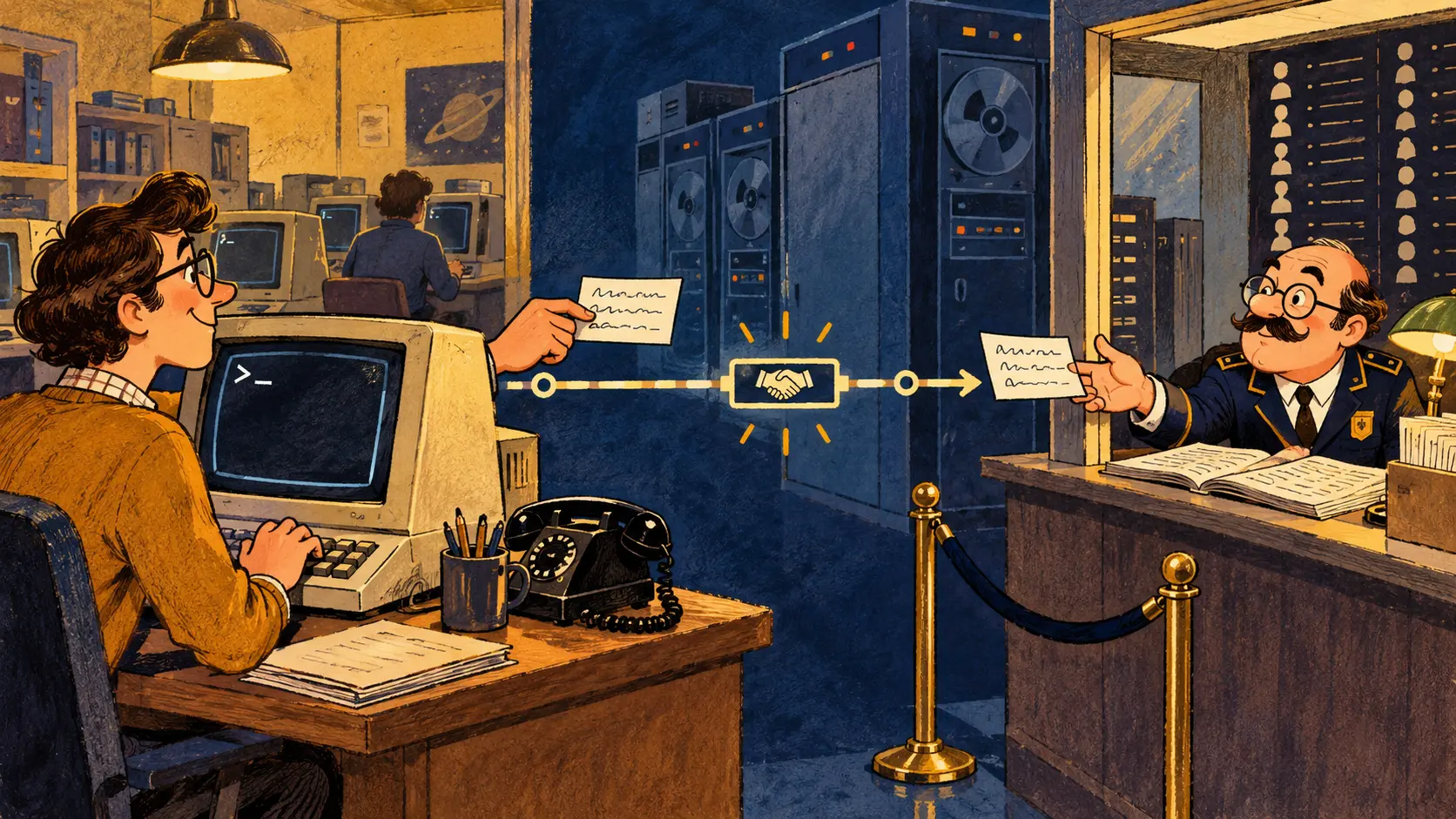
The incoming mail looked free until someone removed the login command. In RFC 871, Michael A. Padlipsky recalled a design argument over electronic mail carried through FTP. Some designers wanted to avoid charging a recipient for incoming mail. Making login optional looked like a clean way to do it. On other operating systems, those same commands did more than start accounting; they also activated authentication. The protocol had reached the point where somebody's elegant line on a diagram would break somebody else's real machine. The eventual arrangement preserved the ability to require login and used a shared free account for incoming mail.
Padlipsky called the underlying principle equity. When a proposed mechanism felt natural on one host but seriously disturbed another, designers needed to listen to the people who had to make it run. It was an engineering discipline with a social shape: unlike operating systems had seats at the table because the network had to include them. A drawing could make their differences disappear. The code brought them back before lunch.
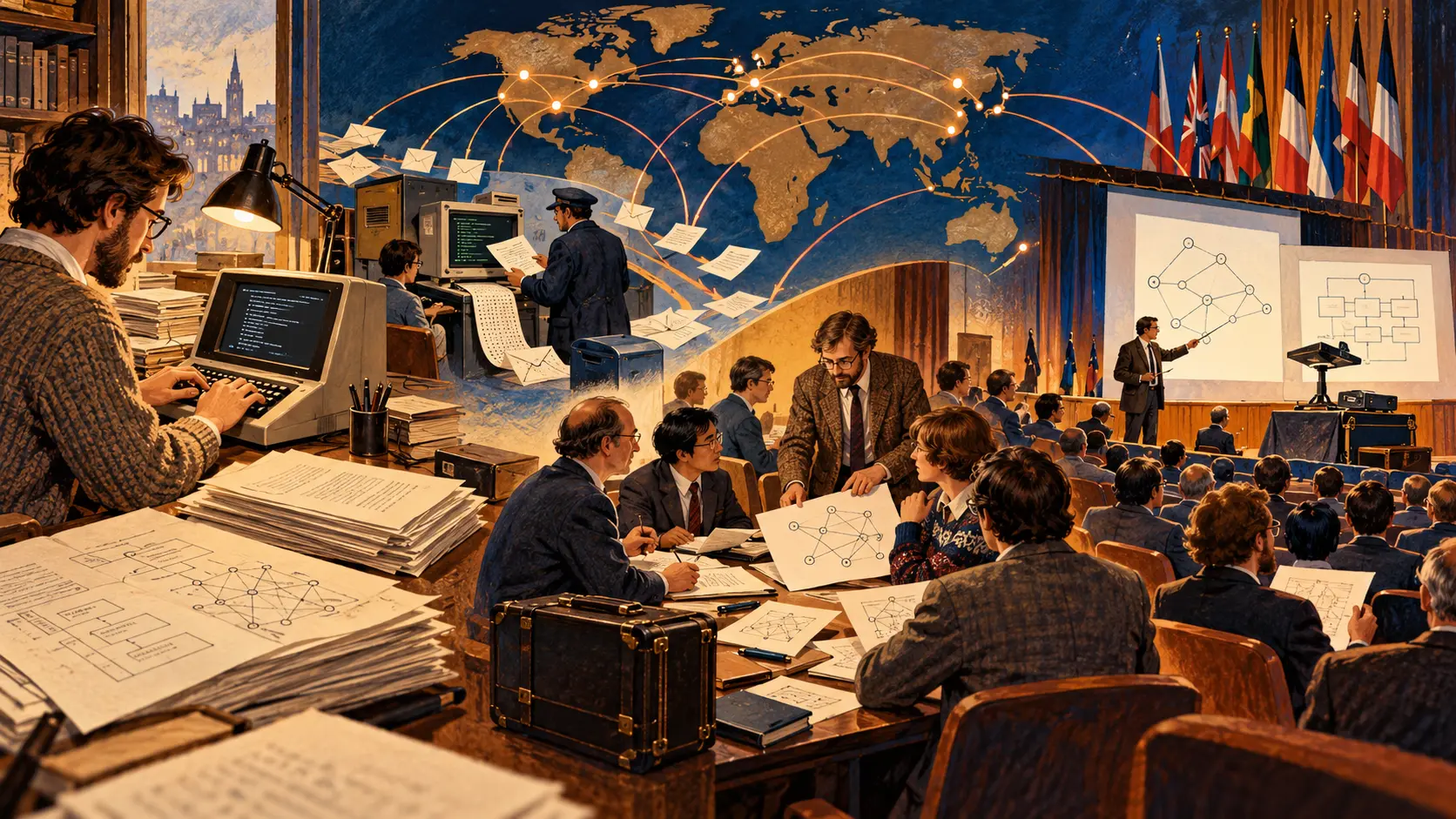
The larger story began before anyone published a polished model. In September 1982, Padlipsky wrote A Perspective on the ARPANET Reference Model to make explicit a framework he said the ARPANET Network Working Group had used, largely without naming it, while building protocols. The ISO reference model had become a popular way to describe networking, and comparisons increasingly treated it as the starting diagram. Padlipsky wanted the running ARPANET design to be described on its own terms. His account was a reconstruction by a participant, grounded in protocol decisions already made.
The first decision was what the network was for. The goal was resource sharing among potentially different computer systems. Remote login had a place, but programs and data on separate hosts had to cooperate as well. That goal led to communication between running processes, not merely a terminal line stretched over a long distance. Logical connections then gave those conversations meaningful addresses: a well-known socket identified where a service could be found, while other numbers remained available for new experiments. The address was part of the service arrangement, not just a mark on the cable.
One of the cleverest practical choices dealt with a multiplication problem. Suppose each kind of host had to understand every kind of terminal attached to every other host. Add hosts and terminal types, and the integration work grows as their product. The Network Virtual Terminal put a common representation in the middle. Each host mapped its own local form into or out of that shared form. The same tactic could help file transfer. A virtual terminal was a small piece of restraint: it asked each system to learn one common language rather than every other system's private dialect.
Layering was another piece of restraint. Padlipsky described broad Network Interface, Host-Host and Process-Level/Application groups. Protocols in a group could offer different services; the boundary between groups kept one implementation from needing to understand the internal details of another. He argued against turning every box in a reference drawing into an obligatory runtime procession. The more important test was whether the functions were packaged so that changes stayed local and useful shortcuts remained possible.
A reference model could describe a working design without becoming a staircase that every packet had to climb just because the drawing had steps.
Efficiency followed from this view. CPU time, memory and unnecessary conversions belonged in the calculation. So did the ability of implementers to integrate protocol code with the operating systems they actually ran. Padlipsky's comparison with the ISO model was pointed and partisan; in his telling, the ARPANET's broad groups allowed flexibility that a strict reading of more numerous layers might obstruct. His argument reached beyond the count of layers. The receiving host still had an authentication mechanism, a scheduling system and an accounting ledger.
A model that ignored those mechanisms would eventually meet them in production.
The FTP mail argument made the consequence visible. One designer saw a charge that should disappear; another saw the login path that protected a system. The compromise kept the required command available and made the mail account free. RFC 871 records this as a design lesson from the early network, not a universal recipe for mail security. The general rule was to let implementation evidence change a protocol before the protocol forced every operating system into one engineer's favorite shape.
Padlipsky gave the ARPANET Reference Model three broad groups and a longer list of commitments: resource sharing, process communication, logical connections, common representations, efficiency and equity. The diagram was compact. The hard part was persuading unlike computers to take part without pretending they were alike. In that sense, the operating system's “no” was useful design information.
Member Briefing
Deeper Profile Context
Sign in with the right membership level to unlock the full briefing and source notes.
Only for Strategic Circle
Strategic Circle
Open to all readers. Unlock profile briefings after joining and signing in.
Join Strategic CircleOnly for Leadership Alliance
Leadership Alliance
For qualified IP-asset owners and management; sign in to unlock alliance briefings.
Join Leadership Alliance