
Summary
- R & F Bassan's historical legal name, the current RB NETONE LTDA. registration, the NetOne brand and AS28194 all resolve to CNPJ
05.527.661/0001-93. Current public corporate data identifies Rodrigo Alessandro Bassan as the shareholder-administrator; it does not substantiate a second current owner-administrator. - Guapiaçu Chamber contracts from 2024 and 2025 provide unusually concrete evidence that the company supplied local fibre Internet service. A 2026 renewal supports continuity only with a warning: it prints a CNPJ that belongs to another company.
- NetOne advertises 600, 800 and 1,000 Mbps plans, but publishes no upload rates, minimum throughput, contention policy, access-node inventory, transit commits, customer count, power runtime, field-crew depth or restoration objective.
- In the RIPE RIS collector snapshot at 08:00 UTC on 15 July 2026, AS28194's IPv4 and IPv6 covering aggregates were visible through both Sinal BR and AW Fibra. Both IPv4 /22s and both IPv6 /33s, however, had Sinal BR immediately before NetOne on every collected path. That is a scoped observation of logical routing concentration, not a map of physical fibre.
- The network evidence grade is Medium: legal identity, local operation, address resources and present routing are well supported, while the physical topology and the capacity available after a cut, power failure or upstream loss remain unverified.
One postcode, three retail speeds
NetOne presents a compact commercial proposition. Its plans page lists fibre packages of 600 Mbps for R$79.90 a month, 800 Mbps for R$89.90 and 1,000 Mbps for R$99.90. The prices carry an on-time-payment condition. The page says technical support is included, no telephone line is required, and service remains subject to an availability check. The home page repeats the three tiers and directs customers to a support channel, a speed test and an online customer centre.
That is enough to establish a current retail offer. It is not enough to establish the capacity behind it. NetOne does not publish upload rates, minimum or typical busy-hour throughput, a contention rule, latency targets, packet-loss targets, installation charges, contract duration, router terms or a consumer restoration commitment. The 1,000 Mbps label describes the top rate offered to one qualifying connection. It does not reveal the line rate of an optical port, the number of homes sharing that port, the uplink from an access node, the Internet transit commit, or the amount of spare bandwidth maintained for failure.
The coverage interface makes the geographic evidence narrower still. NetOne's public checker recognizes 15110-000, the broad postcode used for Guapiaçu, and gives a negative response for other values while saying expansion continues. It does not ask for a street, number, building, neighbourhood or rural locality. There is no polygon, service-address list, fibre route, cabinet layer or distinction between premises already connected and those merely near the network.
This matters because Guapiaçu is not a single dense block. The IBGE municipal profile records 21,711 residents at the 2022 census, an estimated 22,445 in 2025, and 324.752 square kilometres of territory. A municipality-wide postcode response cannot demonstrate plant across that whole area. It can support the modest conclusion that NetOne markets service in Guapiaçu. Only an address-level qualification result, an anonymized homes-passed table or a dated access map could establish how much of the municipality is actually serviceable.
The evidence-specific tension is therefore visible before any routing analysis begins. NetOne sells a gigabit headline into one postcode-level market, but the public interface does not disclose the physical scope or shared resources beneath that offer. The customer sees three speeds. The infrastructure investor, public buyer or business continuity manager still needs to know which feeder, node, upstream and repair team make those speeds usable.
The historical R & F Bassan name and today's RB NETONE are one CNPJ
The company identity requires care because different public systems preserve different moments in its history. The existing entity is named R & F BASSAN COMÉRCIO SERVIÇOS E SISTEMA. Registro.br's AS28194 record retains a closely matching legacy name and assigns the ASN to CNPJ 05.527.661/0001-93. The same registry connects that CNPJ to the company's IPv4 /21, IPv6 /32 and netone.com.br domain.
Current corporate data uses a shorter name. The public BrasilAPI CNPJ record identifies RB NETONE LTDA. as the legal name, NETONE as the trade name, active status, a start date of 24 February 2003, and telecommunications service by SCM as the principal activity. It gives Rua das Palmeiras 1309 in Guapiaçu as the registered address and lists Rodrigo Alessandro Bassan as shareholder-administrator. A second corporate index independently reproduces the same current name, CNPJ, status, address, main activity and administrator.
The shared CNPJ is the strongest bridge. It avoids the common error of treating the historical R & F Bassan name, RB NETONE, NetOne and AS28194 as four separate operators. They are public labels around the same registered company. It also prevents a different error: turning the letters R and F into evidence about current ownership. The reviewed current corporate records identify Rodrigo, while the Registro.br contacts also identify Rodrigo. They do not substantiate a second current shareholder-administrator. A historical trading name may preserve initials long after a corporate change; it cannot replace a current ownership record.
The dates also need separate meanings. The domain was registered in 2002, the company record begins in 2003, the SCM authorization was published in 2012, the IPv4 and ASN resources were registered in 2013, and the IPv6 /32 followed in 2017. These milestones document legal and Internet-number history. They do not prove that today's retail topology, staffing or equipment has existed unchanged since any of those dates.
Anatel's Ato 688 granted the same CNPJ an indefinite, non-exclusive authorization to provide SCM across Brazil. That nationwide scope is permission, not footprint. It does not contradict the website's Guapiaçu focus, and it must not be represented as a national network. The operator boundary supported by the evidence is narrower: RB NETONE is the legal company, NetOne is the public brand, and AS28194 is the routing system attached to that same company. Poles, ducts, upstream transport, power, premises equipment and any third-party hosting remain separate dependencies unless evidence shows NetOne owns them.
A municipal bill proves more than the marketing map
Small regional providers often leave a thin public trail. Guapiaçu's own procurement records supply the clearest evidence that NetOne is not merely a registered company with an active ASN. A 2024 official-gazette notice records Contract 01/2024 with R & F Bassan under the same CNPJ for fibre Internet service to the municipal Chamber. It gives a 12-month term and total value of R$1,918.80. A direct 2025 Chamber contract again names the same company and CNPJ, describes fibre TCP/IP Internet service, gives the same annual value and runs from January 2025.
Those documents do not show the route, but they establish a named local customer, a fibre service and continuity across two contracting years. That is stronger operating evidence than a generic coverage claim. It also reveals the price scale of one public connection: R$1,918.80 over 12 months equals R$159.90 a month before considering any terms not visible in the summary. The figure should not be generalized to business pricing, margin or network economics, but it is a concrete local transaction rather than an estimated market signal.
The contracts include a warning about taking procurement language too literally. Their performance wording uses the Portuguese equivalent of one "gigabyte." A gigabyte is a storage quantity, not a transmission rate. The documents do not say one gigabit per second in technically valid terms, and there is no measurement schedule that repairs the ambiguity. It would be wrong to silently convert the wording into a verified 1 Gbps service. The defensible claims are that the service is described as fibre Internet, that the supplier is the same company, and that the annual contract value is stated.
The 2026 renewal notice extends the 2025 contract into January 2027 and uses the current RB NETONE name and Rua Palmeiras address. But it prints CNPJ 21.922.507/0001-72. The federal Transparency Portal assigns that number to Mega Vale, an unrelated company. The renewal is thus a useful continuity signal with a material clerical defect. It cannot serve as the identity anchor when the 2024 and 2025 documents, corporate record and number registries already supply a cleaner chain.
Address details create a second caution. The current corporate record and contact text use Rua das Palmeiras 1309. The 2024 and 2025 contracts use Rua Tiradentes 516. NetOne's contact page embeds a map near Tiradentes 518, while PeeringDB's organization record gives Tiradentes 530. These points are close enough to suggest administrative or commercial history, but they cannot be promoted into four facilities, or even one confirmed network site. None is labelled as a PoP, OLT room, core site, customer centre, warehouse or data centre in a source that supplies equipment or occupancy evidence.
The procurement record therefore resolves operating status without resolving topology. NetOne has supplied a local public institution over fibre. The path from that institution to an access node, from that node to AS28194, and from AS28194 to the wider Internet remains undisclosed.
"Fully redundant" is a claim about a system, not a count of BGP neighbours
NetOne's company page describes a secure, fully redundant metropolitan fibre network and says the business has its own data-centre infrastructure. Those are consequential claims. Full redundancy can refer to many different layers: dual fibres around a ring, two building entries, separate access nodes, redundant switches, two edge routers, diverse upstream circuits, independent power feeds, UPS and generation, replicated service platforms, spare equipment, or enough staff to repair two faults at once. A system can duplicate one layer and remain exposed at another.
The public material does not specify which interpretation NetOne intends. There is no topology drawing, list of nodes, route map, fibre length, ring test, protection-switching result, building-entry photograph with provenance, equipment inventory, power diagram, generator runtime, facility address, audit or service-availability history. The word "metropolitan" is also geographically undefined. It could refer to the Guapiaçu urban area, a broader municipal network, or only a marketing description of local fibre. The one-postcode checker supplies no resolution.
Two adjacent ASes in a BGP view cannot fill that gap. BGP describes how networks tell one another where an IP prefix can be reached. It does not expose whether two sessions ride the same pole line, the same long-haul carrier, the same entrance conduit, the same router, the same room or the same utility feed. Two upstream names can terminate on one chassis. One upstream name can be delivered over physically diverse circuits. The AS path alone distinguishes neither case.
Likewise, a responsive customer portal at 187.33.57.44 is useful but limited operating evidence. The address sits inside NetOne's /21 and the page exposes customer-login, recovery and new-customer functions under central.netone.com.br. That shows a live service endpoint associated with the operator. It does not prove where the server runs, whether the company owns the building or hardware, how the application is backed up, or whether customers can reach it during an access outage.
A credible full-redundancy case would join layers rather than point to one. It would show that access rings close over different streets or pole lines; that both directions terminate on independent ports or nodes; that upstream circuits take separately documented paths and can each carry peak demand; that service systems and DNS remain reachable; and that power and repair procedures have been tested. Until then, the claim is a hypothesis to test, not a fact established by the company page.
AS28194 is visible, current and more complicated than a two-upstream badge
At 08:00 UTC on 15 July 2026, RIPEstat's routing-status view showed AS28194 visible to 324 of 326 IPv4 RIS peers and all 322 IPv6 peers in that snapshot. It counted three IPv4 announcements covering 2,048 unique IPv4 addresses and four IPv6 announcements, with three observed neighbouring ASes. That is strong evidence that the network was participating in global routing near the publication date.
The announced-prefix view gives the necessary detail. NetOne's IPv4 space appeared as the covering 187.33.56.0/21 plus two halves, 187.33.56.0/22 and 187.33.60.0/22. Its IPv6 space appeared as 2804:4390::/32 plus two /33 halves. A seventh route, 2804:34b4::/32, belongs to another Brazilian network and needs separate treatment.
The overlapping announcements are not additive. A /21 contains the two /22s; a /32 contains the two /33s. NetOne did not thereby have three times as many IPv4 addresses or three independent networks. More-specific routes usually win over a covering aggregate under longest-prefix matching. That makes the path for each /22 and /33 more relevant to ordinary inbound reachability while those routes remain present.
For the IPv4 /21 aggregate, the dated BGP state returned 375 collected paths. AS262761 appeared immediately before AS28194 on 266, and AS61775 appeared immediately before it on 109. Registro.br identifies AS262761 as Sinal BR Telecom and AS61775 as AW Fibra. This supports two logical adjacent networks for the aggregate. It does not reveal contracts, handoff points, circuit rates or traffic split. A collector path count is the number of observed paths, not the percentage of packets or revenue that uses each connection.
The two /22s tell a more concentrated story. RIPEstat returned 353 paths for 187.33.56.0/22, every one with Sinal BR immediately before NetOne. It returned the same 353-path, all-Sinal result for 187.33.60.0/22. All observed origins were AS28194.
This does not mean every packet travelled over one physical Sinal fibre. BGP collectors do not see outbound choices, internal forwarding or a cable map. But it does mean that the more-specific inbound advertisements visible in that snapshot did not display AW Fibra as the immediate external AS. If the /22s were withdrawn cleanly, the /21 aggregate visible through both adjacent networks might provide fallback. Whether that actually converges, whether customer sessions recover, and whether the surviving path has enough capacity are unanswered questions. A static control-plane snapshot cannot perform the failure test.
The distinction changes the redundancy conclusion. "Two upstreams" is too broad if it implies equal active paths for every route. "One upstream" is also too broad because the aggregates were visible through two adjacent networks. The precise finding is that, in the 08:00 UTC RIPE RIS snapshot on 15 July 2026, aggregate-level logical diversity coexisted with more-specific concentration through Sinal BR.
IPv6 repeats the same hierarchy
NetOne has held 2804:4390::/32 since 2017, and the 08:00 UTC RIPE RIS snapshot on 15 July 2026 showed it broadly visible. The covering /32 state contained 348 collected paths: 259 immediately through Sinal BR and 89 through AW Fibra, all with AS28194 as origin. That resembles the IPv4 /21 aggregate split.
The more-specific halves again concentrated. Both 2804:4390::/33 and 2804:4390:8000::/33 returned 342 paths, all immediately through Sinal BR and all originated by AS28194. As with IPv4, the aggregate could have a logical alternate while the preferred more-specific view remained concentrated.
The route origins were positively authorized. RIPEstat's IPv4 RPKI result returned valid and allowed more-specifics down to /24, covering the two /22s. The IPv6 result was also valid with a length allowance that covers the two /33s. This is useful routing-security evidence: participating networks that enforce route-origin validation can recognize those AS28194 origins as authorized. It is not a measure of throughput, availability or physical protection.
End-user IPv6 use is less certain. APNIC's sample-based IPv6 measurements showed roughly 38 percent capability and preference around the research cut-off, based on about 1,639 samples in the displayed window. That suggests meaningful IPv6 use among traffic attributed to AS28194. It cannot be translated into a percentage of NetOne subscribers: the sample is not a census, and traffic from another network behind AS28194 may be included.
The practical IPv6 question is therefore twofold. NetOne clearly originates and authorizes IPv6 space. Public evidence does not show whether every retail tier receives IPv6, what customer-premises equipment supports it, whether support staff treat IPv4 and IPv6 faults equally, or whether the AW aggregate path can carry the /33s after a Sinal-side withdrawal. Addressing readiness and failure readiness are not the same thing.
The i100 prefix is a routing signal, not permission to invent a relationship
One route in the AS28194 view does not belong to NetOne. Registro.br assigns 2804:34b4::/32 to i100 Servicos de Informatica and associates that company with AS265474. In the same 08:00 UTC RIPE RIS snapshot, the BGP state for that /32 contained a mixed view. Most collected paths ended with AS28194 as the visible origin through Sinal BR, while a smaller set ended with AS265474 behind AS28194.
That is evidence of a live routing interaction. It may reflect a downstream arrangement, route migration, origin-policy choice or another operational configuration. The snapshot cannot decide among them. There is no public contract, service description, date range, capacity, handoff or physical circuit in the cited evidence. It would be inappropriate to convert one day's paths into a permanent customer, subsidiary, resale or partnership claim.
Route-origin validation adds caution rather than a verdict. The checked RPKI endpoint found no validating authorization for AS28194 to originate the i100 /32 and returned unknown. Unknown is not invalid. It means the validator did not find a route-origin authorization that proves or rejects the origin under RPKI. Operational legitimacy can still rest on arrangements outside that system, but the public cryptographic evidence is weaker than it is for NetOne's own prefixes.
The foreign prefix also affects capacity reasoning. If AS28194 is carrying traffic for another network, some edge, transit and support resources may serve more than NetOne's direct retail lines. Yet there is no basis for estimating how much traffic, how many users or what responsibility is involved. The route should be counted as an operational dependency signal, not added to NetOne's address estate or used to inflate customer scale.
The 20-50 Gbps and 12,000-user figures do not settle capacity
PeeringDB's AS28194 profile labels the network a regional Cable/DSL/ISP operation, gives NetOne Fibra as an alias, and reports a 20-50 Gbps traffic band with mostly inbound traffic. It was last updated in January 2024 and lists no exchange or facility records. The band is a useful order-of-magnitude signal because it is supplied in an interconnection context. It is not a live meter, an audited peak, an interface inventory or a transit commitment.
The value cannot be assigned to any specific layer. It might approximate traffic across multiple interfaces; it does not say whether NetOne has one 40 or 100 Gbps edge, several 10 Gbps links, a different mix, or spare capacity at all. It does not separate retail demand from possible downstream traffic, identify busy-hour use, or show what remains after the loss of Sinal BR. A network carrying 20 Gbps over 100 Gbps of protected interfaces has a different failure posture from one carrying 20 Gbps over two constrained links, even though both fit the same broad band.
The profile's empty facility and exchange fields are also negative documentation evidence, not proof of absence. An operator can use private transit or an unlisted facility. Conversely, an exchange listing would prove a logical service relationship, not route diversity by itself. The appropriate conclusion is that public interconnection documentation is sparse.
Cloudflare Radar's AS28194 page offers a separate estimate of roughly 12,000 users. That figure is not a NetOne subscriber count. It is an estimate derived from observed Internet traffic, and it may include people behind a downstream network. It cannot distinguish a household subscription from individual users, a business circuit from its employees, or direct NetOne access from i100-attributed traffic. It is valuable as a signal that the ASN serves a non-trivial population; it is unsafe as a revenue, port or outage-impact denominator.
The only hard address quantity is 2,048 IPv4 addresses in the assigned /21. Even that cannot be equated with customers. Addresses may serve routers, servers, infrastructure, business assignments, dynamic pools or network-address translation. IPv6 space is vastly larger by design and is even less related to line count. The public record therefore contains three different units - retail Mbps, a broad Gbps traffic estimate and address positions - that must remain separate.
A capacity statement strong enough for resilience analysis would disclose interface rates, transit commitments, 95th-percentile or peak traffic, access uplinks, PON occupancy, oversubscription rules and the load carried after a planned upstream withdrawal. None is public. The installed, lit, powered and immediately usable totals remain unknown, as do the amounts sold to customers and reserved for restoration.
The data-centre claim lacks a site and power envelope
NetOne's statement that it has its own data-centre infrastructure could describe anything from a small equipment room to an owned facility, a leased rack or simply company-operated servers. The wording does not resolve ownership of the building, racks, power system or hosting environment. No public facility address, rack count, equipment list, photograph with verifiable provenance, certification, carrier list or colocation record accompanies it.
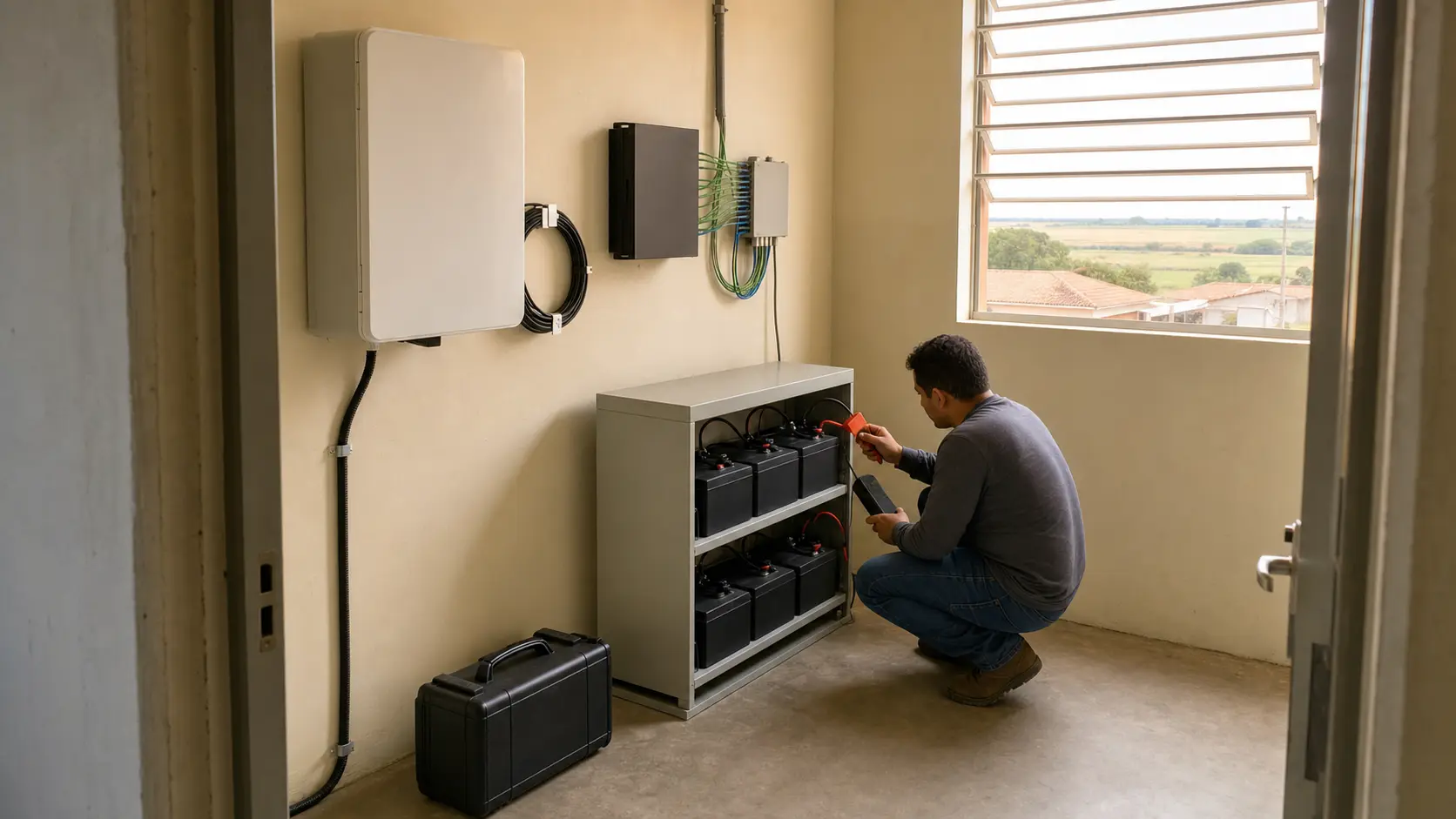
Power is the central missing variable. A fibre path and two BGP sessions can both fail if their common router, switch, OLT or service platform loses power. Public evidence provides no utility-feed count, UPS capacity, battery runtime, generator rating, fuel plan, cooling design or maintenance-test result. It also does not say which customer-facing systems are local, which are externally hosted, or whether DNS and authentication remain available during a site incident.
Registro.br's domain record uses external UOL nameservers, while the customer portal responds inside NetOne's own IPv4 allocation; neither fact locates the underlying hardware.
The multiple Guapiaçu addresses cannot be used as a substitute. Rua Palmeiras 1309 is a corporate/contact address. The Tiradentes numbers appear in older contracts, an embedded map and PeeringDB. Without an equipment or facility record, mapping them as data centres would be false precision. Even if network hardware exists at one of them, a street address would not prove dual power, fire separation, diverse entries or the ability to lose the site without losing service.
For a small regional ISP, this is not an academic distinction. A compact local design can be efficient and responsive, but it can also concentrate the edge router, optical access equipment, billing portal, spare stock and staff in one operational base. Public evidence neither confirms nor excludes that concentration. The phrase "own data-centre infrastructure" should therefore be treated as a facility claim awaiting a physical and power description, not as a resilience certificate.
Local support is visible; local repair capacity is not
NetOne publishes a Guapiaçu telephone number, mobile contact, email address and customer portal. These channels support the inference that customers can reach a local-facing operator rather than only an anonymous national call centre. The municipal contracts reinforce that local operating relationship. They do not reveal the number of technicians, shift coverage, vehicles, contractor reliance, field skills or the radius within which a crew can arrive.
That missing labour evidence matters because fibre recovery is physical. A feeder cut may require locating the fault, securing pole or roadside access, identifying fibres, preparing a closure, splicing, testing optical levels and coordinating with a pole owner or civil contractor. A failed OLT card or power unit requires a compatible spare. A simultaneous storm or vehicle incident can create more work than one crew can handle. The presence of a support phone proves contactability; it does not prove concurrent repair capacity.
NetOne publishes no mean time to repair, dispatch window, after-hours rota, escalation structure or stock policy. The plans page says technical support is included but does not define on-site response. Anatel's reimbursement guidance explains proportional credits for interruptions and ties repair treatment to the customer's request, but compensation is not restoration. A household may receive a small credit while still losing work, education or communication. A business may face a much larger operational cost than the monthly fee.
Customer-premises equipment forms the last labour boundary. NetOne does not publish ONU or router models, Wi-Fi capability, Ethernet-port rates, replacement terms or backup-power options. Anatel's measurement guidance distinguishes download, upload, latency, jitter and loss and notes that the terminal, local connection, provider network and destination can each affect results. A 1,000 Mbps service may therefore be constrained by Wi-Fi, device capability or local power even when the access circuit is healthy. Diagnosing that boundary consumes support time that is separate from repairing a cut fibre.
The labour conclusion is balanced. The operator has visible local contact channels and demonstrable local service. There is no public basis to call the support operation absent. There is equally no basis to quantify its surge capacity or promise rapid recovery. Headcount, on-call coverage, spares and restoration history would be the evidence needed to move from local presence to local resilience.
Six failures expose six different boundaries
The first failure is an access cut. If NetOne's local distribution is aerial, a vehicle strike, pole work, weather or third-party construction could damage a feeder or several drops; if it uses ducts, excavation or chamber access creates a different risk. The public material does not establish which design applies to any street. A ring can protect customers only if both directions are actually connected, active, routed over independent segments and terminated on equipment that survives the same incident. The "fully redundant" claim does not provide those details.
Customers behind one severed branch may remain isolated even when the core has two upstreams.
The second failure is an access node or local site. A line card, OLT, aggregation switch, edge router, cooling system or power unit can remove many connections without changing the global visibility of AS28194. External collectors may continue to see the prefixes while Guapiaçu customers cannot reach the router that originates them. This is why broad BGP visibility is operating evidence for the Internet edge, not proof of end-to-end service availability. The affected population depends on node layout and port occupancy, neither of which is public.
The third failure is Sinal-side reachability. In the 08:00 UTC RIPE RIS snapshot on 15 July 2026, both IPv4 /22s and both IPv6 /33s had Sinal BR immediately before NetOne on every collected path. If those more-specific advertisements disappear, Internet routers can in principle fall back to the covering /21 and /32, which were also visible through AW Fibra. But several things must go right: the specifics must withdraw cleanly, the aggregates must remain reachable, filtering must accept them, customer sessions must recover, and the AW path must have capacity. The snapshot proves none of those failure-state properties.
The fourth failure is congestion without a route loss. BGP can remain stable while packet loss and latency rise because an access uplink, aggregation link or transit interface is saturated. Retail plan totals cannot be added to estimate this risk because customers do not all transmit at headline speed simultaneously, and the operator does not publish its engineering assumptions. Conversely, the PeeringDB traffic band cannot reveal the spare margin on the most constrained component. Only time-series interface data and busy-hour tests across normal and single-failure states would show usable headroom.
The fifth failure is power or common-site loss. Two logical adjacencies are of little help if both sessions terminate on one unprotected router or depend on the same electrical room. Fibre access also depends on powered OLTs, switches and customer equipment. No published battery or generator duration establishes how long the network survives a Guapiaçu utility interruption. A customer with no local backup loses the ONU and Wi-Fi router immediately even if NetOne's plant remains powered.
The sixth failure is repair scarcity. A clean design still needs people and compatible parts. One crew may handle a routine drop fault quickly but be unable to repair two feeder cuts at once. A spare optical module is useful only if it matches the installed platform and can reach the site. NetOne's public pages do not disclose crew count, depot, stock, maintenance contracts or escalation with upstreams and pole owners. The duration of a real outage may therefore be governed by labour and access permissions rather than by routing policy.
These scenarios are tests, not claims that NetOne has suffered the failures. They show why different evidence is needed at each layer. Prefix visibility tests the external control plane. Optical and interface monitoring test the network. Power logs test site endurance. Work orders and restoration records test labour. Customer measurements test the delivered service. A provider can perform well without publishing all of them, but a public assessment cannot award unverified resilience.
Regional ISP economics turn modest prices into a headroom question
The retail price ladder is compressed: only R$20 separates 600 Mbps from 1,000 Mbps on the advertised monthly rates. That structure can encourage customers toward the top tier and simplify sales. It does not show cost or margin. A local ISP must fund access construction, pole or duct access, electronics, transit, customer equipment, billing, taxes, support, repairs and periodic upgrades from the revenue base. The municipal Chamber contract adds one concrete local price point, but it is one procurement and cannot represent the portfolio.
At regional scale, resilience is partly an allocation decision. Spare fibre cores, a second route, an unused port, battery runtime, a compatible line card and an on-call technician all cost money before a failure. Capacity sold at headline rates produces revenue; capacity reserved for failover may sit idle in normal operation. Without subscriber counts, peak load, network length or expense data, it is impossible to calculate NetOne's economics. The evidence does, however, identify the central question: whether the price structure leaves enough physical and operational reserve to make the redundancy claim meaningful.
Pole access can be a material external dependency where networks are aerial. Anatel's national pole-data initiative reflects the regulatory importance of pole-use contracts to Brazilian fixed-broadband providers. That context must not be used to claim NetOne follows a particular pole route; no such route is public. It does explain why ownership and operating boundaries matter. A local ISP can own the optical cable and electronics while depending on a utility for attachment access and on contractors for civil work.
Transit creates a similar boundary. The BGP evidence names Sinal BR and AW Fibra as immediate adjacent networks at aggregate level, while secondary routing summaries commonly classify both as upstreams. No public order, circuit rate, commitment, facility or service-level agreement confirms the commercial terms. If the links are purchased transit, their price and burst arrangements influence headroom. If either is delivered over a shared carrier path, the number of contracts may overstate physical diversity. The route data alone cannot settle either issue.
Local support labour is the third economic boundary. A small staff may know the area and customers well, improving diagnosis. It may also have limited concurrency during a widespread incident. Outsourcing can add reach but introduces response and coordination dependencies. The company publishes enough to show local contact, not enough to determine which staffing model it uses. Any claim about low cost, family labour, contractor dependence or exceptional local response would go beyond the evidence.
The regional economics verdict is therefore not that low prices imply weak service. It is that low prices and high headline speeds make hidden reserve more important to measure. The relevant quantities are peak-to-port ratio, customers per access segment, cost of alternate routes, spare inventory, power autonomy and crew concurrency. None can be derived from the three plan cards.
Who is affected when a local network fails
The directly evidenced affected group includes NetOne's residential and business market in Guapiaçu and at least one public institution, the municipal Chamber. The plans and corporate pages establish the first two categories; the procurement contracts establish the third. They do not publish a customer list or count, so the number of households, workers and services exposed to a common failure remains unknown.
For a household, an outage can interrupt remote work, education, entertainment and communications. For a small business, card payments, cloud applications, supplier contact and customer service may fail. For the Chamber, a connection can affect administrative work and public-facing access, though the contract does not identify critical systems. The consequence depends on each user's backup, such as mobile service or a second fixed provider, which is outside NetOne's disclosed network.
The i100 prefix introduces a possible wider group. If AS28194 is providing durable upstream reachability to AS265474, users behind that network could also depend on NetOne's edge or upstream paths. The one-day routing snapshot is not enough to confirm the contract or quantify those users, so they cannot be counted as NetOne customers. They remain a conditional impact category that deserves operational clarification.
Geography also limits the conclusion. IBGE's municipal population is not the subscriber base, and the postcode checker is not proof that every resident can buy service. The most defensible formulation is qualitative: a failure can affect local households, enterprises and a documented public customer, with possible downstream consequences. The breadth of each incident depends on an access topology and customer distribution that are not public.
What evidence would change the grade
The network earns a Medium evidence grade because its identity and operation are much clearer than its physical resilience. Several disclosures could raise that grade without exposing customer-sensitive detail.
First, NetOne could publish a dated service-area description at neighbourhood or anonymized grid level, separating homes passed, premises serviceable and active lines. A diagram could show access nodes and protected rings at coarse resolution without revealing exact fibre routes. The key is to distinguish a marketing municipality from installed plant.
Second, a resilience note could identify the number of edge routers, access-node classes and upstream handoffs; state whether Sinal BR and AW Fibra arrive over physically separate paths and building entries; and provide a recent controlled failover result. For the route pattern observed by RIPE RIS at 08:00 UTC on 15 July 2026, the decisive test would withdraw the Sinal-only /22 and /33 advertisements, verify clean aggregate fallback through AW, and record convergence, packet loss and usable throughput. It should also explain whether the current more-specific policy is intentional.
Third, capacity could be reported as ranges: access ports installed and occupied, aggregation and transit interface rates, normal busy-hour load, and surviving headroom under the largest single failure. This would turn the 20-50 Gbps traffic estimate into an engineering context. It would also show whether gigabit retail tiers can be supported without relying on an undefined contention margin.
Fourth, the company could describe each network site's power protection, including UPS runtime, generation, fuel and testing cadence, and clarify what "own data-centre infrastructure" means. A facility can be described without publishing security-sensitive room plans. The present absence of even a site role or power envelope makes the claim impossible to evaluate.
Fifth, an operational summary could state support hours, on-call arrangements, concurrent field crews, major spare categories and restoration performance. Aggregate annual median and high-percentile repair times would reveal more than a generic support promise while protecting customer identities. Evidence of pole-owner and upstream escalation arrangements would further define dependencies.
Finally, public records should be reconciled. The 2026 Chamber renewal's wrong CNPJ should be corrected by the issuing body, and company-controlled profiles should use the current legal name and address consistently. Address differences are manageable when their roles and dates are clear; unexplained differences create false facility signals.
Absent those disclosures, the downgrade is specific rather than dismissive. AS28194 was active and broadly visible, its own routes had valid origin authorizations, current retail offers were live, and local government contracts documented fibre service. The unknowns concern what happens beneath and after that normal operating state.
A visible network with an untested alternate
NetOne is not a paper operator. The same CNPJ connects its present company, historic name, brand, licence, Internet-number resources and domain. Guapiaçu's Chamber contracts show local fibre delivery. The customer portal responds inside its address block. Its IPv4 and IPv6 routes were visible across nearly all RIPE RIS peers in the publication snapshot.
Nor does the public evidence justify the simple label "single-homed." The covering IPv4 /21 and IPv6 /32 appeared through both Sinal BR and AW Fibra. The more useful finding is more exact: in the 08:00 UTC RIPE RIS snapshot on 15 July 2026, every collected path for each of the two /22s and two /33s had Sinal BR immediately before AS28194. Longest-prefix routing makes those specifics operationally important while they are present, yet the aggregates leave open a possible AW fallback that has not been publicly tested.
That unresolved state is the heart of the company. NetOne's website calls the metropolitan fibre network fully redundant, but no public physical topology shows what is duplicated. No capacity record shows that the logical alternate can absorb the active load. No power or repair record shows how long local service survives a site failure or how quickly a cut can be restored. The one-postcode checker says still less about where the plant reaches.
The fair conclusion is Medium evidence, not a negative operating verdict. Current service and routing are supported. Installed versus usable capacity, physical independence and recovery remain open. For customers choosing among 600, 800 and 1,000 Mbps, the unanswered question is not whether the number on the plan card is large. It is whether access fibre, upstream paths, power and local field repair remain available together when one component stops working.