Summary
- The exact BTW directory entry and LACNIC RDAP record connect AIREDATA SRL with AS269786 at the identity and administrative-record layers. The RDAP object's
activestatus applies to that registry object; it does not certify current routes, equipment, access links or customer service. - RIPEstat's routing-status snapshot reported four announced IPv4 prefixes, representing 1,024 IPv4 addresses, at a last-seen time of 6 August 2026 at 16:00 UTC. It reported zero announced IPv6 /48s and IPv6 visibility at 0 of 322 listed peers for this ASN in that snapshot. Those are collector observations, not proof of universal reachability, performance, physical diversity or the absence of IPv6 capability in every context.
- AIREDATA's website presents Internet service, customer self-service and payment functions, and a commercial office in Maciel, Santa Fe. These are operator statements and contact context. They do not establish exact coverage, subscriber numbers, licence scope, infrastructure ownership or continuity under failure.
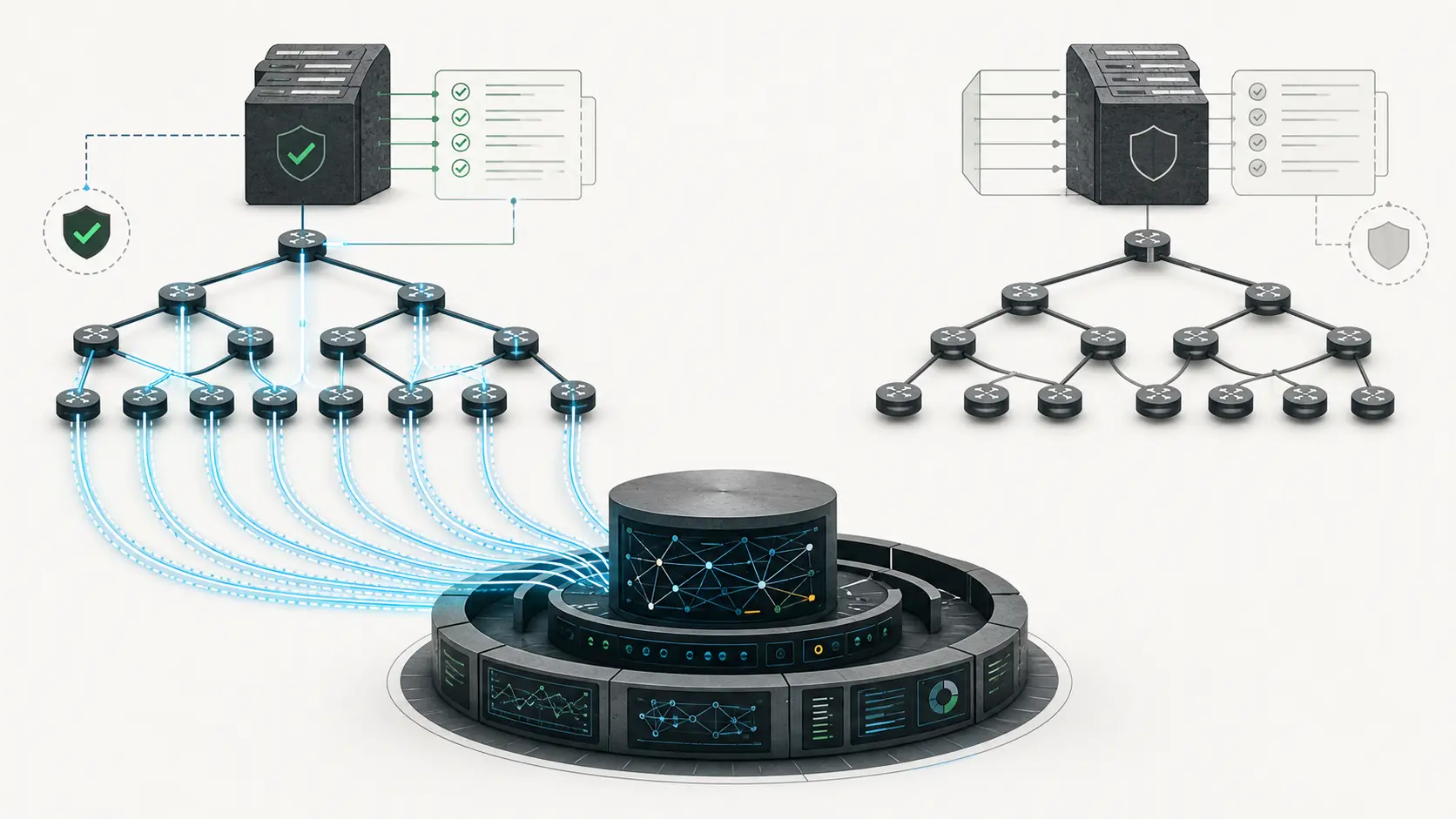
Image note: The featured image is an original synthetic conceptual illustration separating a registry ledger from observed routing signals. It is not a photograph of an AIREDATA facility, a geographic map, a network topology, a coverage claim, a capacity measurement or evidence of current availability.
One network identity, four different questions
The exact public BTW directory route for AIREDATA SRL displays AS269786. That pairing establishes the subject of this briefing: the selected directory company and the autonomous system number explicitly attached to its profile. It also avoids a subtle identity error. A separate same-name directory entry represents a LACNIC member-directory identity but does not bind AS269786. A matching name is not enough to merge two records or transfer the ASN connection from one to the other.
Once the exact entity is fixed, the source set divides into four layers. The directory answers which public company profile is in scope. LACNIC RDAP answers who is recorded for the unique number resource and when that record was created or changed. RIPEstat answers what qualifying Border Gateway Protocol (BGP) routes its Routing Information Service (RIS) collectors observed at a timestamp. BGP is the system networks use to exchange reachability information, while RIS collectors provide selected observation points rather than a view from every network.
AIREDATA's website answers what the operator says it offers and how it presents customer contact and account functions.
These layers complement one another without becoming interchangeable. A registry object can remain administratively active while a route is not visible from a particular observer. A route can be visible to nearly every listed collector peer while a local access connection, application or power system is unavailable. An operator can present Internet service without documenting every serviceable address or dependency. AS269786 provides a common reference, but each decision still needs evidence from the layer where the question lives.
Layer one: the exact directory entry fixes the subject
The selected BTW directory page Only for Strategic Circle returned at its exact canonical route, rendered the expected AIREDATA SRL heading and showed AS269786 in visible text. That is enough to anchor this article to the exact ASN-bound company profile and to distinguish it from the separate same-name entry.
The result is an identity boundary, not an endorsement of every possible relationship or service claim. A network-resource claim should follow the explicit identifier binding, not a text match. Here, that rule selects one record and excludes the other. It does not establish which physical assets AIREDATA owns or leases, which routes carry a particular customer service or which party is responsible for every dependency.
Layer two: LACNIC records the administrative resource
LACNIC's RDAP response covers exactly autonomous system 269786. The handle is AS269786, the starting and ending autonomous-system values are both 269786, the registrant is AIREDATA SRL and the object's status is active. The response records a registration event on 14 November 2019 and a last-changed event on 15 November 2019.
That record provides an authoritative administrative layer for the number resource. It answers a concrete question: which organisation does the regional registry record as the registrant for this ASN? It also gives operators and researchers a stable identifier around which to organise coordination and compare other records.
The RDAP contact data creates a narrow identity bridge to the operator website. An administrative and technical contact uses an airedata.com.ar email address and lists Maciel, Santa Fe. The website uses the same domain and presents a commercial office in Maciel. This alignment supports treating the site as operator-controlled context, not as proof of ownership structure, customer scale, licence scope or a defined service territory.
The active label requires even tighter handling. It belongs to the registry object. It says nothing direct about whether a BGP route is visible now, whether a router is forwarding traffic, whether a radio or fibre access link is functioning, whether a customer session is established or whether an application is available. Converting the field into “the network is active” would collapse an administrative label into an operational claim that RDAP does not test.
A useful way to read the registry is as a ledger. It supports uniqueness, accurate association and contact continuity for a number resource, but it is not the system that carries packets. Operational continuity depends on running equipment, accepted routing policy, transport, power, people and procedures. The record can identify the associated party without certifying those systems.
The defensible conclusion is therefore specific: LACNIC records AIREDATA SRL as the registrant for AS269786, with an active administrative object and the stated event dates. Any claim about live routing or service health must come from another layer.
Layer three: RIPE RIS supplies a time-stamped routing observation
RIPEstat's AS overview identified the holder string as “AS269786 - AIREDATA SRL” and reported the ASN as announced when the endpoint was fetched. Its routing-status response supplied the more detailed observation. The last-seen route record was timestamped 6 August 2026 at 16:00 UTC. At that collection point, the response reported four announced IPv4 prefixes representing 1,024 IPv4 addresses and zero announced IPv6 /48s. It also reported two observed neighbours.
The visibility fields add important context. The qualifying IPv4 routes were visible from 326 of 327 listed RIS peers. For IPv6, the response showed no qualifying route at 0 of 322 listed IPv6 peers. Those denominators should stay attached to the numbers. They identify a collector-derived view under the documented routing-status method, not a measurement from every network or every user on the Internet.
This layer reflects observed routing rather than an administrative field. At a stated time, RIPE RIS collectors received qualifying route information associated with AS269786. Operators can compare it with their own view, researchers can preserve its timestamp and peer coverage, and incident responders can use it as one signal when deciding where to investigate.
Yet the observation remains bounded. Visibility at 326 listed IPv4 peers is not proof that every destination could reach every address in the four prefixes. It does not test whether a website loaded, whether a customer could authenticate, whether a last-mile connection passed traffic or whether a particular application was healthy. It does not measure latency, packet loss, congestion, available capacity or traffic volume.
Nor does it describe the physical network. Four visible IPv4 prefixes do not reveal where fibre runs, whether components are owned or leased, or whether logical paths share a conduit, facility, power source or upstream dependency. Two observed neighbours are not proof of commercial peering, contractual transit, control or resilience.
The time boundary matters as much as the viewpoint boundary. A snapshot can be accurate for its collection point and stale for a later decision. A changed collector view should not immediately be called an outage: analysts must preserve what changed, when, which address space and viewpoints were affected, and what other evidence agrees or conflicts.
The right sentence is therefore conditional: at the cited timestamp, RIPEstat reported the stated qualifying IPv4 route and peer visibility for AS269786, with no qualifying IPv6 announcement in that response. The wrong sentence is that the data proves universal service availability or a permanent network design.
The IPv6 result is an observation, not a capability verdict
The zero announced IPv6 /48s in the cited routing-status snapshot deserve their own boundary because they are easy to overstate. The response reported no qualifying IPv6 announcement for AS269786 at 0 of the 322 listed IPv6 peers. That is a precise and useful description of what the endpoint returned for this ASN and time.
It does not prove that AIREDATA has no IPv6 capability in any context. The source set does not establish whether IPv6 may exist behind another ASN, inside a private or customer environment, in testing, through a different arrangement or outside the endpoint's qualifying observation. It also does not establish a plan, commercial commitment or technical limitation. Those possibilities are not claims that any such deployment exists; they explain why the public observation cannot support a universal negative.
A buyer who requires IPv6 should therefore ask a service-specific question: will the proposed service provide the required IPv6 function, address plan and reachability, and how will that be tested? A researcher should record the ASN, timestamp, method and peer denominator. An incident responder should compare current routing evidence with the expected configuration. None should turn one zero in a collector snapshot into a complete statement about organisational capability.
Layer four: the operator website describes customer-facing service
AIREDATA's website presents “Airedata Comunicaciones,” offers a path to request Internet service and provides customer self-service and payment functions. It also displays a commercial office in Maciel, Santa Fe and an airedata.com.ar contact channel. These details align narrowly with the RDAP contact domain and locality and support using the site as operator-presented context.
The site answers a different question from RDAP or RIPEstat. It shows that the organisation publicly presents Internet service to prospective and existing customers. The self-service and payment paths provide additional customer context.
They remain statements and functions on an operator-controlled website. The page does not establish the number of connected customers, the exact addresses that can receive service, a geographic coverage boundary, market share, licence scope or present performance. It does not show whether AS269786 carries every product presented by the company. It does not disclose how traffic is engineered or whether the underlying infrastructure is owned, leased or shared.
The site is not continuity evidence. A service-request page, account function or payment function cannot show that a particular access link is available or that service will survive a named failure. Operational assurance requires evidence from the service and dependencies being evaluated.
A claim-to-evidence guide
| Reader's question | Evidence in this briefing | What remains unknown |
|---|---|---|
| Which public company profile explicitly binds AS269786? | The exact BTW directory route for AIREDATA SRL | Ownership or control of every physical asset and service dependency |
| Who is recorded for the number resource? | LACNIC RDAP for AS269786 | Live routing, equipment state, access availability or application health |
| What qualifying routes did the cited collectors observe? | RIPEstat's time-stamped AS overview and routing-status responses | Universal reachability, performance, traffic, physical diversity or customer experience |
| What service does the organisation publicly present? | AIREDATA's operator-controlled website | Exact serviceability, subscriber scale, licence scope or continuity under failure |
| Can a proposed connection meet a resilience requirement? | None of the public records alone | Service design, shared dependencies, current measurements and tested recovery evidence |
The table is not a reason to dismiss public data. It is a way to make each source useful. The directory prevents an entity mismatch. RDAP establishes the recorded resource holder. RIPEstat supplies a dated external observation. The website explains the operator's public service context. Each closes one question and identifies the next evidence request.
A buyer's decision framework
A buyer considering an AIREDATA Internet service can use AS269786 to begin due diligence, but the decision should be framed around the purchased service rather than the ASN alone.
First, confirm identity. The buyer can use the exact directory entry and LACNIC record to verify that AS269786 is associated with the expected AIREDATA SRL entity. This step reduces the risk of evaluating a same-name record that lacks the ASN binding. It does not yet say how the proposed service is built.
Second, define the service boundary. Is the requirement Internet access at one site, several sites or another customer-facing function? Which portions are controlled by the customer and provider? Does the decision concern the access link, routing beyond it, an application or all three? Without that boundary, words such as “available” and “redundant” are too vague to test.
Third, name the failure that matters. A buyer might need continuity after loss of a customer device, an access segment, a power source, a transport path or another dependency. The public records do not reveal whether apparently separate paths share a physical or organisational point. The question should therefore identify the component or condition whose loss the service must tolerate.
Fourth, define an acceptable outcome. The team should state what must remain reachable, what level of service is needed and how quickly a failure must be detected and recovered. Route visibility is relevant to Internet reachability, but a route count or collector-peer ratio is not a substitute for a service result. The same is true of the RDAP status and the existence of customer web functions.
Finally, request evidence matched to the requirement: bounded dependency information, current route and interface observations, maintenance and escalation procedures, or results from a test of the named failure. This briefing does not claim that such evidence is absent; it says the cited public sources do not contain it.
AS269786 remains valuable through the process. It keeps routing-related questions attached to the correct network identity. It should serve as an anchor for verification, not as shorthand for the answer to every procurement question.
An incident decision framework
During an incident, the same method helps teams avoid a premature diagnosis. Start with the symptom: which user, site, prefix, destination or application is affected, and when did the problem begin? A broad statement that “AIREDATA is down” asks the public evidence to prove more than it can.
Next, separate the layers. Confirm the exact identity, then check a fresh routing observation for the relevant ASN and address space while preserving its timestamp and viewpoints. Compare that external view with operator and customer measurements. A route visible to RIS can coexist with a local access failure; one absent from a single view can coexist with reachability elsewhere. The snapshot is a signal, not the verdict.
Then test the service boundary. If routing appears as expected, investigate access, customer equipment, name resolution, applications and other dependencies. If it differs, determine which prefixes and observers are affected and seek current operator evidence before attributing cause. The two observed neighbours do not identify a failed commercial relationship.
Finally, document what is known, observed and inferred. “LACNIC records the object as active,” “RIPEstat observed these routes at this time,” and “the customer could not reach this application” are three different statements. Keeping them separate makes escalation more precise and reduces the risk of converting correlation into responsibility.
The cited source set does not report a current incident, prove safeguards present or absent, or assign contractual responsibility. It helps investigators ask the next bounded question with the correct identity in hand.
How to interpret a future change
Each change should first be interpreted within its layer. A new RDAP event is administrative, not automatic proof of a routing or physical change. A different RIPEstat result is a collector observation whose timestamp, address space, peer denominators and method must be preserved. A website update is an operator statement, not independent proof of coverage or continuity. The disciplined sequence is signal, question, corroboration and only then conclusion.
What the public evidence supports now
The available records support a clear, limited account. The exact BTW directory entry binds AIREDATA SRL to AS269786 and distinguishes it from a same-name record without that ASN connection. LACNIC RDAP records AIREDATA SRL as the registrant for the autonomous-system resource and labels the administrative object active. RIPEstat reports a dated collector view with four announced IPv4 prefixes representing 1,024 addresses, visibility at 326 of 327 listed IPv4 peers, zero announced IPv6 /48s with visibility at 0 of 322 listed IPv6 peers, and two observed neighbours.
AIREDATA's own website presents Internet service and customer-facing functions from an operator-controlled domain.
Together, the sources connect administrative identity, observed routing and public service context. They do not prove universal reachability, uptime, latency, capacity, physical path diversity, exact coverage, customer experience, subscriber numbers or regulatory status. They do not show that every AIREDATA service uses AS269786, and they do not show whether any particular asset is owned or leased.
Those limits are not allegations. The organisation may hold operational, commercial or engineering evidence that is not public. A lack of that evidence in this source set does not prove that a capability or safeguard is absent. It defines what an external reader can responsibly conclude from the cited records.
The practical lesson is simple. Use AS269786 to identify the network resource and coordinate around the correct company record. Use RDAP for the administrative ledger. Use RIPEstat for a time-stamped routing observation. Use AIREDATA's website for attributed service context. For physical design, service performance and continuity, ask for evidence from the systems and service boundary that must actually work.