
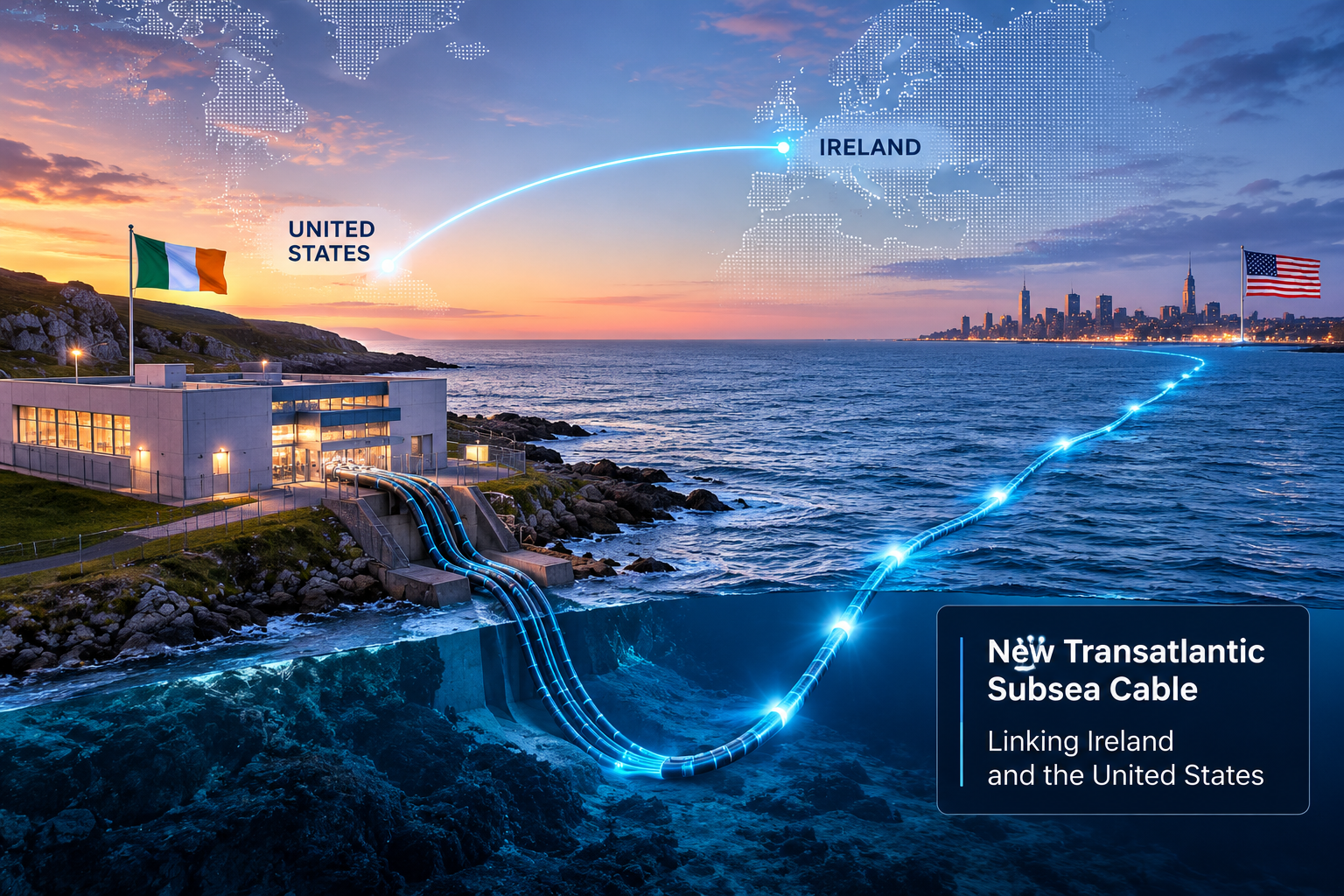
- MDM’s subsea work covers route planning, permitting, cable landings, installation and maintenance across the project lifecycle
- The system’s resilience value will depend on its final landfalls and onshore backhaul, which will determine how distinct it is from existing routes
The fact
MDM, a Dublin-based engineering and project-management company, has announced plans for a new transatlantic subsea cable linking Ireland and the United States, according to Data Center Dynamics. The company specialises in subsea projects, with work covering route planning, permitting, cable landings, installation and maintenance.
Its previous projects include IRIS, which connects Iceland and Ireland, as well as PISCES, a planned system linking Ireland with France, Spain and Portugal. Ireland already has transatlantic cable connections, including AEC-2/Havfrue, which runs between the United States and Denmark with a landing in County Mayo.
The assessment
The value of the new system will depend on the route it actually takes. Two cables can connect the same countries but still share the same coastal approach, landing station or terrestrial fibre, leaving both exposed to the same point of failure. Until MDM confirms the landfalls and onshore connections, carriers will not be able to judge how much additional route diversity the system provides.
Those details will also shape how the cable connects into Ireland’s wider network. The project will need landing infrastructure, permits and backhaul into carrier and data-centre networks. For BTW readers, the cable could add transatlantic capacity, but its resilience value will depend on whether it follows a genuinely separate path from existing routes.
What to watch
Watch for confirmation of the Irish and US landing points, cable route, supplier, fibre-pair design and ready-for-service date. Planning and marine permits will provide the clearest evidence that the project is advancing. Details of the onshore backhaul will also matter, showing how the new cable would connect with Ireland’s carrier and data-centre networks.