
Profiles of leaders, operators and founders included in our market intelligence.
Market / People
People
People intelligence profiles the leaders, operators, researchers, creators, investors, and policy actors shaping internet infrastructure strategy. The category connects interviews, public profiles, company links, role changes, governance exposure, affiliation context, and related articles so readers can follow decision-makers by operating role rather than by isolated article chronology.
LeadersDisruptorsAcademicsCreators

Leaders, disruptors, academics, and creators grouped so readers can compare role, authority, and market influence.
People coverage gives readers a clear path from market category to individual profile detail.
Private contact channels remain behind membership access on profile detail pages.
Latest Coverage
Latest from People
523 articles
Academics
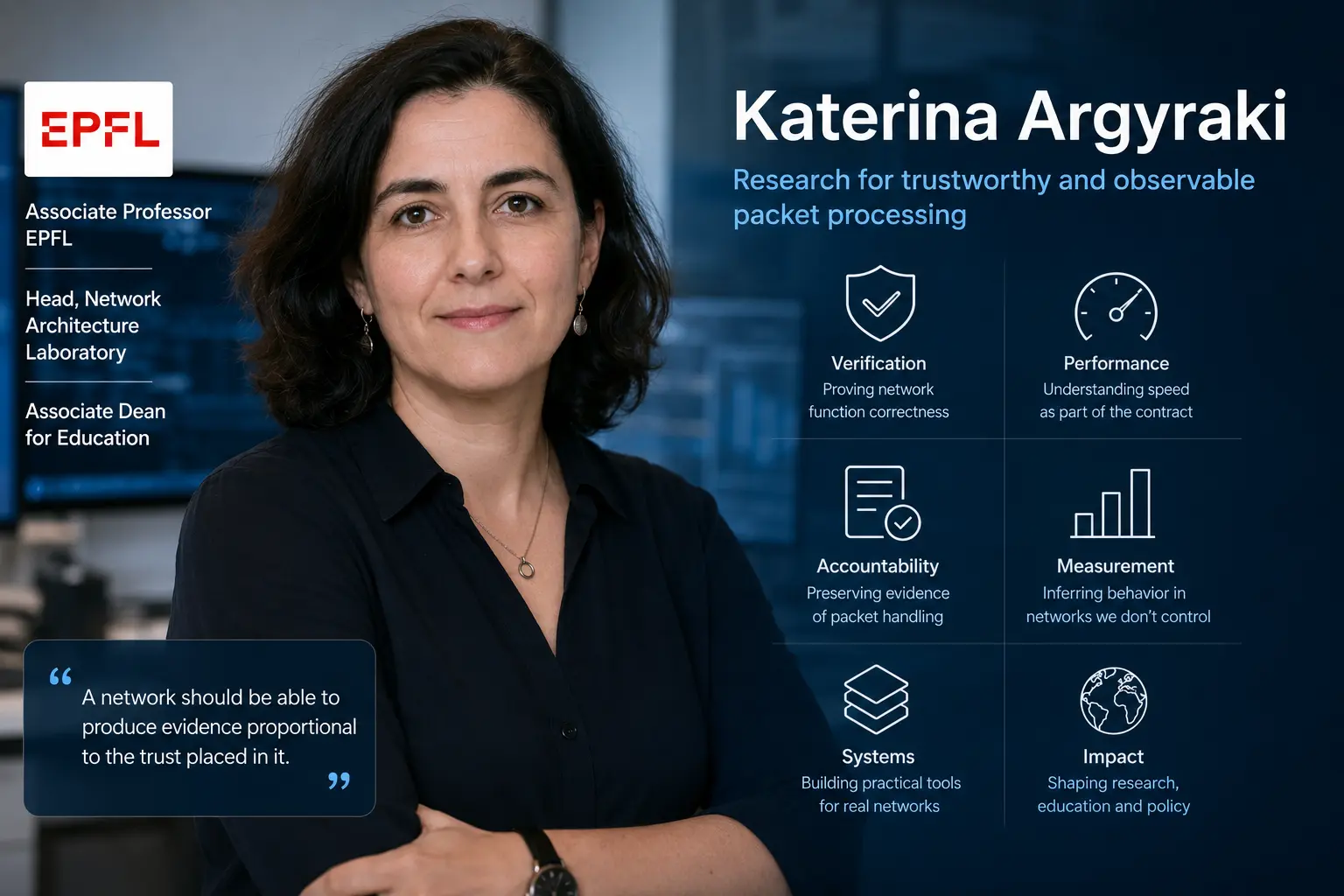
Katerina Argyraki and the search for proof in packet forwarding
Katerina Argyraki’s research follows a problem that becomes harder as networks become more programmable: a packet-processing system may be fast and flexible, yet operators and users often have little evidence that it behaved correctly. Her work at EPFL connects software-router…

Creators
Steven Bellovin and the security questions that escaped the network
Steven M. Bellovin began by testing the claims computers accepted from packets: source addresses, routes, sequence numbers and names. His later work applied the same suspicion to institutions, asking what systems make the public trust when governments demand access, companies…

Creators
Ion Stoica and the abstractions behind distributed computing
Distributed systems fail when software assumes machines are interchangeable. Ion Stoica’s work repeatedly moves complexity behind a narrower abstraction—from packet-carried state and Chord to Mesos, Spark, Ray and cross-cloud placement—then tests how much operational, economic…
Leaders
Rupesh Shrestha and the NPIX Community Record Behind Nepal Internet Exchange
Rupesh Shrestha's public record is best understood as a long-running operator-community record rather than a founder myth. Across an APNIC history, regional conference programmes, NPIX material and exchange-directory snapshots, he appears at the points where a technical…
Leaders
Thomas Heinzmann
Thomas Heinzmann profile intelligence explains the public role, affiliation context, sources of authority, geography, and decisions that make this person relevant to internet infrastructure markets. The summary links published evidence with company ties, governance exposure…

Leaders
María Eugenia Spagnuolo and the Small-Operator Signal in Latin American Internet Governance
María Eugenia Spagnuolo's public record is not a story of formal victory or consolidated control. It is more precise than that: a 2022 LACNIC Electoral Commission candidacy that missed a single seat by six votes, a candidate biography that places her in Argentina's local…
Leaders
Dave McBreen and the registrar layer beneath Identity Digital's consumer surface
Dave McBreen's public record is not the story of a loud founder remaking the domain market from a podium. It is the quieter case of an operator who entered Name.com when the registrar was still young, worked close to its software and infrastructure, and later became the executive…

Academics
Kathleen Nichols and the queue delay a fast link cannot hide
Kathleen Nichols’ best-known work changed the variable used to judge a network queue: time, rather than packet count. CoDel made persistent waiting measurable, while leaving deployment dependent on bottleneck placement, responsive senders and maintained implementations.

Academics
Dr. Mohamed Awang Lah
Dr. Mohamed’s fascinating journey 1980-1985: Universiti Malaya After completing his Doctorate Degree at the University of London King’s College, Dr. Mohamed Awang Lah began his career as a lecturer in the Faculty of Engineering at Universiti Malaya in 1980. It was during this…

Leaders
Michael Lim
Michael Lim is the Co-Founder of Nexthop, an Australian telecommunications carrier specializing in wholesale dark fibre solutions since 2016. With over 8 years of experience at Nexthop, he has led the company in delivering customized network solutions for carriers, ISPs, and…

Creators
Harald Welte and the work of opening telecom’s closed interfaces
Across Linux firewalls, licence enforcement, open phones, GSM network functions and SIM tooling, Harald Welte repeatedly made closed communications systems inspectable. His record shows both the leverage of public implementations and the hardware, regulatory and maintenance…

Leaders
Paulius Judickas
Why CFOs must treat IPv4 addresses as balance sheet assets and consider leasing versus ownership in financial strategy.

Leaders
Geoff Huston
IPv4 vs IPv6 explained: why scarce IPv4 blocks still command premium value despite growing IPv6 adoption worldwide.

Leaders
Ribera's Big Tech meetings put AI competition on the agenda—not a ruling
Teresa Ribera's scheduled meetings with Alphabet, Meta, OpenAI and Amazon were regulatory engagement, not a new investigation or decision. The legal next step depends on evidence and the specific competition, merger or DMA tool used.

Academics
Nick Feamster: making networks explain themselves, and exposing the limits of measurement
In 2005, a checker he co-developed reported over 1,000 previously undetected faults in 17 autonomous systems. Since then, his effort to make hidden infrastructure explainable has extended to spam, broadband, censorship, smart homes, and machine learning, repeatedly showing that…

Leaders
Aaron Wendel and the Infrastructure Choices Shaping Kansas City’s Interconnection Hub
Aaron Wendel’s public record is not a conventional executive biography. It is a trail of exchange switches, data-centre connections and partner deployments that shows how a regional operator has tried to make Kansas City a more consequential place for networks to meet.

Academics
Nick Feamster built tools that explain networks – and show their limits
In 2005, a checker he co-developed reported more than 1,000 previously undetected faults across configurations from 17 autonomous systems. The same effort to make hidden infrastructure readable later expanded to spam, broadband, censorship, smart homes and machine learning – and…
Academics
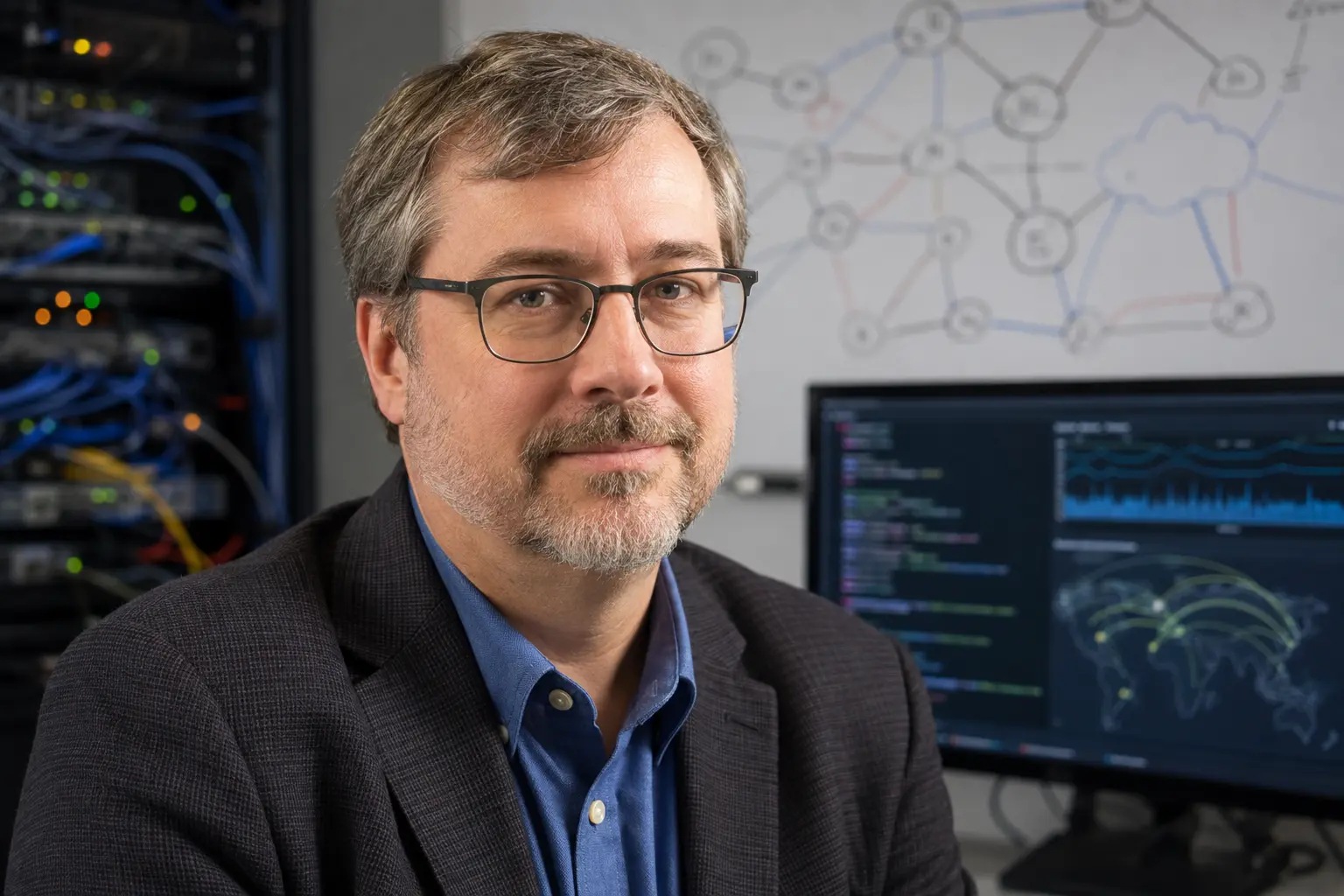
Nick Feamster created tools to explain networks and revealed their limits
In 2005, a checker he co-authored detected over 1,000 previously unidentified faults in configurations of 17 autonomous systems. The same effort to make hidden infrastructure legible later extended to spam, broadband, censorship, connected homes and machine learning, repeatedly…

Academics
Nick Feamster Built Tools to Explain Networks and Reveal Their Limits
In 2005, an audit tool he co-authored reported over a thousand previously undetected faults in the configurations of 17 autonomous systems. The same quest to make hidden infrastructure understandable later extended to spam, broadband, censorship, smart homes, and machine…

Academics
Nick Feamster Created Tools to Explain Networks — and Exposed Their Limits
In 2005, a co-authored verifier reported over 1,000 previously undetected faults in 17 autonomous systems. The same effort to make hidden infrastructure legible later extended to spam, broadband, censorship, connected homes, and machine learning — and repeatedly showed that an…
Taxonomy
People Categories
Profiles
Leaders
Senior decision-makers controlling strategy, capital, and execution.
Profiles
Disruptors
Operators driving step-change performance and market reconfiguration.
Profiles
Academics
Researchers shaping long-cycle infrastructure and governance thinking.
Profiles
Creators
Protocol and platform creators shaping architecture and standards behavior.