
Summary
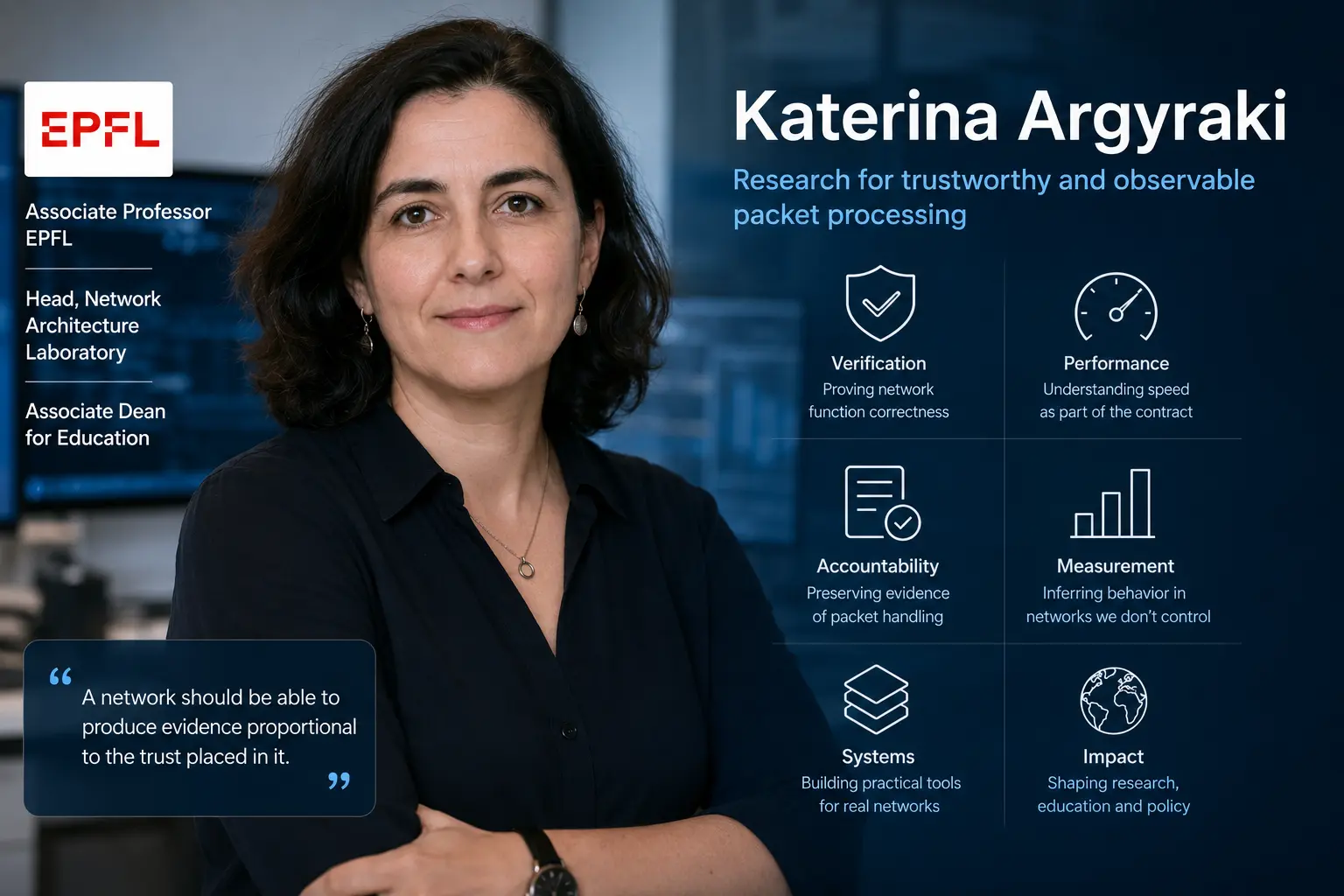
- Katerina Argyraki leads EPFL’s Network Architecture Laboratory and serves as Associate Dean for Education; her research asks how packet-processing behaviour can be proved, measured and explained rather than accepted on trust.
- RouteBricks established that software forwarding could scale through parallelism, while later work on Software Dataplane Verification, a verified NAT, Vigor and Klint moved assurance from abstract rules into implementation code and even source-unavailable binaries.
- PIX and subsequent cache reasoning treat performance as part of correctness, recognising that a function can forward the right packets while violating latency or throughput expectations on a particular CPU, NIC or memory hierarchy.
- Packet receipts, neutrality inference, latency extraction from gaming footage and edge-caching studies extend accountability to networks that observers do not control, but none can prove every internal cause or intention from external evidence alone.
Packet processing usually asks the user to trust an invisible chain
A packet enters a software router or middlebox. Code parses its headers, consults tables, updates state, perhaps changes an address or chooses a backend, then forwards or drops it. The operator sees counters and logs. The customer sees a result. Neither necessarily possesses proof that the implementation performed the intended transformation, avoided memory faults, met its latency objective and treated comparable traffic consistently.
That gap is easy to overlook when the function is packaged as an appliance. A firewall may expose a policy interface and a health dashboard while hiding the code path that enforces the rule. A virtual network function may be delivered as a binary whose vendor regards source as proprietary. A cloud service may reveal end-to-end latency but not the queues, caches or placement decisions that produced it.
Network assurance traditionally addresses parts of the problem. Configuration verification can check whether forwarding rules create a loop or violate isolation. Testing can send representative packets. Monitoring can observe loss and delay. These controls are useful, but they do not answer the same question. A correct policy model does not prove the C implementation is memory-safe. A passing functional test does not describe performance under a different cache state. End-to-end delay does not identify which network applied different treatment.
Argyraki’s research record can be read as an effort to build evidence at each boundary. The first step was to show that software packet processing could reach serious performance. Once flexible software became a credible data plane, correctness could no longer be dismissed as a problem for low-speed prototypes. Verification work then moved from high-level models into code and binaries. Performance-interface work treated speed as a behaviour to be described, not a benchmark to be repeated. Packet receipts preserved evidence of selected forwarding events.
External measurement sought accountability where the observer had no access to the implementation.
The result is not one certification system. It is a stack of methods with different assumptions. Formal proof needs a specification and trusted environment model. Binary verification needs contracts that describe allowed behaviour. A performance interface is tied to hardware and workload. A receipt can be authentic yet incomplete. An external inference can reveal a pattern without proving motive.
Argyraki is an Associate Professor at EPFL, head of the Network Architecture Laboratory and Associate Dean for Education in the School of Computer and Communication Sciences. Her institutional roles establish current responsibility for a research programme and education; they do not make her the sole author of the systems associated with the lab. The papers include students and collaborators whose implementation and conceptual work must remain visible.
The most useful way to assess her contribution is therefore not to count project names. It is to examine how those projects narrow distinct forms of uncertainty. The common question is whether a network can produce evidence proportional to the trust placed in it.
Early work connected high-speed switching with academic systems questions
EPFL records that Argyraki completed a PhD at Stanford University in 2007 and was an early employee of Arista Networks before joining EPFL. The combination is relevant because it placed her near two pressures that shaped modern networking: the demand for high-performance switching and the desire to move more network behaviour into software.
Arista’s early context should not be turned into product authorship or an equity narrative unsupported by public evidence. Its importance is experiential. Commercial switching exposes constraints that academic models can simplify: packet rates, memory hierarchies, device interfaces, release pressure and customers whose networks cannot pause for a proof.
Software data planes offered a different form of control. General-purpose processors allowed developers to change packet functions without waiting for a new fixed-function ASIC. The trade-off was performance and predictability. A flexible implementation that processed too few packets per second or behaved erratically under load would remain a laboratory object.
This tension created the foundation for RouteBricks. If software forwarding could be scaled through parallelism across cores and servers, then routers and middleboxes could become ordinary programmable systems. Once that happened, the familiar software questions followed: how to establish memory safety, functional correctness, performance behaviour and accountability after deployment.
Argyraki’s research has consistently resisted solving one layer by pretending the others do not exist. A proof that ignores the driver or hardware may be useful but bounded. A benchmark that omits policy complexity may be fast but unrepresentative. An inference that detects differentiation cannot automatically identify intent. The systems are built around these boundaries rather than hidden behind a universal claim.
The academic setting also matters. A laboratory can design methods whose value is not immediately commercial. Packet receipts may require new infrastructure and governance before an operator adopts them. Binary verification may alter procurement without becoming a standalone product. External measurement can inform a regulatory debate even when it cannot produce a legal conclusion.
Argyraki’s current role as Associate Dean for Education adds another institutional dimension. The work depends on training researchers who can move between networking, formal methods, measurement and systems performance. Those fields use different concepts of evidence. A network engineer may accept a test; a verification researcher asks what was proved; a measurement scientist asks how the sample was selected. The research programme gains force by bringing those standards into the same conversation.
RouteBricks made software forwarding fast enough to deserve stronger guarantees
RouteBricks, recognised with the 2009 SOSP Best Paper award, explored how packet processing could be distributed across commodity servers and processor cores. The architecture used parallelism to build a high-speed software router rather than assuming one general-purpose machine had to carry every packet through one serial path.
The significance of the work is not a timeless throughput number. Hardware, drivers and packet-processing frameworks have changed substantially since 2009. RouteBricks demonstrated that software routing could be organised as a scalable system, and that performance limits were not necessarily an argument for keeping packet logic inside closed appliances.
Parallel software forwarding raises several design questions. Packets must be distributed across cores without destroying flow affinity. State shared by flows can create contention. Network interface queues have to be mapped to processing threads. Memory allocation and cache locality affect throughput. Sending work to another server adds communication and ordering concerns.
The architecture can scale only where the workload can be partitioned. A stateless forwarder is easier than a network function with shared counters, connection state or complex policy. A benchmark based on minimum-size packets stresses a different path from one dominated by large transfers. The paper’s experimental evidence should remain attached to its testbed and functions.
RouteBricks nevertheless changed the accountability problem. If software routing were permanently slower than hardware, formal assurance might remain a niche concern. A credible high-speed software router created a realistic deployment choice. Operators could gain flexibility, but they would also run more code in the packet path and need evidence that the code was safe.
The work anticipated later frameworks such as DPDK, VPP and XDP without being identical to them. Those ecosystems provide high-performance packet I/O and processing models. They do not automatically verify every network function built on top. RouteBricks belongs to the performance lineage that made such functions practical; Argyraki’s later research addressed the trust they required.
The award was a team result. A profile centred on a professor should not erase the collaborators who designed, implemented and evaluated the system. The defensible contribution is her role in a research trajectory that connected software forwarding scale with subsequent verification questions.
The transition is important because performance and correctness often compete for engineering attention. Optimised code uses batching, prefetching, specialised memory layouts and driver assumptions that can make reasoning harder. Argyraki’s later systems did not avoid that tension. They attempted to show that useful guarantees could coexist with competitive packet processing rather than requiring a slow, simplified implementation.
Software Dataplane Verification moved assurance below the configuration model
By 2014, network verification had made substantial progress in checking forwarding rules and configurations. A model could determine whether a packet might reach a forbidden destination or become trapped in a loop. The model assumed that devices implemented their rules correctly. Software Dataplane Verification challenged that assumption by analysing implementation code.
A network function can violate its policy in several ways that a configuration model will not reveal. It can dereference invalid memory, mishandle malformed packets, update state in the wrong order, crash on an unexpected header or implement a protocol differently from the specification. A proof about the intended forwarding table does not cover those defects.
The 2014 NSDI Best Paper work targeted the software data plane itself. The research used verification techniques to establish properties of implementation paths, bringing packet-processing code into a domain more often associated with small critical programs than with performance-oriented networking.
This move changes the trusted computing base. Instead of assuming the network function is correct, the proof assumes a verifier, a specification and a model of the environment. Drivers, hardware, compiler behaviour and external libraries may remain outside the boundary. A responsible statement of verification must name those assumptions.
Specifications are another source of risk. A verifier can prove that code meets a property that is incomplete or wrong. For a NAT, the specification must state how mappings are allocated, when they expire and which packets are rejected. For a firewall, it must define policy and state behaviour. An operator may care about service-level requirements not present in the formal model.
The work is still strategically valuable because it relocates disagreement. Instead of arguing that a binary is “trusted” because a vendor built it, parties can examine the property, the proof boundary and the assumptions. A failed verification can identify a concrete path. A successful one can reduce a class of uncertainty without claiming omniscience.
Code-level verification also has operational implications. Network functions evolve. A patch can invalidate a proof or change an assumption. The verification process has to be repeatable as part of development rather than performed once for a paper. Tooling, build reproducibility and specification ownership become part of the software lifecycle.
Academic prototypes face a productisation gap at this boundary. A paper can verify a bounded function under a documented environment. An operator needs integration with CI, support for its compiler and driver versions, diagnostics when the proof fails and engineers able to update the contract. The research demonstrates possibility; sustained deployment requires an institution around the method.
A verified NAT showed how narrow specifications can produce strong claims
The work on a formally verified network address translator provided a focused test of the verification approach. NAT is conceptually familiar but stateful. It maps internal addresses and ports to external ones, tracks sessions, rewrites packets and handles timeouts. A small error can send traffic to the wrong endpoint, leak a mapping or crash the function.
A useful verification target needs enough complexity to matter and enough structure to specify. NAT offers both. The implementation can be checked for memory safety and for relationships between input packets, state and output. The result can show that defined transformations hold across program paths rather than only for a test set.
The strength of the claim depends on what the model includes. If the driver delivers a malformed buffer length that the environment model excludes, the proof may not cover the resulting behaviour. If the hardware or compiler violates an assumption, the verified source property may not hold in the binary. If deployment adds a custom feature, the original proof no longer describes the complete function.
These qualifications do not make formal verification empty. Ordinary testing also depends on an environment and misses untested paths. The value of a proof is that its assumptions and property can be stated precisely, and that it covers a broader space of inputs within those assumptions than sampled tests.
The NAT lineage helped motivate reusable verified components. A single fully hand-proved function can require effort unavailable to most network developers. To influence infrastructure, the method needs abstractions for common data structures and packet-processing patterns. The proof burden has to move into tools and libraries rather than remain entirely with specialists.
The question is economic as much as technical. Verification costs time upfront. Its benefits appear through avoided defects, easier review or stronger procurement confidence. Those benefits are difficult to quantify without production evidence. A high-risk network function may justify the effort; an experimental feature may change too rapidly for a deep proof to remain current.
Argyraki’s research does not provide a universal cost formula. It demonstrates a path by which the claim “this function is safe” can be replaced with a bounded and inspectable guarantee. That shift matters in infrastructure where one binary may process traffic for many tenants and where the source may be unavailable to the operator.
Vigor tried to make full-stack proof a development workflow
Vigor, published at SOSP in 2019, sought to automate the construction of verified network functions using reusable components, symbolic execution and formal specifications. The ambition was practical: a developer should not need to become a theorem-proving expert to build a NAT, bridge, firewall, load balancer or policer with strong guarantees.
The system provided verified data structures and a constrained programming model. Symbolic execution explored packet and state paths. Specifications described the expected relation between inputs, state and outputs. The resulting functions aimed to deliver performance competitive with ordinary software while carrying proofs about safety and behaviour.
Restricting the programming model is part of the method. Arbitrary C with unrestricted pointers and concurrency is difficult to verify. A framework can make proof tractable by controlling how state is represented and which operations are allowed. That restriction may also make some features awkward or impossible. The right question is not whether Vigor verifies “C” in general, but which network-function class fits its model.
The phrase “full stack” requires care. Project descriptions can suggest verification down toward hardware, but every guarantee retains trusted components and models. The verifier, specifications, compiler, driver assumptions and hardware interface form a boundary. A CPU erratum or NIC firmware defect is not eliminated because the network-function logic has been proved.
Vigor’s importance lies in composability. Verified containers and packet-processing primitives can be reused across functions. A proof of one component reduces repeated effort. The development workflow can catch violations when code changes rather than after a deployment.
The system also illustrates why performance is not a secondary concern. A verified function that consumes substantially more CPU may be rejected by operators even when its safety is stronger. Vigor’s evaluations attempted to show that proof need not require an impractical data plane. Results remain tied to the evaluated hardware and functions.
Operational adoption would require more than open code. Toolchains must build on current systems. Specifications need owners. Developers need understandable counterexamples. Integration with NICs, orchestration and telemetry has to preserve the proof boundary. Public repositories establish that artefacts exist; they do not establish a production support commitment or a customer base.
Vigor should therefore be treated as an important research system rather than a certification label. It shows that a class of high-performance network functions can be developed with substantial formal assurance. It also exposes the institutional work needed before a proof becomes part of ordinary network operations.
Klint changed the operator-vendor bargain by targeting binaries
Source-code verification is difficult when the operator does not receive source. Commercial network functions may be delivered as proprietary binaries. A vendor can provide documentation and tests, but the customer cannot assume that the shipped binary corresponds exactly to the reviewed source or build.
Klint, presented at NSDI in 2022, addressed this boundary by verifying selected network-function binaries without requiring source code or debug symbols. It used contracts and abstract “ghost maps” to model state and interactions. The approach aimed to let an operator obtain guarantees about the executable it would run.
This changes the procurement conversation in a concrete way. A vendor could preserve source confidentiality while supplying a binary and a contract describing its intended behaviour. The operator could verify defined properties independently. Disagreement would move toward the completeness of the contract and the trusted verification tool rather than remaining an all-or-nothing demand for source.
The method is bounded. Klint evaluated a set of network functions and reported verification on the scale of minutes for those cases. That result is not a generic proof time for arbitrary binaries. Complex concurrency, unsupported instructions, dynamic code or external libraries can expand the state space or fall outside the model.
A contract can also omit the behaviour that matters most. A load balancer may be memory-safe and still violate a business requirement about affinity. A firewall can satisfy a packet-level rule while mishandling management traffic. The operator needs expertise to state the right properties and identify environment assumptions.
Binary verification does offer a distinct advantage over trusting a source build. It checks the artefact intended for deployment. That can catch compiler or build differences within the model. It does not verify hardware, firmware or every privileged component around the function.
Liability becomes an important governance question. If a vendor supplies an incomplete contract and verification passes, who bears responsibility for the omitted property? If the verifier has a bug, is the result a warranty or research evidence? Technical tools can change the evidence available in a dispute, but contracts and regulation decide the remedy.
Klint’s strategic contribution is to make source availability and assurance less tightly coupled. Open source remains valuable for inspection and maintenance. Binary verification provides another path where disclosure is constrained. The two can complement each other rather than define opposing camps.
A green proof result is only as honest as its trusted computing base
Formal methods are sometimes presented through a binary outcome: verified or not verified. Infrastructure requires a more detailed label. A proof applies to a property, implementation, environment model and toolchain. Everything outside that set remains trusted, unmodelled or separately tested.
For a software network function, the trusted computing base can include the verifier, theorem prover, compiler, runtime, packet-I/O framework, driver, NIC firmware, CPU and operating-system services. Some systems reduce this set; none remove physical reality. The claim should identify which components were verified and which were assumed.
The specification is part of the trusted base because it defines success. A perfectly proved implementation of a flawed policy is reliably wrong. Specifications need review by people who understand both the protocol and the deployment. Formal precision does not automatically supply operational relevance.
Environment models can hide rare but important inputs. Packet lengths, DMA behaviour, timing, concurrency and failure injection may be simplified. The model should be challenged using incidents and fuzzing, not treated as a static document. Testing and formal verification are complementary because they fail in different ways.
Proof maintenance is another boundary. A function changes after a security disclosure, feature request or compiler update. If the verification pipeline cannot run on every release, the organisation may continue deploying on the reputation of an old result. The proof becomes technical debt rather than assurance.
Communication matters because operators may overread labels. “Verified NAT” can be interpreted as secure, fast and production-ready when the proof covered only selected packet transformations and memory safety. Researchers and vendors need language that states guarantees without turning every caveat into an unreadable footnote.
Argyraki’s work repeatedly returns to this problem of calibrated evidence. The objective is not to make the user trust the verifier blindly. It is to replace a vague trust claim with a structured statement that can be examined, combined with other evidence and updated when assumptions change.
This is why her later performance and accountability projects belong in the same profile. Functional proof answers one question. It does not show that the function meets a latency objective, preserve evidence of a disputed packet or explain behaviour in a remote network. A credible assurance stack needs separate instruments for those dimensions.
PIX treated performance as an interface rather than a benchmark result
A network function can forward every packet correctly and still fail its user. Latency may rise under a particular state size. Throughput may collapse for one packet distribution. A change in memory layout can create cache misses. A NIC offload can help one workload and hurt another. Functional correctness does not imply usable performance.
PIX, published at NSDI in 2022, introduced performance interfaces: compact descriptions automatically extracted from network functions. Instead of reporting one benchmark number, the system attempted to describe how performance changed with relevant inputs and system conditions. The interface could support regression detection, diagnosis and reasoning about offload.
The idea addresses a recurrent procurement problem. A vendor states that a function can process a particular rate. The operator’s workload contains different packet sizes, state distributions and hardware. A performance interface can make the dimensions of the claim explicit and reveal where the function changes behaviour.
Extraction is itself an approximation. The system observes or analyses the function across a chosen space. It must select variables, samples and hardware. An important interaction omitted from that space will not appear in the interface. A compact model can be useful without being complete.
Portability is the sharpest limit. A description extracted on one CPU, cache hierarchy, NIC, compiler and NUMA placement may not hold after an upgrade. Even a small code change can invalidate it. The interface needs a version and environment identity just as an API does.
PIX’s evaluation covered twelve network functions and several uses. That establishes a bounded demonstration, not a universal model for all packet processing. The research value lies in making performance a first-class object that can be compared and checked rather than an informal expectation.
A performance interface can also improve verification. If functional contracts say what packets should do and performance contracts say under which conditions they remain timely, an operator can assess both. The two may conflict: a stronger security check can increase cost, and an optimisation can complicate proof. Making the trade visible is better than allowing it to appear as an unexplained regression.
The approach depends on organisational adoption. Developers must rerun extraction, operators must define acceptable regions and deployment systems must identify hardware accurately. Without that workflow, the interface remains a paper artefact. With it, performance can become part of change control rather than a surprise discovered in production.
CPU-cache reasoning moved performance evidence below packet-level abstractions
Packet-processing code often appears simple: parse, look up, modify, forward. On modern processors, the cost can be dominated by where data resides in the cache hierarchy, how structures map to cache sets and whether several cores contend for shared lines. Two implementations with the same algorithm can behave very differently because of memory layout.
Argyraki’s group continued the performance-interface agenda with work on automated reasoning about CPU-cache use, published at OSDI in 2024. The research attempted to identify performance behaviour that ordinary profiling may expose only after a workload reaches an unfortunate alignment or contention pattern.
Cache reasoning matters because network functions handle repeated data structures at high rate. A table entry that spills from one cache level, a per-flow state layout that creates conflict misses or a counter shared across cores can change tail latency and throughput. These effects may appear only at particular table sizes or traffic distributions.
Empirical benchmarks remain necessary. A model of cache behaviour depends on processor details and program assumptions. Prefetching, out-of-order execution, NUMA and NIC DMA can alter outcomes. Automated reasoning can identify conditions and reduce the search space; it does not make hardware-independent performance guarantees.
The work reinforces a broader point: performance is part of the system’s observable contract. An operator deciding whether to offload a function needs to know not only average CPU cost but where the software becomes unstable or sensitive. A developer reviewing a patch needs evidence that a new field did not create a cache cliff.
This level of analysis can be expensive and specialised. Product teams may not run it for every change. The strategic challenge is to integrate the most valuable checks into ordinary tools, much as Vigor sought to move proof expertise into reusable components.
Argyraki’s research programme gains coherence through this progression. RouteBricks showed that parallel software could be fast. Verification established functional guarantees. PIX and cache reasoning made performance behaviour inspectable. The next question was how to preserve evidence after packets passed through a system or through a network the observer did not own.
Packet receipts preserve selected evidence without retaining all traffic
Full packet capture can provide detailed evidence, but it is expensive and invasive. High-rate networks produce enormous volumes. Payloads and identifiers raise privacy and security concerns. Retention creates a valuable target. An operator may need to investigate one disputed event without storing every packet indefinitely.
Retroactive packet sampling and MorphIT explored alternatives based on compact receipts and post-event selection. The objective was to preserve enough cryptographic or structured evidence that an event could be audited later, while reducing storage and limiting exposure of traffic content.
The word “receipt” is useful because it separates evidence from capture. A receipt can commit to the fact that a packet or transformation was observed without reproducing the entire packet. It may support a later query or dispute. The exact information retained determines what can be proved.
Completeness is the central trade-off. Sampling reduces cost and privacy risk but may miss the packet that matters. A deterministic selection rule can be anticipated or biased. Retroactive techniques seek to preserve options for later selection, yet they still operate within storage and sensor assumptions.
Cryptographic integrity does not prove that the sensor saw every packet or was placed at the claimed boundary. A compromised measurement point can omit events. A receipt can show that recorded evidence was not altered while leaving capture completeness outside the guarantee.
Governance determines whether the system is useful. Who controls the receipts? How long are they retained? Can customers query them? Can law enforcement or litigants compel access? Do receipts reveal communication relationships even without payload? The technical format cannot answer those institutional questions.
MorphIT received the 2020 IRTF Applied Networking Research Prize, recognising the practical relevance of this line of work. The award belongs to the co-authored research and should not be converted into proof of deployment or personal sole credit.
Packet receipts could change disputes between operators and customers by creating a shared evidence object. They could also create a new surveillance layer if deployed without minimisation. Argyraki’s contribution is to expose the trade rather than claim that cryptography alone produces accountability.
Neutrality inference seeks evidence where the operator controls the internal story
Users and regulators often want to know whether a network treats traffic differently. The operator controls routers, policies and internal telemetry. An external observer sees latency, loss and throughput affected by many causes: congestion, routing, servers, radio conditions, content placement and intentional policy.
Argyraki and collaborators developed methods for network-neutrality inference and for localising traffic differentiation. The aim was to design measurements that could identify consistent treatment differences and narrow where they arose, rather than rely on one speed test or an operator’s explanation.
Inference is not direct observation of policy. Statistical evidence can show that two traffic classes behave differently under controlled conditions. It may identify a segment consistent with the difference. It cannot automatically establish motive, legal discrimination or the exact configuration line responsible.
Experimental design is therefore decisive. Traffic must be comparable. Measurements need enough vantage points and time periods to separate transient congestion from persistent treatment. Shared paths create correlated observations. Server and content differences have to be controlled or modelled.
The work intersects with regulation but does not supply legal standards. A regulator must decide what differential treatment is prohibited, what burden of proof applies and which remedies are proportionate. Technical evidence can inform the decision and expose weak claims; it cannot define fairness on its own.
False certainty is a risk in both directions. An operator may dismiss external evidence because it lacks internal visibility. A critic may treat every performance difference as intentional throttling. The responsible use of inference states the alternative explanations and the confidence with which they can be rejected.
This line of research extends the accountability stack beyond software the analyst can verify. Where source, contracts and receipts are unavailable, carefully designed measurement can still create evidence. Its blind spots differ from formal proof, which is why the methods can support one another rather than compete for one universal label.
Tero turns public gaming footage into a distributed latency sensor
Recent work associated with Argyraki’s laboratory uses public gaming footage to infer network latency. Online games often display or encode latency information visible in streams or recorded videos. Tero extracts observations from that public content to build near-real-time evidence without deploying a dedicated probe in every household.
The method is inventive because it reuses an existing measurement surface. Gamers are geographically distributed, latency-sensitive and often expose metrics during ordinary play. Public footage can supply observations from places where research probe coverage is limited.
The sample is not representative of all internet users. It is biased toward games, platforms, streamers and regions where footage is published. The displayed metric may reflect game-server latency rather than a complete path to other services. Devices and overlays can affect interpretation.
Extraction also depends on visual or platform consistency. Interface changes, hidden overlays and video compression can reduce accuracy. A public observation needs time and location context to become useful. The method can generate a rich signal without becoming a global census.
Its value is complementary. Dedicated systems such as RIPE Atlas provide controlled probes with known software and scheduling. Gaming footage provides opportunistic observations tied to real user experience. Combining them can reveal where controlled infrastructure and lived performance disagree.
The project illustrates Argyraki’s broader approach to external evidence. When the network will not provide internal telemetry, look for observable artefacts that constrain the possible explanation. The result should be used with the humility appropriate to its sample.
Tero also raises privacy and consent questions. Public content is available for observation, but large-scale extraction can create datasets the original publisher did not anticipate. Researchers and operators need policies for retention, aggregation and identification. Accountability methods should not recreate the privacy problem they are meant to solve.
The work is best understood as a new measurement instrument. Its strategic importance will depend on validation against known paths, transparency about bias and whether operators or policymakers can use the signal to investigate specific network conditions.
Edge caching complicates the idea that differentiation happens inside the access network
The 2025 SIGCOMM Best Student Paper on edge caching as differentiation asks a difficult neutrality question. Users may receive different performance not because an access provider throttled packets, but because popular content was placed nearby while less popular or less connected content remained distant.
Caching is economically and technically efficient. Serving popular objects from the edge reduces backbone traffic and latency. Treating every resulting advantage as improper discrimination would undermine a basic mechanism of content delivery. Ignoring placement entirely can also conceal structural differences in who receives good performance.
The relevant evidence needs to distinguish packet treatment from content architecture. Two flows may receive identical forwarding policy and still experience different delay because one terminates at a local cache. A speed test focused on the access link will not explain the difference. A policy focused only on throttling may miss how commercial relationships and popularity shape placement.
Intent remains difficult to infer. A cache may be placed according to demand and cost, not a desire to disadvantage a competitor. A smaller content provider may lack traffic volume or integration resources needed for edge deployment. The user experiences differentiation even when no packet rule explicitly creates it.
This reframes accountability. The question becomes which layer produced the outcome and whether the mechanism is transparent and contestable. Operators, content networks and regulators may need evidence about cache reach, hit rates, placement criteria and interconnection rather than only queue behaviour.
The paper’s award was specifically a Best Student Paper and involved a team. The recognition should preserve student authorship and the bounded research result. It does not establish a universal measurement of caching discrimination across the internet.
For Argyraki’s research programme, edge caching connects early performance work with external transparency. A network can behave correctly according to its forwarding code and still produce unequal service through architecture. Accountability must therefore include where content and computation are placed, not only what routers do to packets.
The policy implication is not a simple rule. Efficient infrastructure depends on caching. Fairness claims need to identify when placement reflects ordinary demand, when access is unavailable on reasonable terms and which party controls the relevant decision. Measurement can clarify the structure; governance must define the remedy.
Academic recognition does not substitute for deployment evidence
Argyraki’s record includes the 2009 SOSP Best Paper for RouteBricks, the 2014 NSDI Best Paper for Software Dataplane Verification, the 2016 EuroSys Jochen Liedtke Young Researcher Award, the 2020 IRTF Applied Networking Research Prize for MorphIT and the 2025 SIGCOMM Best Student Paper associated with edge-caching work. These awards establish peer recognition and the importance of particular research contributions. They do not prove that the systems are widely deployed, commercially supported or maintained years after publication. A paper artefact can be influential while difficult to build on current hardware.
This distinction is especially important for verification. A successful prototype may demonstrate that a class of network function can be proved. An operator needs support for its binaries, drivers and release process. Public repositories show availability, not a service-level commitment.
Team attribution is another editorial control. Professor profiles often compress work into the laboratory leader’s name. Students and collaborators may have designed major mechanisms and written the code. The current awards record itself signals this issue through the Best Student Paper category.
Argyraki’s role is substantial without erasing those contributions. She has led a laboratory agenda that connects performance, proof and accountability across many projects. Advising, framing and sustaining the programme are forms of authorship and leadership distinct from implementing each system.
The lack of a public commercial deployment census should shape claims. It would be reasonable to say that the work has influenced research and created methods that could alter procurement or regulation. It would be irresponsible to claim that Vigor, Klint or packet receipts are standard production practice without operator evidence.
Academic research can create value before product adoption. It changes what questions vendors and operators can be asked. A buyer can request a binary contract. A regulator can demand an inference methodology. A developer can treat performance as an interface. Those conceptual changes are part of infrastructure even when the tools remain experimental.
The accountability stack works because its layers fail differently
Functional verification can prove selected properties under a model. It may miss hardware and specification errors. Performance interfaces can identify regions where a function slows. They may not survive a hardware change. Packet receipts can preserve evidence of selected events. They may miss the disputed packet or create privacy risk. External measurements can reveal differential outcomes. They may not identify intent.
The methods become stronger when combined. A verified network function can produce receipts whose format and processing are themselves specified. A performance interface can identify when a software change alters timing even though functional proof still passes. External measurements can reveal that a supposedly correct deployment behaves differently from the model.
Composition also creates a governance problem. Different parties may control each layer. A vendor supplies the binary and contract. An operator runs the verifier. A platform provides hardware. A third party stores receipts. Researchers or regulators conduct external measurements. Accountability depends on access to evidence and agreement about its interpretation.
No green indicator should become a universal trust badge. “Verified” can hide a narrow property. “Within performance interface” can ignore service-level impact. “Receipt present” can omit capture completeness. “Differentiation detected” can be reported as intent. The strength of the stack lies in preserving these distinctions.
This approach is more demanding than a certification label, but it is better suited to programmable networks. Code, hardware and policy change. Evidence has to be versioned with the artefact and environment. A guarantee that cannot be updated will become stale while retaining authority.
Argyraki’s research has moved from systems the operator controls toward networks observed from outside. The trajectory is coherent because both settings involve asymmetric trust. In one, the vendor says its code is correct. In the other, the operator says its network is neutral or performant. The research asks what evidence can make the claim testable.
The unresolved challenge is institutional adoption. Tools require owners, standards and incentives. Vendors may resist contracts that expose behaviour. Operators may not want to retain receipts. Regulators may prefer simple metrics. Academic success does not guarantee that the evidence will be collected when a dispute occurs.
The programme’s lasting contribution may be to change the default question from “Do we trust this system?” to “Which claim, under which assumptions, can this evidence support?” That is a more limited question and a more useful basis for infrastructure decisions.
Verification changes procurement only when the claim becomes a contract
A network operator buying a software appliance or virtual network function normally receives a feature list, performance figures and support terms. A verification-oriented procurement model would ask a different set of questions. What property is claimed? Which binary and configuration were checked? What environment was modelled? Which components remain trusted? What happens when the vendor updates the code?
Argyraki’s work on source-level and binary-level verification makes those questions practical. Klint is especially relevant because it targets binaries rather than requiring source disclosure. An operator could in principle ask a supplier to provide a binary, a functional contract and evidence that the artefact satisfies it. This changes the trust discussion from “we reviewed our code” to a bounded claim about the file the customer will run.
The contract still has to be written. A firewall may be memory-safe and crash-free while enforcing the wrong policy. A NAT may preserve mapping invariants under the model and fail when a driver behaves differently. A load balancer can distribute flows correctly and miss a performance requirement. Verification should therefore be tied to the operator’s service objective, not to whichever property the tool can prove most easily.
Updates create the hardest commercial boundary. Evidence for one release does not automatically cover a later point release. A compiler change, library update or different build flag can alter the binary. Suppliers and customers need a rule for when re-verification is required and how quickly it can be completed. Reproducible builds and signed artefacts can connect the proof to the deployed package.
Performance interfaces such as PIX could complement the functional contract. Instead of accepting one throughput maximum, a buyer could require a description of how latency or throughput changes with packet size, state occupancy, cache behaviour and selected features. The interface would need to be regenerated for the target hardware and software version. Its value lies in revealing sensitivity, not promising that every deployment will match a laboratory.
The trusted computing base should appear in procurement language. If a proof assumes a framework, driver, NIC model and CPU behaviour, those assumptions belong in the support matrix. A vendor should not market “full-stack verification” while leaving the customer to discover that a proprietary offload path was excluded.
This model does not require every network function to be formally verified. It creates tiers of evidence. A high-blast-radius function handling untrusted traffic may justify stronger proof and binary checks. A low-risk internal tool may rely on testing. The decision can reflect failure cost and change frequency.
The strategic effect would be to make assurance portable across organisations. Today, much verification knowledge remains with a research team or specialist vendor. A contract that names properties, versions and trusted components gives operators something they can audit after staff and suppliers change. Without that operational wrapper, even a strong proof remains a publication rather than infrastructure governance.
Packet evidence needs custody, privacy limits and an honest statement of completeness
Packet receipts and retroactive sampling seek to preserve evidence without storing every packet. Their practical value will depend on how the evidence is collected and governed after the cryptographic mechanism has done its work.
A receipt can show that a measurement point committed to selected packet information. It cannot prove that the sensor saw every packet, that it was placed at the claimed boundary or that its clock and keys were trustworthy. An auditor needs device identity, software version, key history and an account of capture conditions. Otherwise, an intact receipt can authenticate an incomplete observation.
Chain of custody matters during disputes. Receipts should be timestamped, retained under a documented policy and protected from alteration or selective deletion. Access has to be logged because even compressed or privacy-preserving evidence can reveal communication relationships. The party operating the network should not be the only party able to interpret the record when the record is meant to support external accountability.
Privacy constraints are not secondary. Full packet capture can expose content and identifiers far beyond the operational question. Sampling and cryptographic commitments can reduce retention, but parameters determine what remains linkable. A design should specify who can query the evidence, under what authority and whether repeated queries can reconstruct activity that a single receipt was intended to conceal.
Completeness should be reported as a property, not implied. If the system samples events probabilistically, the result can support statements about likelihood and observed patterns. It should not be presented as proof that an unobserved event did not happen. Retroactive selection is valuable because investigators may not know the relevant packets in advance, but it remains bounded by what was committed and retained.
These governance requirements connect Argyraki’s packet-accountability work with her external inference research. Both create evidence about systems the observer does not fully control. Their credibility depends on explaining the vantage point and alternative causes. A neutrality measurement can identify persistent differentiation without proving motive. A receipt can establish selected processing evidence without proving the complete internal path.
The practical contribution is therefore a stronger vocabulary for disputes. Operators, users and regulators can ask what was measured, where, with which guarantees and what remains unknown. That is more defensible than treating either the operator’s internal logs or an external probe as the whole truth.
A counterexample is most valuable when it changes the operating rule
Verification tools often produce a packet, state or execution path that violates a claimed property. The artefact can shorten debugging, but its larger value is institutional. It reveals whether the specification, implementation or deployment assumption was wrong.
Teams should preserve counterexamples as regression cases and link them to the corrected contract. If the property was incomplete, the specification changes. If the code was wrong, the binary and source tests change. If the environment violated an assumption, the support matrix or runtime monitor changes. Closing only the immediate bug loses the evidence.
This practice connects Argyraki’s verification work with performance interfaces and packet accountability. A functional counterexample, a performance regression and an external measurement are different forms of disagreement between claim and behaviour. Each becomes durable infrastructure knowledge only when someone owns the resulting rule and verifies it after later changes.
Proof becomes operational only when someone owns the assumptions
Argyraki’s work does not offer a machine that can certify a network once and remove uncertainty. It offers methods for making specific uncertainties visible. That distinction determines whether the research becomes responsible practice or marketing language.
An operator using verification needs an owner for the specification. The team extracting a performance interface needs to rerun it when hardware changes. A receipt system needs retention and access rules. An external measurement programme needs sampling and validation. Each assumption must belong to someone who can update or challenge it.
The infrastructure opportunity is significant. Proprietary binaries could be purchased with verifiable contracts. High-performance network functions could carry formal safety properties. Performance regressions could be detected before deployment. Users could obtain evidence about packet treatment without requiring full internal access.
The risks are equally concrete. A verifier can become a new trusted monopoly. Receipts can create surveillance. Performance models can become stale. Inference can be overinterpreted in policy disputes. A formal label can give an unsafe system greater credibility than an openly unverified one.
The correct response is not to reject assurance because it is bounded. Ordinary network operations already rely on bounded evidence—tests, counters, logs and vendor claims. Argyraki’s programme improves the precision of those bounds and gives different parties ways to challenge them.
Her current work at EPFL connects the packet path to a larger question of internet transparency. Fast forwarding, formal proof, cache behaviour and gaming latency may appear to be separate topics. They are different locations at which a user is asked to trust a system it cannot fully inspect.
A network cannot prove everything it did with every packet without unacceptable cost and privacy intrusion. It can often produce better evidence than it does today. The value of Argyraki’s research lies in defining the trade: what can be proved, what can be measured, what can be retained and what must remain an inference.
Member Briefing
Deeper Profile Context
Sign in with the right membership level to unlock the full briefing and source notes.
Only for Strategic Circle
Strategic Circle
Open to all readers. Unlock profile briefings after joining and signing in.
Join Strategic CircleOnly for Leadership Alliance
Leadership Alliance
For qualified IP-asset owners and management; sign in to unlock alliance briefings.
Join Leadership Alliance