
Global Companies
Global Companies
Global company intelligence maps internet infrastructure operators, cloud service providers, telecom networks, data centre companies, registries, alliances, standards bodies, and institutional market actors across global internet infrastructure markets.

Latest Coverage
Latest from Global Companies
1,933 articles

Global Institutional
PCI-SIG: The common rules that power AI servers
PCI-SIG sets the common rules that let AI server components work together and backs them with compliance testing. Its authority is limited to connectivity layer.

Global Institutional
PCI-SIG: the internal rulebook of the AI server
An AI server can bring together processors, accelerators, network cards, storage controllers, switches, retimers and security devices from competing companies. PCI-SIG maintains the common interface that lets these components discover one another and exchange data, then organises…

Global Institutional
PCI-SIG and the internal rules of the AI server
An AI server can bring together processors, accelerators, network adapters, storage controllers, switches, retimers and security devices from companies that compete with one another. PCI-SIG maintains the common interface that lets these components discover one another and…
Global Institutional
PCI-SIG and the rulebook in the AI server
An AI server can combine processors, accelerators, network cards, storage controllers, switches, retimers and security devices from companies that otherwise compete with one another. PCI-SIG maintains the common interface through which these components discover each other and…

Global Institutional
PCI-SIG and the interconnect rules inside AI servers
An AI server may combine processors, accelerators, network cards, storage controllers, switches, retimers and security devices from companies that compete elsewhere. PCI-SIG maintains the shared interface that allows these components to recognise one another, negotiate…

Global Institutional
PCI-SIG and the rules that make an AI server work
A single AI server can contain processors, accelerators, network adapters, storage controllers, switches, retimers and security components from companies that compete everywhere else. PCI-SIG maintains the common interface that lets these components find and talk to each other…

Global Institutional
PCI-SIG and the rulebook inside the AI server
An AI server may bring together processors, accelerators, network adapters, storage controllers, switches, retimers and security devices from companies that compete everywhere else. PCI-SIG maintains the shared interface that lets those parts find one another and exchange data…

Global Institutional
Console Connect: The Telecom Network Behind a Cloud-Style API
Console Connect presents global connectivity through the language of cloud consumption: choose endpoints, select capacity, create a service and manage it through a portal or API. Beneath that interface sits a more complicated system of carrier backbone, data-centre ports, local…
Global Institutional
Caliptra and the root of trust inside the data-centre chip
Modern servers contain several chips that boot code, hold keys and enforce policy before the host operating system is awake. Caliptra gives those components a common open root of trust, but factories, provisioning systems, physical implementations and fleet verifiers still decide…
Global Institutional
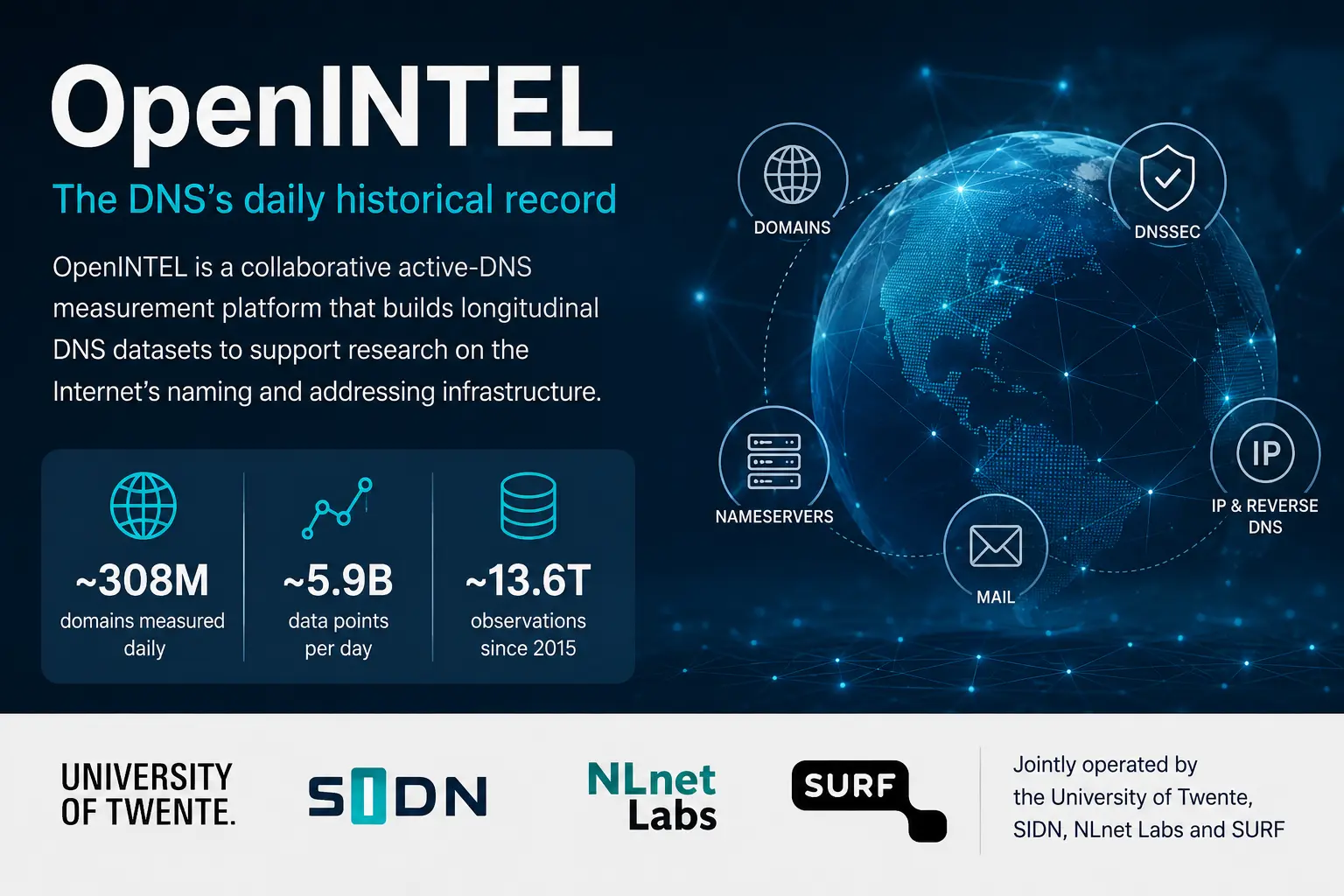
OpenINTEL built a memory for the DNS—not a copy of it
The Domain Name System answers current questions and preserves little of its own history. OpenINTEL has built a longitudinal record by repeatedly measuring a defined set of domains and address space, creating unusual research value while leaving user demand, resolver behaviour…

Global Datacenter
Equinix Fabric and the Limits of Programmable Interconnection
For more than a decade, Equinix has turned private connections between data centres, clouds, and network services into software-addressable products. The 2026 push into agent-assisted operations and geographic path control extends the platform's usefulness but also makes the…

Global Datacenter
Equinix Fabric and the Limits of Programmable Interconnection
Equinix has spent more than a decade turning private connections between data centres, clouds, and network services into software-manageable products. Its 2026 expansion into agent-assisted operations and geographically constrained routing pushes the platform into broader…

Global Institutional
DNSViz and the graph that makes DNSSEC failures legible
DNSViz turns one of the internet's least intuitive failure modes into a picture that teams can actually examine. Created by Casey Deccio and run publicly by DNS-OARC, this open-source project links delegations, keys, signatures and non-existence proofs in a single operational…

Global Institutional
DNSViz: Turning DNSSEC failures into a readable map
DNSViz turns one of the hardest Internet failures to grasp at a glance into diagrams operators can check step by step. Created and maintained by Casey Deccio, with its public instance run by DNS-OARC, the open-source tool connects delegation, keys, signatures and authenticated…
Global Institutional
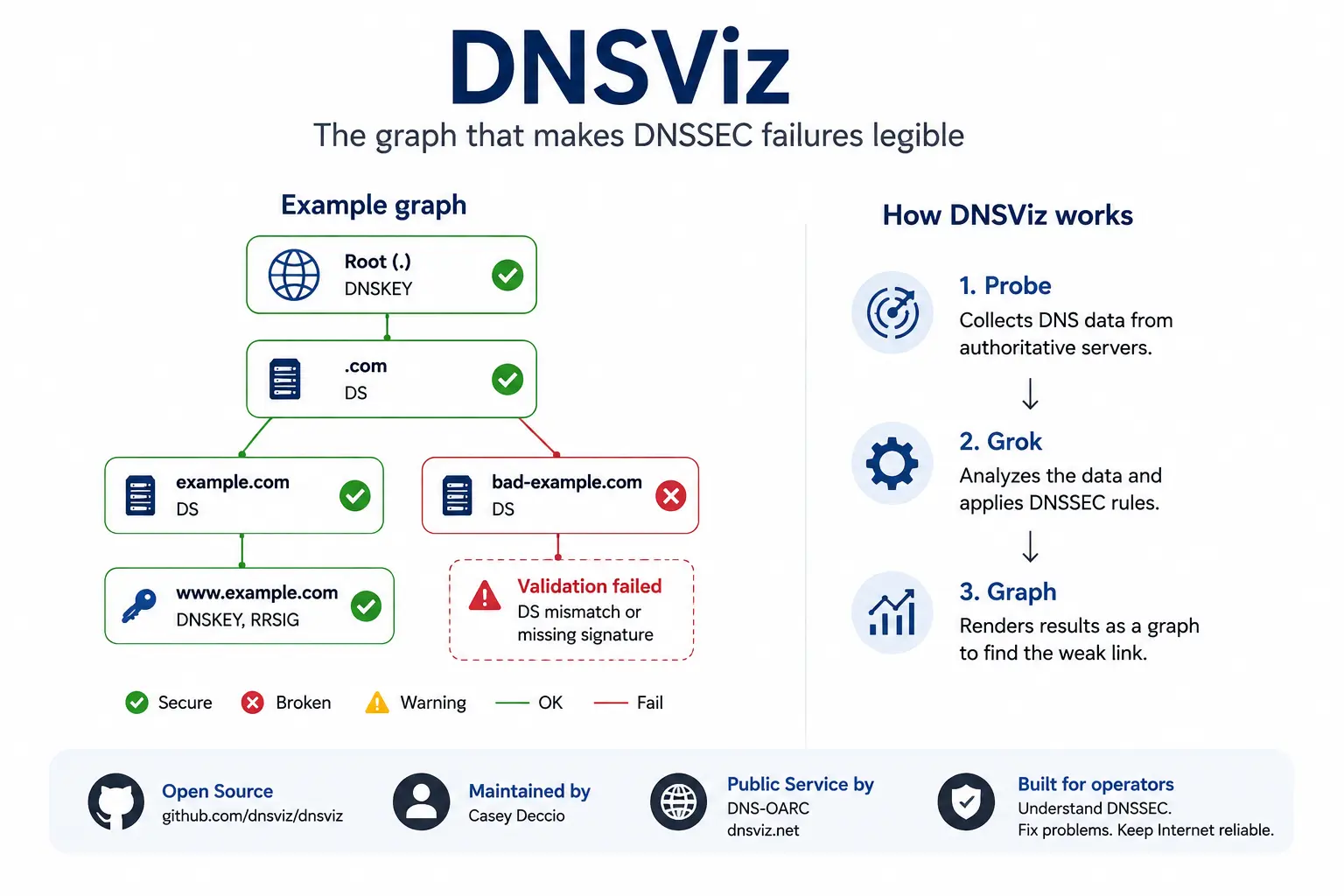
DNSViz and the graph that makes DNSSEC failures legible
DNSViz turns one of the internet's least intuitive failures into an image operators can investigate. Created by Casey Deccio and publicly operated by DNS-OARC, the open-source project links delegations, keys, signatures and authenticated non-existence proofs into an operational…
Global Institutional
DNSViz and the graph that makes DNSSEC errors understandable
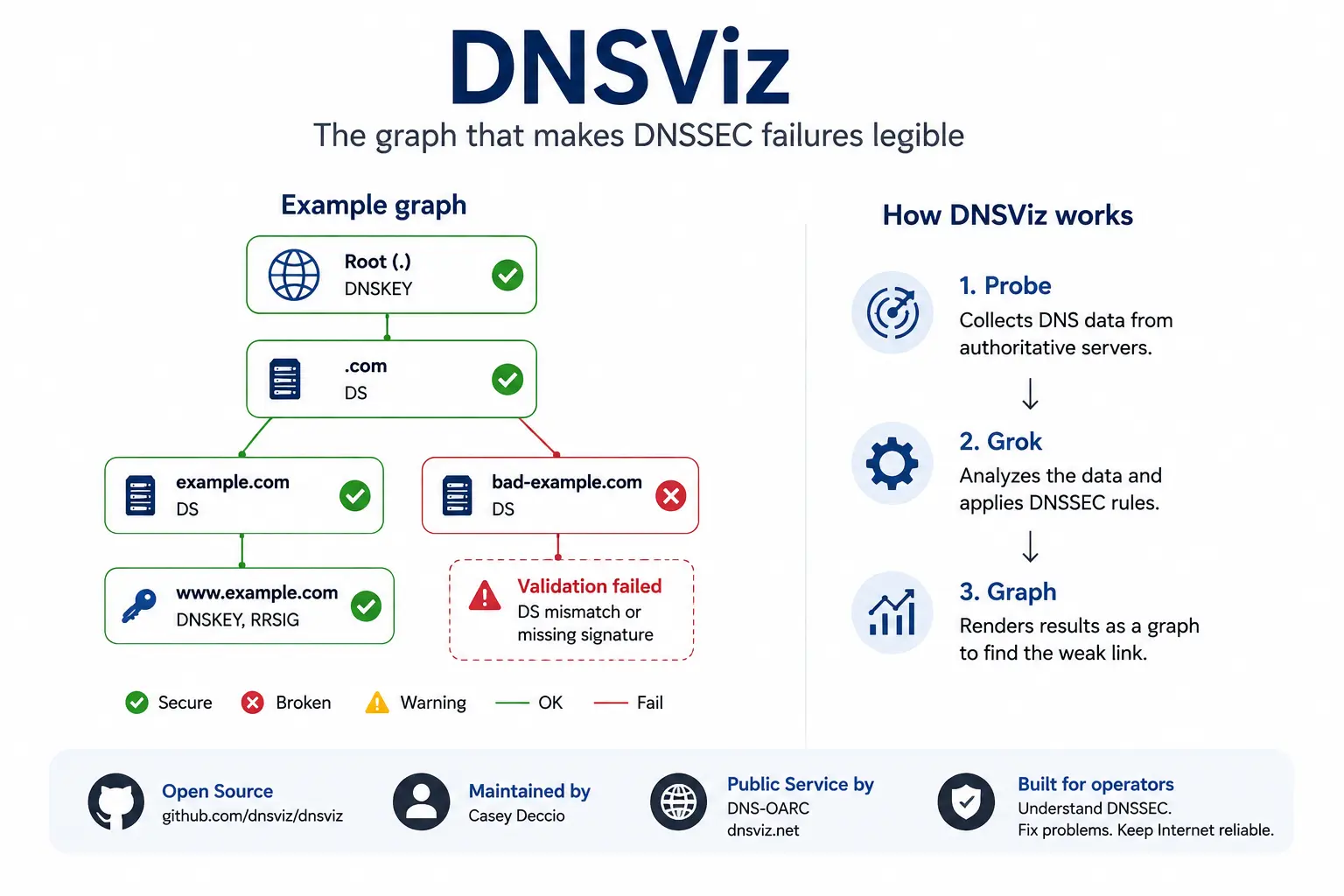
DNSViz turns one of the internet’s most difficult-to-fathom error types into a picture that operators can examine. The open-source project, developed by Casey Deccio and publicly operated by DNS-OARC, links delegations, keys, signatures and authenticated non-existence proofs into…
Global Institutional
DNSViz and the graph that makes DNSSEC failures understandable
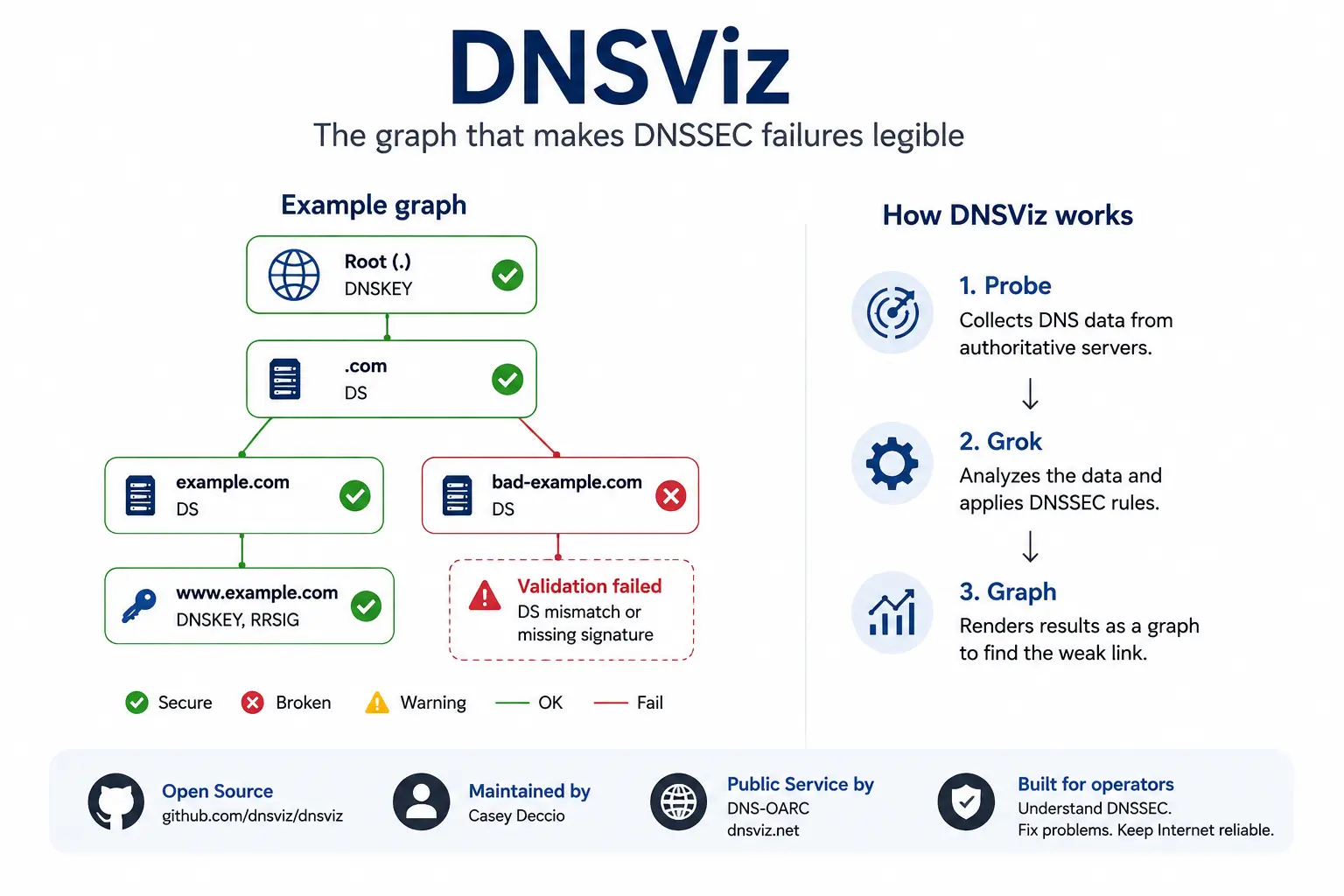
DNSViz turns one of the most opaque Internet failures into a picture operations teams can investigate. The open-source project, created by Casey Deccio and operated publicly by DNS-OARC, links delegations, keys, signatures and authenticated denial-of-existence proofs into an…

Global Institutional
DNSViz and the graph that makes DNSSEC failures legible
DNSViz turns one of the internet’s least intuitive failure modes into a picture that operators can investigate. Created by Casey Deccio and publicly operated by DNS-OARC, the open-source project links delegations, keys, signatures and authenticated denial records into an…

Global Institutional
perfSONAR and the path no single network can diagnose alone
perfSONAR gives research and education networks a shared way to test paths that cross several institutions. It can replace anecdote with common evidence, but endpoint quality, clock accuracy, local policy and incomplete coverage keep diagnosis a collective judgement rather than…
Global Institutional
OpenTitan’s real test began after the silicon shipped
OpenTitan makes the first security decisions inside a computer inspectable. Its reported March 2026 Chromebook deployment moved the project from open design to commercial hardware, where manufacturers, provisioning systems and long-term maintenance now determine whether…