
Summary
- DNSViz is an open-source DNS and DNSSEC diagnostic, visualisation and measurement project created and maintained by Casey Deccio. DNS-OARC operates the public instance at dnsviz.net, but hosting the service is distinct from controlling every software decision.
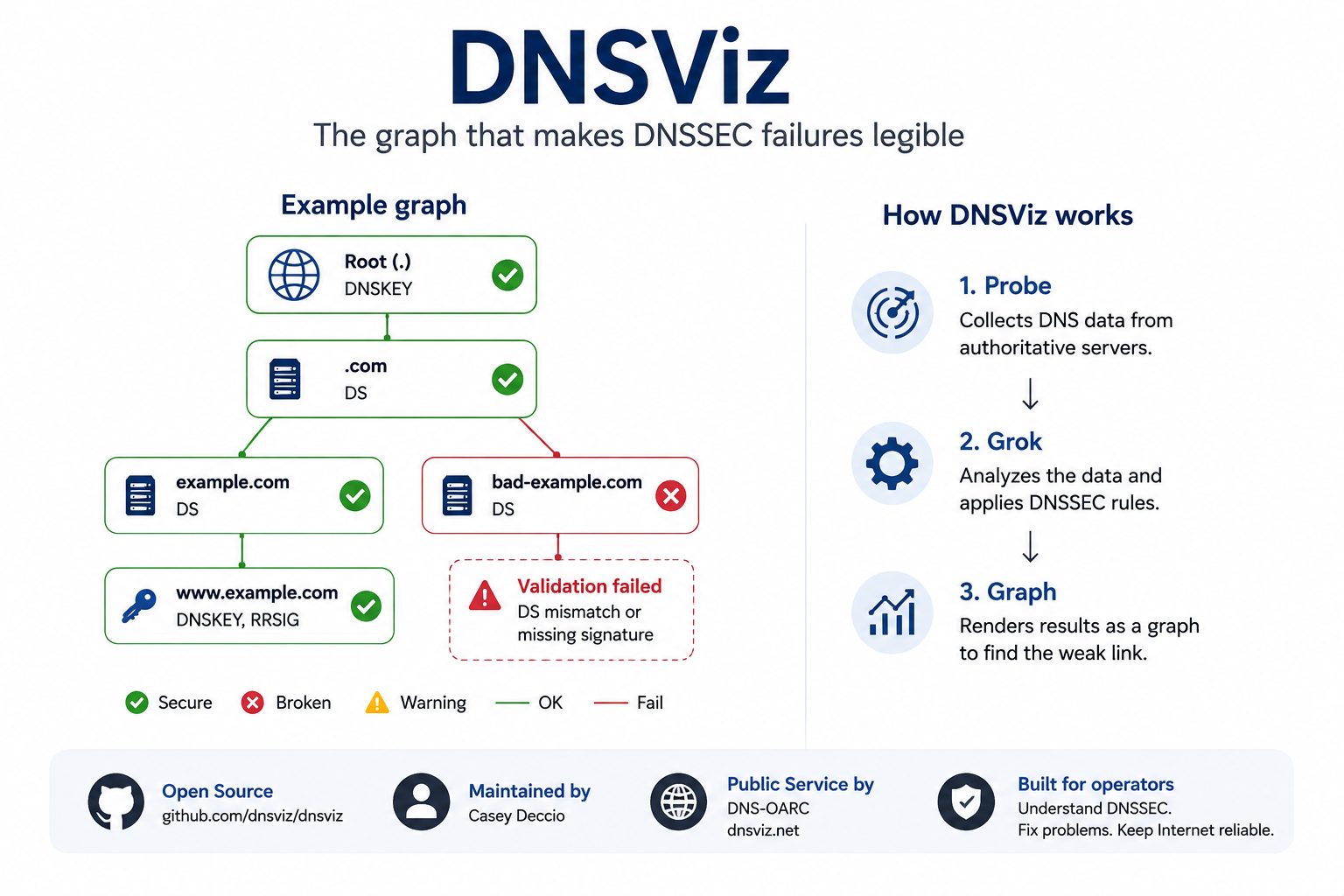
- The project’s defining output is a graph of authentication and delegation relationships. It connects parent DS records, child DNSKEY records, RRSIG signatures and NSEC or NSEC3 denial proofs so that an operator can see which link appears missing, stale, inconsistent or cryptographically invalid.
- DNSViz is a suite rather than only a website. Its command-line workflow separates collection, analysis and rendering through
probe,grokandgraph, allowing operators and researchers to preserve observations, automate checks and run the tool from private or controlled vantage points. - A result is evidence from a particular place and time, not a universal certificate. Anycast, split-horizon DNS, resolver caches, trust anchors, algorithm policy, transient packet loss and rapidly changing rollover state can make another observer see something different.
- DNSViz does not automatically repair a zone and a warning does not establish business impact. A green graph cannot guarantee that every resolver will succeed, while a red graph identifies a technical condition rather than proving malicious intent.
- The April 2025 release expanded analysis for multi-signer deployments, CDS and CDNSKEY signalling, negative-response consistency and other modern operational cases. These additions reflect the growing complexity of changing DNS providers and automating parent-child delegation updates.
- Repeated public diagnostics have also created a research resource. A 2025 academic study used a large collection of DNSViz snapshots from 2020 to 2024 to examine DNSSEC errors at scale, although the corpus remains shaped by submitted names, scan schedules and retention choices.
- DNSViz matters because it gives domain operators, authoritative providers, registrars, registries and resolver teams a shared explanation of failure. Its long-term value depends on release continuity, maintainer succession, transparent service policies and disciplined use alongside resolver logs, record-level tools and change records.
When a secure domain suddenly looks “bogus”
A DNSSEC failure often reaches an operator as a compressed verdict. A validating resolver labels an answer bogus, an application stops resolving a name, or a monitoring system reports that a signed domain has become unreachable. The message can be technically correct and still be operationally unhelpful. It says that a chain of evidence did not validate, but it does not immediately show which organisation, record or moment in a change process produced the break.
The difficulty comes from the way DNSSEC distributes responsibility. A parent zone publishes information about the child, the child publishes keys and signatures, authoritative servers deliver the records, and recursive resolvers apply trust anchors and local policy. A stale DS record at the parent can invalidate a correctly signed child. An expired signature at the child can defeat a correct delegation. A negative answer can fail even when the queried name genuinely does not exist.
DNSViz was built to widen that narrow verdict into an inspectable explanation. It gathers the relevant authoritative data, reconstructs the relationships among records and marks the places where the observed chain appears to fail. The project does not make DNSSEC simple, because the protocol and its administrative boundaries remain complex. It makes the complexity visible enough that an operator can decide what to verify next.
DNSSEC spreads one decision across several organisations
Ordinary DNS resolution already crosses multiple systems, but DNSSEC adds a cryptographic dependency to the administrative dependency. The parent and child do more than delegate authority: they must publish records whose mathematical relationship remains coherent through key changes, provider migrations and cache lifetimes. No single party necessarily controls the whole path. That is why a fault can persist even when each organisation believes its own system is behaving correctly.
The parent’s role is usually expressed through a DS record that identifies a digest of a key in the child zone. The child publishes DNSKEY records and signs its record sets with RRSIG records. A validating resolver follows that evidence from a configured trust anchor towards the requested name. The process is distributed by design, and its reliability depends on both cryptography and routine operational coordination.
This structure explains why DNSSEC incidents can become disputes about responsibility. A registrar may have submitted a change, a registry may not yet have published it, a provider may have introduced a new key set, and a resolver may still hold older data in cache. DNSViz cannot settle contractual responsibility, but it can put the observed records and their relationships in one frame. That shared frame is often more useful than exchanging isolated command output between teams.
The protocol is already a graph, even when tools print it as lines
Traditional DNS tools are indispensable because they expose exact records and response details. Their output, however, is usually linear: one query, one response, one set of fields at a time. The operator must hold the dependency structure in mind and connect the parent delegation to the child keys, the keys to signatures, and the denial records to the name space they cover. That mental reconstruction becomes difficult during a rollover or a multi-provider migration.
DNSViz treats the dependency structure as the primary object. Names, keys, record sets and trust relationships become nodes and edges in a graph, while warnings and errors are attached to the relevant connection. The visual layer is not cosmetic. It expresses the protocol in the form in which validation actually proceeds, showing why a record that looks valid in isolation may still fail to establish a complete path.
A graph also changes the conversation between specialists and general operators. It provides a common object that can be expanded into record-level detail without forcing every participant to begin with cryptographic notation. That accessibility has limits: dense zones can produce dense diagrams, and colour alone should never drive a production change. The gain is not the removal of expertise but a more reliable way to direct it.
A DS record is the parent’s promise about the child
The DS record is one of the most consequential small objects in DNSSEC. It appears in the parent zone and identifies a digest derived from a child DNSKEY, allowing a validator to connect the parent’s authenticated data to the child’s signing material. When the digest, key tag or algorithm no longer matches what the child publishes, the chain can break even if both zones continue answering DNS queries normally.
This mismatch commonly appears during key replacement, provider migration or an incomplete rollback. A child may remove an old key before the parent removes the corresponding DS record, or the parent may publish a new DS before every authoritative server exposes the expected key set. Propagation and caching can make the transition look different from one observer to another. DNSViz compares the observed DS and DNSKEY material so the operator can see whether the parent’s promise still corresponds to the child’s current state.
The graph does not know the operator’s intended change schedule. A temporary overlap may be deliberate, while a persistent mismatch may be an error. This is a recurring boundary in DNSViz: it can show what the published data implies, but it cannot infer every maintenance plan or registrar workflow. The operator must combine the graph with change tickets, provider documentation and the expected timing of the rollover.
DNSKEY records divide signing roles without removing operational risk
A signed zone can publish several DNSKEY records, often reflecting different operational roles or stages in a rollover. Some keys may be used to sign zone data, while others protect the DNSKEY set itself, depending on the deployment model. The presence of multiple keys is not inherently suspicious. It can improve operational separation and make planned replacement possible without abruptly breaking trust.
The difficulty is keeping every related object coherent. Signatures must be produced by the expected keys, validators must support the relevant algorithms, and the parent’s DS material must continue to identify a valid path into the child. Old keys and signatures need enough overlap for caches and remote systems to age out safely. DNSViz places those objects in one dependency model rather than asking the operator to compare several separate query transcripts.
This is particularly useful when the zone is not controlled through one signing platform. The graph can reveal that different authoritative servers expose different key sets or signatures, but it cannot always tell whether the difference is planned. The same evidence can describe a careful staged migration, a provider synchronisation delay or a genuine outage. Operational context remains the difference between diagnosis and judgement.
RRSIG validity depends on clocks, coverage and the right key
An RRSIG record states that a particular DNS record set was signed with a named algorithm and key, and it includes inception and expiration times. Validation therefore depends on more than a cryptographic calculation. The signature must cover the expected data, the associated key must be available and trusted through the chain, and the observation must fall within the signature’s validity window.
Time makes DNSSEC failure unusually sensitive to operational discipline. A signing system with a bad clock can create signatures that appear not yet valid or already expired. A delayed publication process can leave a new record set without the expected signature. A rollover can expose signatures produced by a key that some servers no longer publish. DNSViz checks these relationships and presents the timing evidence beside the authentication path.
The timestamp on a DNSViz result is therefore part of the diagnosis, not administrative decoration. A graph generated before a signature expires and a graph generated afterwards can both be accurate descriptions of different states. Operators should preserve the observation time, compare it with signing and deployment logs, and re-run the analysis before making a change based on an old snapshot.
NSEC and NSEC3 make absence provable—and failure harder to explain
DNSSEC must authenticate not only records that exist but also answers saying that a name or record type does not exist. NSEC and NSEC3 provide this proof by describing ranges or hashed relationships within the signed name space. Their logic is essential because an unsigned negative answer could otherwise be forged to hide a real record. It is also one of the parts of DNSSEC that many operators encounter only when something goes wrong.
A denial proof can fail because the covered interval is wrong, the record is unsigned, the NSEC3 parameters do not match the zone’s operation, or opt-out behaviour interacts with delegation in an unexpected way. The resulting symptom may look like a simple name-not-found response, yet a validating resolver treats it as insecure or bogus depending on the evidence. DNSViz analyses the denial records in the same graph as the positive authentication chain.
Visualisation is especially valuable here because the error concerns a relationship between a query and a covered part of the name space. Even then, the graph cannot remove every policy question. NSEC3 opt-out and delegation structures create legitimate complexity, and different validators may apply algorithm or policy constraints differently. The right response is detailed inspection, not a reflexive assumption that every negative-answer warning requires the same fix.
Casey Deccio built DNSViz where protocol theory met operator confusion
DNSViz emerged from Casey Deccio’s work in a security-research setting at Sandia National Laboratories. The original project addressed a practical gap: DNSSEC standards defined how trust should be established, but operators needed a way to examine why a real deployment did or did not satisfy those rules. The 2012 research report documented a visual-analysis model rather than only another validation command.
The distinction matters for a profile of the project. DNSViz should not be reduced to Deccio’s wider career, and the project is not identical to the institutions where he later worked. At the same time, its architecture and long-term maintenance are closely associated with one creator’s expertise. DNS-OARC’s software directory continues to distinguish Deccio’s development and maintenance role from the organisation’s operation of the public instance.
That concentration is both a strength and a risk. A coherent diagnostic model benefits from sustained protocol knowledge and a maintainer who understands its historical assumptions. Yet infrastructure that becomes widely relied upon needs documentation, review and a path for other contributors to understand the code. DNSViz’s story is therefore also a story about how a small research tool acquires responsibilities that were never formalised at its origin.
The 2012 Sandia work turned validation into an explanatory model
The Sandia report established the central editorial insight behind DNSViz: a secure result and an insecure result are less useful than an account of the evidence connecting them. The project represented DNSSEC components and relationships visually, allowing an analyst to move from the high-level chain to the records supporting each judgement. That approach made the tool relevant to incident response, education and measurement at the same time.
Research prototypes often prove a concept without becoming durable operational software. DNSViz had to move beyond that stage by supporting more environments, evolving algorithms and repeatable collection. The original interface and architecture were therefore a beginning rather than a frozen product specification. Later work restructured the project so that observation, analysis and rendering could be used separately.
This evolution also complicates historical claims. Sandia provided the setting for the original work, but that does not establish current sponsorship or control. A public-service operator, an academic affiliation and an open-source repository later became part of the project’s life. The most accurate account is a sequence of institutional contexts around a continuing software lineage.
Portability changed DNSViz from one web page into reusable infrastructure
A public web analyser lowers the barrier to use, but a single hosted interface cannot meet every operational need. Internal zones may be invisible from the public internet, automated pipelines need machine-readable results, and researchers may want to preserve raw observations before applying a new analysis. Portability therefore changed DNSViz from a destination into a toolkit.
During the 2013–2014 period, the project was reworked for greater portability and extensibility and was presented to the DNS operator community at a DNS-OARC workshop. The command-line package made it possible to run the same broad workflow outside the public site. That shift created a clearer separation between the software, the public service and the data collected during a particular analysis.
Portable software does not automatically produce reproducible conclusions. Versions can change diagnostic rules, dependencies can alter rendering, and stored observations can age. Reproducibility requires recording the package version, query conditions, timestamps and analysis settings. The architectural separation makes that discipline possible, but users still have to practise it.
probe records what the authoritative system actually says
The collection stage begins with authoritative observation. DNSViz queries the delegation path and relevant servers for records including NS, DS, DNSKEY, RRSIG, NSEC and NSEC3, together with metadata needed for later analysis. This differs from asking one recursive resolver for a final application answer. The goal is to expose the parts of the authoritative system that a validator may need to assemble.
The probe component makes that collection a distinct step. An operator can preserve the result, compare observations taken at different times or run the probe from a controlled network where internal views are reachable. Researchers can collect data once and apply later analysis without repeatedly querying a live zone. The separation also reduces the risk of confusing a changed DNS state with a changed analysis rule.
Collection remains vulnerable to the network conditions under which it runs. A server may not respond, an anycast service may direct the probe to a different site, and filtering may suppress a packet. DNSViz can report what it observed and sometimes expose inconsistency among servers, but it cannot guarantee that every missing answer represents persistent authoritative state. Operators need to distinguish absence in the data from evidence of absence in the service.
grok turns observations into a reasoned dependency model
Raw DNS responses are necessary but not sufficient for diagnosis. The analysis stage has to determine how records relate, whether signatures are valid, whether a DS corresponds to a published key and whether denial proofs cover the requested name or type. DNSViz’s grok component performs that interpretive work against the collected evidence.
This is where the project’s value becomes more than data gathering. The analyser applies protocol rules and operational checks to construct a model of authentication and delegation. It can identify missing signatures, algorithm mismatches, expired data, lame delegation, inconsistent answers and other conditions represented in the project’s diagnostic logic. The output is a reasoned account rather than a transcript.
Every reasoned model contains assumptions. DNS standards evolve, algorithm support changes and some warnings express operational risk rather than strict invalidity. A newer release may classify an edge case more accurately than an older one. For that reason, users should treat the analysis version as part of the evidence and avoid presenting a diagnostic colour as if it were independent of software policy.
graph lets operators inspect the chain without hiding the records
The rendering stage converts the analysis into a graph that can be inspected in a browser or saved as an output. Good visualisation has to do two things at once: reduce the cognitive burden of following the chain and preserve enough detail for a specialist to verify the judgement. DNSViz’s value lies in linking those levels rather than replacing technical evidence with a simplified score.
Edges and nodes show which objects authenticate or delegate to others, while annotations direct attention to the relationship at issue. An operator can begin with the broken path and then expand the underlying records, keys and signatures. This approach is particularly effective when several plausible causes produce the same end-user symptom.
The graph can still become crowded. Multi-signer zones, overlapping rollovers and inconsistent authoritative servers create legitimate visual density because the underlying state is dense. A successful tool should not hide that complexity to make the picture attractive. It should help the operator navigate it while preserving the possibility that the right conclusion is “more evidence is needed.”
DNS-OARC keeps the public service running without owning the whole project
A public diagnostic becomes infrastructure only when someone keeps it reachable, patches its dependencies and responds when it is abused or breaks. DNS-OARC provides that operational home for dnsviz.net. The organisation’s role connects the tool to a community of people who run authoritative servers, resolvers and other parts of the DNS, giving the service a setting that is closer to operations than a temporary research demonstration.
The governance boundary is unusually clear in the available evidence. DNS-OARC says Casey Deccio developed and maintains DNSViz, while DNS-OARC operates the public instance. A 2021 DNS operations discussion reiterated the same division when describing support and newer algorithm handling. Hosting, software stewardship and standards authority therefore belong to different actors.
That separation prevents a common attribution error, but it also creates coordination needs. A code change may require a service upgrade, and a service incident may reveal a software problem. Neither the project nor DNS-OARC publishes a complete standalone budget, service-level objective or succession arrangement for DNSViz. The public endpoint is valuable precisely because those unglamorous responsibilities are being performed, even though the institutional terms remain only partly visible.
The public endpoint and the local suite answer different operational questions
The web service is useful when an operator needs a quick external view. A name can be submitted without installing a package, and the resulting graph can be shared with another organisation during an incident. That ease of access gives DNSViz educational reach as well as operational value. It also encourages people outside the DNS specialist community to inspect a chain that would otherwise be represented by several command-line queries.
A local deployment serves a different purpose. It can run from inside a private network, form part of a pre-deployment pipeline, preserve raw data or use a controlled schedule. It also lets an organisation select the software version and integrate the output with its own change records. The PyPI distribution and repository documentation make that workflow available without turning DNSViz into a paid managed service.
The choice is not simply convenience versus sophistication. The public endpoint offers independence from the operator’s own environment, while a local probe can see names and network paths the public service cannot. Strong incident work may use both and compare them with actual resolver behaviour. Different answers are not automatically evidence that one tool is wrong; they may reveal the boundary that needs investigation.
A DNSViz result belongs to a place and a moment
Active measurement always has a vantage point. The probe sends queries from a particular network, reaches particular authoritative instances and records responses under the routing conditions of that moment. DNS is designed to distribute service, and DNSSEC adds time-dependent signatures and cached delegation data. The result is therefore an observation with coordinates, even when the interface presents it as one graph.
This limitation does not weaken the tool; it defines the claim the tool can honestly make. DNSViz can show why the chain it observed appears valid, insecure or broken under its analysis rules. It cannot certify that every resolver, user or geography saw the same records. The project documentation and research use are most reliable when the timestamp and collection context remain attached to the output.
Operators should respond by collecting comparative evidence rather than demanding impossible universality from one test. A second vantage, authoritative server logs, resolver traces and a fresh run after cache expiry can establish whether the condition is local, transient or broadly published. The graph is the beginning of that comparison, not the end of it.
Anycast can make one authoritative service look like several systems
Many authoritative DNS services use anycast, announcing the same service address from multiple locations. Routing directs different users and probes towards different sites, which can improve resilience and reduce latency. It can also expose inconsistent software versions, zone data or network conditions when one site has not converged with the others. A single service name may therefore produce several operational realities.
DNSViz can compare responses from authoritative servers and expose inconsistency, but the public probe reaches only the instances selected by routing at the time. Another user may arrive at a different anycast site and receive a different answer. Packet loss or path filtering can also make a healthy instance appear absent from one vantage. These possibilities are part of the project’s stated measurement boundary rather than exceptional excuses.
The practical response is to use the graph as a clue about distribution. If a key or signature appears on some servers but not others, the operator should inspect deployment state across sites and test from more than one network. DNSSEC makes inconsistency particularly damaging because validators cannot simply tolerate different content; they require a valid chain for the content they receive.
Split-horizon DNS marks the boundary of any public diagnostic
Split-horizon DNS deliberately gives different answers to different networks. An internal client may see private addresses or names that are not published externally, while an outside user sees a reduced public zone. The design can be legitimate, but it means a public analyser cannot describe the internal view unless it is authorised and placed inside the relevant network.
A green public result may therefore say nothing about an internal application that relies on a different delegation or signer. A red result for a name submitted from outside may be irrelevant if that name is intended to exist only internally. DNSViz’s command-line suite is important because it allows an organisation to move the same diagnostic model to the place where the private view is visible.
This boundary also carries a security implication. Internal names, topology and key material can be sensitive, so an organisation should not expose them to a public endpoint merely to obtain a graph. Local analysis keeps the query process and stored evidence under organisational control. The tool’s openness supports that choice, but access permissions and data handling remain the operator’s responsibility.
A green graph is evidence, not a universal availability certificate
A successful DNSViz graph can be reassuring because it shows an observed chain in which the relevant authentication relationships appear coherent. That is strong evidence about the authoritative data the probe collected. It is not proof that every recursive resolver can reach the domain, because users may encounter different routes, cached records, trust anchors, algorithm policies or unrelated network failures.
Resolvers can also apply local constraints that a general diagnostic cannot reproduce. An implementation may disable an older algorithm, hold a stale negative cache entry or fail to reach one authoritative site. Applications can fail for reasons above DNS, including transport, certificates or service configuration. DNSViz should therefore be used to narrow the fault domain, not to dismiss user reports that do not match the graph.
The most defensible operational language is precise: the observed DNSSEC chain validated under the tool’s vantage and analysis at a stated time. That formulation preserves the value of the result without turning it into a guarantee the system was not designed to provide. Precision is particularly important when the graph becomes evidence in a dispute between providers.
A red graph identifies a condition, not an attacker
DNSViz can expose missing, stale, inconsistent or invalid material, but none of those conditions automatically establishes motive. A broken chain may result from a rushed key rollover, a registrar delay, an incomplete provider migration, a software defect or a deliberate attempt to interfere with resolution. The protocol evidence shows what changed or failed, not who intended the outcome.
Security teams should resist the temptation to treat visual severity as attribution. A signature that no longer validates is important, but the explanation may be an expired key rather than compromise. An unexpected DS record deserves investigation, but a recent authorised change may account for it. Change history, registrar records, authoritative logs and organisational contacts are needed before the incident can be classified.
This distinction protects both accuracy and recovery. An operator who assumes attack may freeze or reverse a legitimate migration, while an operator who assumes error may overlook a hostile change. DNSViz contributes a structured technical finding that can be correlated with other evidence. It is most useful when it reduces speculation rather than becoming another source of it.
Multi-signer DNS makes provider choice easier and diagnosis denser
A zone can use more than one signer or authoritative provider to improve resilience, support migration or reduce dependence on one platform. Multi-signer models require the participating systems to publish compatible keys, signatures and delegation information. The commercial benefit can be substantial, but the cryptographic state becomes more distributed and the number of legitimate intermediate conditions increases.
DNSViz’s recent development reflects this operating reality. The April 2025 release added or improved analysis for multi-signer deployments, allowing the graph to compare signer sets and authoritative responses more effectively. The feature does not make every multi-provider architecture equivalent; the models described by the IETF include different ways to coordinate keys and signatures.
Dense graphs are not evidence that multi-signer DNS is a mistake. They show that resilience has been purchased with additional coordination. Operators need documented roles, tested rollover procedures and a clear method for distinguishing expected overlap from a stalled transition. DNSViz can expose the state, but the deployment team must supply the intended model.
Provider migrations create legitimate states that resemble faults
Changing an authoritative DNS or signing provider rarely happens in one atomic step. New servers and keys may be introduced before old ones are removed, and the parent’s DS record may need to change at a different pace from the child zone. During the transition, several key sets and signatures can coexist. A tool that expects only the final state could misclassify a safe overlap as an error.
The opposite risk is more serious: a transition can remain stuck in a state that was intended to be temporary. One provider may continue serving an old key, a registrar update may not reach the registry, or a rollback may remove records in the wrong order. DNSViz’s graph helps by showing the complete observed relationship rather than hiding transitional objects behind one status.
Interpretation should be tied to the migration plan. Teams can record the expected stages, run DNSViz before and after each change and preserve the outputs as evidence. A warning that matches an approved intermediate state may be accepted for a defined period, while the same warning outside that period becomes a trigger for escalation. The tool becomes safer when it is connected to change governance.
CDS and CDNSKEY automate delegation changes but move risk into policy
CDS and CDNSKEY records let a child zone signal desired changes to the DS material held by its parent. The mechanism can reduce manual work and make key rollover more reliable, especially at scale. It also shifts trust into an automated relationship: the parent or registrar must decide when and how to accept the child’s signal.
DNSViz can compare the signalling records with the child’s DNSKEY set and the parent’s published DS state. The April 2025 release expanded this analysis, making it easier to see whether an automated delegation update appears coherent or incomplete. The tool implements protocol relationships, but it cannot compel a registry or registrar to adopt one acceptance policy.
Automation reduces one class of delay while creating another class of control question. Who authorises the initial trust relationship? How are deletion signals handled? What happens when a provider publishes a record unexpectedly? DNSViz can make the evidence visible, yet the operational safety of CDS and CDNSKEY depends on the parent’s policy, the child’s key management and the ability to investigate an anomalous signal before it becomes an outage.
The April 2025 release brought modern deployment patterns into the graph
A diagnostic tool ages when the infrastructure it observes changes faster than its rules. DNSSEC deployments now include newer algorithms, several providers, automated delegation signalling and more complicated negative-answer behaviour. The April 2025 DNSViz release addressed parts of that gap through multi-signer analysis, CDS and CDNSKEY checks, negative-response consistency improvements and other operational cases.
Release notes are strong evidence that code exists, not proof that every environment has upgraded or every edge case is solved. Public dnsviz.net may run a particular version, local packages may lag, and downstream distributions can update on different schedules. Operators should record the version used for a result, especially when comparing a historical snapshot with a current diagnosis.
The release also shows why maintenance matters more than a single invention. DNSSEC remains a moving operational system even when its core standards are stable. A tool that once explained the common failure modes must continue to learn the deployment models that operators actually adopt. DNSViz’s relevance depends on that continuing translation from standards and practice into diagnostic logic.
Longitudinal snapshots turn troubleshooting into measurement
A single graph helps one incident. A sequence of graphs can show whether an error persists, how a rollover proceeds or how quickly an operator repairs a broken chain. When many names are observed repeatedly under a consistent diagnostic model, the collection becomes a research corpus rather than only a history of individual queries.
DNSViz supports this transition because collection and analysis are structured and timestamped. Researchers can group conditions, compare snapshots and examine recurring classes of error. The public service and automated runs therefore produce a secondary form of infrastructure: a record of how DNSSEC behaves in operation, rather than just repeating what the standards say should happen.
Historical data requires careful treatment. A snapshot may describe a transient rollover that was corrected minutes later, and repeated observations can overrepresent names that attract more testing. Retention rules determine which histories remain available. The corpus is valuable because its diagnostic method is consistent, but consistency does not by itself make the sample representative.
The 2025 study shows what a consistent diagnostic corpus can reveal
The 2025 research described in the pack used a large collection of DNSViz results spanning 2020 to 2024 to examine DNSSEC errors at scale. Its importance lies in moving the discussion beyond isolated anecdotes. A standardised analyser can identify recurring failure categories and allow researchers to ask how long they last or whether the same mistakes return.
That work also demonstrates the public service’s role as measurement infrastructure. The value is not only the number of snapshots but the explanatory structure attached to them. A dataset of final success and failure labels would offer less insight into whether the underlying problem involved delegation, signing, denial or consistency. DNSViz provides a taxonomy grounded in the graph it constructs.
The study should not be turned into a claim about every signed domain. Its authors’ sampling and snapshot choices define the population they observed. Domains submitted after a problem may be more likely to contain errors than randomly selected names, while scheduled scans introduce their own bias. The broader lesson is methodological: large numbers become credible only when the path by which they entered the corpus is explained.
Anycast and vantage point can make two honest observations disagree
Authoritative DNS providers commonly use anycast, advertising the same server address from several locations. The network directs a query towards a site according to routing conditions, so two observers can reach different machines or service instances while addressing the same IP. If those sites are not perfectly synchronised, a DNSViz probe in one network may see a different key set or signature from a resolver elsewhere.
Routing is not the only source of variation. Firewalls may drop particular packet sizes or transport modes, fragmented responses may take different paths, and transient loss may prevent a server from answering during one run. A diagnostic system can retry and collect metadata, but it cannot claim a view from every relevant path. An external result is strongest when it is treated as one controlled observation that can be compared with other evidence.
This is a general measurement lesson with particular force in DNS. The service being tested is itself distributed, and the system performing the test sits inside another distributed network. A disagreement should prompt questions about vantage, time and server selection before it becomes an accusation that one tool or operator is wrong.
Caches preserve old truths after the authoritative configuration has changed
Recursive resolvers cache DNS records to reduce latency and authoritative load. During a rollover or repair, the authoritative servers may already publish a coherent new chain while some resolvers continue to use older DS, DNSKEY or RRSIG material until its TTL expires. DNSViz may show the current authoritative state and still fail to reproduce what an affected user sees through a cache.
The reverse can occur as well. A resolver may retain a previously valid answer while the current authoritative state is broken, delaying visible impact for some users. This produces a staggered incident in which success and failure depend on cache history. Operators need to know when the change was made, what TTLs applied, which records the resolver holds and whether negative caching is involved.
DNSViz contributes by preserving the authoritative relationships observed at a known time. Resolver logs and direct cache inspection supply the other side. Combining the two can distinguish a continuing publication error from a propagation delay. Treating the graph alone as the complete user experience would erase the very distributed behaviour that DNS was designed to create.
Resolver policy and trust anchors define a result the authoritative graph cannot fully predict
A validator begins with trust anchors and applies implementation and operator policy. The root trust anchor is common in ordinary public DNSSEC validation, but private environments can add or change anchors. Resolvers can also differ in algorithm support, treatment of exceptional conditions, clock behaviour and software version. A chain that appears acceptable under one policy may fail under another.
DNSViz models protocol relationships using its own software and observation process. That makes it a powerful independent check, but not a clone of every resolver. An operator investigating a discrepancy should identify the resolver implementation and version, inspect its validation logs and compare its cached data with the graph. The aim is to explain the difference, not to declare that the public diagnostic automatically outranks the production system.
This boundary protects the project from an unrealistic promise. A useful diagnostic does not need universal equivalence. It needs to make its evidence clear enough that another operator can reproduce, challenge or supplement it. DNSViz’s open code and command-line workflow support that form of scrutiny.
Protocol severity and business impact are different measurements
DNSSEC errors can be caused by hostile action, but misconfiguration, delayed propagation, failed automation and ordinary operational mistakes are common explanations. A mismatched DS record shows that the observed parent and child state cannot form the expected trust path. It does not reveal whether someone acted maliciously, misunderstood a registrar interface or followed a rollover plan that was observed midway through execution.
The visual force of a red edge or warning can encourage over-interpretation. During an incident, teams may be under pressure to attribute the outage quickly, especially when a security control is involved. DNSViz should be used to state what the evidence supports: which records were observed, which relationship failed and when. Attribution requires change logs, account history, registrar records, provider evidence and, in some cases, a wider security investigation.
The same discipline applies to less severe warnings. Some annotations reflect operational guidance or risk rather than an invalid chain. A team should distinguish errors, warnings and recommendations before triggering a repair. Colour is a navigation aid, not a substitute for the underlying record details.
DNSSEC validity does not test the rest of the application path
A valid DNSSEC chain answers a narrow but important question: can the observed DNS data be authenticated through the expected trust path? It does not prove that the returned IP address is correct for the application, that BGP reaches the server, that a TLS certificate is valid, that a firewall permits traffic or that the application is healthy. DNSViz can clear one layer of uncertainty while the outage remains elsewhere.
Even within DNS, a green result may not cover every name or record type an application uses. A web service can depend on aliases, service records, separate API names, email policy or third-party domains. A test of the apex does not automatically validate the complete dependency tree. Operators need to choose names and record types that correspond to the failing workflow.
This limitation does not diminish the tool. Infrastructure diagnosis advances by reducing the search space and making each claim precise. DNSViz provides a structured answer about observed DNSSEC relationships. It is most valuable when teams resist asking it to certify systems it was not designed to see.
The graph belongs in change review before it appears in an outage call
DNSViz is often encountered after a domain has broken, but the safer use is before and after a planned change. A team preparing a key rollover, registrar transfer, authoritative-provider migration or multi-signer deployment can run the command-line suite against a staging or controlled environment, record the expected graph and define which intermediate states are acceptable. After each production step, a new observation can be compared with the plan.
This turns the diagnostic from a reactive website into a change-control instrument. The workflow can include checks that the new key is published, that signatures exist, that parent signalling is coherent and that old material is removed only after the required overlap. A failed check can pause the change before users report a problem. The project documentation provides the basis for scripted use, while each organisation must design its own approval and recovery process.
Automation should not collapse the output into a single red-or-green gate without context. Some transitions are intentionally mixed, and a warning can be expected for a limited period. The better control records the exact rule, the observed objects and the reason the change owner believes the state is safe.
Incident response improves when every party can point to the same broken edge
A DNSSEC outage can involve a domain owner, managed DNS provider, registrar, registry, recursive-resolver operator and application team. Each party sees a different part of the system and may initially report that its own component is healthy. DNSViz creates a shared object for the conversation. A graph can show that the child keys are present but the parent DS is stale, or that one authoritative server lacks the signature found on the others.
Shared evidence does not erase responsibility boundaries. The registrar may control the parent update but lack access to the signer. The DNS provider may publish correct records while the domain owner has supplied an obsolete key. The resolver operator may be the first to observe the failure but have no authority to repair it. A useful incident process maps the broken relationship to the organisation that can act, then verifies the result from the user’s path.
The graph also supports a cleaner post-incident review. Teams can preserve the observation that triggered the repair, the change made, the time at which the chain became coherent and the cache period that followed. That record is more useful than a conclusion that “DNS was down” because it identifies the mechanism and the control that failed.
Safe automation needs evidence, approval and a way back
It is tempting to connect a diagnostic directly to remediation: remove a stale DS, republish a key, force a signer run or roll back a provider change when the graph turns red. Some organisations can automate parts of that sequence safely, especially in a controlled environment with well-tested ownership. DNSViz itself is not presented as an automatic repair system, and that boundary is prudent.
DNS changes cross administrative systems that rarely provide one atomic transaction. A registrar API may accept an update before every parent server publishes it. An authoritative platform may deploy to one region before another. A rollback may restore the old configuration but encounter caches that already hold the new state. Automation needs checkpoints, timeouts, explicit authority and evidence that the previous state is still usable.
A sound design lets DNSViz supply observations while a separate workflow decides what to do. High-risk actions can require human approval, and low-risk checks can run continuously. The objective is not to keep people in every loop forever; it is to prevent a diagnostic classification from being mistaken for permission to change infrastructure owned by several parties.
Open source makes the method inspectable, not maintenance automatic
The DNSViz code is publicly available, and the suite can be installed or adapted without buying a proprietary service. That lowers the barrier for operators and researchers, allows local deployment and makes the diagnostic logic open to examination. It also creates an exit path if the hosted service is unavailable: an organisation can retain the ability to run the method itself.
Open code does not maintain its own dependencies or review new standards. Python versions change, cryptographic libraries evolve, graph-rendering tools break compatibility and DNSSEC practice moves on. Someone must interpret new RFCs, update tests, resolve reports and publish releases. The project’s continued activity through the 2025 release and public availability in August 2026 is evidence of maintenance, but not a guarantee of indefinite capacity.
The distinction mirrors the project’s broader philosophy. Visibility creates the possibility of informed action; it does not supply the action automatically. The repository makes stewardship inspectable. A sustainable future still depends on people and institutions choosing to do the work.
A small maintainer base carries knowledge that many operators use indirectly
DNSViz’s governance is centred on Deccio, repository contributors and DNS-OARC’s service operation. There is no identified standalone foundation, board or paid product organisation devoted solely to the project. That lightweight structure has supported more than a decade of useful work, but the reviewed evidence does not establish a complete maintainer roster or succession plan.
Concentration matters because diagnostic quality depends on accumulated protocol judgement. A new algorithm or multi-signer edge case is not only a programming task; it requires deciding how the condition should be represented, which warnings are justified and how existing users will interpret the change. That knowledge can be documented and shared, but it remains vulnerable when review is carried by very few people.
The appropriate conclusion is not that the project is about to fail. No such evidence exists. The risk is structural: operational importance can grow faster than governance and funding. Release cadence, contributor activity, DNS-OARC support and the clarity of project roles are therefore worth monitoring alongside technical features.
DNSViz competes with no single tool because DNS failure has several layers
Operators can inspect DNS records with dig, drill or delv; run broader zone tests with platforms such as Zonemaster; use Internet.nl for a wider standards-compliance view; compare distributed measurements through systems such as RIPE Atlas; and inspect resolver logs for actual production behaviour. DNSViz’s distinctive contribution is the graph-based explanation of DNSSEC authentication and delegation relationships.
These tools answer different questions. Record-level commands show the exact response and flags. A broad test suite can identify delegation, transport or policy problems beyond DNSSEC. Distributed probes improve geographic coverage. Resolver logs reveal cache and policy decisions for a particular service. DNSViz fits between them by giving the cryptographic chain a form that can be discussed across teams.
The practical choice is therefore cumulative rather than exclusive. A DNSViz warning can be followed by direct queries to the affected server, a resolver trace and a check of registry provisioning. The graph is strongest as a map for the investigation, not as an argument that every other instrument is redundant.
The project makes cryptographic infrastructure legible without claiming control over it
DNSSEC promises authenticated DNS data, but the promise is realised through a sequence of administrative and technical decisions made by different organisations. Keys must be generated and protected. Signatures must be renewed. Parents must publish correct DS records. Authoritative servers must agree. Resolvers must implement and apply validation. A protocol designed for distributed trust also distributes the ways in which trust can fail.
DNSViz’s contribution is to make that distribution readable. It does not operate the root, a registry, a registrar, an authoritative fleet or the user’s resolver. It observes published evidence and constructs an explanation of how the pieces fit from its vantage point. The graph can shorten an incident because it tells people where to look, while preserving the fact that someone else must perform the repair.
That is a modest claim compared with automated security slogans, and a more durable one. Infrastructure becomes safer when operators can distinguish observation from authority, diagnosis from remediation and a model from the world it represents. DNSViz has remained useful because it makes those boundaries visible at the same time as the chain itself.
Member Briefing
Deeper Profile Context
Sign in with the right membership level to unlock the full briefing and source notes.
Only for Strategic Circle
Strategic Circle
Open to all readers. Unlock profile briefings after joining and signing in.
Join Strategic CircleOnly for Leadership Alliance
Leadership Alliance
For qualified IP-asset owners and management; sign in to unlock alliance briefings.
Join Leadership Alliance