
Summary
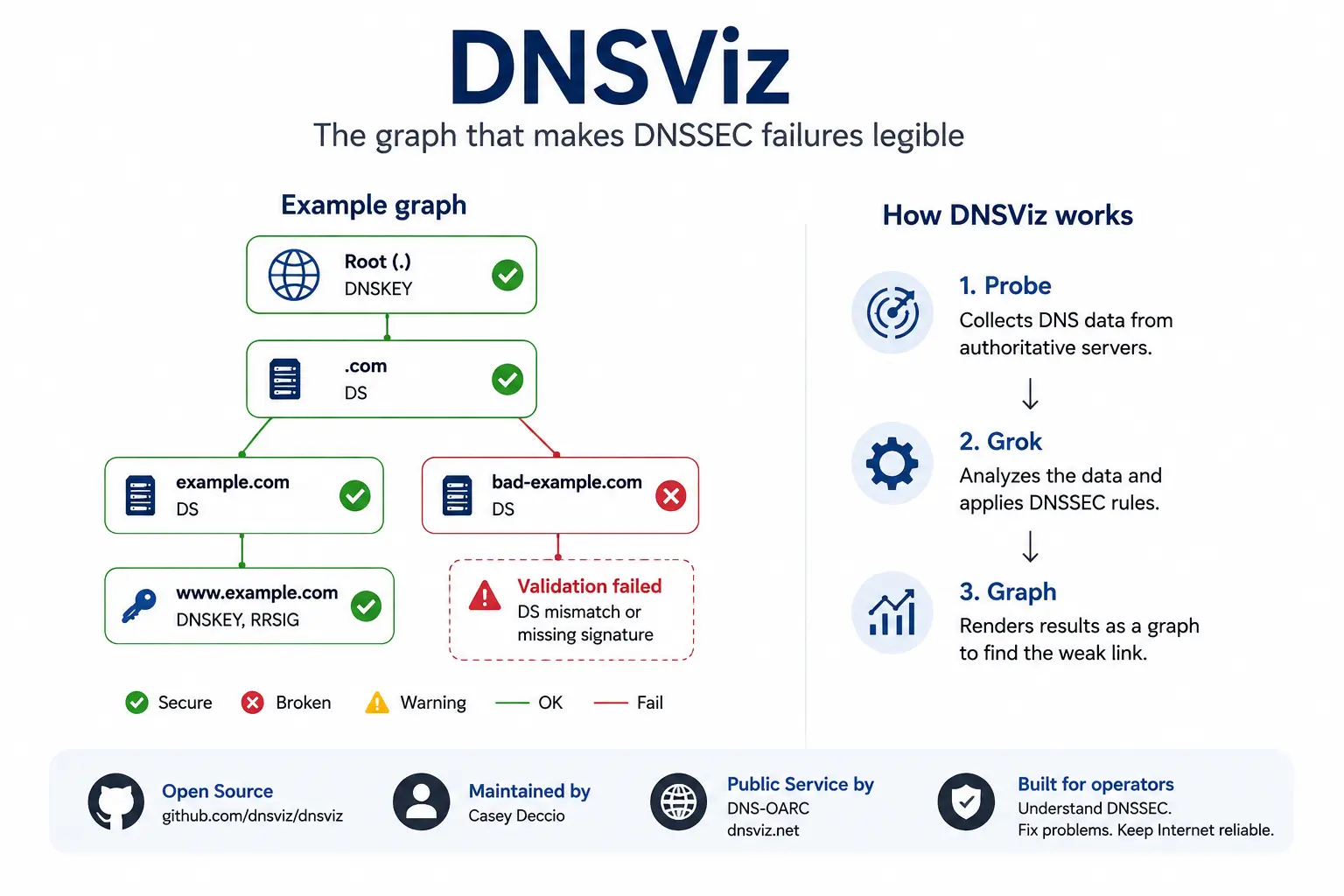
- DNSViz is an open-source DNS and DNSSEC diagnostic, visualisation and measurement project, created by Casey Deccio, who acts as its principal maintainer. DNS-OARC operates the public instance at dnsviz.net, but hosting the service is not the same as owning every software decision.
- The project's distinctive output is a graph of authentication and delegation relationships. It links the DS record in the parent zone to the DNSKEY records in the child zone, RRSIG signatures and NSEC or NSEC3 proofs, in order to show which link appears missing, stale, inconsistent or cryptographically invalid.
- DNSViz is a toolkit rather than a single website. The command-line workflow separates collection, analysis and drawing through
probe,grokandgraph, enabling saved observations, automated checks and operation from private or controlled measurement points. - A result is evidence from a specific place and time, not a universal certificate. Anycast, split-horizon DNS, resolver caches, trust anchors, algorithm policies, transient packet loss and rapid key rollovers can all make another observer see something different.
- DNSViz does not repair the zone automatically, and a warning alone does not determine commercial impact. A green graph does not guarantee that every resolver will succeed, while a red graph describes a technical state and does not prove malicious intent.
- The April 2025 release expanded analysis of multi-signer deployments, CDS and CDNSKEY signals, negative-answer consistency and other modern operational states. These additions reflect the complexity of switching DNS providers and automating parent-child delegation updates.
- Recurring public checks have also created a research resource. A 2025 academic study used a large collection of DNSViz snapshots from 2020 to 2024 to analyse DNSSEC failures at scale, while the findings remain shaped by the names submitted, the scan schedule and retention policies.
- DNSViz matters because it gives domain operators, authoritative DNS providers, registrars, registries and resolver teams a shared interpretation of failure. Its long-term value depends on continued releases, maintenance succession, clear service policies and use alongside resolver logs, registry checks and change history.
When a secure domain suddenly appears as “bogus”
A DNSSEC failure usually reaches the operator as a compressed verdict. A validating resolver classifies the answer as bogus, an application stops resolving the name, or monitoring reports that a signed domain has become unreachable. The verdict may be technically correct but operationally weak, because it says that the chain of evidence did not validate without immediately showing which organisation, record or moment in the change process broke the chain.
The ambiguity comes from distributed responsibility. The parent zone publishes information about the child, the child publishes keys and signatures, authoritative servers serve the records, and recursive resolvers then apply trust anchors and local policy. A stale DS record in the parent can invalidate a correctly signed child zone, an expired signature can defeat a sound delegation, and a negative answer can fail even when the requested name genuinely does not exist.
DNSViz was created to expand that narrow verdict into an explanation that can be inspected. It collects the relevant authoritative data, reconstructs the relationships between records, and marks the point at which the observed chain appears broken. The project does not make DNSSEC simple; the protocol and its administrative boundaries remain complex, but it makes the complexity visible enough for an operator to know what to check next.
DNSSEC distributes one decision across several organisations
Ordinary DNS resolution already passes through multiple systems, but DNSSEC adds a cryptographic dependency to the administrative dependency. The parent and child zones do not merely delegate authority; they must also publish elements whose mathematical relationship remains consistent during key rollovers, provider migrations and cache expiry. No single party necessarily controls the entire path, which is why a failure can persist while each organisation believes its own component is working correctly.
The parent's role usually appears as a DS record identifying a digest derived from a DNSKEY belonging to the child. The child zone publishes DNSKEY records and signs record sets with RRSIG signatures. A validating resolver follows this evidence from a configured trust anchor to the requested name. This distribution is part of the design, and its reliability depends equally on cryptography and on day-to-day operational coordination.
This structure explains why incidents become disputes over responsibility. The registrar may have submitted a change that the registry has not yet published, or the provider may have introduced new keys while a resolver still holds an older state. DNSViz does not adjudicate contracts, but it places the observed records and their relationships in a single frame, which is often more useful than exchanging separate command outputs between teams.
The protocol is already a graph even when tools print it line by line
Traditional DNS tools are indispensable because they display precise records and fields, but their approach is often linear: one query, one answer and one set of fields at a time. The operator has to reconstruct in their head the dependency between delegation, keys, signatures and denial-of-existence proofs. This task becomes harder when old and new keys overlap or more than one provider is active at the same time.
DNSViz treats the dependency structure itself as the main entity. Names, keys, record sets and relationships become nodes and edges, and warnings are attached to the relevant link. The visual layer is not decoration; it represents the protocol in the way validation actually proceeds, and it clarifies why a record may be valid on its own yet still fail to form a complete path of trust.
The drawing also changes the conversation between experts and general operations teams. It provides a shared entity that can be expanded down to record details without forcing everyone to begin with cryptographic notation. Nevertheless, graphs can become dense in complex zones, and colours alone must not drive a production change. The gain is directing expertise to the right link, not replacing expertise.
The DS record is the parent zone's promise about the child zone
A DS record is small in size and large in effect. The parent zone publishes it to identify a digest derived from a DNSKEY belonging to the child, thereby connecting authenticated parent data to the child's signing material. If the digest, key tag or algorithm no longer matches what the child publishes, the chain can break even when both zones continue to answer queries normally.
Mismatches arise during key rollovers, provider migrations or incomplete rollbacks. The child zone may remove a key before the parent deletes the corresponding DS, or the parent may publish a new DS before every authoritative server is exposing the expected key. Propagation and caching make different observers see different stages. DNSViz compares DS and DNSKEY records to show whether the parent's promise still matches the child's state.
The graph does not know the operator's intended schedule. An overlap may be temporary and deliberate, while a persistent difference may be an error. DNSViz shows what the published data implies, but it does not infer every maintenance plan or registrar workflow. The result should therefore be read together with the change ticket, provider documentation and the expected rollover duration.
DNSKEY records distribute signing roles without eliminating operational risk
A signed zone may publish several DNSKEY records to reflect different roles or stages of a key rollover. Some keys sign zone data, while other keys protect the DNSKEY set itself depending on the model in use. Multiple keys are not suspicious in themselves; they allow separation of roles and rotation of cryptographic material without breaking trust all at once.
The difficulty is keeping every related element consistent. Signatures must come from the intended keys, resolvers must accept the algorithms, and the DS record in the parent must maintain a valid path. Old keys and signatures also need an overlap period long enough for remote resolver caches to expire safely. DNSViz brings these elements into a single model instead of asking the operator to compare many queries by hand.
The theoretical split between key roles does not solve the management question. Teams still need a key inventory, a rotation schedule, clear ownership and the ability to roll back. The graph shows the published state, but it does not guarantee that the correct key is present in the security module, that all providers implemented the same plan, or that an old key has been removed everywhere.
RRSIG validity depends on time, coverage and the correct key
An RRSIG signature covers a specific record set and records the algorithm, the key, and the start and end of its validity period. The data itself may be correct, but the signature may not cover the requested set, may point to a key no longer on the trusted path, may not yet be valid, or may have expired. These are different causes that produce the same user-visible outcome: validation failure.
DNSViz examines the relationship between signature, key, data and time, then places the error at the relevant link instead of reducing it to a single word. Time itself is part of the measurement, however: the system clock, the moment of data collection and the amount of skew a resolver tolerates all affect the result. Timestamps should therefore be saved with the graph, especially when investigating a signature that expired near the start of an incident.
Early visibility helps prevent an outage, but it does not replace good operations. Zones need signatures renewed before expiry, clock monitoring, and checks that all servers are publishing the same material. DNSViz explains the observed failure; preventing recurrence requires control of the signing and key-management process.
NSEC and NSEC3 make non-existence provable and make failure harder to interpret
In DNSSEC it is not enough for a server to say that a name or type does not exist, because an attacker could fabricate a negative answer. NSEC and NSEC3 use signed records to prove that the requested name falls outside the existing ranges or that the record type is absent. “No answer” thus becomes part of the chain of trust itself.
The process is complicated by interval coverage, NSEC3 Opt-Out, hash parameters, multiple servers and the signatures attached to each proof. Servers may return different results, or the proof may be signed with an invalid key, or it may not precisely cover the question. DNSViz analyses these relationships, which is why it can explain a failure in negative answers that is not visible when looking only at key records.
Complexity does not mean NSEC3 is wrong or that every warning affects clients in the same way. It means that authenticated denial has its own logic that must be verified. The graph helps place the warning within the chain, while the operator still needs to know the zone policy and whether the state comes from deliberate design or inconsistent publication.
Casey Deccio built DNSViz at the meeting point of protocol theory and operator confusion
DNSViz began in a security research environment at a time when DNSSEC deployment was widening the gap between what the specifications said and what operators could interpret during a failure. Casey Deccio was working at Sandia National Laboratories, where the question was not simply to write another resolver but to find a way to make distributed relationships systematically inspectable.
The project combined protocol knowledge, active measurement and visual software. That combination is what distinguished it from a tool that merely announces success or failure. The goal was not to replace the recursive resolver but to explain why a resolver could or could not build trust based on the data the tool observed.
The attribution should be kept precise. Deccio is the creator and principal maintainer, but the project grew through contributors, DNS-OARC hosting, later research and use by the DNS community. His academic and professional career is also broader than DNSViz; an article about the project does not turn everything he has done into part of the tool.
Sandia's 2012 work turned validation into an explanatory model
A 2012 Sandia report documented a visual approach to DNSSEC analysis. The key step was to represent the path of trust as relationships between names, keys, signatures and delegations, and then to show where the observed data did not support the required relationship. What had previously appeared as a final verdict became a path that could be followed.
The implementation at that stage was research-oriented, and its old interface or architecture should not be projected onto the current version. Its historical importance is that it demonstrated that a drawing could be a diagnostic model rather than mere illustration. It laid the foundation for separating observation from conclusion and made the checkable cause more important than the final colour.
This research origin also defines the limits of the claim. The report did not give DNSViz a global view of the Internet, and it did not make a single result identical for every resolver. It offered a structured way to reason from a sample of data, which is the foundation that still requires attention to place, time and policy in every later release.
Portability made DNSViz a reusable framework instead of a single page
Between 2013 and 2014 DNSViz was refactored to become more portable and extensible. Instead of tying collection, analysis and display to a single web service, components emerged that could be run locally and integrated into tests and research. A DNS-OARC workshop in 2014 presented this transition to the operator community.
That changed the nature of the project. An operator could now measure an internal zone, save the raw data, re-run the analysis later and render the result to a file. A researcher could run repeated measurements under a pinned version. These properties are what make DNSViz both a program and a measurement framework, rather than merely a useful website.
Portability does not mean every environment produces the same result. The package needs Python, cryptographic and charting dependencies, and suitable connectivity to servers. Command interfaces and packaging also change between releases. But portability gives teams control over the measurement point, version and retention, which a public endpoint alone cannot provide.
proberecords what the authoritative system actually says
The command pipeline begins with theprobecomponent, which queries the delegation path and authoritative servers and collects NS, DS, DNSKEY, RRSIG, NSEC, NSEC3 and related answers. It does not start from the final verdict of a single recursive resolver; instead it keeps the elements the analysis needs in order to explain the chain it saw at that time.
Every active measurement is affected by server selection, path, packet loss, timing and zone visibility. DNSViz can report inconsistency in what it observed, but it cannot guarantee that every missing answer means a permanent absence in every copy of the service. What did not reach the probe is not necessarily absent from the entire Internet.
Separating collection from analysis allows a snapshot to be saved and inspected after the zone has changed. It also allows newer analysis logic to be applied to the same evidence, provided the differences between versions are understood. The value of a snapshot depends on preserving its time, vantage point and the data the tool could not collect.
grokturns observations into a reasoned model of dependency
Thegrokcomponent does not classify each record in isolation. It connects delegations to keys, signatures and denial proofs, then tests whether the relationships satisfy the rules implemented in the release being used. The result is not simply “validation failed”; it is the specific link that is no longer supported by the observed data.
This process includes technical choices that change over time. Accepted algorithms, rollover models, multi-signer states and handling of inconsistent answers all evolve. Two releases may therefore interpret the same snapshot differently. Publishing rules, versions and test cases makes the judgement reviewable, which is critical for a tool that may feed an automated change gate.
The model does not, however, imitate every recursive resolver on the market. Resolvers may use different trust anchors, algorithms or cache policies.grokprovides a consistent interpretation of the observation under its own rules, and the operator must compare it with the resolver that actually made the user-affecting decision.
graphallows the chain to be inspected without hiding the records
Thegraphcomponent turns the analysis into a drawing that can be browsed or saved. A good image reduces the effort needed to follow the chain, but it keeps the details an expert needs in order to verify the judgement. DNSViz combines summary and evidence instead of replacing data with a single uninterpretable score.
Nodes and edges show which elements authenticate or delegate to others, and notes are placed at the questionable relationship. An operator can start from the point of breakage and then open the relevant record, key or signature. This is especially useful when different causes produce the same symptom, such as the word bogus in a resolver log.
The drawing can become dense in multi-signer deployments or during overlapping rollover stages. That density is not only a display flaw; it reflects real complexity. The tool should not hide it to make the picture look simpler, but should help the user navigate it while preserving the possibility that some evidence is incomplete or needs interpretation from the operational plan.
DNS-OARC keeps the public service running without owning the whole project
A public diagnostic tool becomes infrastructure only when someone operates it, updates its dependencies, protects it from abuse and responds to failures. DNS-OARC provides this operational home for dnsviz.net and places it within a community that includes authoritative and recursive DNS operators and protocol researchers.
The governance boundaries are clear in public materials. DNS-OARC states that Casey Deccio develops and maintains DNSViz, while the organisation operates the public instance. A 2021 discussion reaffirmed the separation between hosting and code management. The host, the software maintainer and the bodies that set DNS standards are not a single authority.
This separation prevents work from being wrongly attributed to one organisation, but it creates a continuing need for coordination. A code change may require a service upgrade, and an operational incident may expose a bug in the software. No independent budget, comprehensive SLA or complete succession plan has been published for the project. The value of the public endpoint is the product of real operational work even when its full institutional terms are not spelled out.
The public instance and the local package answer different operational questions
The web service offers a quick external vantage point without installation and produces a graph that is easy to share across organisations. This simplicity also has educational value; it makes the chain of trust understandable to teams that do not run a full command-line toolkit or know every DNSSEC detail.
The local package serves private-network names, pre-change checks, scheduled measurements and data retention under the organisation's control. A team can pin a version and attach the result to a change ticket and its own logs. PyPI and the documentation enable this use without turning DNSViz into a closed paid service.
The difference is not only between convenience and complexity. The public service is independent of the internal environment, while a local probe sees names and paths that cannot be reached from outside. A strong investigation can use both and then compare them with the behaviour of the actual resolver. Differences between results may be the evidence that identifies which administrative or network boundary should be examined.
Every DNSViz result belongs to a place and a moment
Every active measurement has a vantage point. The probe leaves from a particular network, reaches specific copies of servers, and records answers under the routing conditions of that moment. DNS is inherently distributed, and DNSSEC adds time-bound signatures and cached delegations. The graph therefore has operational coordinates even when it appears as a single final image.
This fact sets the limit of an honest claim. DNSViz explains why the observed chain appears valid, insecure or broken under its own rules, but it does not attest that every resolver and every geographic region saw the same thing. Recording the time, version and measurement point increases the value of the result and makes later comparison possible.
Operators should collect comparative evidence: run from another network, examine authoritative server logs, trace from the affected resolver and re-measure after TTL expiry. That is how a local or transient condition can be separated from a widely published state. The graph begins the comparison; it does not end it.
Anycast can make one authoritative service look like several systems
Many DNS services announce the same server address from multiple sites using anycast. The Internet directs each query to a site according to routing conditions, improving latency and resilience but potentially exposing unsynchronised copies or different network conditions. One operational name can carry different facts depending on which site a user reached.
DNSViz compares the answers it collects, but the public probe only reaches the sites routing chose for it. Another user may reach a different site, and transient loss or filtering can make a healthy server appear silent. This is not a flaw unique to DNSViz; it is a natural limit of any single-point measurement.
If a key or signature appears on some servers and is absent from others, the investigation should move to the publication of the sites themselves and measurements should be repeated from multiple networks. DNSSEC makes such divergence serious because a resolver needs a coherent chain for the data it actually received, not a theoretical average of the provider's state.
Split-horizon DNS draws the boundary of any public diagnosis
Split-horizon DNS provides different answers depending on the network or client identity. Internal staff may see private names and addresses that do not exist in the public view. The design may be legitimate and deliberate, but it means an outside observer cannot describe the internal view without running inside it with appropriate access.
A green result from outside may say nothing about an internal application, and a red public warning may be irrelevant to a name internal users do not use. The local package moves the DNSViz model to the place where those data are visible.
There is a security consideration as well. Internal names, topology and key material may reveal sensitive information, and they should not be sent to a public endpoint merely to obtain a drawing. Local operation keeps queries and results under the organisation's control, while the operator remains responsible for permissions, retention and disposal of the data.
A green graph is evidence, not a universal availability certificate
A successful drawing means the observed relationships appear consistent under the applied rules. That is strong evidence about the authoritative data the tool collected, but it does not prove that every resolver can reach the domain or that every user has a healthy experience. Paths, caches, trust anchors, local policies and network faults can produce other outcomes.
Resolvers also apply their own constraints; they may disable an algorithm, hold stale negative cache data, or be unable to reach a particular anycast site. An application may also fail because of transport, TLS or configuration, not because of DNSSEC. DNSViz should narrow the range of possibilities, not cancel a report because it does not match the graph.
The precise formulation is that the observed chain validated at that time, from that point and under those rules. This statement preserves the value of the result without turning it into a guarantee the tool never offered and cannot offer.
A red graph identifies a state, not an attacker
DNSViz shows material that is missing, stale, conflicting or invalid, but it does not know the cause. A broken chain may come from a rushed rollover, a registrar delay, an incomplete migration, a software bug or an attack. The protocol evidence shows what is no longer consistent, but it does not prove who intended the outcome or whether the intent was malicious.
Security teams must not confuse the severity of the colour with an assignment of responsibility. A signature may be invalid because it expired, and an unexpected DS record may appear because of an authorised change. Investigation needs change history, registrar and registry logs, authoritative server logs, and contact with the parties that hold authority.
Assuming an attack may halt a legitimate migration, while assuming an error may conceal a hostile change. The tool is most useful when the result is treated as a structured technical finding to be compared with other evidence, not as a final judgement of intent.
Multi-signer increases provider-choice resilience and makes diagnosis denser
A zone may use more than one signer or authoritative provider to improve resilience, ease transition or reduce dependence on a single platform. That requires the participating systems to publish compatible keys, signatures and delegations. The commercial and operational benefit can be substantial, but the cryptographic state is spread across more parties and the number of legitimate transitional states that must be distinguished from errors grows.
The April 2025 release added better analysis of multi-signer models and comparison of key sets and answers. That does not make every multi-provider design identical; IETF documents describe different models for exchanging keys or signatures. A dense graph is not evidence of bad design, but evidence that resilience required additional coordination. DNSViz can display the state, while deciding whether an overlap is intentional requires a written plan, known roles and tested rotation procedures.
Provider migration creates legitimate states that resemble failures
A zone rarely moves to a new authoritative provider or signer in a single atomic step. New servers and keys may be added before old ones are withdrawn, and the DS record in the parent may change at a different pace from the publication of DNSKEY and signatures in the child. During this period several sets coexist, and a tool that expects only the final state may classify a safe overlap as an error.
The opposite risk is that migration stops at a stage that was supposed to be temporary: a provider continues to serve an old key, a registrar transaction never reaches the registry, or a rollback removes records in the wrong order. DNSViz helps by showing every element and its relationships. The team should document acceptable stages, run checks before and after each step, and attach a deadline to every warning. A warning that was legitimate during overlap becomes a reason to escalate if it persists beyond the agreed date.
CDS and CDNSKEY automate delegation updates but move risk into policy
CDS and CDNSKEY records allow the child zone to signal the desired change in the parent zone's DS material. That can reduce manual work and make key rotation more regular at scale. But it shifts part of the trust onto an automated path: the registry, registrar or parent operator must decide when to accept the signal, what prior validation to apply, and how to handle deletion requests or conflicting states.
DNSViz compares the signals with the child's DNSKEY set and the DS published by the parent, and the April 2025 release expanded this analysis. The tool can show that an update appears consistent or incomplete, but it does not impose an acceptance policy on the parent. Safety remains tied to who authorised the initial trust, to protection of the child's keys, and to the ability of teams to investigate an unexpected signal before it becomes a widespread outage.
The April 2025 release brought modern deployment patterns into the drawing
A diagnostic tool becomes dated when practice changes faster than its rules. DNSSEC environments are no longer limited to a single signer and manual updates; they use newer algorithms, multiple providers, CDS/CDNSKEY signals and more complex negative-answer states. The April 2025 release addressed part of this gap with improvements to multi-signer analysis, negative-answer consistency and automated delegation signal analysis.
Release notes prove that code was added; they do not prove that every environment uses it or that every edge case is solved. The public service may run a version different from a locally installed package, and system distributions may lag. The version number should therefore be saved with every result, especially when re-analysing an old snapshot. The release also shows that DNSViz's value does not come from the original idea alone, but from the continued translation of changing practice into understandable, reviewable diagnostic rules.
Repeated snapshots turn failure investigation into a measurement framework
A single drawing helps understand a particular incident, while a series of drawings shows outage duration, rollover progress and repair speed. When many names are collected repeatedly in the same way, the results become a resource for studying real-world DNSSEC failures rather than merely a log of individual requests. The separation of collection and analysis supports this use because a snapshot can be saved and reinterpreted with its time and version known.
Accumulation does not, however, create a complete picture by itself. A snapshot may capture a transient state that ended minutes later, and domains submitted by people with problems may be more error-prone than the rest of the population. Retention policy also determines what can be studied later. The value of a DNSViz dataset lies in the consistency of the diagnostic model and the richness of the relationships, provided the sample, schedule and limits are disclosed rather than presented as an exhaustive census of every signed domain.
The 2025 study shows what a consistent diagnostic collection can reveal
The study published in 2025 analysed a large collection of DNSViz results spanning 2020 to 2024. Its importance is that it moves beyond the story of a single incident and allows aggregation of patterns such as delegation, signature or denial-of-existence failures, followed by questions about their frequency and duration. The power does not come from numbers alone, but from the fact that every result is tied to a model that shows which relationship produced the classification.
The study must not be turned into a judgement about all signed domains. The method of selecting names, the scan schedule and record retention define the population the researchers saw. Domains inspected after a problem report may differ from a random sample, and a change of tool version may change classification. The broader lesson is that large-scale measurement becomes trustworthy when researchers explain how the data were collected and what they do not represent.
Anycast and vantage point can produce two honest but different observations
Authoritative DNS services announce the same address from many cities and networks, and routing chooses the site each probe reaches. If the sites are not perfectly synchronised, a DNSViz probe may see a key set or signature that differs from what a resolver elsewhere received. Filtering, fragmentation or packet loss can also change what appears available in a single run.
An external result should therefore be treated as a controlled observation that can be compared, not as a total view of the Internet. When two results differ, the time of each check, the path and the answering server should be recorded, and measurement should be repeated from other locations. Disagreement does not mean the tool or the operator is lying; it may be evidence that a distributed service has not published a single state at every site.
Caches hold old facts after the authoritative state changes
Recursive resolvers store DNS records to reduce latency and load. After a repair or rollover, authoritative servers may have published a new consistent chain while some resolvers still use an older DS, DNSKEY or RRSIG until its TTL expires. DNSViz then shows the current state, while a user continues to see a failure caused by stale material in a cache.
The reverse can also happen: a resolver serves a cached valid chain while the authoritative state has broken, and the failure appears gradually as old copies expire. Authoritative analysis must therefore be combined with tracing the actual resolver and understanding TTL values. Flushing one cache tests a hypothesis but does not erase caches across the Internet. Good rollover planning expects a period in which old and new facts coexist rather than assuming an instant transition.
Resolver policy and trust anchor produce a result the graph cannot fully predict
DNSViz applies the rules of its version to the data it collected. A production resolver, however, may use a different trust anchor, reject an algorithm, hold a local exception, apply stricter behaviour or use previously cached material. Two systems can therefore reach different judgements from similar records without either having collected the data incorrectly.
This limit becomes visible during algorithm transitions or when one type of resolver is affected. A consistent chain on the servers does not guarantee that old software will accept it, and a successful response from a cache does not prove that the published state is sound. DNSViz is a consistent diagnostic reference, not a simulator for every resolver. When there is disagreement, the trust anchor, policy, algorithm, cache and path that produced the actual result must be identified.
Protocol severity and business impact are two different measures
A warning describes a technical relationship and does not count users or measure the importance of a name. A failure in an experimental domain may have limited impact, while the same failure in a login or payment name may cause widespread disruption. The colour in the graph does not know the value of the service, peak timing or available alternatives, and it should not be converted directly into a business priority.
Conversely, a small warning may be the opening of a later outage when a signature expires or the last healthy copy leaves caches. The team should connect the DNSViz state to the service inventory, usage volume, application dependencies and remaining time. This separation prevents danger from being ignored because the service still works, and also prevents an overreaction merely because the graph is red. The tool describes the protocol state; the organisation translates that into impact and decision.
DNSSEC validity does not test the rest of the application path
DNSViz answers a specific question: can the observed DNS data be authenticated through the expected path of trust? It does not prove that the address is correct for the application, that BGP reaches the server, that the TLS certificate is valid, that the firewall permits traffic, or that the application itself is sound. DNSSEC can succeed completely while the user remains unable to connect.
Even within DNS, a check of one name may not cover every dependency; the application may depend on a CNAME, a separate API name, a service record or a third-party domain. The reverse is possible too: an application may keep working temporarily despite broken DNSSEC because the resolver does not validate or relies on a cache. These limits do not diminish the tool; they make its claim precise and reduce the search space, provided the team does not ask it for a comprehensive certificate about a system it cannot see.
The graph belongs in change review before the outage call
DNSViz is often used after a problem occurs, but its preventive value is greater. Teams can run the package before a key rotation, registrar transfer, DNS provider migration or adoption of multiple signers, then save the expected graph and define the acceptable transitional states. After each production step a new observation is collected and compared with the plan, and the change stops if a key or signature is absent or the parent-child relationship is inconsistent.
This process turns the tool from a reactive website into a change gate. Checks can be automated through the project's documentation, but the decision should not be reduced to a red or green gate; some transitions are deliberately mixed. The better gate records the rule that failed, the observed elements, the reason the state is temporarily acceptable, and the date after which it becomes a cause for rollback or escalation.
Incident response improves when all parties point to the same broken edge
A single incident may involve the domain owner, DNS provider, registrar, registry, resolver operator and application team. Each party sees a different part and may prove that its own platform “works”. DNSViz gives them a shared entity for discussion: the graph can show that the child's keys are correct but the DS in the parent is stale, or that one authoritative server lacks the signature present on other servers.
Shared evidence does not erase authority boundaries, but it connects the broken relationship to whoever can repair it. The registrar may be able to update the parent while not controlling the signer, and the resolver operator may detect the failure while controlling none of the records. The initial snapshot, the change made, the time consistency returned and the following cache period should all be saved. That produces a more precise analysis than “DNS broke”, and it reveals the control that failed and the responsibility needed next time.
Safe automation needs evidence, approval and a way back
It is tempting to connect the graph to an automatic action: delete an old DS record, republish a key, force a signing process or roll back a provider. Some low-risk checks can be automated, but DNSViz does not present itself as a self-repair system. That is a sound limit because change passes between administrative systems that do not usually share a single atomic transaction.
A registrar interface may accept the update before it is published on every parent server, settings may propagate zone by zone, and rollback may meet caches already holding the new state. The process should define checkpoints, timeouts, explicit authority, named approval for wide-impact actions and a rollback path tested against cache times. DNSViz provides the observation; a separate path decides whether the evidence is sufficient to change infrastructure owned by more than one party.
Open source makes the method inspectable but not maintenance automatic
Public code lets teams install the package, run it locally, inspect the rules and adapt them without buying a closed service. It also provides an escape route if the public site becomes unreachable. These are important properties for independence and verification, but they do not mean the project will update itself or that every fork will remain compatible.
Python, cryptographic libraries and charting tools change, and new RFCs and operational practices appear. The project needs someone to update tests, interpret new cases, review reports and publish releases. The continued service and the 2025 release are evidence of real work, not an eternal guarantee. Just as DNSViz separates observation from action, open source separates the possibility of maintenance from the existence of people and organisations willing to perform it.
A small maintenance base carries knowledge many operators use indirectly
DNSViz governance centres on Casey Deccio, repository contributors and DNS-OARC operation of the service. No independent foundation, board or product company dedicated solely to the project has been found, and no complete maintainer census or clear succession plan has been published. This light structure has supported more than a decade of work, but it places a large share of the interpretive memory in a limited number of people.
The task goes beyond writing code. Someone must decide how to represent a new algorithm, when a multi-signer warning is legitimate, and how a new rule affects old snapshots. There is no evidence of imminent failure, so alarmism is not appropriate. The risk is structural: the tool's importance may grow faster than its resources and governance. The indicators to watch are release cadence, diversity of reviewers, continuity of DNS-OARC support, and the quality of documentation that allows knowledge to transfer.
DNSViz does not compete with a single tool because DNS failure spans several layers
Operators can use dig, drill or delv to inspect records, Zonemaster for broader tests, Internet.nl for compliance, RIPE Atlas for distributed monitoring, and resolver logs to learn the actual decision. DNSViz does not try to replace all of that; its strength is turning DNSSEC delegation and authentication relationships into an explanatory graph that different teams can discuss.
The tools answer different questions. Commands show precise fields, broad platforms expose transport and policy problems, probes add a geographic dimension, and logs show cache and local-policy effects. DNSViz sits among them as a map of the cryptographic chain. The strongest use is cumulative: a team starts from the edge the graph identifies, then runs direct queries, traces the resolver and checks registry provisioning, rather than declaring that one tool has eliminated the need for the rest.
The project makes the cryptographic structure readable without claiming to control it
DNSSEC fulfils the promise of authentication through distributed decisions: key generation and protection, signature renewal, publication of the correct DS record, server consistency and validation in resolvers. This design distributes trust and, with it, distributes ways to fail. DNSViz does not manage the root, the registry, the registrar, the server fleet or the user's resolver, and it has no authority to repair any of them.
Its contribution is to make the distribution understandable. It observes published evidence and builds an interpretation of how the pieces connect from its vantage point, shortening the time needed to identify where to look while leaving repair in the hands of the responsible party. That is a more modest claim than slogans about self-healing security, but it is more durable. The infrastructure becomes safer when observation is distinguished from authority, diagnosis from repair, and the model from the world it represents; DNSViz has remained useful because it draws these boundaries together with the chain itself.
Member Briefing
Deeper Profile Context
Sign in with the right membership level to unlock the full briefing and source notes.
Only for Strategic Circle
Strategic Circle
Open to all readers. Unlock profile briefings after joining and signing in.
Join Strategic CircleOnly for Leadership Alliance
Leadership Alliance
For qualified IP-asset owners and management; sign in to unlock alliance briefings.
Join Leadership Alliance