
Summary
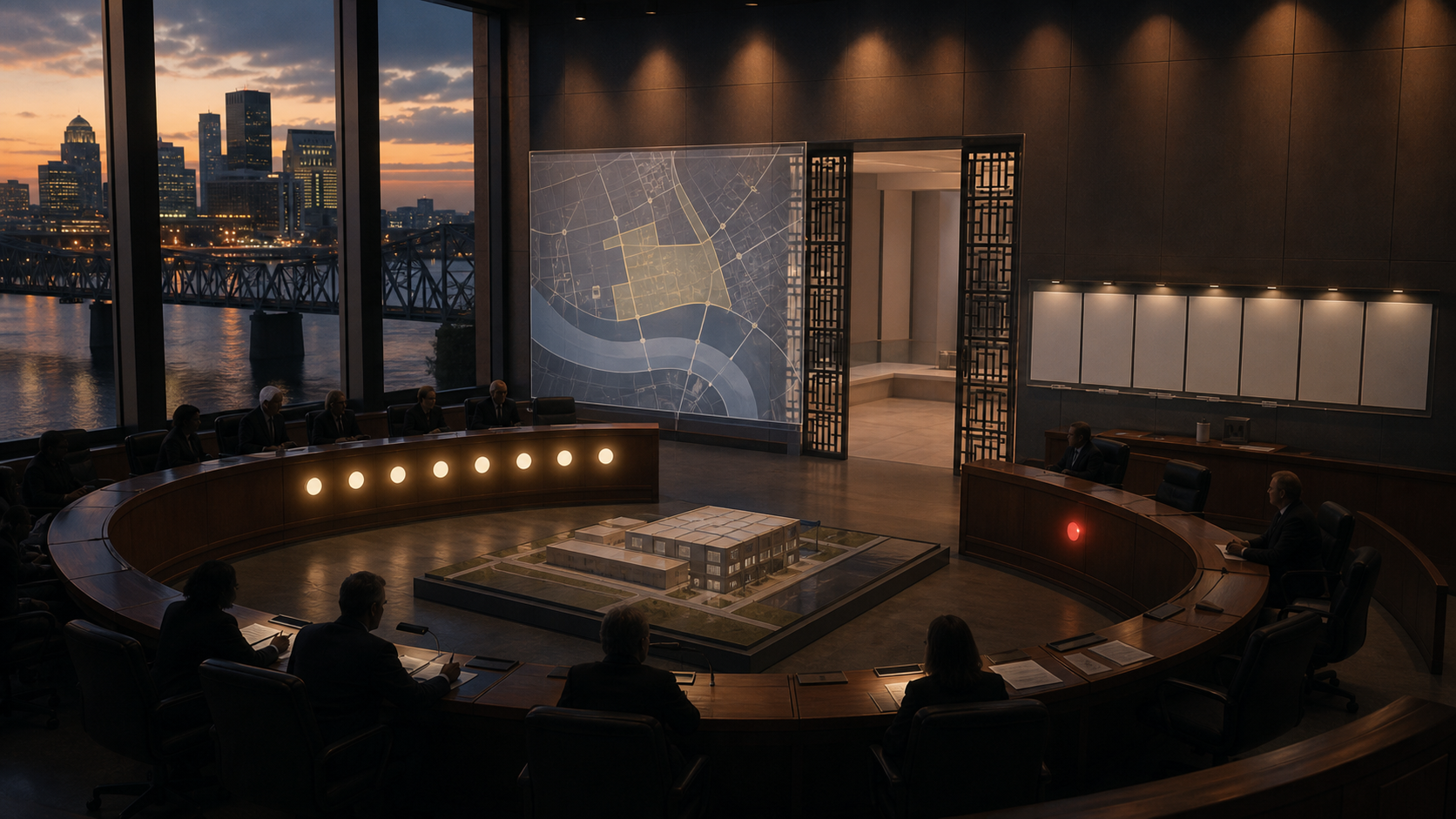
- Louisville’s Planning and Zoning Committee returned O-135-26 to the table, amended it and voted 7–1 on 4 August to advance it.
- Seven members—Andrew Owen, Scott Reed, Shameka Parrish-Wright, Josie Raymond, Betsy Ruhe, Jeff Hudson and Khalil Batshon—voted yes; Stuart Benson voted no.
- At the cutoff, the official record classified the proposal as Old Business for 13 August and listed no passed date, enactment date or enactment number, so no moratorium was in force.
- If enacted, the amended measure would pause acceptance and further processing of specified rezoning, conditional-use and Plan Certain Category 2B and 3 applications proposing telecommunications hotels or data centres.
- Applications already scheduled for a public hearing on the effective date could continue, and the pause would end after 180 days unless repealed, extended or superseded by final council action on permanent rules.
- A separate planning process is considering restrictions including a proposed prohibition on hyperscale facilities above 500,000 square feet, but those recommendations were not law at the cutoff.
One dissent changes the route, not the substance of the committee vote
The roll call was unambiguous: seven approvals and one rejection. That margin shows substantial committee support. It does not substitute for the vote of the 26-member full council. The later official matter state lists the ordinance under Old Business for 13 August, consistent with local reporting that the dissent prevents it from proceeding as uncontested consent business.
That procedural detail disciplines the headline. The committee has advanced a text and made it more politically credible; it has not enacted the text. Full council may pass, amend, postpone or reject it. A stated belief that enough votes are available is political information, not the next legal state.
For project teams, the relevant distinction is between probability and authority. A likely moratorium can justify contingency planning. Only an enacted instrument changes what the planning agencies may legally accept or process.
The proposal targets named application pathways
The amended draft would direct Planning & Design Services, the Planning Commission and the Board of Zoning Adjustment to stop accepting and further processing specified applications for telecommunications hotels or data centres. The covered routes include rezonings, conditional-use permits, and Plan Certain Category 2B and Category 3 filings.
That is more precise than a general prohibition on data-centre activity. It links the pause to particular land-use decisions and agencies. Commercial due diligence therefore starts with the entitlement route a project actually needs, not the label attached to its building. A project that still requires covered rezoning faces a different exposure from one whose approvals already sit outside those stages.
The text also protects applications already scheduled for a public hearing as of the effective date. The boundary is a procedural milestone, not a blanket exemption for every project that has spent money or spoken to the city.
The 180 days would run only after the ordinance becomes law
If the full council passes O-135-26 and the mayor approves it, or if it otherwise becomes law, the pause would last 180 calendar days. It could end earlier through repeal or final council action on the proposed Land Development Code changes, or run differently if lawmakers extend it.
At the fixed cutoff, the matter record contained no passed date, enactment date or enactment number. The 13 August entry is an agenda date, not a pre-recorded outcome. Consequently, it would be wrong to say Louisville has already stopped covered applications or to calculate an expiry date from the committee meeting.
The conditional language is not legal pedantry. It decides which applications remain acceptable today and when any grandfathering boundary is measured.
Temporary and permanent rules are separate instruments
Louisville’s permanent-rule review predates this committee vote. The council asked the Planning Commission in September 2025 to examine data-centre regulation, and an earlier moratorium proposal expired in March 2026 without passage. Public hearings on staff recommendations are now underway, followed by Planning Commission deliberation and recommendation and then a final Metro Council decision.
The administration’s proposals reportedly include barring hyperscale centres larger than 500,000 square feet and generally directing other centres to industrial areas. Those ideas describe the permanent-rule track; they are not current law, and the committee’s moratorium vote did not enact them.
The two tracks solve different problems. A moratorium preserves administrative position during deliberation. The Land Development Code decides lasting location, scale and conditions. Conflating them overstates both the immediate restriction and the certainty of the final regime.
Grandfathering turns scheduling into an economic fact
The exception for applications already scheduled for a public hearing on the effective date makes a calendar entry valuable. It allows those matters to continue to processing and decision even if the moratorium takes effect. Everything therefore turns on the exact application, hearing notice and effective date—not a general claim that a developer was “already in the process.”
Louisville Public Media reports that a previously approved 1.6-million-square-foot Camp Ground Road project near Shively would not be affected. That context illustrates how advanced approvals and transition language can produce different treatment among projects. It does not establish a new approval or change that project’s status in this window.
For investors, a pipeline count that ignores procedural position is misleading. Two proposed sites of similar scale may face different regulatory exposure because one has a scheduled hearing or existing approval and the other still needs a covered filing.
A six-month pause can still finish before six months
The draft links the temporary measure to permanent rulemaking: final council action on the Land Development Code changes could terminate the pause before 180 days. That design makes the moratorium a bridge rather than an independent policy destination.
It also creates execution pressure. The public process lists hearings through 10 August, after which the Planning Commission must deliberate and send recommendations to Metro Council. If that work stalls, council must decide whether to let the temporary measure expire, extend it or operate without completed permanent standards.
A credible bridge therefore needs a visible work plan: hearing record, commission findings, legal text, transition provisions and council calendar. Duration alone does not guarantee delivery.
The vote carries a signal, but not yet a constraint
Committee chair Andrew Owen reportedly said he now believed the measure had enough support in the full council. The 7–1 roll call strengthens that expectation, especially after the proposal had remained pending for months. It can influence developer timing, land negotiations and application strategy before the law changes.
Those market responses are anticipatory. They should not be described as legally compelled. A developer may accelerate a complete filing, reassess the entitlement path, or wait for the permanent code. The city, meanwhile, must continue applying the rules actually in force until a new instrument becomes effective.
Maintaining this line protects public trust. Reporting a proposal as a ban can cause parties to act on a restriction that does not exist, while ignoring the committee signal can understate genuine near-term risk.
The record identifies the next authoritative event
Louisville Public Media’s dated report provides committee context, the exempt-project account and the stated next step. The official matter record supplies current status and missing enactment fields; its history records return to the table and amendment. The roll call identifies each vote. The amended ordinance defines covered filings, grandfathering, conditions of effect and duration. Louisville’s official data-centre planning page describes the parallel permanent-rule hearings and proposals.
The next authoritative state change is full-council disposition. Until then, the evidence supports an advanced proposal—not an operative moratorium or a final 500,000-square-foot rule.
Sources
The evidence combines local reporting, official legislative records, the amended legal text and the city’s planning timetable. Legal status should be updated only from a later council or enactment record.
Member Briefing
Deeper Profile Context
Sign in with the right membership level to unlock the full briefing and source notes.
Only for Strategic Circle
Strategic Circle
Open to all readers. Unlock profile briefings after joining and signing in.
Join Strategic CircleOnly for Leadership Alliance
Leadership Alliance
For qualified IP-asset owners and management; sign in to unlock alliance briefings.
Join Leadership Alliance