
Summary
- Software Tool & Die’s retrospective describes a dial-up service that began with email and Usenet over periodic UUCP exchanges; its path to the wider Internet came in stages.
- The company says public Internet access began in October 1989, while founder Barry Shein says November. Later evidence supports a paid residential proxy model, but does not independently settle a worldwide “first ISP” claim.
The file had to make a detour
A customer wanted a file from the wider Internet. In Software Tool & Die’s account, an operator would dial into an account elsewhere, retrieve the file, then put it somewhere the customer could reach on The World. That manual relay is an unusually clear way to see what the name “Internet access” can conceal: the customer had an account on a service connected to other services, but the customer’s own computer was not yet a general-purpose Internet endpoint.
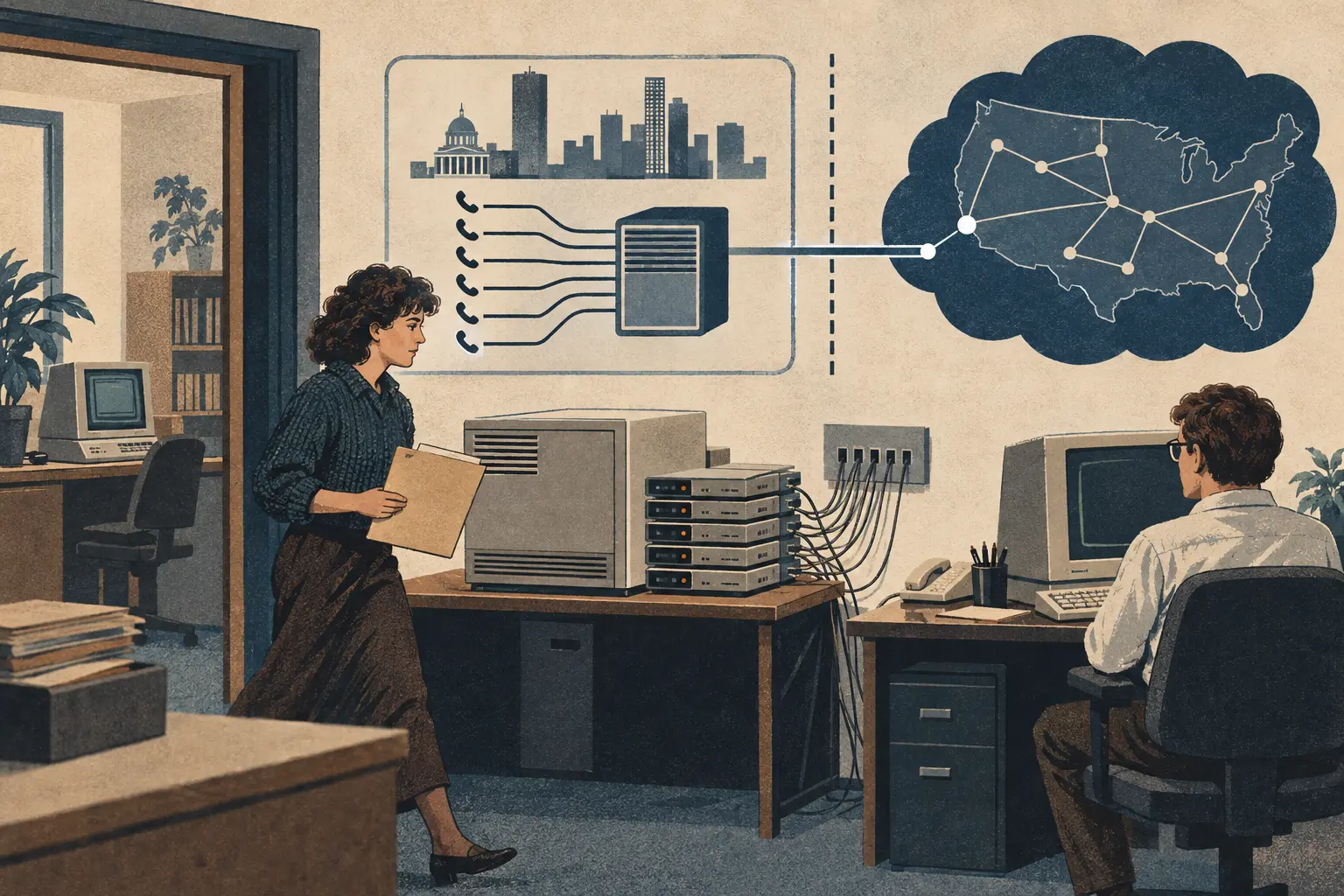
The company says it incorporated as a software consultancy in March 1989. That summer it bought a Sun4/280 server, six 2400-bps modems and telephone lines, then linked with nearby UUCP systems. The World initially offered email and Usenet. Its machines exchanged data a few times an hour rather than maintaining an always-on IP path. The recollection is first-party and retrospective, but it describes a specific operating model, not a later web-era service projected backward.
The distinction mattered to customers. The founders recall dozens of subscribers paying about US$20 a month, with different rates for different times of day. The company says some customers called from outside the United States and also paid international telephone charges. That price bought a local account and useful network services. It did not, by itself, specify which remote hosts or protocols a customer could reach.
A wholesale route did not erase the rules
The World’s history says UUNET asked to place equipment at Software Tool & Die’s Brookline office to serve Boston-area customers. The parties arranged a direct Internet connection that The World could resell. The company dates its public Internet service to October 1989. Barry Shein’s personal homepage instead says November. Both are later first-person accounts; neither supplies a dated circuit record, customer log or launch notice that resolves the month.
The company’s account also describes a dispute over carriage. It says NSFNET restricted the service’s reach and that the National Science Foundation later accepted traffic that complied with its acceptable-use policy. The company page reproduces a message addressed to Shein that calls Software Tool & Die a value-added reseller and places responsibility on it to explain the rules and address customer violations. The published copy removes names and has no visible headers or date. It is evidence of how the operator now tells the story, not an independently authenticated 1989 authorization.
A contemporaneous policy document helps establish the boundary. RFC 1192, published in November 1990, identifies UUNET and PSI among the commercial TCP/IP providers already marketing Internet-connected services. It also says that NSFNET backbone traffic remained tied to NSF’s stated purpose. The draft policy used from 1988 to mid-1990 supported scientific research and scholarly activity; the June 1990 interim policy framed the purpose as research and education in and among US academic institutions. That was a rule for the subsidized backbone, not a blanket statement that every network or every commercial service was forbidden.
RFC 1359’s 1992 guidance makes the distinction explicit: the NSFNET policy applied to the backbone, while connecting networks could set their own policies. An Internet route could therefore cross a policy boundary without making the retail provider, its customers and the subsidized backbone the same actor. The route, the service contract and the backbone’s permitted traffic were separate parts of the system.
What “first” can—and cannot—mean
A 1995 MIT study of residential access identifies The World as one of the first and most widely used commercial proxy services in the Boston area. The report distinguishes proxy access, in which a home user works through a remote Internet host, from full or client access, in which the home computer sends and receives IP packets. It cautions against treating a dial-up telephone line as proof of the latter. That later classification fits the need for a careful chronology; it does not independently certify the service’s exact 1989 configuration.
The strongest supported account is therefore narrower than the familiar slogan. The World was an early paid dial-up door through which ordinary customers could use Internet-related services, and it tested how a small provider could connect those customers to a network still governed by backbone-use rules. The sources do not settle whether it was the first public Internet service anywhere, and the company’s own dates disagree by a month.
The episode is useful because it separates three things later histories often compress into one: a customer login, a provider’s upstream route and permission for particular traffic to cross a publicly supported backbone. Those layers could align, but they did not become identical merely because a modem answered.
Sources
- The World, “History of the World — Our Version” — first-party retrospective and reproduced NSF message.
- Barry Shein, personal homepage — founder’s November 1989 account.
- Sharon Eisner Gillett, Connecting Homes to the Internet: An Engineering Cost Model of Cable vs. ISDN (MIT, 1995) — proxy versus full/client access distinction.
- RFC 1192, Commercialization of the Internet summary report (November 1990) — contemporaneous commercialization and AUP context.
- RFC 1359, Connecting to the Internet (August 1992) — later statement of the backbone-specific AUP boundary.
Member Briefing
Deeper Profile Context
Sign in with the right membership level to unlock the full briefing and source notes.
Only for Strategic Circle
Strategic Circle
Open to all readers. Unlock profile briefings after joining and signing in.
Join Strategic CircleOnly for Leadership Alliance
Leadership Alliance
For qualified IP-asset owners and management; sign in to unlock alliance briefings.
Join Leadership Alliance