
Summary
- LLC "AUTOMATIC GATE - 2000" is best read as an access-control distribution, installation, service and property-adjacent DoorHan operator, not as a cleanly disclosed independent technology platform. Its own site sells DoorHan gates, barriers, drives, access-control devices, doors, roller shutters and fence systems; Russian counterparty pages identify the legal entity, registration data, director, founders, revenue, employees, legal address and activity code; public routing sources also attach AS211000 and the
ru.vorota2000LIR label to the group, but the network evidence does not by itself create a telecom-grade revenue story. - The investment case depends on service attachment after the hardware invoice. A sectional gate, a barrier kit or a drive can be resold by many dealers. Retained value comes from survey accuracy, installation, commissioning, safety devices, integration with remotes and access systems, warranty handling, spare-parts availability, emergency repair, and customer trust when a gate controls a warehouse, parking lot, residential compound or industrial entrance. The company has evidence of scale and long operating history, but it does not disclose enough to prove recurring service revenue, customer concentration, gross margin, working-capital discipline or independence from DoorHan supply.
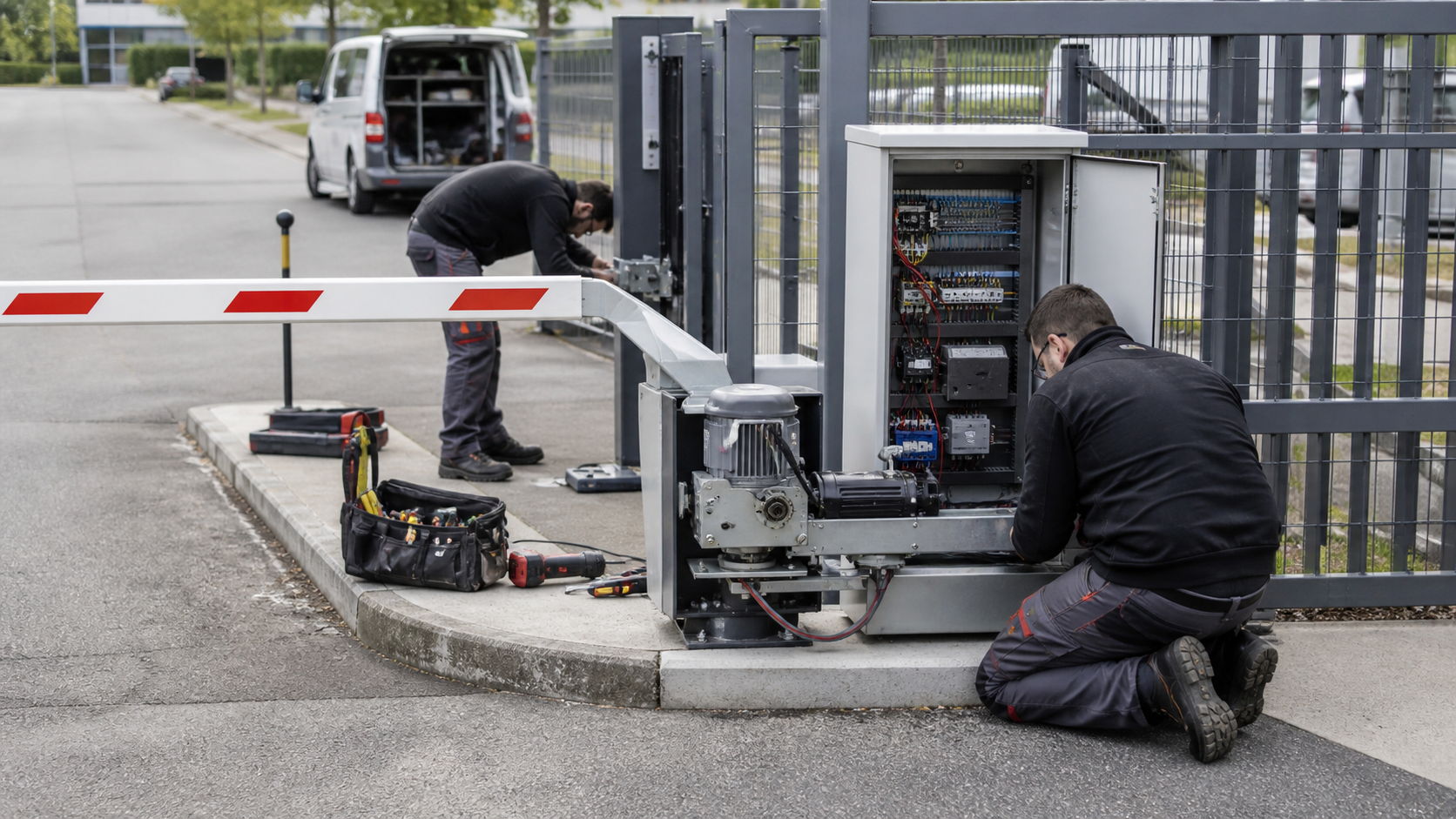
Start with one installed gate, because the economics are easier to understand at the project level than in a registry card. A customer may think it is buying a physical object: a sectional garage door, an industrial gate, a barrier arm, a roller shutter, a swing-gate motor, a photocell, a radio remote and the steel or aluminium pieces that let the system move. That is the visible part of the transaction. It has a catalogue price, a delivery promise and a manufacturer brand. The seller can win the order with product availability, a discount, a familiar brand name and a phone number that answers.
The business problem begins after that visible sale. A moving gate is not a decorative commodity. It is a mechanical boundary, a safety device and a workflow control point. If it sticks, opens slowly, damages a vehicle, fails a safety sensor, loses its remote programming, or cannot be integrated with a parking or access-control routine, the buyer does not simply compare a product code against an online marketplace. The buyer needs somebody who knows the opening, the motor, the control unit, the beam length, the installation geometry, the weather exposure, the usage intensity and the repair path.
This is where an installer or distributor either becomes a recurring service vendor or remains a thin-margin hardware pass-through.
LLC "AUTOMATIC GATE - 2000" has evidence on both sides of that line. The company-facing retail site presents a broad DoorHan catalogue and says the store specialises in the Russian DoorHan brand, with gates, doors, fence structures, roller shutters and automation for private, public and industrial sites. It advertises original DoorHan goods from the factory, delivery across Russia, more than 5,000 products, a 25-year operating history, a large stated customer count and the ability to perform work at customer sites without subcontractors. Those claims matter because they point to more than one-off resale.
They suggest product breadth, repeat availability, installation capability and a service posture.
The hard disclosure is thinner. Seldon.Basis identifies the entity as registered in 1999, with INN 5032057016, OGRN 1025004069001, 2024 revenue of about 509.67 million roubles, 28 employees, an address in Akulovo in Moscow region and a main activity described as leasing and management of own or leased non-residential real estate. Zachestny Biznes confirms the legal identity, an active status, a large charter capital of about 94.7 million roubles, director Irina Romanova, several named founders, a legal address in Akulovo and the same main real-estate activity code.
The company site gives contacts at Mozhayskoye Shosse in Moscow and repeats the INN, OGRN and registration date. These are not identical surfaces. They describe an operating seller, a property-owning legal entity and a broader DoorHan orbit that overlap but are not fully transparent.
That identity boundary is the first analytical constraint. Public sources support that LLC "AUTOMATIC GATE - 2000" is an active Russian company connected to the Vorota2000 store and DoorHan distribution. Public sources also show a DoorHan-heavy ecosystem in which Automatic Gate-2000 appears as distributor, dealer, participant, legal founder of another DoorHan-related company, and historical producer or component supplier.
They do not prove a clean standalone profit pool inside the legal entity, nor do they tell us how much revenue comes from resale, installation, rent, related-party transactions, service contracts or internet-network operations. The right conclusion must hold those ambiguities, not smooth them away.
The starting project economics are still instructive. The company's own visible prices put basic barrier kits in the tens of thousands of roubles, with examples around 71,775 roubles and 76,619 roubles for five- and six-metre Barrier-PRO kits, and chain-barrier kits around 116,473 roubles. Photocells, remotes, signal lamps and chains sit in the low thousands. Sectional gate listings range from roughly 82,626 roubles to more than 140,000 roubles depending on width and height, with price tables showing some sizes available only by request. Those numbers are not a margin schedule, but they show the order size.
A small residential or parking barrier job is not software-like. It is a physical bundle whose gross profit can be quickly consumed by procurement, delivery, survey mistakes, warranty call-backs, rework and receivables.
The value retained by the seller therefore has to come from control over friction. First, the seller has to make the buyer's choice less risky. The old online calculator references from Oborot and a construction forum are small but telling. Even in 2006 and 2008, the company was described as using online calculation to simplify the arithmetic of sectional gates. That is not merely a website feature. It is a way to convert confusing bespoke measurements into an orderable bill of materials. If the seller can reduce wrong specifications, it protects its own margin as much as it helps the customer.
Second, the seller has to control installation labour. The company says it performs all types of work on customer sites without subcontractors. If true at meaningful scale, this is economically important. Subcontracting can turn project profit into coordination risk. The subcontractor controls the final customer experience, and the dealer is left with warranty exposure if the installation is poor. In-house crews cost money even when utilisation is low, but they give the dealer a route to quality control, upsell, service history and faster repair. For a moving access-control product, those advantages are not decorative.
They are the difference between a reseller and a local operating partner.
Third, the seller needs parts density. The Vorota2000 catalogue is not only finished gates. It includes brackets, rollers, seals, springs, locks, remotes, photocells, signal lamps, control devices, beams and other parts. The spare-parts mix matters because replacement work can be better than first-sale work. When a barrier arm fails at an entrance, the customer is buying uptime, not a box. A stocked part, a technician who knows the model and a phone line that can dispatch service can create a profitable small ticket. Without that density, the original sale becomes a future liability: every warranty call is a margin leak.
Fourth, the seller needs to win the customer after the manufacturer has already won the brand. DoorHan is the centre of gravity in this evidence set. Vorota2000 says it sells DoorHan products as an official dealer or distributor. DoorHan's own media page described Automatic Gate-2000 as a DoorHan distributor that completed a production-and-warehouse complex stage in Akulovo, with investment estimated at 40 million roubles, a complex of about 23,000 square metres and planned employment for 105 people.
DoorHan's factory pages describe a much larger manufacturing and logistics system, including industrial parks, factories, production-and-warehouse complexes and large floor area. This is both strength and constraint. The seller benefits from a powerful domestic supply brand. It also has less room to claim unique product economics if the hardware decision is primarily DoorHan's.
The 2020 warehouse story is especially important because it connects the legal company to physical capacity. A distributor that can hold stock, stage orders and support quick delivery has a different cost structure from a website that forwards orders. Inventory gives speed and bargaining relevance; it also consumes capital and creates obsolescence risk. If demand shifts from one motor line to another, or if a manufacturer changes a seal, profile or control unit, the distributor must either sell through old stock or take a working-capital loss.
The Techgr note about DoorHan replacing a bottom rubber seal in a sectional-gate configuration is a small example of the problem. Component lifecycles move. A service business earns money when it manages that movement for customers; a weak distributor loses money when it is left with the wrong parts.
Capital intensity should not be understated. The public registry and DoorHan media evidence point to a company with meaningful charter capital and fixed or leased property exposure. The main activity code is real estate leasing and management, not retail trade or electrical installation. That could reflect a property-owning holding function, the Akulovo warehouse asset, classification choices, or related-party structuring. It is not enough to say the company is "just" a property vehicle, because the operating site clearly presents an access-control business.
It is also not enough to ignore the code, because the cost of buildings, yards, storage, logistics and shop space changes the economics. Hardware margin must pay for physical infrastructure as well as staff.
Bank of Russia rate conditions make that point sharper. Public monetary-policy records show that the key rate remained in the mid-teens into 2026 after reductions from higher 2025 levels. A mid-teens rouble funding environment punishes inventory-heavy distribution. Every slow-moving motor, panel, barrier arm or roller set carries an implicit financing cost. Every unpaid customer invoice matters more. Every project with delayed acceptance can absorb the profit from the next one.
A company with hundreds of millions of roubles in revenue can still have unattractive economics if it must finance stock, credit customers and fixed assets at expensive rouble rates.
The unit-economic test is therefore simple. If the company sells a 75,000 rouble barrier kit and keeps only a conventional dealer spread, there is not much room for mistakes. Delivery, payment fees, sales labour, technical support, warranty handling and tax can take the spread down quickly. If the same order includes paid survey, installation, commissioning, safety-device fitting, remote programming, spare-parts availability and a maintenance relationship, the retained value improves. The best case is not a one-time margin on DoorHan hardware.
It is a service annuity around the installed base, with the first hardware sale acting as customer acquisition.
But there is no public evidence of a formal annuity. The site says the company provides quality work with a guarantee, and it advertises service and repair historically through directory pages, but it does not publish maintenance-contract attach rates, installed-base size, renewal rate, average repair ticket, service-level commitments or revenue split. The company's claim of more than 100,000 satisfied customers sounds impressive, yet it is not a disclosed cohort. It could include historical retail orders, small parts purchases, leads, completed installations or a broader marketing count.
A disciplined reader should not turn that number into active accounts or recurring revenue. The better use is directional: the company has operated long enough and broadly enough to have an installed-base opportunity if it has built the service process.
Customer concentration is another unresolved risk. Access-control demand comes from homeowners, residential compounds, warehouses, industrial estates, parking sites, retail facilities and public or quasi-public buildings. The company's pickup-point page lists several Moscow-region pickup locations and then a large set of cities, suggesting a distribution network beyond a single counter. That breadth helps, but it does not prove diversified revenue. One large warehouse client, one related DoorHan procurement channel, or one property leasing arrangement could still dominate the legal entity.
Seldon says the company has no government contracts, while other sources show commercial and court activity. Without customer-level disclosure, the safest assumption is mixed end markets with unknown concentration.
Competition is visible and economically unforgiving. The IndexBox market page names DoorHan, Alutech, CAME, Nice, FAAC, ROL Systems and regional manufacturers or installers as automatic-gate market participants. Alutech's own automation page shows a competing product story around gate automation, including smartphone and voice-assistant control for swing gates. A Krasnodar Alutech partner page identifies Vorota2000 as an official Alutech representative for rollers, gates and automation, which complicates a purely DoorHan reading and suggests either regional brand overlap, partner-site reuse or a broader dealer identity.
A specialist comparison page frames DoorHan and Alutech as brands that have expanded across price classes. None of this allows a precise market share claim. It does show that customers have alternatives and that the seller must compete on availability, installation trust, service response and total job cost, not only on a catalogue SKU.
The customer also has an in-house alternative. A warehouse operator with maintenance staff can buy parts and use its own electricians or mechanics. A property-management company can standardise on one brand and hold spares internally. A residential compound can tender installation separately from equipment supply. The reseller's defence is not that customers lack hands. It is that the mistakes are expensive. A poorly measured sectional opening, a badly balanced barrier spring, an incorrectly positioned photocell, an under-specified drive or a weak safety routine can create downtime and liability.
The more mission-critical the gate, the more a specialist earns its place. The more generic the job, the easier it is for the customer to unbundle the dealer.
Regulatory and geopolitical risk sits in the supply chain rather than in a simple sanctions label. The company itself is not established in the reviewed public sources as a sanctioned entity. Zachestny Biznes indicates some sanctions fields are not fully visible while also listing common registry checks; that is not a sanctions clearance. The broader environment is material. U.S.
export controls under EAR Part 746 and EU sanctions pages restrict broad categories of technology and goods to Russia and Belarus, including electronics, communications equipment, machinery and components that can matter for automation and industrial equipment supply chains. A RUDN publication on import substitution in Russian construction argues that Russia has made more progress in mass building materials than in equipment and software, where import dependence remains high in many categories.
Gate sellers may use domestic DoorHan hardware, but drives, electronics, semiconductors, software integrations, sensors and replacement components remain exposed to price, logistics and substitution risk.
The role of DoorHan changes that risk but does not remove it. DoorHan's scale, factories and distribution footprint give Automatic Gate-2000 a domestic anchor at a time when import channels are less predictable. A local manufacturer can supply panels, barriers, profiles, warehouse equipment and many mechanical parts without forcing every dealer into direct foreign procurement. That is a real advantage. Yet domestic manufacturing still depends on machinery, electronics, materials, tooling, logistics and supplier choices.
If sanctions or import substitution pressures raise input costs for DoorHan, those costs flow to dealers and installers through prices, lead times or part availability. A distributor cannot fully hedge a manufacturer's bill of materials.
Infrastructure evidence adds a different angle. IPinfo, Hurricane Electric and RIPE-allocation mirrors attach AS211000, IPv4 and IPv6 resources, and the ru.vorota2000 LIR label to the Automatic Gate-2000 or DoorHan-related network identity. Hurricane Electric labels AS211000 as "DoorHan - Torgovyj Dom" LLC, while IPinfo and RIPE allocation statistics connect the broader resource set to LLC "AUTOMATIC GATE - 2000" and show small routeable address holdings. That inconsistency is not a reason to invent a telecom business. It is a reason to treat routing as operating evidence: the company or group had reason to hold and announce internet resources, likely for internal systems, e-commerce, logistics, security, customer infrastructure, or a related corporate network. In an access-control business, reliable internal systems matter, but a few prefixes do not prove regional ISP economics.
This is why the category label should be handled carefully. A public directory may classify the company under a regional-ISP-like bucket because of AS and LIR evidence. Economically, the stronger public record is not an ISP model but an access-control and DoorHan distribution model with network traces. The analytical question still fits the technology theme because gates are becoming connected control points. Remote controls, sensors, smart automation, smartphone operation and service histories introduce software lifecycle risk. But the revenue test remains physical.
The company does not disclose subscribers, peering revenues, broadband customers, transit sales or network-service contracts. Treating it as a telecom operator would overstate the evidence.
The better digital thesis is service continuity. A gate operator increasingly includes control boards, remotes, sensors, radio modules, access-control peripherals and sometimes app or cloud interfaces. Alutech markets smartphone and voice-assistant operation in its automation line. Vorota2000 sells DoorHan control devices, safety devices and access-control categories. These features create a lifecycle beyond the panel or beam. Firmware, compatibility, replacement remotes, control-unit availability, security practices and installation records can all matter.
If the company has a disciplined service database and can support old installations as product lines change, it has a moat. If it merely sells boxes, connected features increase support burden without creating recurring revenue.
Pricing power is conditional. The company says its customers receive prices up to 10 percent below market averages, which is a commercial promise but not a proof of margin. Discount language can indicate scale purchasing power, direct manufacturer relationship or a deliberate low-price strategy. It can also signal a market in which hardware prices are transparent and customers compare easily. The seller earns pricing power when customers value a correct job and fast response more than a low line-item price. That is easier in industrial gates, high-throughput barriers, warehouse docking equipment and multi-site property portfolios.
It is harder in standard residential garage doors where online comparison is immediate.
The company's historical position may help. Exponet's 2003 exhibition page described Automatic Gate-2000 as a Russian producer of components for modern gates, with its own line for specialised sandwich panels, stamping and galvanic shops, and powder-coating capability. Restko's older directory page described sales, installation, service and repair of garage and industrial gates, roller shutters, barriers, gate automation, security systems, dock levellers and dock shelters. These are old sources, so they cannot be used as current operating proof.
They do show that the identity has long sat around gate systems, components and industrial access equipment, not a sudden opportunistic retail site. The long continuity increases confidence that the firm understands the category. It does not settle today's profit quality.
Legal and counterparty signals are mixed in the normal way for a mature Russian SME or mid-sized private company. Seldon reports 55 court proceedings, with the company more often plaintiff than defendant, and no state contracts. Zachestny Biznes shows registry status, SME registry classification as small with 16 to 100 employees, some risk-marker categories, a Rostekhnadzor licence count, Fedresurs audit-result messages and multiple trademarks. Search results around individual counterparties show Automatic Gate-2000 appearing in intellectual-property disputes, including trademark-protection claims.
Those signals may indicate active brand enforcement and commercial collections rather than distress. They also remind us that receivables, counterparties and IP enforcement are part of the cost base. A dealer with many small counterparties can spend real money turning invoices and brand rights into cash.
The apparent link to DoorHan-Stolitsa is relevant for concentration and control. Companium's page on DoorHan-Stolitsa says Automatic Gate-2000 became the founder in June 2024 and owns 100 percent of that company's charter capital. That supports a picture of corporate activity inside the DoorHan distribution network. It may be strategically useful: regional distribution companies can deepen market reach, coordinate inventory and protect channel position. It also makes arm's-length profitability harder to read from outside.
If sales, inventory, property, trademarks or network functions move among related entities, public revenue at one entity does not necessarily equal economic profit available to that entity.
The labour base deserves the same caution. Seldon lists 28 employees for 2024, while the 2020 warehouse article referred to planned employment of 105 people at the new production-and-warehouse complex. These numbers need not contradict each other. One may refer to a legal-entity average, another to project plans, and work may be done through related companies, contractors, dealerships or retail locations. But they change the service-margin question. A 28-person company can operate a lean distributor with some technical teams; it cannot by itself blanket Russia with intensive maintenance unless the network is partner-based.
A planned or related 105-person warehouse workforce supports logistics scale but still does not disclose service attachment. The burden is on future evidence to show how many technicians are active, how often they visit installed sites and what customers pay for aftersales work.
The macro demand side is better than a narrow residential story. Rosstat construction pages and statistical publications show that Russian construction remains a large measured sector, and regional data for Moscow-region-style construction activity show meaningful building, engineering and specialised-construction volumes. NF Group's 2026 report on Moscow-region warehouses describes a 2025 correction after strong 2023-2024 growth, with 1.9 million square metres of new supply and vacancy rising to 4.3 percent including sublease.
Warehouses, industrial parks and logistics facilities are natural gate, barrier, dock and access-control customers. Correction can reduce new-build urgency, but it also expands the installed base requiring maintenance. For a service-capable operator, slower new construction is not fatal if repair and retrofit volumes remain available.
Still, cyclical exposure is real. New gates and barriers are tied to construction, renovation, warehouse fit-out, residential compounds, public facilities and capital expenditure. A high-rate environment can delay projects. A logistics tenant with excess vacancy may postpone upgrades. A property developer may push for lowest equipment price and defer service contracts. In those moments, the dealer's economics move away from engineering margin and toward price competition.
The company's resilience depends on how much work comes from necessary replacements, safety repairs, spare parts and operational uptime rather than discretionary installations.
There is also a security and liability layer. Access-control equipment mediates entry. In residential compounds it affects residents and visitors; in warehouses it affects traffic flow, worker safety and asset protection; in industrial sites it can intersect with fire routes, security protocols and shift changes. Failures can create costs out of proportion to the hardware. This is the best argument for a service business. Customers do not want to diagnose a control board or a beam alignment every time a gate fails. They want a vendor who can take responsibility.
A company that can contract around uptime, scheduled maintenance and fast repair can transfer operational risk from the customer to itself for a price. That is the recurring revenue opportunity, but it only works if the vendor prices the risk and staffs it efficiently.
Risk transfer can also backfire. Guarantees and service promises are valuable only when the seller understands failure rates and has parts in stock. If low-price hardware sales create many under-priced warranty obligations, the service tail becomes a loss pool. If installation crews are underutilised, fixed wages dilute margin. If customer locations are dispersed across Russia and service depends on partners, the seller may own brand risk without controlling execution. The company site's broad delivery geography is a strength for sales reach, but broad reach is not the same as controlled service reach.
The supplier-dependence question therefore has a precise answer: dependence on DoorHan is economically tolerable if it brings purchasing terms, availability, training, warranty support and brand demand that competitors cannot match. It is dangerous if it leaves Automatic Gate-2000 as a replaceable channel with little data ownership and no unique customer relationship. The evidence shows strong DoorHan anchoring. It does not show exclusive rights, preferential margins, long-term supply contracts, rebate structures, or service-data ownership. A buyer or lender should not assume supplier power belongs to the dealer.
A useful way to frame the business is a margin bridge from catalogue price to retained operating profit. The first deduction is the manufacturer's or supplier's cost of the product. The second is freight, handling, storage and damage risk. The third is sales labour and technical pre-sale time, because a customer rarely buys a correct gate system from a bare SKU without discussing opening width, height, duty cycle, foundation, electrical access, wind exposure, safety devices and finish. The fourth is installation labour and travel.
The fifth is warranty reserve, because moving equipment fails in the field and every call-back can consume several hours even when the defective component is cheap. The sixth is working capital, which becomes costly in a high-rate rouble environment. The seventh is overhead: the store, phone support, website, warehouse, management, legal defence of trademarks, accounting and property costs. Only what remains after that bridge is the economic profit that matters.
That bridge explains why the most attractive customer is not always the one buying the largest gate. A bespoke industrial opening can carry a higher invoice but also higher specification risk, site delays and acceptance disputes. A standard residential gate can be simpler but more price-transparent. A multi-site warehouse or property-management client may be the best account if it buys repeat service, accepts standardised equipment, pays on schedule and lets the vendor consolidate truck rolls.
A one-off bargain buyer may be the weakest account if it negotiates hard on hardware, refuses paid maintenance and calls only when something has failed. The public sources do not disclose Automatic Gate-2000's customer mix, so the article cannot assign a precise margin. It can identify what would make the margin defensible: repeat accounts, standardised installed equipment, spare-parts predictability and paid service response.
The catalogue itself points to a layered value stack. A barrier arm or sectional door is the anchor product, but the surrounding basket includes photocells, signal lamps, remotes, locks, control units, chains, springs, seals, rollers, brackets and safety devices. Those small items are not trivial. They are where downtime is often resolved. A customer may delay replacing an entire gate, but it cannot leave an entrance disabled because a safety sensor, remote, spring or control device is unavailable. In a mature installed base, the parts basket can smooth cyclicality: new construction may slow, while repairs continue.
The seller with parts knowledge and inventory gets the call. The seller without inventory becomes a price comparison page.
There is also a data advantage that is easy to miss. If the same company surveyed the opening, sold the motor, installed the safety devices and handled the first warranty call, it knows the customer's configuration. It can diagnose faster, recommend compatible parts and avoid sending the wrong technician or component. That is a real operating asset if it is recorded and reused. It is not automatically valuable; it requires a service database, disciplined job notes and staff who can act on them.
The public routing and e-commerce evidence suggests the company or group has some technical operating capacity, but it does not show a service-management system. This is one of the places where a physical business can become more software-dependent without becoming a software company.
Procurement risk has to be read through both product and time. Gate systems are long-lived. A customer may install a barrier in 2024 and need parts in 2028. If the manufacturer changes components, if imported electronics become harder to source, if a control board is superseded, or if a seal profile changes, the dealer must bridge old and new systems. The Techgr example of a DoorHan seal replacement is small, but it illustrates the pattern: product lifecycles change beneath the installed base. This can be a service opportunity for a capable vendor that keeps compatibility knowledge.
It can also become a liability for a vendor that sold cheap hardware and did not price future support.
The public court and trademark signals fit this operating reality. A company with a broad dealer network and recognised product names has reason to police brand misuse, collect receivables and protect channel economics. IP enforcement is not automatically evidence of market strength, but it shows that brand and distribution boundaries matter. The risk is cost and distraction. Legal activity can support margin if it preserves authorised sales and prevents counterfeits. It can erode margin if the company spends heavily fighting small counterparties because the distribution channel is fragmented and difficult to control.
Another point is payment discipline. Access-control jobs often sit between construction and operations. In construction, payment can depend on stages, acceptance certificates and contractor cash flow. In operations, repairs may be urgent but procurement departments can still pay slowly. A mid-sized distributor can be profitable on paper and strained in cash if it funds inventory and receivables at the same time. Seldon's revenue-per-employee implication is high if one simply divides reported revenue by listed staff, but that does not prove operating leverage.
It may reflect distribution turnover, related labour outside the legal entity, property income, lean staffing or group structure. High turnover through a small entity can still be low-quality if cash conversion is poor.
The upside case would look different. In that case, Automatic Gate-2000 would have a dense Moscow-region installed base, strong DoorHan purchasing terms, fast-moving inventory, technicians with high utilisation, clear paid call-out pricing, a documented maintenance plan for industrial and residential-compound customers, and enough recurring repair work to offset new-build cycles. DoorHan's domestic manufacturing depth would reduce import disruption, while the company's own local warehouse and pickup network would shorten lead times.
AS211000 and the company's digital infrastructure would support e-commerce, inventory visibility, customer records and dispatch rather than sit as an irrelevant routing footnote. Under that case, the hardware sale is not the profit centre; it is the acquisition event for a long service relationship.
The downside case is equally plausible from public evidence. In that case, the company is one part of a broader DoorHan-affiliated channel and property structure, with revenue passing through at thin spread, opaque related-party economics, expensive stock, incomplete service attachment and customers willing to compare prices across DoorHan, Alutech and other automation sellers. Legal identifiers and routing resources make the company visible, but they do not create pricing power. The warehouse asset creates fixed cost. The official-dealer promise helps close sales, but the manufacturer captures most product economics.
In that case, strong revenue and long history would not be enough. The company would be a useful channel, not a durable independent compounder.
The base case sits between those extremes. The company appears too established, too technically adjacent and too DoorHan-integrated to dismiss as a simple online storefront. At the same time, the available record is too sparse to underwrite a high-recurring-revenue story. The sensible base case is a hybrid distributor and service operator whose economics vary by project type.
Standard catalogue sales likely face price pressure; complex installations and urgent repairs likely carry better retained value; property and related-party activity may influence reported numbers; and the technology layer matters mainly as an enabler of service continuity rather than as an independent product line.
For customers, the buying decision should therefore be structured around total cost of ownership, not the first invoice. A lower hardware quote is less valuable if it creates wrong specification, slow repair, unavailable parts or weak accountability. A higher quote may be rational if it includes a correct survey, reliable installation, safety compliance, documented controls, spare-parts availability and a clear repair path.
For Automatic Gate-2000, that means the commercial message should not stop at "official dealer" or "below-market price." It should make the service promise measurable: what is included, how fast repairs are handled, which parts are stocked, how warranty responsibilities are divided and what a customer pays after year one.
For competitors, the opening is to unbundle the service claim. If Alutech dealers, local installers or multi-brand automation firms can match DoorHan availability and offer better service transparency, they can attack the margin that Automatic Gate-2000 needs. If they cannot, DoorHan's domestic manufacturing depth and the company's long local history become effective defences. The competitive battle is therefore not a catalogue battle alone. It is a battle over who owns the installed base, who answers when the gate fails and who can translate a messy physical site into a predictable operating system.
What facts would change the judgment? The first would be revenue split. If management could show that installation, maintenance, repair, paid warranty extensions, spare parts and recurring service contracts account for a large and growing share of gross profit, the company would look much stronger. A second would be installed-base data: number of active service customers, annual call-outs, response times, churn and renewal rates. A third would be channel terms with DoorHan and other brands, including rebates, credit terms and warranty reimbursement.
A fourth would be receivables ageing and inventory turnover, because those decide whether 500 million roubles of revenue is healthy or capital hungry. A fifth would be customer concentration and related-party transaction disclosure. A sixth would be clarity over AS211000 and LIR resources: whether they support internal operations, customer services or unrelated group infrastructure.
Absent those facts, the conclusion is deliberately narrow. LLC "AUTOMATIC GATE - 2000" appears to have a real operating footprint, a long history, a public DoorHan-heavy catalogue, visible legal identity, meaningful revenue, physical logistics evidence and enough technical breadth to participate in access-control projects. It should not be valued or described as if every rouble of hardware revenue were high-quality service revenue. The economic core is not the gate; it is the ability to remain economically useful after the gate is installed.
If the company owns that aftersales relationship, its installed base can produce durable margin in a difficult market. If it does not, it is exposed to the classic distributor squeeze: transparent hardware prices, expensive inventory, supplier dependence, cyclic construction demand, and customers who can unbundle installation from maintenance.
The most defensible reading is therefore positive but conditional. Automatic Gate-2000 has enough evidence of category depth and DoorHan-linked infrastructure to be more than a casual reseller. It also has enough disclosure gaps to prevent a strong moat claim. The company earns strategic interest only to the extent that it can turn access-control hardware into service continuity: correct specification, reliable installation, stocked replacements, responsive repair, control-system support and risk transfer that customers are willing to pay for repeatedly. The facts that would upgrade the case are not heroic growth projections.
They are mundane operating disclosures: service gross profit, repeat accounts, utilisation, inventory turns, receivable discipline and customer concentration. Until those are visible, the prudent conclusion is that the service margin must be earned project by project after the hardware sale, not assumed from the DoorHan catalogue or the company's long history.
Sources
- https://vorota2000.ru/
- https://vorota2000.ru/about/
- https://vorota2000.ru/contacts/
- https://vorota2000.ru/warranty/
- https://vorota2000.ru/catalog/avtomatika/
- https://vorota2000.ru/catalog/shlagbaumy_i_barery_2/
- https://vorota2000.ru/catalog/sektsionnye_vorota/
- https://vorota2000.ru/catalog/otkatnye_vorota/
- https://vorota2000.ru/catalog/raspashnye_vorota/
- https://vorota2000.ru/catalog/rollety/
- https://vorota2000.ru/catalog/dveri/
- https://vorota2000.ru/catalog/sistemy_ograzhdeniy/
- https://doorhan.ru/about/mediasfera-o-nas/agenstvo-biznes-informatsii-abireg-ru/distribyutor-doorhan-otkroet-v-podmoskove-skladskoy-kompleks-za-40-mln-rubley/
- https://construction.doorhan.ru/o-koncerne/factories/
- https://development.doorhan.ru/o-koncerne/smi/predstavitelstvo-doorhan-v-kazani-razvitie-2024/
- https://www.exponet.ru/exhibitions/online/windowsmo2003/x.ru.html
- https://www.exponet.ru/exhibitions/online/batimat2002/komplektI.ru.html
- https://oborot.ru/news/raschet-vorot-onlajn-i44058.html
- https://www.kroi.ru/forum/showthread.php?t=2206
- https://www.restko.ru/firm/19976
- https://basis.myseldon.com/ru/company/1025004069001/facts
- https://zachestnyibiznes.ru/company/ul/1025004069001_5032057016_OOO-AVTOMATIChESKIE-VOROTA-2000
- https://marketpublishers.ru/report/company_reports/company_5032057016_business_profile.html
- https://companium.ru/id/1155032000518-dorhan-stolica
- https://xfirm.ru/person/773406022646
- https://xfirm.ru/person/772206758959
- https://xfirm.ru/person/711613294276
- https://xfirm.ru/person/234305712903
- https://ipinfo.io/AS211000
- https://ipinfo.io/AS211000/91.209.94.0/24
- https://bgp.he.net/AS211000
- https://bgp.he.net/net/91.209.94.0/24
- https://www-public.telecom-sudparis.eu/~maigron/rir-stats/ripe-allocations/ipv4/by-lir/ru-ipv4-by-lir.html
- https://www-public.telecom-sudparis.eu/~maigron/rir-stats/ripe-allocations/ipv6/by-lir/ru-ipv6-by-lir.html
- https://lir.internet-registry.net/?cdir=desc&country=ru&csort=lirs&dir=desc&p=5&sort=total_slash24
- https://www.cbr.ru/eng/dkp/mp_dec/
- https://cbr.ru/eng/hd_base/KeyRate/?UniDbQuery.FromDate=&UniDbQuery.Posted=True
- https://rosstat.gov.ru/folder/14458
- https://www.rosstat.gov.ru/folder/210/document/13227
- https://rosstat.gov.ru/region/docl1103/IssWWW.exe/Stg/d054/i058010r.htm
- https://cre.ru/analytics/101076
- https://repository.rudn.ru/ru/records/article/record/101507/
- https://www.bis.gov/regulations/ear/746
- https://commission.europa.eu/topics/eu-solidarity-ukraine/eu-sanctions-against-russia-following-invasion-ukraine/sanctions-dual-use-goods_en
- https://www.indexbox.io/store/russia-automatic-gates-market-analysis-forecast-size-trends-and-insights/
- https://www.researchandmarkets.com/reports/6082797/automatic-doors-market-aidc-global-forecast
- https://alutech-group.com/ru-ru/korporativnyy-klient/avtomatika/dlya-raspashnyh-vorot/alutech-ambo/
- https://krasnodar.alutech.ru/partner/vorota2000/
- https://gs-automatic.ru/articles/article_post/kakie-vorota-luchshe-alyuteh-alutech-ili-dorhan-doorhan
- https://www.techgr.ru/
Member Briefing
Deeper Profile Context
Sign in with the right membership level to unlock the full briefing and source notes.
Only for Strategic Circle
Strategic Circle
Open to all readers. Unlock profile briefings after joining and signing in.
Join Strategic CircleOnly for Leadership Alliance
Leadership Alliance
For qualified IP-asset owners and management; sign in to unlock alliance briefings.
Join Leadership Alliance