
Summary
- Level-MSK's most credible public business boundary is operator-grade connectivity rather than ordinary mass-market Moscow broadband: its own site advertises trunk channels, layer-two VPN, IP transit, LIR support, IPv4 leasing, Donetsk colocation, dark-fibre rental and round-the-clock support, while PeeringDB, RIPE and BGP datasets show AS52091 as a regional carrier with multiple exchanges, upstreams, peers and downstream customer networks.
- The unit economics are narrow. A single connected customer has to fund upstream and peering ports, leased or owned fibre, colocation, LIR resource work, installation, field repair, documentation, receivables and equipment replacement. Public 2025 revenue of roughly 142.8 million rubles and a 2025 net loss mean scale alone does not prove margin, especially when the company reports only a small formal workforce.
- Concentration risk is the central uncertainty. The strongest network evidence points to a wholesale or operator-customer model in which a few carrier, public-sector, enterprise or regional network accounts can move revenue faster than household churn does. Public sources do not disclose customer count, contract tenor, monthly recurring revenue, field backlog, gross margin or capital commitments.
- Larger Russian fixed and mobile operators are the practical substitutes. Rostelecom and MegaFon are extending a fixed-virtual-network-operator model in Moscow and the Moscow region; MTS sells national business internet and mobile-data alternatives while investing in domestic fixed-core routers; Beeline and other national mobile providers keep low-friction data options visible. Level-MSK therefore has to sell resilience, geography and responsiveness, not just bandwidth.
Begin with one connected customer whose contract is anchored in Moscow but whose service need is not a generic apartment line. The customer may be a regional operator buying IP transit, an enterprise needing a layer-2 path, a data-centre client with equipment in Donetsk, or a public-sector/commercial account in a southern route geography that wants one provider to solve transport, addressing and field access. The invoice looks simple: capacity, a port, maybe an installation charge, maybe an address-resource line, maybe a service-level promise. The economics behind that invoice are not simple.
Before Level-MSK keeps a ruble of operating contribution, the connection must absorb transit or settlement costs, exchange-port and colocation charges, dark-fibre or leased-fibre costs, last-mile construction or splicing, customer-premises equipment, routing hardware, monitoring, account management, tax, licence compliance, support labour and working capital.
That is why the company cannot be judged as a directory entry with an ASN. The question is not whether AS52091 exists. It plainly does. The question is whether each incremental connection produces more contribution than the obligations it creates. A local provider can look economically stronger than a national carrier if it owns a scarce route, can dispatch a technician faster, has working interconnection in a market others avoid, or already has fibre and racks near the customer.
The same provider can look weak if its price is only a pass-through for upstream capacity, if one customer buys most traffic, if field service has to be subcontracted over long distances, or if replacement routers and optics must be sourced under import friction. Level-MSK's public record contains evidence for both sides.
The identity boundary matters first. The telecom company in this evidence set is the Level-MSK/LEVEL-MSK operator associated with level-msk.com, level-msk.net, AS52091, ORG-LL304-RIPE and the Russian legal profile for ООО "ЛЭВЭЛ-МСК", INN 7714967759, OGRN 1177746021628. It is easy to confuse that record with the separate food-service company ООО "ЛЕВЕЛ МСК", INN 7724457620, which appears in Russian company databases with restaurant and delivery activity. That near-name collision is not a cosmetic problem. If the wrong entity is used, every financial conclusion is wrong. The telecom record points to an entity registered in January 2017 at Chernyakhovskogo Street in Moscow, with main activity in wireline communications, a small stated capital base, telecom licences and a website selling carrier-grade services. The food-service record has different registration numbers, different activity codes, different scale and different economics. Only the telecom record belongs in this analysis.
Within that telecom boundary, Level-MSK has three visible operating layers. The first is legal and regulatory. Russian contractor profiles identify a Moscow limited-liability company, a wireline-communications activity code, a general director, two current communications licences with terms running to December 2028, and public financial figures. The second is network control. RIPE, BGP and PeeringDB data connect the organisation to AS52091, an AS-set, route objects, RPKI-valid originated space, multiple exchange points, upstreams and downstreams. The third is commercial positioning.
The company's own site does not pitch a mass retail fibre brand. It pitches trunk communication channels, layer-two VPN, IP transit, LIR services, IPv4 block rental, ASN and resource-registration assistance, colocation in Donetsk, dark-fibre rental in the DNR and Rostov region, 24/7 support and a 99.9 percent uptime claim. Those are operator and enterprise services. They imply fewer, heavier accounts than a household ISP, and they shift the margin test from "how many homes passed?" to "how much recurring contribution does each route, port and support obligation produce?"
The public routing evidence supports that operator-grade reading. PeeringDB lists Level-MSK LLC as a regional NSP with AS52091, IRR set AS-LEVEL-MSK, selective peering, no formal contract requirement, no ratio requirement, support for IPv4 and IPv6, and a self-reported traffic band of 300 to 500 Gbps with traffic mostly inbound. It also lists public peering at exchanges including Eurasia Peering IX, GNM-IX, MSK-IX Moscow, MSK-IX Rostov-on-Don, PITER-IX locations, Sea-IX and SFO-IX, plus facilities in Moscow, Donetsk and Rostov-on-Don.
BGP.tools presents AS52091 as active under RIPE, with originated IPv4 and IPv6 prefixes, seven upstreams, a large peer set and a handful of downstreams. Hurricane Electric's view also shows many observed peers and a larger set of announced prefixes than the originated-prefix count, which is what one expects when a carrier announces customer routes as well as its own space. Cloudflare Radar's RPKI view shows the directly originated AS52091 prefix set as valid rather than unknown or invalid in the observed period.
None of that proves customer economics, but it tells the analyst where to look. A small access ISP with only three originated IPv4 route entries might be constrained by address space and local take-up. A wholesale operator with hundreds of PeeringDB prefix limits, customer routes and 300 to 500 Gbps of traffic can have a very different model: margin may come from selling upstream, route reachability, layer-two transport, colocation adjacency, resource services and problem ownership. In that model, a single customer may consume more engineering time than a block of households but also pay for a higher-value service.
The risk is that such a customer can also leave a large hole when it churns.
The upstream map is diverse enough to be operationally useful but not free. BGP.tools lists Level-MSK upstreams including Arelion, RETN, RASCOM, iHome, INETCOM, Transroute and BiMajLink. The RIPE aut-num policy also includes imports and exports with large global and regional networks, route servers and customer ASNs. That is a serious interconnection posture for a small legal entity. It can improve latency, reduce dependence on a single transit supplier and create negotiating leverage. Yet every upstream or exchange decision has a cost side.
Paid transit, exchange ports, cross-connects, router interfaces, optics, remote hands, route filtering and monitoring all have to be paid before any customer margin exists. Settlement-free peering is not costless when the operator must maintain ports, traffic engineering and capacity headroom.
The per-connection logic is therefore different from consumer broadband. If a Moscow-area SME buys a backup mobile SIM, the cost is transparent and cancellation is easy. If the same buyer needs a managed office circuit, it cares about installation time, repair time, SLA, static addressing, clean routing and a human escalation path. If a regional operator or public-sector client buys a trunk channel into a difficult route geography, it cares about whether Level-MSK can actually deliver a path, maintain power and equipment, document the circuit and restore service after a cut. The price premium comes from that bundle.
The cost burden comes from the same bundle.
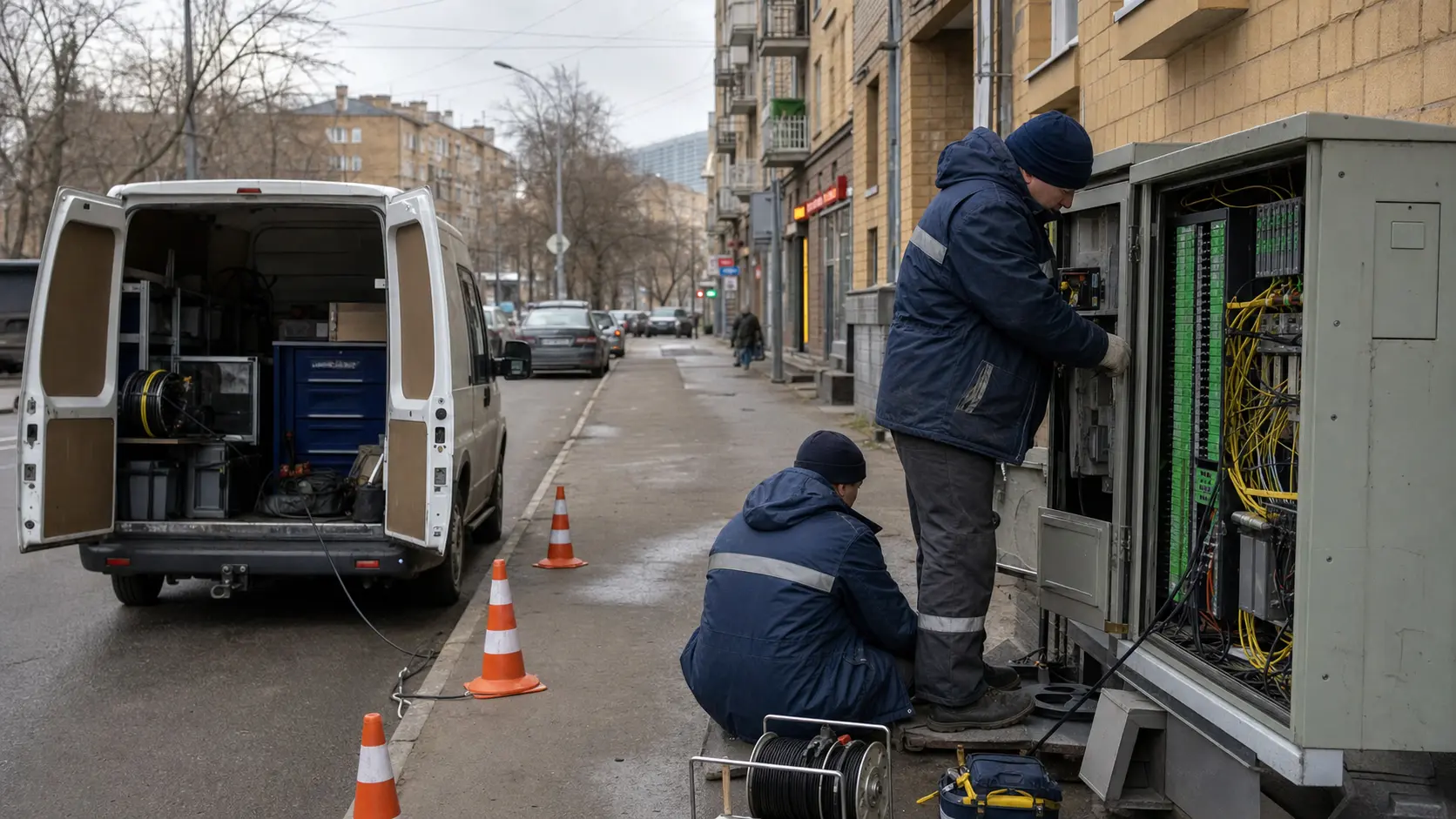
The company's public website sharpens the field-cost problem. It says Level-MSK works in the DNR, LNR and Zaporizhzhia region, offers colocation in Donetsk and dark-fibre rental in the DNR and Rostov region, and claims its own fibre, racks and equipment in key points of presence. Those claims are material because field economics deteriorate quickly when the provider's support zone stretches beyond one dense urban access ring. A technician trip, a fibre splice, a rack intervention, an optical-module swap or a customer installation can erase months of contribution from a small monthly circuit if the account is underpriced.
If the connection is high-capacity and contractually sticky, the same field obligation can be rational. The public record does not disclose job-costing, installation recovery or mean time to repair, so the financial conclusion has to remain conditional.
One rough public calculation illustrates the constraint without pretending to know private pricing. B2B.house reports 2025 revenue of 142.776 million rubles and a 2025 net loss of 6.376 million rubles. That revenue equals about 11.9 million rubles per month. PeeringDB's self-reported traffic band is 300 to 500 Gbps, but that is not billable traffic and should not be treated as sold capacity.
If one divided monthly revenue by that traffic band only as a stress test, the result would be roughly 23,800 to 39,700 rubles per Gbps-month before recognising that revenue includes services other than traffic and that traffic may include settlement-free or customer-carried volume. The exercise is useful only because it shows how thin wholesale bandwidth economics can become if the business is priced as commodity transit. Level-MSK needs the invoice to include route value, engineering, SLA, address-resource work or scarcity value, not just raw bits.
The same connection looks different when the price is decomposed into service lines. A transit-only component should behave like a pass-through plus a network-management spread. The customer is paying for upstream availability, route filtering, route selection, support and the provider's credit with larger carriers. A layer-two transport component should behave more like infrastructure rental. It uses ports, fibre, transport equipment, monitoring and restoration capacity, and it becomes expensive when the circuit requires a field team on both ends. Colocation should recover rack space, power, cooling, remote hands and security.
LIR and address-resource services should recover administrative labour, registry obligations, abuse handling and the opportunity cost of scarce IPv4 space. Installation should recover survey work, splicing, customer-premises equipment, documentation and the risk that a customer cancels before the connection has paid back. If those components are bundled into one low monthly price, reported revenue can rise while contribution stays flat or negative.
Installation recovery is especially important for a provider that advertises dark fibre and difficult regional routes. The economics of a simple port turn-up at an existing facility are not the economics of a physical build. If the customer's location is already on-net, the incremental cost may be a patch, an optic, a configuration, a cross-connect order and an engineer's time. If the customer requires a new lateral, a repair-prone access segment, additional power, new customer equipment or a contractor visit, the upfront cost should either be charged directly or locked into a term long enough to earn it back.
A national carrier can sometimes bury those costs in a large regional budget. A compact operator cannot do that indefinitely without turning growth into deferred loss.
This is also where the "metropolitan proximity" thesis has to be precise. Proximity is valuable only if it lowers response time, improves route availability or gives the provider a cheaper physical path than a distant competitor. A Moscow registration alone does not create pricing power; many carriers can reach Moscow. A Moscow interconnection point combined with a working southern route, known local contractors, address-resource competence and a direct escalation path may create pricing power. The customer has to believe that Level-MSK can solve a problem that would sit unresolved in a larger carrier's queue.
That belief is commercially useful, but it has to be converted into explicit price, term and scope. Otherwise the provider absorbs the complexity while the customer compares the invoice against generic broadband or mobile data.
The employee evidence tells the same story from another angle. Public contractor profiles report a very small formal headcount, with RBC's 2024 snapshot showing three employees and B2B.house indicating five average employees in 2025. If the 2025 figure is used mechanically, revenue per reported employee is around 28.6 million rubles. That is plausible for a lean carrier or brokered infrastructure model, but it also raises questions.
Either the company has a compact technical and commercial staff using outsourced field labour and upstream partners, or a small team is carrying heavy operational risk, or the public headcount does not describe the full labour boundary. Any buyer should want to know which is true. A lean support model can be efficient if routes are stable and automation is strong. It becomes fragile when installations, repairs and receivables require local hands.
The financial trajectory is not a clean compounding story. RBC's profile reports 2024 revenue of 125.182 million rubles, a 2024 loss of 16.496 million rubles, assets of 71.305 million rubles and equity of 52.959 million rubles. B2B.house reports revenue rising to 142.776 million rubles in 2025 and the net loss narrowing to 6.376 million rubles. Revenue growth plus a smaller loss is better than contraction, but it does not establish durable pricing power. It might reflect higher traffic volumes, a new customer, better mix, licence changes, route expansion, inflation pass-through, or one-off work.
Without gross margin, customer concentration, recurring versus project revenue, receivable ageing and capex, the analyst cannot tell whether Level-MSK is moving toward a defensible local-carrier margin or merely handling more low-margin pass-through.
The useful internal report would therefore be a connection-level margin waterfall rather than a headline revenue chart. Start with contracted monthly revenue, subtract upstream and exchange costs, subtract colocation and cross-connect costs, subtract field labour or contractor charges, subtract amortised installation and customer-equipment cost, subtract address-resource administration, subtract expected support hours, subtract bad-debt allowance, and only then ask what remains for overhead and replacement capital. If that contribution is positive on ordinary accounts and materially higher on difficult-route accounts, the niche is working.
If the waterfall depends on one large customer, ignores field labour, or assumes that installation costs never recur, the apparent improvement in net loss may be temporary. This is the difference between an operator that owns a scarce operating surface and an operator that merely concentrates external costs under one invoice.
The upstream and downstream evidence makes concentration risk more important than address-space size. BGP.tools and Hurricane Electric show downstream or customer-adjacent networks, and RIPE policy includes exports of ANY to a series of smaller ASNs. Separate records show AS47694, AS197658 and other Level-MSK-linked or Level-MSK-sponsored objects; AS47694 is visible as an older Level-MSK ASN that is not currently in the global routing table in some views, while AS197658 appears inactive in IPinfo. Those histories are not negative by themselves. Operators migrate ASNs, retire routes, sponsor customers and restructure route policy.
The economic point is that Level-MSK is not merely consuming upstream; it appears to sit in a small ecosystem of customer or related networks. If only a few of those networks drive most paid traffic, churn or payment delay can dominate the income statement.
Customer concentration is especially hard to infer from public routing data because a prefix is not a contract. A downstream ASN may be a paying customer, a related operator, a settlement arrangement, a legacy policy object, or a temporarily visible route. A public job advertisement from 2025 is more directly commercial: it advertised a communications-services sales manager for B2B and B2G work in Donetsk, with responsibilities including existing commercial and public-sector clients, contracts, order forms, primary documentation, connection control, contractor coordination, receivables control and commercial proposals.
That is only a job ad, and it should be treated as a market signal rather than audited evidence. Still, it fits the rest of the record. The business seems to depend on active account management and document-heavy selling, not a fully automated consumer sign-up funnel.
Churn behaves differently in that model. A household broadband subscriber may cancel over price or poor Wi-Fi. A regional operator buying IP transit or an enterprise buying layer-two VPN may churn only after a contract review, a service failure, a route change, a procurement cycle or a better bundle from a national carrier. That can make revenue sticky. It can also make individual losses painful.
The most important operating questions are therefore not only "how many customers?" but "how much revenue is in the top ten accounts?", "what share is monthly recurring?", "how many routes are protected by minimum terms?", "how many circuits are paid in advance?", "how fast are disputes collected?", and "who owns the field obligation when the failure is outside Level-MSK's direct plant?"
The working-capital version of churn is payment delay. In operator and public-sector connectivity, a service can remain technically active while the invoice becomes contested, slow or bundled into paperwork. Level-MSK's public job advertisement explicitly mentions receivables control, which is exactly the discipline a business like this needs. A customer that pays late can consume upstream, ports, field attention and address resources while contributing no cash. If the provider cuts service too quickly, it may lose a strategic account or trigger a dispute. If it carries the receivable too long, it finances the customer's operation.
That trade-off is less visible than a route announcement, but it is more important to survival.
There is also a billing-boundary problem. If a Level-MSK customer resells connectivity to its own users, runs a local network, or hosts third-party equipment, the end-user churn happens outside Level-MSK's direct relationship. Level-MSK may see only aggregate demand changes, support escalations, abuse complaints or payment strain. That makes account management more like credit underwriting. A strong contract will define traffic scope, abuse obligations, payment timing, suspension rights, maintenance windows, service credits and restoration responsibilities.
A weak contract will leave Level-MSK accountable for downstream behaviour it cannot control. The public evidence does not show contract language, so the article cannot grade that control. It can only identify the risk.
Capex is the second hard boundary. Level-MSK's site claims own infrastructure, fibre routes, colocation racks and operator-grade equipment. PeeringDB and BGP evidence imply routers capable of handling multiple peering and transit sessions, with enough headroom for traffic peaks. Those assets are not static. Ports fill, optics fail, power systems need maintenance, routers age, firmware support changes, and spare inventories have to be stocked. Russian operators also face a changed equipment environment after the departure or restriction of major foreign vendors.
MTS's 2026 statement that it would invest 1 billion rubles in fixed-network core modernisation and deploy its own BRAS/BNG software after foreign vendor exits is a national-carrier example of a problem that also reaches smaller carriers: equipment replacement is no longer a routine procurement footnote. It is a strategic cost.
For a small carrier, equipment substitution can cut two ways. Larger operators may be better placed to develop, certify or bulk-procure domestic replacements, and they can amortise engineering over a national base. Smaller operators may be faster at reusing equipment, buying from alternative channels, operating mixed-vendor networks and extending asset life. But the risk of a single router, optics batch or power event is higher when capital and staff are thinner.
A Level-MSK customer paying for geographic reach and responsiveness is really buying the company's ability to hold spare parts, manage BGP policy, coordinate remote hands and fix failures under pressure. That ability must be priced into the connection.
Redundancy is the part of capex that customers often want but do not always pay for. BGP diversity can keep reachability alive after one upstream problem, but it does not by itself protect a fibre cut, a failed local power feed, a damaged customer router or a congested exchange port. Physical route diversity requires different ducts, different entry points, different optical paths, separate power assumptions and sometimes different counterparties. Each layer adds cost before it adds revenue. A customer who asks for carrier-grade continuity while paying for a single cheap path is effectively asking the provider to carry hidden insurance.
Level-MSK's 99.9 percent uptime claim is credible only to the extent that the service being sold has the physical and operational redundancy to support it.
Address resources add another capital-like constraint. IPv4 leasing can be attractive because scarce addresses may generate recurring revenue without the same field burden as a circuit. But address leasing also creates abuse, reputation and registry-policy obligations. A block that earns rent can quickly become a liability if customers use it for spam, scanning, fraud or sanctioned traffic. Upstreams may pressure the origin AS, abuse desks consume staff time, and clean reputation may require rejecting marginal customers.
The better strategy is to treat address resources as a controlled product attached to vetted connectivity or LIR work, not as anonymous inventory to be rented to anyone with cash.
The substitute set is not theoretical. In Moscow and the Moscow region, Rostelecom and MegaFon are expanding a fixed-virtual-network-operator model that lets MegaFon sell home internet on Rostelecom infrastructure across multiple Moscow districts and planned Moscow-region cities. MTS sells business internet in Moscow and the Moscow region with a portfolio that includes wired office service, guest Wi-Fi, telematics and mobile-data options, and it advertises national reach, 24/7 support and 99.9 percent availability for business internet.
MTS's mobile business plans also show low-friction data alternatives from 500 rubles per month for 30 GB to 3,000 rubles per month for 300 GB. Beeline business continues to adjust mobile tariffs for corporate customers. DataReportal's 2026 Russia report, using late-2025 figures, shows 225 million mobile connections, equivalent to 157 percent of population, 136 million internet users and high internet penetration. Mobile broadband is not a perfect substitute for a carrier circuit, but it is good enough to cap prices for many small sites and temporary connections.
That substitute pressure means Level-MSK cannot win by being "another connection" in dense Moscow. Its defensible product has to be specific: a route a national carrier does not prioritise, a faster installation in a constrained building, a transport path into a southern or difficult geography, LIR work bundled with transit, a small-provider willingness to handle documentation, or a support line that answers when a national carrier's queue does not. The closer the customer need is to generic internet access, the stronger the national substitute.
The closer it is to operator-grade route control, colocation, layer-two transport or field coordination in the provider's own geography, the more room Level-MSK has to price above commodity bandwidth.
Substitutes do not need to be technically identical to discipline price. A mobile plan cannot replace a serious wholesale transit port, but it can replace a backup line for a small office, a temporary construction-site connection, a point-of-sale uplink or a low-volume monitoring feed. A national fixed carrier may not match Level-MSK's regional route knowledge, but it can bundle fixed access, mobile failover, security, billing and account management for an SME. A data-centre or cloud provider can reduce the need for a local colocation rack if the customer's workload can move.
A system integrator can bundle procurement, routers and maintenance without owning all the underlying network. Each substitute removes one reason for the customer to pay a local premium.
The answer is segmentation. Level-MSK should want customers whose problem is expensive for substitutes to solve: regional carrier backhaul, route-specific resilience, address-resource administration, local colocation, dark-fibre access, or a narrow business continuity path where the buyer values one accountable operator. It should be careful with customers whose problem is only cheap internet. Those customers churn toward national brands, mobile bundles or whatever promotion is available. They also tend to resist installation recovery and service-scope discipline.
In a small carrier, bad-fit customers are not harmless; they consume attention that should go to accounts willing to pay for complexity.
Segmentation also protects technical focus. A carrier that serves every low-margin request eventually designs its operations around exception handling: custom billing, unsupported customer routers, rushed installations, vague backup promises and disputes about what the service included. A carrier that chooses accounts by route value can standardise the expensive parts: minimum terms, defined demarcation points, paid installation, documented escalation, abuse responsibilities and clear maintenance windows. That discipline is how geographic knowledge becomes margin rather than goodwill.
Geography is therefore both the asset and the risk. The company name and registration are Moscow, and Moscow M9 interconnection is valuable because traffic, carriers and customers concentrate there. But the company site emphasises DNR, LNR, Zaporizhzhia, Donetsk and Rostov-related services. Public routing records and a 2018 Ukrainian media article also connect Level-MSK to the question of who supplies connectivity into Donetsk-area networks. That article is not a financial source and should be treated as a geopolitical market signal, not as proof of any current contract.
Yet the broader point remains: the company's differentiated market appears tied to politically and operationally sensitive geographies. Such geographies can support a scarcity premium, but they can also create sanctions exposure, supplier caution, insurance difficulty, payment friction, route instability and reputational risk.
Regulatory status partially offsets that risk but does not remove it. Public Russian contractor profiles list communications licences and a wireline-communications main activity. RIPE records show a LIR organisation and maintained route objects. PeeringDB shows public interconnection data updated in 2026. Those are positive operating signals. They mean Level-MSK is not merely a website making telecom claims. But regulatory evidence is not a profitability guarantee. A licence allows service; it does not prove that customers pay on time, that field costs are recovered, or that sanctions and equipment constraints are manageable.
The address-resource evidence deserves separate treatment. AS52091's directly originated IPv4 footprint is modest in some datasets: IPinfo reports 768 IPv4 addresses, while Ipregistry counts 1,024 because it lists overlapping route entries. BGP.tools describes three IPv4 /24 equivalents and a large IPv6 allocation, and Cloudflare Radar reports RPKI-valid originated prefixes. The overlap discrepancy is a reminder that route counts are not customer counts. Still, IPv4 scarcity can create a real revenue line if Level-MSK leases IPv4 blocks or bundles addressing with transit.
Its own site explicitly advertises LIR services, IPv4 block rental and help with AS-number and network-resource registration. That can be high-margin administrative and scarce-resource work when managed carefully. It can also be risky if address use attracts abuse complaints, policy violations or non-payment.
Abuse and reputation signals are visible but limited. Some IP-level databases identify Level-MSK or Level-MSK abuse contacts for ranges associated with hosting, transit or company traffic. AbuseIPDB-style reports and IP geolocation pages can flag suspicious traffic or hosting/VPN characteristics, but such pages are not reliable enough to conclude that the provider has a systemic abuse problem. They are useful as monitoring inputs. For an operator that sells transit, LIR and address services, abuse handling is part of cost.
If customers generate scanning, spam, botnet or sanctions-sensitive traffic, Level-MSK has to process complaints, update filters, suspend accounts, protect upstream relationships and avoid reputational spillover. That labour can consume margin even when the customer pays.
The company also has to manage working capital. The job advertisement's reference to receivables control is notable because connectivity businesses can look profitable until collection lags. Upstream, exchange, rent, payroll and power costs are paid on schedule; customer payments may arrive late, be disputed after outages, or depend on public-sector paperwork. If Level-MSK serves a small number of large accounts, one delayed receivable can affect cash more than dozens of residential cancellations.
Public databases do not disclose receivable ageing, but the combination of small headcount, field commitments and operator customers makes collection discipline a central economic variable.
What would prove the model? First, monthly recurring revenue by service line: IP transit, layer-two VPN, trunk channels, colocation, dark fibre, LIR/address services and one-off installation. Second, gross margin after upstream, exchange, fibre, colocation and contractor costs. Third, customer concentration, ideally the share of revenue in the top five and top ten accounts. Fourth, churn and renewal by customer type, because operator customers and public-sector customers behave differently. Fifth, capex and spare-parts policy, especially router, optics, power and fibre-restoration inventories.
Sixth, route and facility redundancy: how many customer circuits are protected by physically separate paths rather than BGP diversity alone. Seventh, receivables ageing and bad debt. Without those facts, the public judgment has to be directional rather than final.
The facts that would change the view most quickly are not vanity metrics. A larger peer count would be useful, but it would not answer the margin question. A press release about a new route would be useful, but it would not show whether the route is prepaid or subsidised by a customer. The decisive facts would be a service-line income statement, top-customer exposure, average contract term, installation payback period, field-dispatch cost per incident, paid capacity versus free peering traffic, abuse ticket volume, receivables ageing and capex committed for replacement equipment.
If those facts showed recurring contracted revenue, low concentration, controlled field costs and disciplined payment terms, Level-MSK would look like a focused regional carrier with real pricing power. If they showed a few customers, weak collection and high pass-through costs, the same public network footprint would look fragile.
The directional judgment is that Level-MSK's public footprint is stronger than its small legal profile would suggest, but its economics are not self-validating. The routing and peering record shows a real carrier-service surface. The website shows a differentiated proposition in operator transport, IP transit, LIR, Donetsk colocation and dark-fibre services. The licence and registry record supports the operating identity. The 2025 revenue level suggests the business is not dormant.
But the loss, the small reported employee base and the absence of customer disclosures mean the company must still prove that each connection is priced above its full-service burden.
For a single connected Moscow-area customer, the practical test is simple. If the customer buys only commodity access, national fixed and mobile substitutes will compress the price. If the customer buys route certainty, field responsiveness, address-resource work, colocation adjacency or a path into geography where large carriers are slower or less willing, Level-MSK can earn a local premium. That premium must be explicit enough to pay for upstream diversity, exchange participation, field repair, spares, licences, compliance, documentation and working capital.
A connection that does not fund those items is not growth; it is a future outage or receivable disguised as revenue.
The most constructive reading is that Level-MSK has a plausible niche as a compact operator-grade connectivity business rather than a mass ISP. Its strongest asset is not the word "Moscow" in the address but the combination of Moscow interconnection, regional route knowledge, LIR capability and field-specific service claims. Its weakest point is the opacity of margin and concentration. A well-priced carrier connection can make metropolitan proximity pay. An underpriced one merely transfers upstream and field costs onto a small balance sheet.
Sources
- https://www.level-msk.com/
- https://www.peeringdb.com/asn/52091
- https://bgp.tools/as/52091
- https://bgp.he.net/AS52091
- https://radar.cloudflare.com/routing/as52091
- https://ipinfo.io/AS52091
- https://ipregistry.co/AS52091
- https://www.cidr-report.org/cgi-bin/as-report?as=AS52091&view=2.0
- https://whois.ipip.net/AS52091
- https://robtex.com/en/as-numbers/AS52091
- https://2ip.ru/as/52091/
- https://2ip.io/as/52091/
- https://ipgeolocation.io/browse/asn/AS52091
- https://stat.ripe.net/AS52091
- https://stat.ripe.net/data/as-overview/data.json?resource=AS52091
- https://stat.ripe.net/data/announced-prefixes/data.json?resource=AS52091
- https://stat.ripe.net/data/routing-status/data.json?resource=AS52091
- https://stat.ripe.net/data/routing-history/data.json?resource=AS52091
- https://stat.ripe.net/data/looking-glass/data.json?resource=AS52091
- https://stat.ripe.net/data/as-routing-consistency/data.json?resource=AS52091
- https://rest.db.ripe.net/ripe/aut-num/AS52091.json
- https://rest.db.ripe.net/ripe/organisation/ORG-LL304-RIPE.json
- https://rest.db.ripe.net/search.json?query-string=31.133.40.0/23&type-filter=route
- https://rest.db.ripe.net/search.json?query-string=31.133.42.0/24&type-filter=route
- https://rest.db.ripe.net/search.json?query-string=2a0d:df80::/31&type-filter=route6
- https://stat.ripe.net/data/rpki-validation/data.json?resource=AS52091&prefix=31.133.40.0/23
- https://stat.ripe.net/data/rpki-validation/data.json?resource=AS52091&prefix=31.133.42.0/24
- https://stat.ripe.net/data/rpki-validation/data.json?resource=AS52091&prefix=2a0d:df80::/31
- https://www.msk-ix.ru/?org_oid=1070
- https://bgp.tools/as/47694
- https://bgp.he.net/AS47694
- https://whois.ipip.net/AS47694
- https://ipgeolocation.io/browse/asn/AS47694
- https://2ip.ru/as/47694/
- https://ipinfo.io/AS197658
- https://2ip.ru/as/197658/
- https://2ip.io/as/197658/
- https://2ip.io/ru/net/185.253.40.0-185.253.43.255/
- https://ipinfo.io/176.124.21.215
- https://ipgeolocation.io/browse/ip/91.211.16.74
- https://b2b.house/company/OOO-LEVEL-MSK_c9ed3a29-c6dc-43bd-8fdc-837e09dcb498/
- https://companies.rbc.ru/id/1177746021628-ooo-level-msk/
- https://companies.rbc.ru/amp/ogrn/1177746021628/
- https://star-pro.ru/proverka-kontragenta/organization/1177746021628--ooo-level-msk
- https://spark-interfax.ru/moskva-aeroport/ooo-level-msk-inn-7714967759-ogrn-1177746021628-a06361ab2f014b4bb1834c6ee32ee756
- https://www.1cont.ru/contragent/1177746021628/egr
- https://www.tenderer.ru/contragent/7714967759-1177746021628-obschestvo-s-ogranichennoy-otvetstvennostyu-level-msk-g-moskva-r-n-aeroport
- https://classinform.ru/okpo/kod-06267282.html
- https://dreamjob.ru/employers/147187/vakansii/122613293
- https://internetua.com/rostovskaya-shema-kto-podaet-internet-v-dnr-
- https://datareportal.com/reports/digital-2026-russian-federation
- https://www.company.rt.ru/press/news/d477645/
- https://moskva.mts.ru/about/media-centr/soobshheniya-kompanii/novosti-mts-v-rossii-i-mire/2026-06-15/mts-vlozhit-1-mlrd-rub-v-modernizaciyu-yadra-seti-shpd-i-ustanovku-marshrutizatorov-sobstvennoj-razrabotki
- https://business.mts.ru/moskva/internet-dlya-biznesa
- https://business.mts.ru/moskva/business_connect_corp
- https://vniissok.beeline.ru/business/news/zapusk-novih-tarifnih-planov-probiznes-zakritie-tarifnih-planov-gibkoe-reshenie-bezlimitnoe-reshenie/
Member Briefing
Deeper Profile Context
Sign in with the right membership level to unlock the full briefing and source notes.
Only for Strategic Circle
Strategic Circle
Open to all readers. Unlock profile briefings after joining and signing in.
Join Strategic CircleOnly for Leadership Alliance
Leadership Alliance
For qualified IP-asset owners and management; sign in to unlock alliance briefings.
Join Leadership Alliance