
Intelligence
Latest Articles
Latest intelligence on infrastructure operators, policy decisions, market moves, and digital power shifts.
Global Institutional
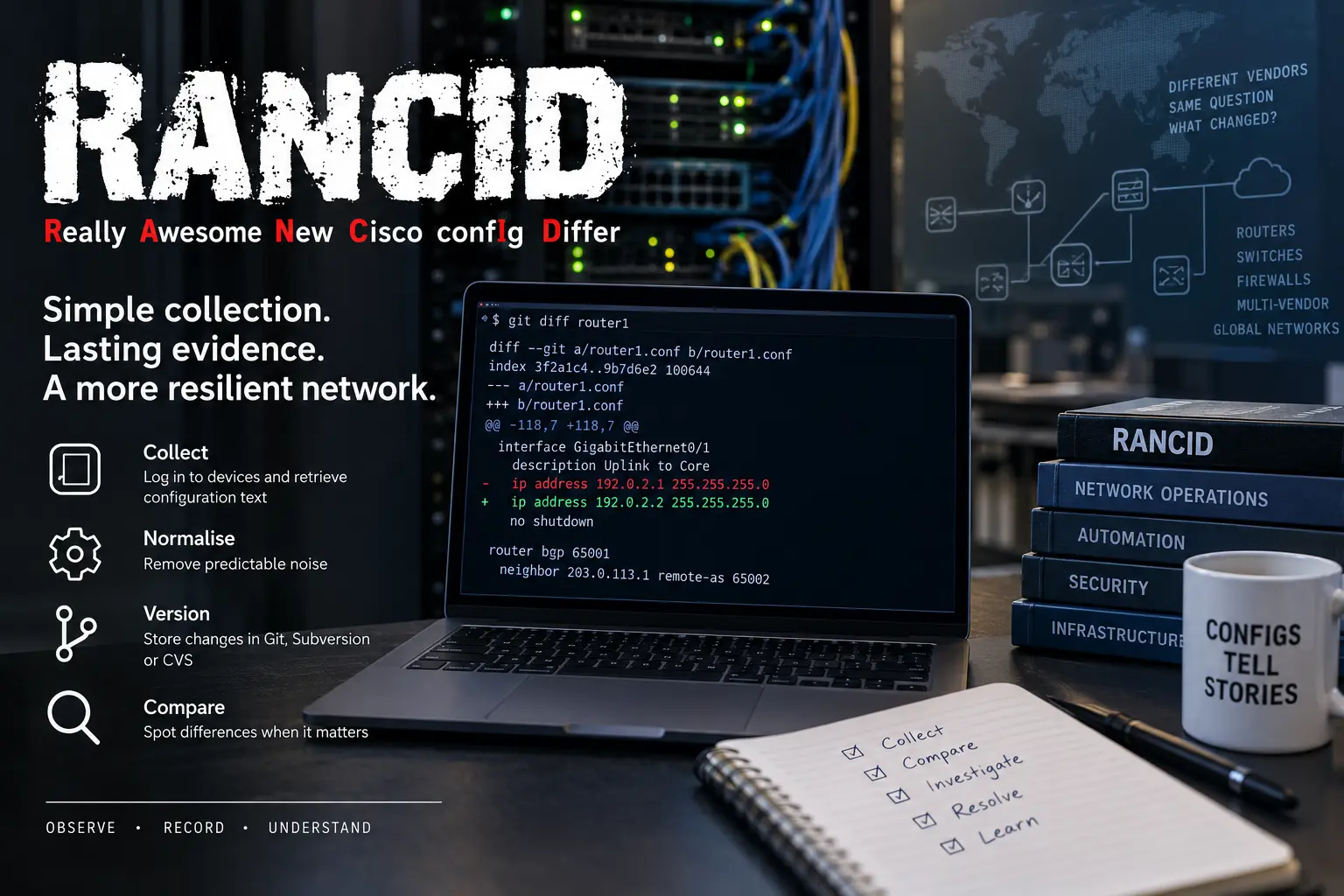
RANCID and the enduring value of a one-line network diff
RANCID preserves a form of evidence that large management platforms can easily blur: configuration text reported by a device at a particular moment, and the difference from the previous observation. It does not represent the full intent model, every event or causality. That…

Creators
Jeff Bonwick and the architecture of making failure visible
Jeff Bonwick’s career connects two problems that usually appear unrelated: how an operating-system kernel allocates small entities at high speed, and how a storage system decides whether the bytes it reads are still the bytes an application wrote. From the slab allocator and…
Global Institutional
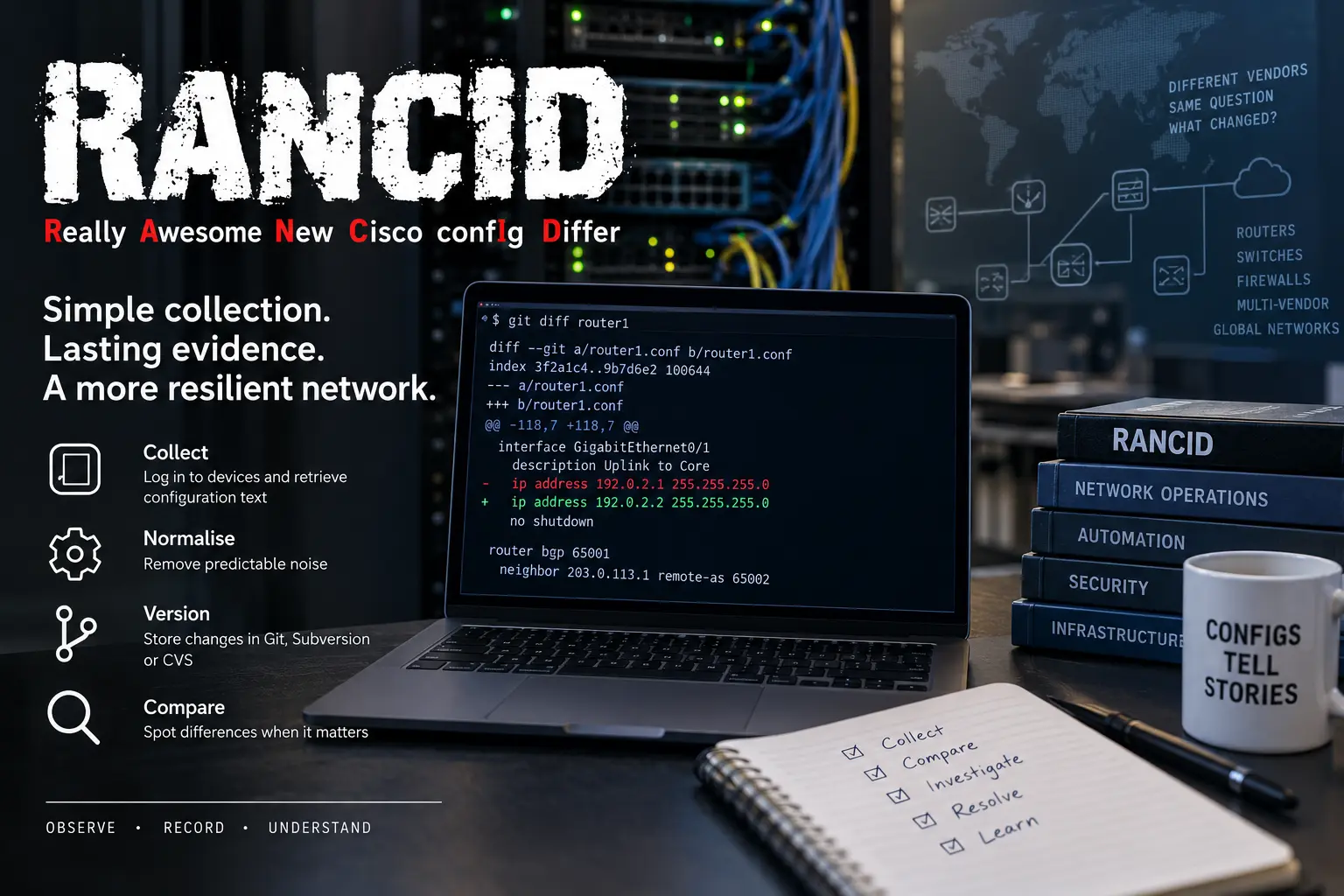
RANCID and the enduring value of a one-line network diff
RANCID has survived successive eras of network management by doing one narrow job: logging into devices, collecting selected configuration text, removing predictable noise and committing the result to version control. It does not model intent, approve changes or reconstruct every…

History
Rob Pike and the 9P Walk That Opened Nothing
A client walks a name in 9P and receives every qid it expected. The path has resolved, yet no file has been opened and no byte has moved. The distinction at the heart of Rob Pike’s naming work is useful far beyond Plan 9: a protocol receipt is strongest when it is allowed to…

CASE FILE
RFC 9919's SHA-1 Count Is Not a Retirement Receipt
RFC 9919 gives OCSP operators a useful migration signal: log the hash algorithm used by clients. It does not turn a falling counter at one responder into proof that every relying party has left SHA-1 behind.

Story
LACNIC Approved the Security Framework Before Measuring the Baseline. The Next Control Is a Versioned Maturity Receipt
The May board record exposes a useful sequence: authorize the framework, have outside experts measure the current state, and only then choose the destination. That order is not evidence of a security failure. It is a reason to keep approval, implementation, target-setting…

History
The Page Had One Character Universe, Whatever Bytes Carried It: RFC 2070
Two HTML files could carry different octets and still present the parser with the same character. RFC 2070 made that result architectural rather than accidental: `charset` selected the decoder for the concrete resource, while HTML kept one abstract UCS document character set.…

IETF
Marshall T. Rose and the SNMP SetRequest That Changed Every Variable or None
A maintenance console sends one SNMP SetRequest containing several variable bindings. The agent answers `noError`. That is a useful receipt—but only for a deliberately narrow claim. The early SNMP design associated with Marshall T. Rose’s working-group leadership helps show why a…

Story
Rapport Counts Outcomes Only After a Requested Test Path Exists
LACNIC’s revised Rapport runner can expand several category and test selectors into a matrix. Yet a requested cell with no matching directory leaves no row in the result: it returns before a test identity is printed or any outcome counter moves.

History
The Password Left the Wire. Its Equivalent Stayed in the File: RFC 2069
“We do not store passwords,” an administrator might have said in 1997. “We store only their digests.” RFC 2069 made the first half of that reassurance meaningful on the network: a client could prove knowledge of a password without sending it in cleartext. It also made the second…

IETF
EVPN Can Select One Multicast Source. It Cannot Certify Redundancy.
A receiver may show one clean programme while two contribution sources are transmitting. RFC 9856 explains how an EVPN can suppress the extra copy. It does not establish that the surviving source was healthy, equivalent, or switched without loss. Those are separate operational…

Story
APNIC’s Two-Nameserver Run Had Fewer Repeats. The Difference Still Needs a Reproduction Receipt
APNIC measured fewer authoritative DNS queries in a later run using two nameservers than in an earlier run using one. The observation is real in the published aggregates; the cause is not settled. A reproducible decision needs the two treatments to share a clock, cohort and…

History
Ned Freed and the Filename That Had to Be Reassembled Before It Could Be Distrusted
RFC 2231 let a long internationalised MIME parameter travel as numbered pieces. A receiver has to reconstruct the pieces in order before decoding them—but a valid result is still content-disposition metadata, not a safe pathname, an identity claim or permission to act.

History
The Version Number Promised the Next Message, Not This One: RFC 2068
In January 1997, an HTTP message that began with `HTTP/1.1` was making a carefully bounded promise. The label described the sender’s message format and the highest HTTP capability it could support in further communication. It did not say which HTTP/1.1 features this particular…

IETF
The Reply Crossed Three Domains. The Proof Did Not
RFC 9716 gives an SR-MPLS echo reply a route home when ordinary IP reachability ends at a domain boundary. Its label stack can be supplied in advance or assembled border by border. That makes inter-domain diagnosis practical; it does not turn one returned echo into proof that the…

History
RFC 2067: The Standard Deleted Three Legal Packet Shapes
In 1997, Internet engineers advanced IP over HIPPI by making the specification smaller. Three packet forms allowed by RFC 1374 disappeared: a short burst could no longer come first, the D1 area could no longer contain fill, and the D2 offset could no longer be nonzero. RFC 2067…

IETF
A DTLS Return-Routability Probe Is Not a Migration Receipt
A protected datagram arrives with the right Connection ID and a new source address. The cryptography can locate an existing DTLS security context, yet the receiver still has a separate decision to make: whether to move that context, release application output to the new address…

History
Ward Christensen and the 128-Byte Agreement That Left the Ends Free
XMODEM became useful by declining to become a platform. Ward Christensen put a small, deterministic agreement on the line, then left almost every other decision—dialling, storage, filenames, interface and improvement—to the computers and people at either end.

Story
AFRINIC’s Holiday Notice Appeared One Day Before Closure. That Is Not a 72-Hour Verdict
AFRINIC’s public record shows a 14 September notice for a 15 September office closure. Its service commitment speaks of seventy-two hours, but on a different channel: announcement mail. The right audit separates the website, the mail record, human response time and always-on…

IETF
The Orbit Said the Link Was Ready. The Network Had Not Agreed
RFC 9717 turns orbital predictability into a routing advantage without confusing a forecast with an observation. Its proposed satellite architecture can prepare for scheduled change, but a schedule, a computed SID list and even a successful install receipt remain different claims…