
Intelligence
Latest Articles
Latest intelligence on infrastructure operators, policy decisions, market moves, and digital power shifts.

Africa Institutional
UbuntuNet’s 10 Gbps Core Network Constrained by Campus Endpoints
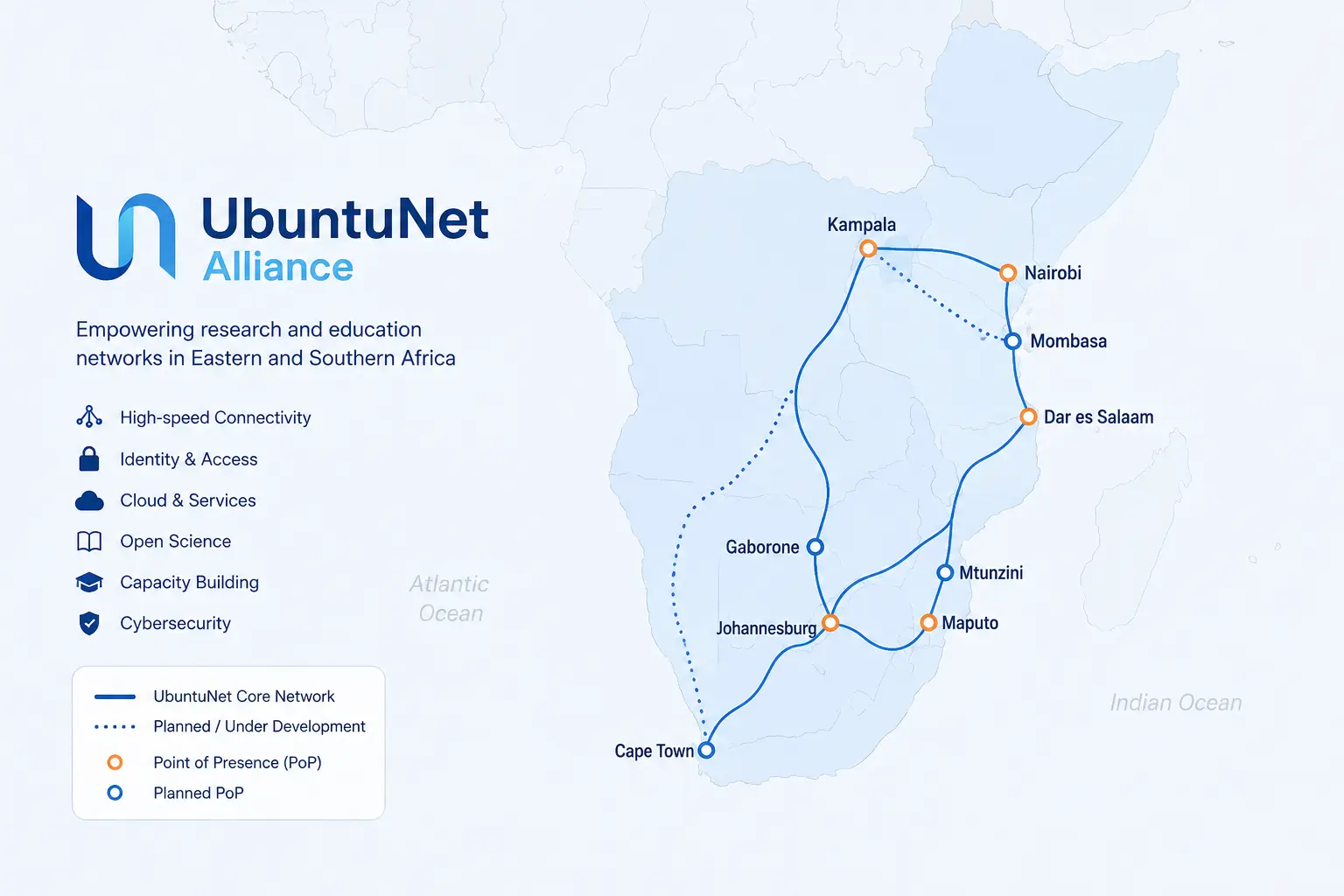
UbuntuNet’s 2023 report says core links were upgraded from around 2.5 Gbps to 10 Gbps, and new points of presence plus peering were added. Translating this regional upgrade into research capacity, however, depends on national research networks, campus systems, commercial…
Africa Institutional
UbuntuNet’s 10 Gbps core still depends on the campus edge
UbuntuNet’s 2023 report described core links upgraded from about 2.5 to 10 Gbps, along with new points of presence and peering. This regional gain only reaches researchers when national networks, campus systems, operators and recurrent funding can sustain it after each…

Asia-Pacific Regional ISP Trends
PXNET and the Records Behind Network Operations
PXNET appears in public records through more than one network identifier and through several evidence systems that answer different operational questions. Read carefully, those records show how registry entries, operator-maintained directories, observed routing and origin…

Story
When a removal did not end a term: AFRINIC's 2013 director-record puzzle
In February 2013, AFRINIC recorded the consented removal of two directors. Yet its later records continued to place them in governance roles and eventually said that both completed their terms in June 2015. The puzzle is not a licence to invent a dispute. It is a case study in…

Story
Three names, two elections and one corporate register
In February 2013, AFRINIC placed three directors into a single resolution. The sentence looks complete until it is compared with the elections that preceded it and the corporate records that should follow it. That comparison turns a short appointment notice into a test of whether…

Story
The Treasury Policy AFRINIC Approved but Did Not Show
In February 2013, AFRINIC’s Board approved investment policies and guidelines submitted by the Secretariat. The surviving resolution proves that the organisation created a treasury-governance instrument, but it does not disclose a single operative rule. That gap matters because…

Story
The Office at the Bank: What AFRINIC’s 2013 COO Signatory Resolution Actually Changed
In April 2013, AFRINIC’s Board placed the Chief Operating Officer inside the organisation’s bank-execution perimeter. The decision was concrete but narrower than a casual reading might suggest: it changed an internal delegation for a member-funded private coordinator, while the…

Story
When “Remove” Does Not Mean Punish: AFRINIC’s 2013 Padayatchy Resolution
Resolution 201302.164 used a hard corporate verb—“remove”—while recording both the written approval of all present registered directors and Viv Padayatchy’s own written consent. Read at its proper scale, that combination describes a bounded transition in a private-company office…

Europe and Middle East Regional ISP Trends
INTERBIT and the Boundaries of Network Identity
A company name can appear to offer a simple answer to a network question. In practice, the identity behind an Internet service is distributed across legal records, number-resource registries, declared routing policy, observed routes, service descriptions and the equipment that…

Europe and Middle East Regional ISP Trends
Florian Obser and the Incremental Rebuild of OpenBSD Network Configuration
When a broad plan for one network-configuration service proved too ambitious, Florian Obser helped turn the unfinished idea into smaller working parts. The result was not a clean victory over complexity. It was a sequence of bounded changes, explicit trade-offs, and…

Story
The Small Surplus That Made AFRINIC’s 2013 Budget Testable
Resolution 201301.161 occupies a single line in AFRINIC’s public Board register, yet the budget it approved did something consequential: it exposed a private technical coordinator’s expectations about membership growth, fee income, operating costs, infrastructure renewal and…

Story
The Constitution That Started Before Its Paper Trail Ended
At the turn of 1 January 2013, AFRINIC said a new constitution had become operative. The 48-page text mapped membership, elections, meetings, fees, Board authority and an orderly transition to a new nine-seat structure. What the surviving public record does not map with equal…

Story
The USD 64,327 question on AFRINIC’s 2012 infrastructure page
Printed page 30 of AFRINIC’s 2012 annual report asks a reader to hold two infrastructure figures at once. Its narrative says approximately USD 309,000 was spent on infrastructure during the year, while a table on the same page reports USD 244,673 as “Reinvestment in…

Story
What AFRINIC’s 2012 Cost Jump Proves—and What It Does Not
AFRINIC’s reported operating expenses climbed by nearly a third in one year, with staffing the largest visible driver. The arithmetic is clear; the public chain connecting the approved budget, recorded categories, individual commitments and accepted results is not.

Story
AFRINIC’s first reported deficit: the accounts reconcile, the control bridge does not
USD 2,636,032 of membership-fee income plus USD 121,931 of grants, less USD 3,161,186 of operating expenses, plus USD 140,132 of reported other and finance income, equals a deficit of USD 263,091. AFRINIC’s 2012 figures make that result unusually easy to reproduce. What they do…

North America Datacenter Trends
Riot signed the 191 MW lease; Anthropic’s name comes from reporting
Riot Platforms has disclosed a 20-year Rockdale lease with an unnamed frontier AI lab. Independent reporting identifies Anthropic as the tenant. Keeping those evidence layers separate is essential, as is distinguishing $9.1 billion of expected contract revenue from capacity that…

Latin America and Caribbean National Telecom Trends
Google’s Americas Connect makes the Dominican Republic a network hinge
Google has announced three subsea systems and a new Firmina branch across the Americas. The map gives the Dominican Republic an unusually central role, but the resilience claim will remain prospective until separate routes are built, lit and tested under failure.

North America National Telecom Trends
Grain owns T-Mobile’s 800 MHz map; the access model comes next
The nationwide low-band portfolio has completed its transfer from T-Mobile US to Grain Management for $2.9 billion in cash plus Grain’s 600 MHz licences. Ownership is now settled. Whether the spectrum becomes a shared infrastructure layer, a set of private networks or something…

Asia-Pacific National Telecom Trends
Lightstorm has financed I-2SEA’s next step, not its arrival in 2029
Lightstorm has secured a Rs25 billion debt facility led by IndusInd Bank for the I-2SEA cable between India, Malaysia and Singapore. The financing advances a project announced in July, but without loan terms, drawdown evidence or marine progress it remains one gate in a long path…

Asia-Pacific National Telecom Trends
Sony and TSMC have bound the sensor venture, not started its 2029 output
Sony Semiconductor Solutions and TSMC have replaced a May memorandum with a legally binding agreement for Advanced Vision Semiconductor Manufacturing Corporation in Kumamoto. The deal allocates control, design, process expertise and JPY747 billion of planned cash and assets—but…