
Summary
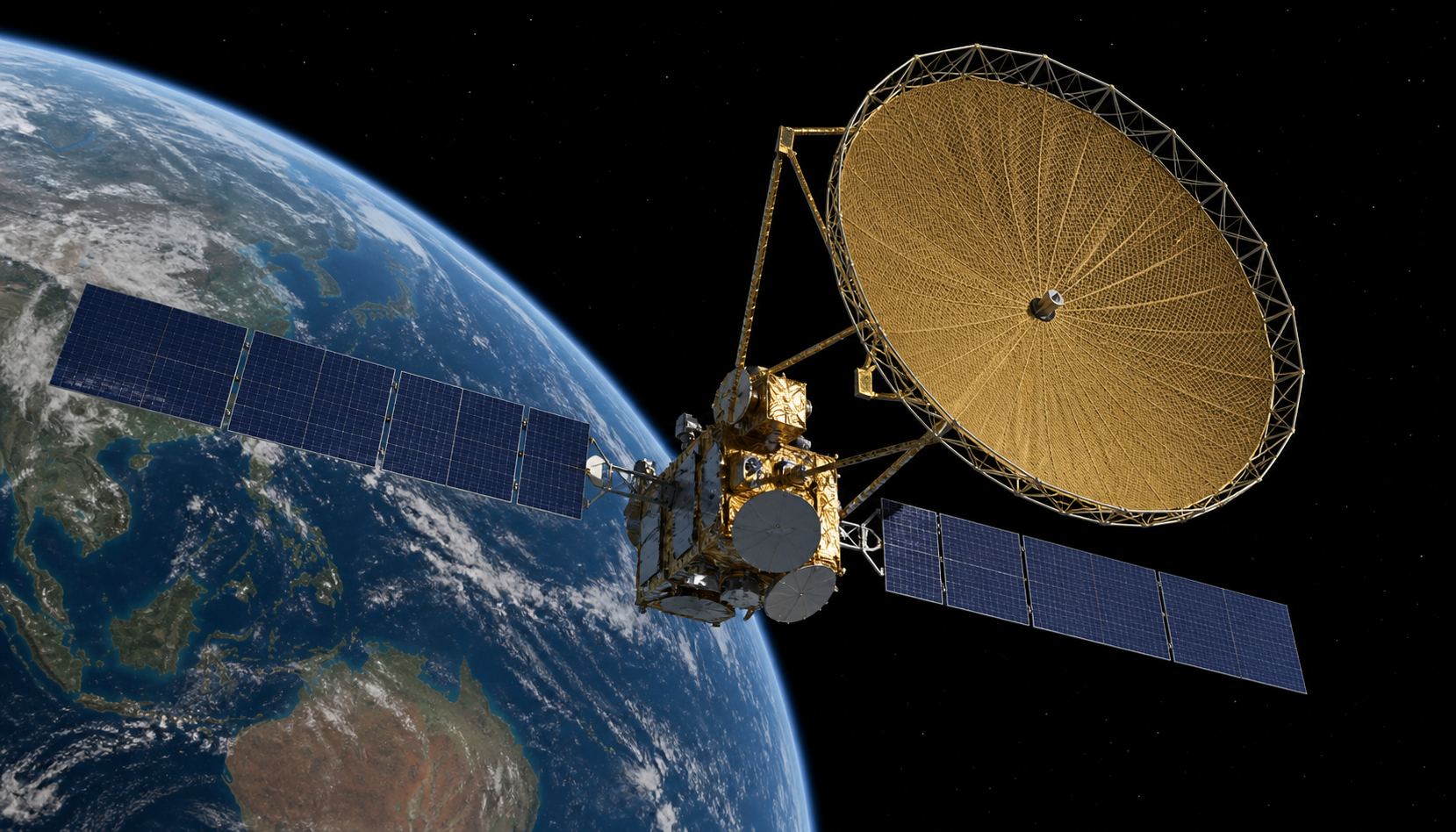
- L3Harris confirmed successful deployment of its first perimeter truss reflector aboard the ViaSat-3 Flight 3 satellite on 4 August 2026.
- ViaSat-3 F3 launched on 29 April, acquired an initial signal and is intended to serve the Asia-Pacific region.
- Viasat described reflector deployment as a final-deployment step that precedes in-orbit testing and network integration.
- At launch, Viasat said F3 was designed to deliver 1 Tbps of capacity and anticipated service entry in late summer.
- L3Harris said this reflector was 30% more compact than the industry-standard perimeter-truss design while retaining the surface precision needed to focus signals.
- The sources disclosed no deployed diameter, telemetry, measured throughput, service-acceptance date, customer traffic or contract value for this reflector.
A deployment is a binary mechanical transition
A large mesh reflector must survive launch in a compact state and then unfold to its intended geometry. The 4 August confirmation closes that particular risk state: the structure deployed. The result is more concrete than a design promise because the hardware is in orbit and has changed configuration.
It does not close every mission risk. The public report provides no deployment telemetry, dimensional measurement or radio-frequency test result. “Successful” is the supplier’s conclusion, reported by Via Satellite, and should remain attached to the deployment event rather than expanded into a claim about end-to-end service.
Compactness has value only when geometry holds
L3Harris says this reflector is 30% more compact than an industry-standard perimeter-truss reflector while maintaining surface precision. Compact stowage can reduce pressure on launch-envelope design and allow a large aperture to travel in limited spacecraft volume. But the public comparison does not identify its reference design or quantify saved mass, volume or cost.
The second half of the claim is the operational hinge. A mesh surface must take and maintain a sufficiently accurate shape to focus signals. Deployment establishes that the structure opened; later testing must establish how the antenna performs. Neither the percentage nor the product page supplies measured gain for F3.
The satellite has not yet crossed the network gate
Viasat’s sequence is explicit: after launch and initial acquisition, final deployments occur, then in-orbit testing and network integration. Each stage changes who can observe and control the system. Mechanical hardware can be deployed while payload testing, beam configuration, gateways and operational integration remain incomplete.
This is why the milestone should not be described as commercial launch. Viasat anticipated entry into service in late summer, but the date is a schedule statement. No service-acceptance notice, customer-traffic measurement or country-level availability appeared in the sources.
One terabit is a design ceiling, not carried traffic
At launch, Viasat described F3 as designed to deliver 1 Tbps. That figure says something about intended system scale. It does not show usable throughput after overhead, beam allocation, gateway constraints, regulation, weather or customer demand. Nor does it isolate the capacity contribution of the L3Harris reflector.
Capacity becomes economic only when it can be placed where demand exists, connected to the ground network, sold and used. A satellite may have high designed capacity while service ramps over time. The next evidence therefore belongs to testing and traffic, not another repetition of the design number.
Asia-Pacific is a destination, not a service map
F3 is intended to be positioned for Asia-Pacific, extending Viasat’s three-satellite geostationary programme. The region label indicates strategic direction but does not specify countries, landing rights, gateways, tariffs or available products. Those decisions involve Viasat, regulators, partners and customer contracts—not L3Harris alone.
The reflector supplier influences signal performance through the antenna system. It does not operate the satellite network or control every commercial dependency. Preserving that boundary makes responsibility legible if service timing later changes.
The first unit creates a reference, not a guarantee
For L3Harris, an on-orbit deployment of its first perimeter-truss unit is a reference event. It can reduce perceived technical risk for future buyers and demonstrate that the compact architecture survived a real mission sequence. The commercial value will depend on repeat orders, test performance and whether compactness improves spacecraft economics.
One successful deployment cannot guarantee identical results on later missions. Manufacturing repeatability, integration and different spacecraft environments remain separate questions. A reference becomes a platform only when it produces reproducible mission outcomes.
Control passes from hardware deployment to verification
Before deployment, the key control was mechanical release and unfolding. After it, responsibility shifts toward antenna characterization, payload testing, orbit and beam configuration, ground integration and service acceptance. The most useful next disclosures would name those state changes rather than merely repeat that the satellite is “progressing.”
This sequence also clarifies failure analysis. If commercial entry moves, the cause cannot automatically be assigned to the reflector. The delayed boundary could lie in any later stage. Evidence must follow the state machine.
Sources
Member Briefing
Deeper Profile Context
Sign in with the right membership level to unlock the full briefing and source notes.
Only for Strategic Circle
Strategic Circle
Open to all readers. Unlock profile briefings after joining and signing in.
Join Strategic CircleOnly for Leadership Alliance
Leadership Alliance
For qualified IP-asset owners and management; sign in to unlock alliance briefings.
Join Leadership Alliance