
Summary
- RFC 1313 describes a San Francisco Bay Area station, Internet Society sponsorship, next-day FTP transcripts and listening through VAT; those claims come from the memo itself.
- The published RFC proves that an informational document entered the archive. It does not independently prove that KRFC broadcast, that its guests appeared or that its listed services worked.
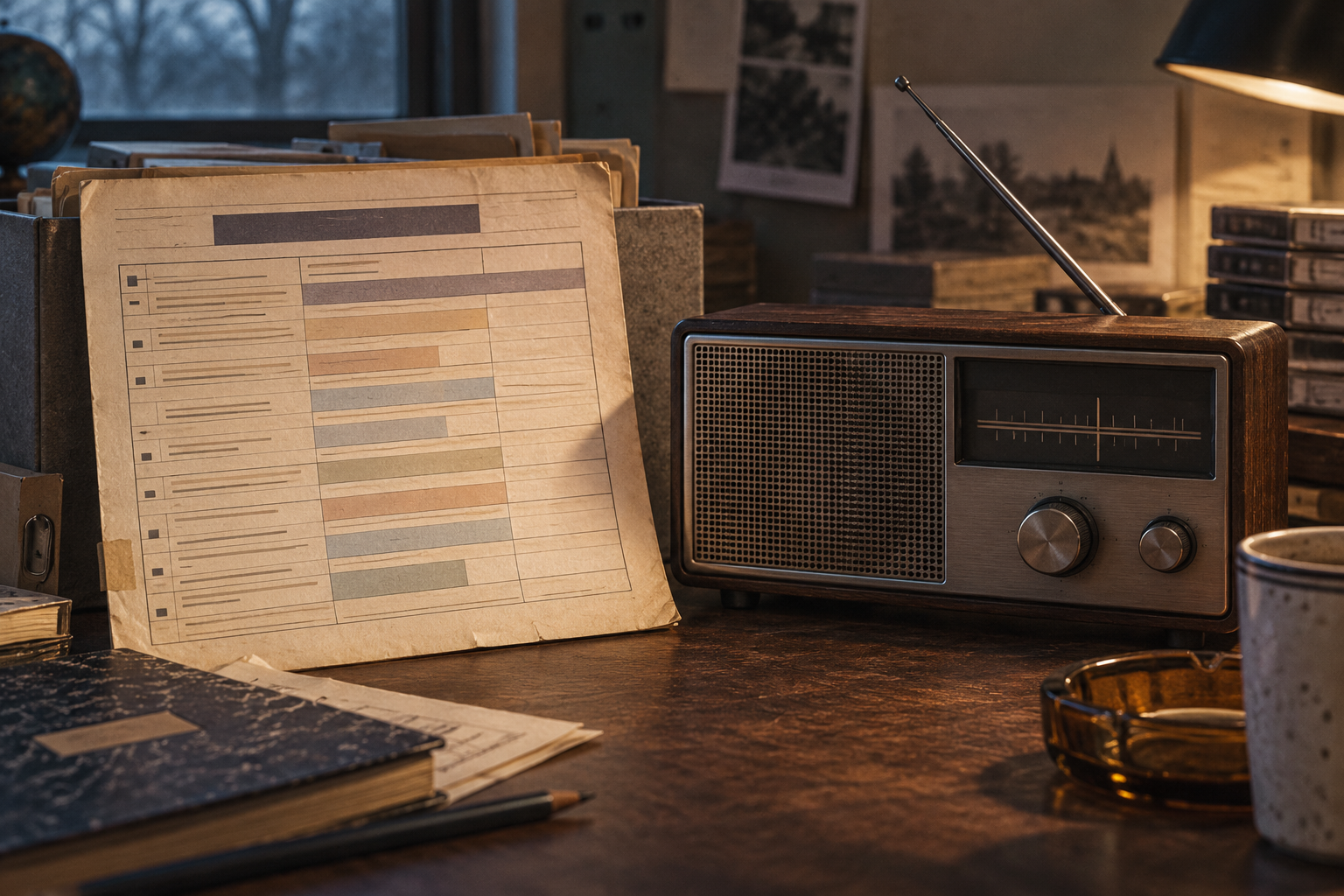
The schedule gives the Internet an AM dial. RFC 1313, dated 1 April 1992, welcomes readers to “KRFC Internet Talk Radio” and promises a full day of networking news, interviews and commentary. Its imaginary lineup moves from a midnight discussion of Doppler correction aboard Concorde to a hot-tub debugging show, a lunch with Vint Cerf, and an evening “Protocol Police.” The jokes are not incidental decoration: they turn familiar arguments about routing, commercial networks, security and standards meetings into radio programming.
The memo even sketches distribution. It says KRFC serves the San Francisco Bay Area, is sponsored by the Internet Society, offers outsiders anonymous FTP transcripts the day after each program, and can be heard via VAT. Read literally, that is a small media architecture: local broadcast, delayed text archive and network audio. But the source for each claim is the same playful memo. It supplies no transmission log, recording, independent transcript, station licence or second account confirming a show took place.
The document also carries its own warning signs. Its first page is dated 1 April 1992; the running headers on pages two and three say 1 April 1991. The title calls the station “AM 1313,” while those later headers call it “AM 13XX.” The schedule includes impossible or deliberately exaggerated premises and promotional asides. These cues support reading the text as satire, but the date mismatch alone cannot tell us whether a line is a joke or an editorial mistake.
Form matters, too. RFC 1313 uses the RFC series' formal numbering and archival presentation, yet it calls itself informational and says it does not specify an Internet standard. The contemporary IAB catalog RFC 1360 likewise places it among information documents. A durable publication record can establish who wrote a memo, what the memo said and when the record assigns it a date. It cannot silently upgrade every statement inside the memo into an independently witnessed event.
That distinction is the real artifact. The RFC records a community able to imagine its technical life as a broadcast schedule—and to joke about the people, institutions and disputes that filled it. It does not give us a verified station history. “KRFC broadcast this program” would require evidence beyond the schedule; “RFC 1313 described this program” is what the archive can support.
Sources: RFC 1313; RFC Editor record for RFC 1313; RFC 1360; RFC 1399.
Member Briefing
Deeper Profile Context
Sign in with the right membership level to unlock the full briefing and source notes.
Only for Strategic Circle
Strategic Circle
Open to all readers. Unlock profile briefings after joining and signing in.
Join Strategic CircleOnly for Leadership Alliance
Leadership Alliance
For qualified IP-asset owners and management; sign in to unlock alliance briefings.
Join Leadership Alliance