
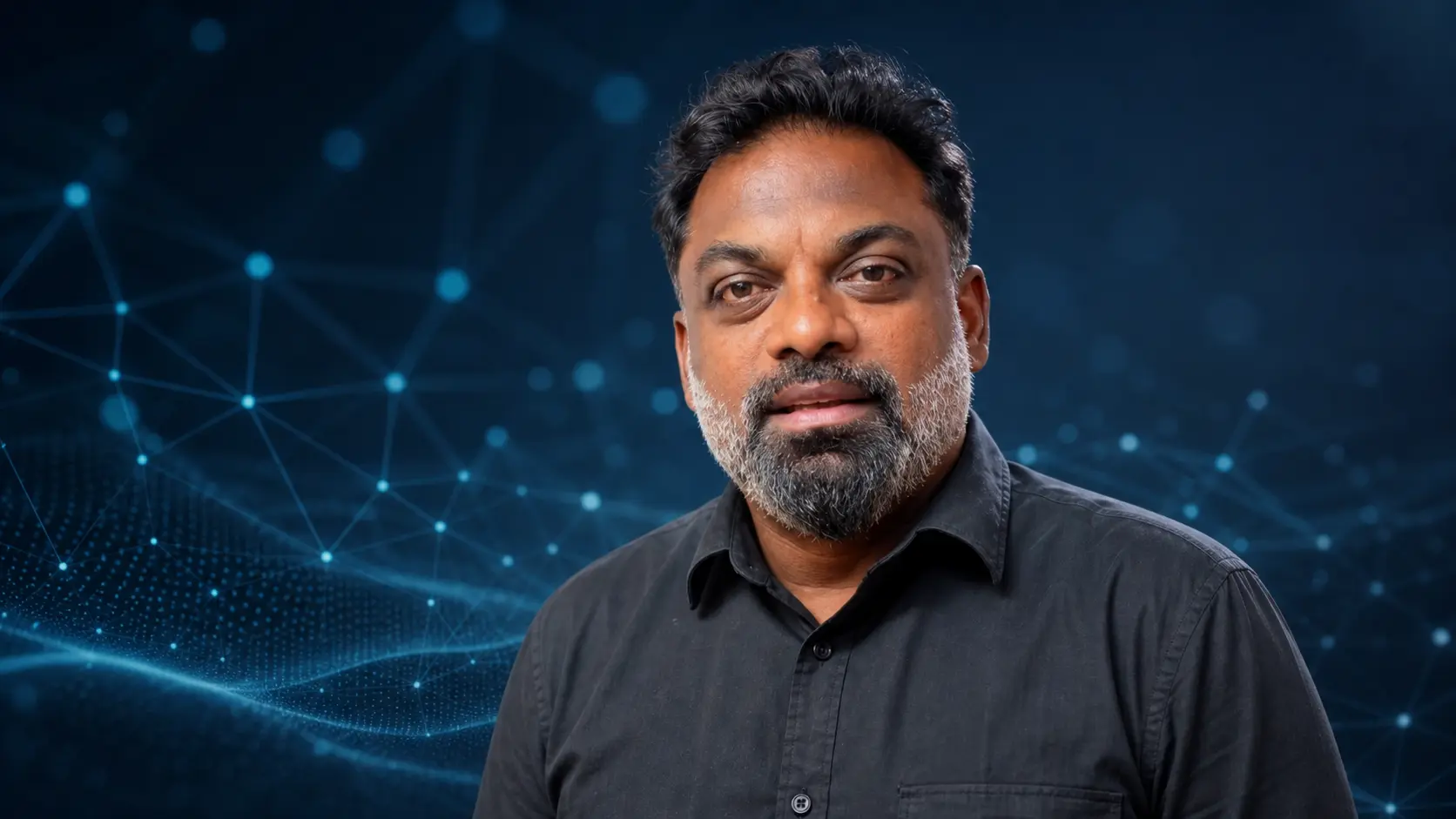
Summary
- Karthick Thangavel argues that regional ISPs cannot obtain useful operational intelligence merely by adding AI to fragmented OLT, switching, CRM, GIS, inventory, field-work and monitoring systems.
- The decisive control surface is the shared operational model: who records passive fibre, who updates field changes, how customer impact is linked to network events, and which human remains accountable for acting on an automated recommendation.
When every dashboard is green
A broadband customer can lose service while the operator’s active devices still appear healthy. The OLT is reachable. The uplink is carrying traffic. The core has no obvious alarm. Yet a damaged drop cable, an undocumented splitter change or a bad splice can still leave one household offline. The network is not lying. It is reporting only the layer it can see.
That is the most useful opening into Karthick Thangavel’s public discussion of regional ISP operations. On his public professional profile, he describes the operating stack as a collection of systems that may include equipment from several vendors, a CRM, GIS, inventory records, field coordination and multiple network-management platforms. His argument is not that AI lacks analytical power. It is that analysis begins too late when the underlying operational objects do not share an identity.
An alarm may know an ONU serial number. The CRM knows a subscriber account. The GIS knows a route drawn months ago. A technician knows that the cable was diverted around a road project. The billing system knows whether the account is current. Unless those facts meet around the same service and physical path, automation can correlate activity without explaining the outage.
A public voice from inside the ISP workflow
Karthick’s public profile identifies him with Klick AI and describes more than two decades of telecom and ISP experience. The organisation-controlled Klick AI page lists him among its employees and presents the service as an FTTH intelligence platform powered by Nach Innovatives Pvt Ltd. Those pages establish a current public association and a point of view. They do not, on their own, prove product performance or customer outcomes.
That evidence boundary matters. Vendor and founder-adjacent commentary is often most valuable as a map of the problem being sold against. It shows which friction the operator believes buyers recognise. Klick AI’s public material repeatedly distinguishes active equipment from the passive FTTH layer: routes, field dependencies and the physical changes that do not naturally appear in a device dashboard. It associates that gap with repeat visits, slower incident handling and higher operating expense. Those are company claims, not audited results, but the underlying control question is concrete.
Who owns the record when a field repair changes the network that software thinks it is monitoring?
Fibre growth raises the price of weak operational memory
India’s broadband scale makes the question more than a small-operator software problem. The Telecom Regulatory Authority of India reported 46.51 million fixed wired broadband subscriptions at the end of March 2026. Each connection is a commercial relationship, but it is also a physical chain of ports, fibre segments, splitters, drops, power conditions and repair obligations.
The official BharatNet programme makes the same operational complexity visible from a public-infrastructure direction. It describes optical-fibre deployment with service-level operations and maintenance, and its published operational material points to NOC, NMS or OSS, ticketing and billing systems as sources used for service decisions. The programme is not evidence of a Klick AI deployment. It is evidence that large fibre systems already depend on several kinds of record to describe one service obligation.
Scale magnifies the cost of disagreement between those records. A wrong route in GIS can send a crew to the wrong place. A field repair that never updates inventory can make the next failure harder to isolate. A customer ticket that cannot be tied to a shared physical segment hides the fact that several apparently separate complaints have one cause. A model trained on those fragments may become faster at producing the wrong answer.
Active telemetry is not passive truth
Network operators are accustomed to treating active telemetry as authoritative because it is machine-generated and current. Interface counters, optical levels and device reachability are indispensable. But passive infrastructure has a different evidence rhythm. It changes when somebody opens a closure, moves a patch, replaces a drop or discovers that the route on paper was never the route in the ground.
This creates an asymmetry. The active layer reports continuously. The passive layer often reports only when a person remembers to record work. Automation therefore starts with a structural bias toward what emits data easily. It can overvalue the clean device record and undervalue the messy field observation, even when the field observation explains the customer’s experience.
Karthick’s public framing is strongest when read as an argument about that asymmetry. Connecting systems is not primarily a dashboard project. It is a decision about which facts are allowed to revise the operator’s model of reality.
One service needs one trail of evidence
The practical unit of operational intelligence is not the dashboard and not even the device. It is the service promise made to a customer. For that promise to be investigated, an operator needs to move in both directions: from a complaint to the serving equipment and physical path, and from a damaged segment to the customers and commitments exposed by it. Neither direction is reliable if the systems have only approximate ways of recognising the same thing.
That is why a common identifier is more consequential than an additional visualisation. An ONU serial number, a customer account, a splitter port, a cable segment, a work order and a ticket can all be accurate inside their own databases while remaining impossible to join decisively. Names change, street descriptions vary, equipment is replaced, and a technician may describe a site in terms that make perfect sense locally but are not a stable key elsewhere. The resulting reconciliation work is often hidden in calls, spreadsheets and personal memory. It becomes visible only when the person who knows the exception is unavailable.
The immediate temptation is to ask an AI system to infer the missing joins. That can be useful as a hypothesis generator. It should not silently become the source of record. A model can rank plausible correlations between an optical alarm, a cluster of tickets and a recent work order. It cannot turn a plausible relation into a confirmed route change without a record of who verified it, what was observed and how the authoritative inventory changed afterwards.
This is a distinction between assistance and substitution. Assistance says: these events may share a cause; send a person the evidence. Substitution says: the system has constructed enough confidence to alter the operational memory without a traceable confirmation. The first can reduce search time. The second can compound an old inventory error into a new automated instruction.
For a regional operator, the better test is not whether every system is merged at once. It is whether the next incident can leave a stronger evidence trail than the last. A repair should create a durable relationship among the customer impact, physical element, field observation and closing decision. When that trail is repeatable, analytics becomes more useful with each cycle. When it is not, the operator is merely accumulating more systems that disagree faster.
The cost of a map that is almost right
Passive-fibre records are often treated as an administrative asset: necessary for planning and audit, but secondary to real-time network control. The operating reality is less forgiving. A fibre map that is mostly right can be more dangerous than one explicitly known to be incomplete because it creates unjustified confidence in the first dispatch, the first customer message and the first decision to close an incident.
Consider the sequence after a cluster of faults. The active network may report normal reachability upstream. The ticketing system may show several customers in a neighbourhood. A route record may point to a likely splitter or feeder. If that route is stale, the crew can spend a morning testing the wrong enclosure while affected customers receive a status message built on the same wrong hypothesis. By the time the true physical dependency is found, the delay has become a commercial and reputational cost as well as a technical one.
The point is not that every field map can be perfectly current. Physical networks are modified under pressure, and the best available description may legitimately carry uncertainty. The important control is to represent that uncertainty rather than hiding it. A system should distinguish a surveyed path from a legacy drawing, a confirmed post-repair record from a technician note awaiting reconciliation, and a model-inferred relation from a verified connection. Those are different kinds of evidence; flattening them into one clean-looking map removes the information that a dispatcher needs most.
Klick AI’s public positioning makes this passive-layer visibility central to its case. That is an attributed product framing, not proof that any operator has achieved the proposed outcomes. But the framing identifies a real design question for any operator considering intelligence tooling: does the product preserve source, time and confidence for the relationships it presents, or does it turn conflicting records into an attractive but unverifiable answer?
The distinction matters especially when management sees a map as an executive control surface. A single red line can prompt a capital decision, a contractor escalation or a promise to customers. Leaders need to know whether that line is a live measurement, a manually maintained inventory claim, a technician observation or a calculated estimate. Requiring that provenance is not bureaucratic caution. It is what makes a later error diagnosable rather than political.
Field capture is a product decision
It is easy to describe the technician as the final mile of an information system. The harder question is whether the tools and incentives make good information capture possible during real work. A field engineer may be operating in heat, rain, traffic, poor signal coverage or a customer’s premises, with another appointment waiting. A form designed in an office can turn a two-minute confirmation into a twenty-minute burden. When that happens, people predictably preserve service first and defer the record, or they adopt a shorthand that satisfies the workflow without describing the network.
That is not an argument for abandoning controls. It is an argument for testing them where they are used. The most valuable field record is usually a small set of facts that changes the next decision: the element touched, the observed condition, the action, an image or measurement where appropriate, and an explicit confidence level. Every extra field must earn its place by changing dispatch, inventory, safety, billing or customer treatment. If it does not, it will compete with the repair itself.
There is also a managerial obligation to separate learning from punishment. If every correction to inventory is interpreted as evidence that a worker did something wrong, staff will hide discrepancies. If corrections are treated as normal maintenance of a living operational model, the network becomes more visible over time. This does not eliminate accountability for negligent work. It does mean that an operator should measure whether records become more accurate after an intervention, rather than rewarding only the speed at which a ticket disappears.
AI can support that process in narrow ways: suggesting likely equipment from a photograph, flagging conflicts between a work order and a route, or drafting a concise record from a spoken note for the technician to confirm. Each is useful only if the confirmation step is clear and the original observation remains available. A generated narrative that obscures what the technician actually saw may be more polished than a raw note but less safe as operational evidence.
Customer records are not a substitute for consent
The connection between network telemetry and customer records creates a second boundary. It can improve fault isolation when an operator sees that apparently separate complaints share a path or a power condition. It can also turn ordinary service data into a broad behavioural profile if the purpose, access and retention rules are left vague.
Good operational design keeps the purpose narrow. The question is whether a particular service obligation is at risk, not what a household is doing online. A customer account may supply contact preference, service plan, address and a history of operator interactions; it should not become a licence to infer attributes that are not necessary for network operations. The same restraint applies to models that prioritise outreach. A recommendation to contact a customer before a likely cancellation should be explainable through service evidence and subject to ordinary commercial and privacy controls, not through opaque scoring.
This is another reason an integrated model needs governance before it needs predictive sophistication. The more records a platform joins, the more it must separate operational necessity from convenience. Access should follow a role and a stated task. Retention should reflect the evidence purpose. Automated suggestions should leave an accountable human with enough context to reject them. These principles matter independently of the specific vendor or platform involved.
A procurement question disguised as an AI question
Operators often meet this problem in a procurement meeting: should they buy an AI capability, a GIS upgrade, a field-service tool, an inventory system or an integration layer? The wrong answer is to treat those as interchangeable products. They operate on different failure modes.
An integration layer can make records exchangeable without resolving which record wins when they disagree. An inventory system can establish a canonical model without making field capture practical. A field-service tool can improve work-order discipline without connecting customer impact to physical topology. An AI layer can identify patterns without possessing the authority to correct the objects on which its recommendations depend. Each purchase can be justified, but the sequencing determines whether it creates a durable operating capability or a new presentation surface over old uncertainty.
Karthick’s public argument points to a simple procurement discipline: ask every vendor to demonstrate the chain from a device event to a physical route, to an affected service, to a field action and back to the corrected source record. Ask which links are retrieved directly, which are inferred, which can be disputed, and who owns each correction. Ask how an operator can export its identifiers and evidence if the relationship ends. A vendor that cannot answer these questions may still offer useful tooling, but its role should be bounded accordingly.
The comparison should also be made against the cost of maintaining a common model. A platform licence is visible; field data governance, change control and integration ownership are recurring internal commitments. Treating the latter as free makes every software proposal appear more attractive than it is. Treating them as an investment in operational memory makes the trade-off clearer.
From correlation to a governed decision
The most important transition occurs after a model sees a pattern. A correlation between power levels, repeat tickets and recent field work may justify investigation. It should not automatically become a customer message, a crew redeployment or a capital request simply because a score crosses a threshold.
A governed decision has at least four parts. First, it identifies the evidence used and its freshness. Second, it states the recommended action and the scope of harm if it is wrong. Third, it gives a named role authority to accept, amend or reject the recommendation. Fourth, it records the outcome so the organisation can distinguish a good model from a good recovery by experienced staff. Without that loop, performance claims become difficult to audit and responsibility migrates quietly into the interface.
This is where the language of operational intelligence can become misleading. Intelligence is not a property of a data store or a model alone. It is a relationship among evidence, authority and feedback. A fast recommendation that no one can contest is not necessarily more intelligent than a slower, well-instrumented process. In infrastructure, the ability to reconstruct why a decision was made is often as valuable as the decision’s apparent speed.
For Karthick’s thesis, that is the deeper implication of linking active equipment, passive fibre, field work and customer records. The goal is not to make human judgement disappear into a unified screen. It is to give that judgement a shared, revisable record. That is a more modest promise than autonomous operations. It is also more likely to survive the next unexpected repair, vendor change or staff transition.
An incident should improve the next incident
An operator can test the maturity of its operational model by following one fault from first signal to final learning. The first signal may be a customer call, an optical reading, a social-media complaint, a field report or a cluster of apparently unrelated tickets. The exact entry point is less important than whether the investigation can create a coherent case without forcing every participant to rebuild the context from scratch.
At triage, the case needs a provisional scope. What is known about the affected service? Which observations are direct, and which are merely compatible with a common cause? At dispatch, it needs a way to tell the technician why the visit was selected and what physical evidence would confirm or disprove the working theory. During the repair, it needs a light but durable account of what was found. At closure, it needs to connect the restored condition to the relevant inventory, ticket and customer communication.
Finally, after the immediate pressure has passed, it needs a way to identify whether the first diagnosis was right, whether a repeated visit was avoidable, and whether the shared model became better or simply received another unverified note.
This lifecycle is not a call for a centralised command centre. Regional ISPs often operate with distributed teams, mixed suppliers and tools accumulated over years. A useful model can be federated if the key relations are stable: service to physical dependency, observation to source, work order to action, and decision to accountable role. What makes a system operationally coherent is not that all records sit in one database, but that a dispute about a service can be resolved without guessing which system is allowed to correct the others.
That perspective changes how leaders use automation. Instead of asking whether an AI assistant can resolve incidents, they can ask where it improves the evidence loop. Can it identify a likely shared segment without overstating confidence? Can it expose conflicting records before a crew is dispatched? Can it help turn a technician’s observed change into a reviewable update? Can it show a supervisor the difference between a recurring symptom and a recurring root cause? These are narrower questions than autonomous repair, but they produce measurable improvements without asking the model to assume authority it cannot justify.
Metrics can hide as much as they reveal
Operational measures are necessary, yet they can create perverse incentives when detached from the evidence chain. Mean time to close a ticket may fall because work is genuinely faster, because the scope of tickets changed, or because teams close them before the underlying fault is resolved. First-visit resolution may improve because dispatch is smarter, or because cases that look difficult are classified elsewhere. A model can optimise a metric and still make the customer experience worse if the metric is a thin proxy for the service obligation.
The right response is not to abandon measurement. It is to maintain a family of measures that test different parts of the workflow. A regional operator might track the proportion of field changes reconciled with inventory within a defined window, the rate at which a closed repair generates a related complaint, the time from first signal to an evidence-backed physical hypothesis, and the portion of automation recommendations that are accepted, amended or rejected by accountable staff. None of these metrics proves quality by itself. Together, they make it harder for an interface to manufacture the appearance of progress.
External claims require the same discipline. Klick AI describes a particular problem—poor visibility across active equipment, passive fibre and field dependencies—and associates it with operational consequences. The public materials available here do not independently establish that its software delivers a specified saving or service outcome. Treating that boundary seriously is not hostile to the company. It protects the distinction between a plausible mechanism, a vendor claim and a documented result. Readers should be able to see which is which.
The evidence standard matters for buyers as well. A useful case study would identify the baseline, the population of incidents, the definition of a repeat visit or outage, the time period, the role of the software, and any parallel changes in staffing or process. It would explain whether the platform observed the decision, recommended it, or executed it. Without that structure, comparative claims can make a product sound more deterministic than the operational environment allows.
Ownership cannot be inferred from a graph
The shared model that Karthick advocates is often described technically: ontology, topology, inventory, integration or data fabric. All of those terms can be helpful. None resolves the organisational question of who is permitted to declare a relation true. A GIS team may own planned routes. Network operations may own active-device configuration. A contractor may report field completion. Customer operations may own account status. Finance may own billing records. When those records conflict, a graph can display the conflict but cannot decide the accountable owner by itself.
That decision should be explicit before the model is used for consequential automation. Operators need a rule for which source is authoritative for each object, how a challenge is raised, how rapidly a verified correction propagates, and how historical versions are retained. They need an escalation path for the cases that cross departments: a route change that affects a customer promise, a field record that conflicts with installed-capacity planning, or a ticket pattern that suggests a common fault but lacks a confirmed physical cause.
This is also where portability becomes a practical concern. If the only usable representation of the network lives inside a vendor product, the operator may lose the ability to inspect, contest or migrate the model without paying a high price. A service contract should therefore address not only uptime and features, but export of identifiers, relationship history, field evidence and decision logs. The aim is not to forbid outside platforms. It is to ensure that the operator retains the memory needed to supervise them.
What a credible next proof would look like
The public record supports a precise thesis, not a final verdict on a company. Karthick’s own account identifies the fragmentation problem. Klick AI’s public material shows the product frame around active devices, passive routes and field dependencies. TRAI’s reported subscription total demonstrates the scale of fixed wired broadband in India at the end of March 2026. BharatNet’s public operational descriptions demonstrate that fibre systems depend on NOC, NMS or OSS, ticketing and billing records. Together, those facts make the governance question worth asking.
The next level of evidence would be more concrete. A named operator could show, with permission, how a particular incident moved through the records before and after a change in operational practice. A technical description could specify which relationships were measured, which were manually maintained, and which were model-inferred. An independent or customer-verifiable account could distinguish a better information model from a coincidental improvement in results. A field team could describe whether the capture workflow reduces duplicated effort or adds it.
And a governance record could show how recommendations are overridden when the physical world disagrees with the system.
Until that evidence exists, the disciplined conclusion remains modest. The value in Karthick Thangavel’s public argument is that it directs attention away from the spectacle of AI and toward the precondition of accountable intelligence: a network model whose uncertainty, ownership and field corrections are visible to the people who must keep service working.
The technician is part of the information system
Regional ISP economics are unusually sensitive to field labour. A second visit to the same customer is not merely an inconvenience. It consumes travel time, technician capacity, fuel and a slot that could have connected or repaired someone else. Yet a system designed only to measure ticket closure may reward the appearance of completion rather than the durability of the repair.
The operational model must therefore capture more than a timestamp. It needs the affected service, the physical element touched, the observed condition, the action taken and the confidence that the network record now matches the field. That is demanding work. If the interface is slow or the taxonomy does not fit real repairs, technicians will route around it through calls, messages or memory.
AI does not remove that incentive problem. It may intensify it by consuming incomplete records at scale. The practical leadership task is to make accurate field capture easier than informal workarounds and to show technicians that their updates prevent repeat labour rather than merely expanding surveillance.
Customer silence is an operational signal
Complaint volume is an incomplete measure of network quality. Ticket counts describe recorded contacts, not every period of degraded service or every decision a customer makes after it.
A customer may reboot equipment, tolerate intermittent loss or switch providers without giving the operator a clean incident record. If operational intelligence depends only on tickets, it sees the customers willing to complain and misses those who have stopped expecting a repair.
This is where the connection between passive network data and commercial records becomes important. Repeated optical fluctuations, reconnects, neighbourhood trouble and prior visits can form a pattern before a cancellation. But that pattern is valuable only if the operator has rules for who may act, what evidence justifies contact and how to avoid turning network monitoring into intrusive customer profiling.
AI changes the allocation of judgement
The phrase “AI for network operations” can hide several different products. One system may summarise alarms. Another may predict a fibre fault. Another may prioritise crews, draft customer messages or recommend capital work. Each step moves from observation toward authority.
That progression should be explicit. A system that groups alarms can be evaluated on correlation quality. A system that changes a crew queue also redistributes labour and customer waiting time. A system that recommends replacing infrastructure shapes capital allocation. The more consequential the action, the more important it becomes to preserve the evidence chain and a human path for challenge.
Karthick’s public emphasis on connecting operational systems points toward this governance requirement even when his posts use the language of visibility and intelligence. A unified model is powerful because it makes more decisions possible. It is risky for the same reason.
What the public record does not establish
The available sources do not prove that Klick AI has reduced outage duration, repeat visits, churn or operating expense for a named operator. They do not establish the scale of its deployments, the accuracy of its models or the contractual allocation of liability when a recommendation is wrong. Those questions should remain open until customer evidence, technical documentation or independently verifiable case material is available.
The sources do establish a person, a current public association and a specific operational argument. Karthick is publicly identified with Klick AI. The company publicly describes an FTTH intelligence platform. Both frame fragmented active, passive, field and customer data as the barrier between network monitoring and useful action.
That is enough for a bounded conclusion. The value of AI in a regional ISP is determined less by the fluency of its output than by the integrity of the operational model beneath it.
Sources
Member Briefing
Deeper Profile Context
Sign in with the right membership level to unlock the full briefing and source notes.
Only for Strategic Circle
Strategic Circle
Open to all readers. Unlock profile briefings after joining and signing in.
Join Strategic CircleOnly for Leadership Alliance
Leadership Alliance
For qualified IP-asset owners and management; sign in to unlock alliance briefings.
Join Leadership Alliance