Summary
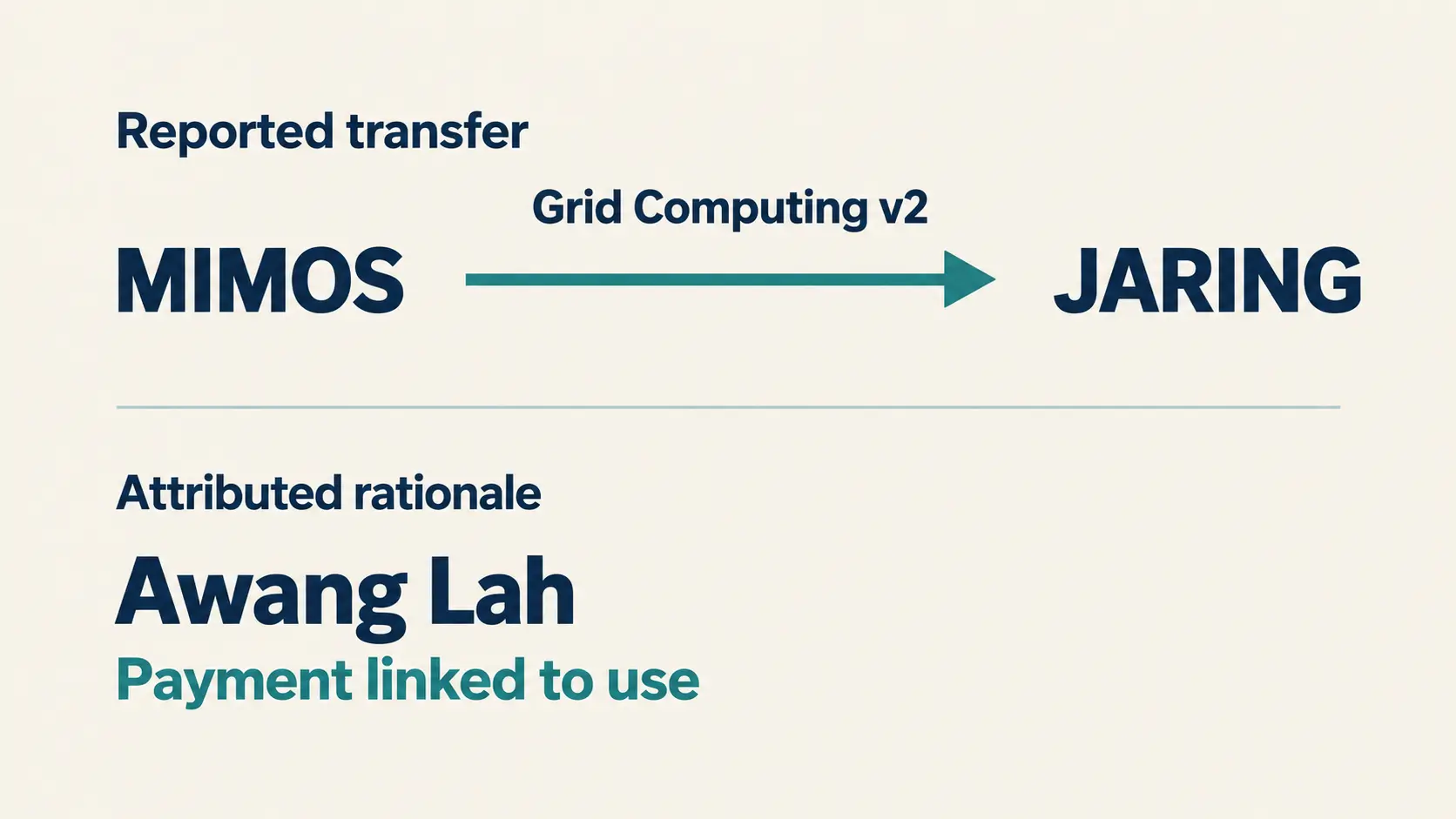
- Four dated documents place Dr. Mohamed Awang Lah in JARING's chief-executive chair as of 2001, 2002, 2003 and 2006 respectively. None of them is an appointment instrument.
- The .my domain he managed from 1987 and the address space JARING operated outlived every version of the title, and the documents reviewed here name neither a current holder nor a liability bearer for either.
Four years, one chair
The most formal document in the stack is not the oldest. It is a draft registration statement for a company called Neutrans, submitted in May 2025 and published through the U.S. Securities and Exchange Commission's filing system, which describes him in one sentence: "from 2002 to 2010, Dr. Mohamed was the CEO of JARING Communications Sdn. Bhd., Malaysia's pioneering Internet Service Provider" (Form F-1, submitted 30 May 2025). Seven years after he left, a company that wanted American capital needed to name a founder and a chief executive, and it did.
Thirteen years before that filing, a Malaysian technology publication described the company's cloud infrastructure and, in passing, its history: "its 10th anniversary in 2001, the then CEO, Dr Mohamed Awang Lah" (Digital News Asia, 7 September 2012). That puts him in the chair a year before the filing says he arrived in it. The same article dates JARING's separation from MIMOS to April 2005, which matters later.
In between sits a document of a different kind. On 27 August 2003, Malaysiakini published a letter under his name, signed "Dr Mohamed Awang Lah, Chief Executive Officer, Jaring" (Malaysiakini, 27 August 2003). A signature is not a contract, and the sign-off names no legal entity. It is, however, contemporaneous in a way that no biography is: the man held the title on a stated day, in an outlet he did not control.
And then there is the version he told himself. In a 2011 interview with Qiadah, the magazine of the Kelantan state government's corporate body, he walks through a career in his own words and separates two jobs with two titles: "Kemudian, saya dilantik sebagai Ketua Eksekutif JARING sehingga tahun 2004 sebelum dinaikkan sebagai Ketua Pegawai Eksekutif JARING Communications Sdn Bhd" — then I was appointed chief executive of JARING until 2004, before being elevated to chief executive officer of JARING Communications Sdn Bhd (Qiadah, issue 9, 2011). Chief executive of the programme to 2004, then chief executive of the company. Two chairs, not one.
A university profile published a year earlier, on the occasion of an honorary doctorate, names a third year: "In 2006, Dr. Mohamed bin Awang Lah was appointed as CEO of JARING Communication Sdn Bhd" (UNITEN alumni magazine, July 2010). A conference biography, meanwhile, hands the exit date back to the filing's side of the argument — JARING Communications chief executive until November 2010, with JARING initiatives in 1999 and 2001 attributed to him (MYNOG 13 speaker profile).
Line the ends up and they converge: 2010, or November 2010. Line the beginnings up and they scatter across five years. That asymmetry is the story. Nobody had much reason to argue about when he stopped. Everybody had a reason to be vague about when he started.
A signature is not an appointment record
MIMOS, the institute that incubated the service, dates the sequence cleanly and names no chief executive at all: operations from 1 January 1985, RangKom opened to selected users in 1987, limited public internet service in 1991, and then, in 1992, "JARING launched to replace RangKom" (MIMOS institutional history). The institute's twenty-fifth-anniversary release recognises him and three colleagues as "the Pioneer Management Team of MIMOS when it first began operations in 1985" and repeats the 1992 launch date (MIMOS news release, 5 May 2011). What the institution's own chronology grants him is a place in the founding management of a laboratory and a launch year for the service. What it does not grant him is a dated title over the service.
That distinction has teeth because the two titles in his own account sit on either side of a corporate event. Digital News Asia dates the spin-off to April 2005; his Qiadah account dates the change in titles to 2004, before the company existed in its separated form. Either the spin-off was prepared before it was announced — plausible, and unsupported by anything in this record — or one of the two dates is approximate.
The 2006 appointment in the UNITEN profile only widens the gap: a first appointment to the corporate chair in 2006 cannot be reconciled with a signed letter of 2003 unless there were two chairs, and there is no document here that names both.
So: no board resolution, no appointment notice, no organisational chart, no corporate-registry extract. Four documents, four years, and an absence where the instrument should be.
Founder is a word without a date
The founding attribution is not the weak part of the record. It is repeated, by different institutions, across four decades. The 2025 filing calls him founder in its business section without dating a founding (Form F-1). ICANN's introduction to a 2022 interview credits him with having "became the first manager of the .my domain, and founded Malaysia's first Internet service provider" (ICANN, 19 September 2022). Hallam Stevens' history of Malaysian networking places him asking for approvals and funds to grow RangKoM in the late 1980s — "By the late 1980s, Dr. Mohamed was seeking approvals and funds to expand RangKoM into larger network" — puts him in JARING planning by 1991, and carefully separates a JARING project establishment of 24 January 1990 from the international connection of November 1992 (Internet Histories, 2021). When the company wound up, a republished Star report credited him with "an instrumental role in the company's direction from 1992 until 2010" and called him its first chief executive in the same breath (JuiceAPac, 9 May 2015).
Read that sequence with the paperwork in mind and the puzzle dissolves without anyone being wrong. A man who is in the room from 1985, writing the funding requests in the late 1980s, planning the service in 1991, launching it in 1992 and signing its letters in 2003 built the thing. A man appointed chief executive of a company in 2002, or 2006, held an office. Those are different claims, and the habit of compressing them into one long tenure does the record no favour — least of all his.
An award attached to the wrong name
Pioneer material accumulates errors the way a beach accumulates rope. One example, checkable in a single document: a 2010 profile circulating alongside this material attached the Jonathan B. Postel Service Award to him. The Internet Society's own announcement that year names someone else entirely — Jianping Wu, "honours leading Chinese technologist Dr Jianping Wu with Postel Award" (Internet Society, 28 July 2010). That correction costs him nothing; his Malaysian record stands on its own. It is the kind of accretion that makes the difference between an attributed credit and an asserted fact worth insisting on.
The record that outlived the title
Every document above is about a chair. The interesting object is what stayed behind when he got up from it.
He managed .my from 1987, according to his own account to ICANN. JARING operated the country's first public internet service and, with it, the address space that service needed. The company wound up. The domain did not. Neither did the addresses. Whatever their current state, they outlasted 2002, 2004, 2006, 2010 and every disagreement between those numbers.
And here the record simply stops. No document obtained for this article names the authority that currently recognises the .my delegation, or the party that currently holds JARING's address space, or the party that answers for either if something goes wrong. That is not an accusation against a person; it is a gap in a public record about an asset that many networks depend on.
This is where the accountability question belongs. A registry layer — the institution that can recognise a holder, transfer a resource, revoke it, condition it or quietly refuse to let it move — can exercise controls of real thickness. The liability it carries rarely matches. Our position is straightforward: whoever can deny portability should carry liability proportional to that power, and the rules for recognition, transfer and exit should be written down where the affected holder can read them before the moment of dispute. Ambiguity in a founding story is survivable. Ambiguity in who can revoke your addresses is not.
What would settle it
A dated appointment instrument would settle the office: a board minute, a personnel record, an appointment notice, a corporate-registry extract showing when the office changed hands and at which entity. A delegated-authority or address-allocation record would settle the other half: who holds .my and JARING's number resources now, and who answers for them.
Neither exists in this record. Until one does, the honest sentence about Dr. Mohamed Awang Lah is the narrow one: widely credited, by institutions that had no incentive to flatter him, with founding and building Malaysia's first internet service; demonstrably in its chief executive's chair in August 2003 by his own signature, and described in that chair across the years from 2001 to 2006 by documents that cannot all be describing the same appointment.
The chair has four start dates. The work has one long record. Keep them apart and both get clearer.
Member Briefing
Deeper Trend Context
Sign in with the right membership level to unlock the full briefing and source notes.
Strategic Circle
A daily briefing in your language, built from changes we have verified.
Join for USD 20/monthCancel anytime.
Public reporting stays free. Member research, the daily briefing and the forum need a membership.