
Summary
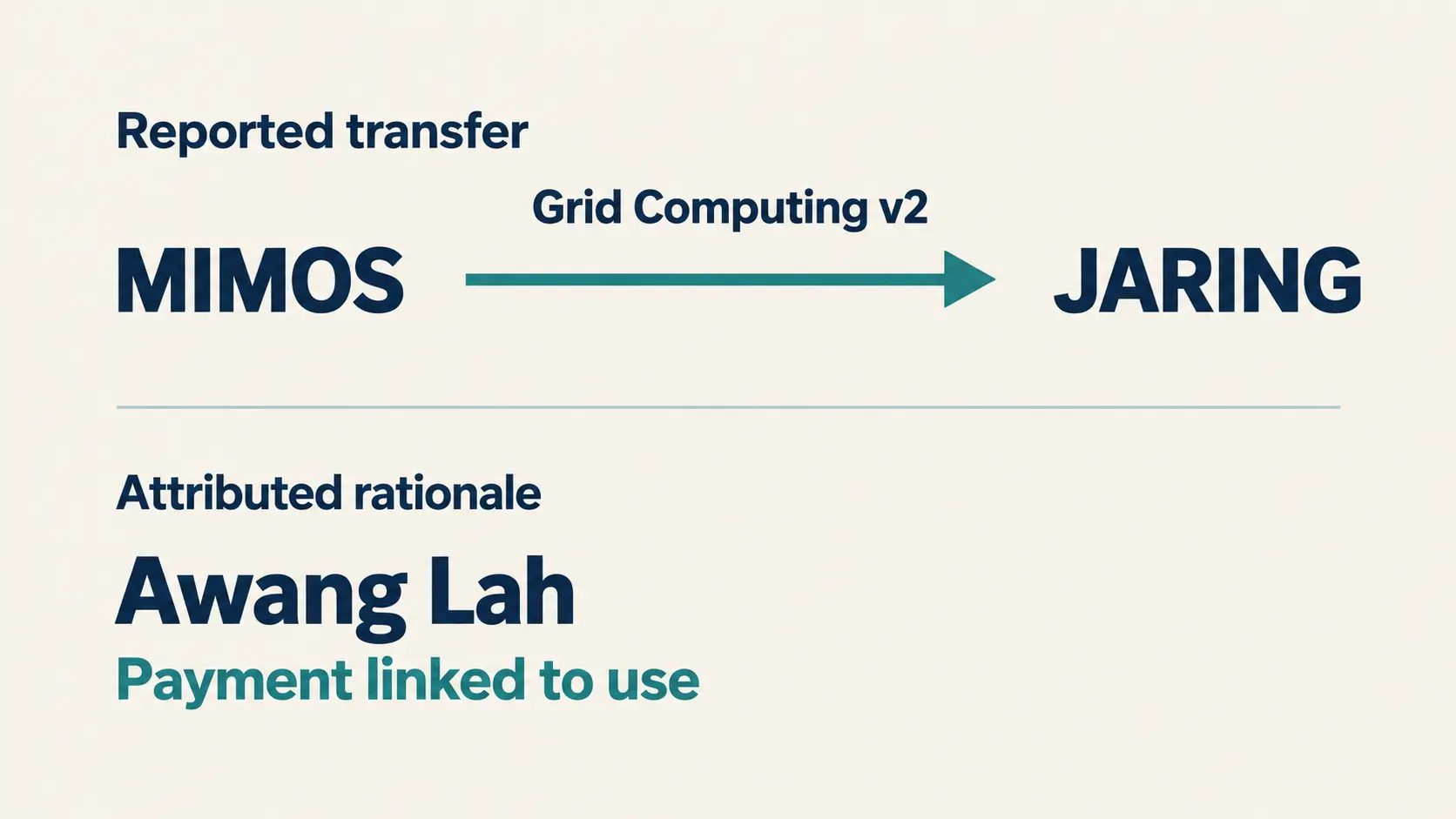
- MIMOS’s annual report for 2008 lists Jaring Communications Sdn Bhd as having been awarded version 2 of Grid Computing. That identifies an organizational recipient, not the individual who negotiated the transfer.
- A Malay report hosted by MIMOS identifies Awang Lah as JARING’s chief executive and attributes to him a cost-saving argument based on paying for what is used. The statement is a commercial proposition, not a measurement of customer savings.
The executive’s argument concerned the customer’s bill
Mohamed Awang Lah’s documented contribution in this episode is specific: he explained a proposed economic benefit of grid computing. The MIMOS-hosted report says JARING received the technology from MIMOS for commercial purposes. It then attributes to its chief executive the argument that users could save costs because payment would follow what they used—expressed in Malay as “bayar apa yang digunakan.” The report links his executive role to that rationale, rather than to a claim of personal invention.
This is a useful point of entry into leadership accountability. The promise was not simply that an organization had acquired technology. It was that a particular way of charging for its use could improve the customer’s economics. Those are different propositions, requiring different evidence.
The report’s publication date remains unverified. Its reference to receiving the technology “today” therefore cannot supply a calendar date for the transfer. Nor does the phrase “for commercial purposes” establish that a production service was already available for customers to buy.
The award identifies institutions, not every decision-maker
The separate documentary anchor is MIMOS’s annual report for 2008. Its entry reads: “Jaring Communications Sdn Bhd – awarded version 2 of Grid Computing.” The annual-report passage supports the narrower finding that MIMOS recorded JARING as a technology recipient.
The year belongs to the report. It should not be converted into an exact signing or launch date. Similarly, “version 2” is a designation in the record, not a description of processing capacity, technical readiness or service performance. The preserved passage does not provide those specifications.
Together, these accounts identify MIMOS as the technology source, JARING as the reported recipient and Awang Lah as the executive presenting a commercial rationale. They do not identify who initiated, negotiated, approved or signed the transfer. They also do not disclose the contractual rights or obligations that would determine what JARING could develop, sell or support.
That division matters when assessing a person rather than an organization. A chief executive’s public explanation is evidence of the position he advanced. It is not, by itself, a record of his control over engineering, contracting or implementation. Assigning all those decisions to him would replace an institutional history with an assumption about his title.
Paying by use is a mechanism, not a savings calculation
The economic logic is plausible but conditional. If charges genuinely follow consumption, a customer may avoid committing money to capacity it does not use. Whether this produces a lower total cost depends on the workload, the alternative and the full set of charges needed to obtain a comparable result.
A meaningful comparison would therefore begin with a defined job. How much work must be completed, to what standard and within what time? It would then compare the cost of accomplishing that job under the proposed service with a credible alternative. Implementation, support and any other necessary expenditure belong in that comparison alongside usage charges.
Service quality also matters. A cheaper bill would not establish an economic improvement if the comparison ignored a material difference in the work completed or the reliability required. Conversely, flexibility could have value even where a simple unit-price comparison showed little difference. These are analytical possibilities, not findings about JARING’s customers.
The cited passages supply no verified tariff, customer workload or comparable cost result. They cannot establish the scale of any saving. Nor can they establish the absence of savings. Missing outcome evidence leaves the proposition unmeasured in this account; it does not turn a claimed benefit into a demonstrated failure.
Credit the argument without inventing the outcome
For Awang Lah, the defensible person-level finding is that he publicly connected the reported technology receipt to a usage-linked cost-saving proposition. The MIMOS-hosted account supports that attribution. It does not establish that he alone designed the commercial model, delivered the service or secured its subsequent continuity.
The distinction preserves both agency and proportion. His commercial argument is not erased because institutional actors also mattered. But neither an award nor an executive statement can stand in for customer evidence. The consequential next question is whether an accessible offer led to actual use and a demonstrable benefit—and which decisions enabled each step.
Member Briefing
Deeper Profile Context
Sign in with the right membership level to unlock the full briefing and source notes.
Only for Strategic Circle
Strategic Circle
Open to all readers. Unlock profile briefings after joining and signing in.
Join Strategic CircleOnly for Leadership Alliance
Leadership Alliance
For qualified IP-asset owners and management; sign in to unlock alliance briefings.
Join Leadership Alliance