
Summary
- Japan’s 12-member Wide-Area Workload Shift consortium says its demonstration began in August and runs through February 2027. It links research-network and utility fibre with data-centre clusters, then proposes to place work using power, market, GPU, battery and network signals.
- The “Virtual Hyperscaler” is a target, not disclosed operating capacity. The consortium still lists common interfaces, an open operating model, business models and governance as future work; the test is whether independent operators can turn movable jobs into a service with a buyer, a price and an accountable service owner.
The name makes a promise before the project has to. A “virtual hyperscaler” sounds like a cloud provider assembled from distributed data centres rather than owned as one campus. But the 12 organizations behind Japan’s Wide-Area Workload Shift demonstration describe a trial, not a launched cloud. Their October 7 announcement says work began in August and is scheduled through February 2027. The stated task is to test technical, operational and business feasibility for coordinating communications, power and computing. The consortium’s announcement
There is a real location problem to solve. Japan’s 2025 Energy White Paper says about 90% of the country’s data-centre floor area was in the Tokyo and Osaka regions in 2023, while carbon-free generation is distributed unevenly. That is a dated, floor-area measure, not a map of spare capacity today. It does show why a network that can place some work nearer available power may be worth testing. Yet moving a task does not move electricity through a constrained transmission line, create a grid connection or guarantee that the receiving site has spare GPUs. METI’s Energy White Paper
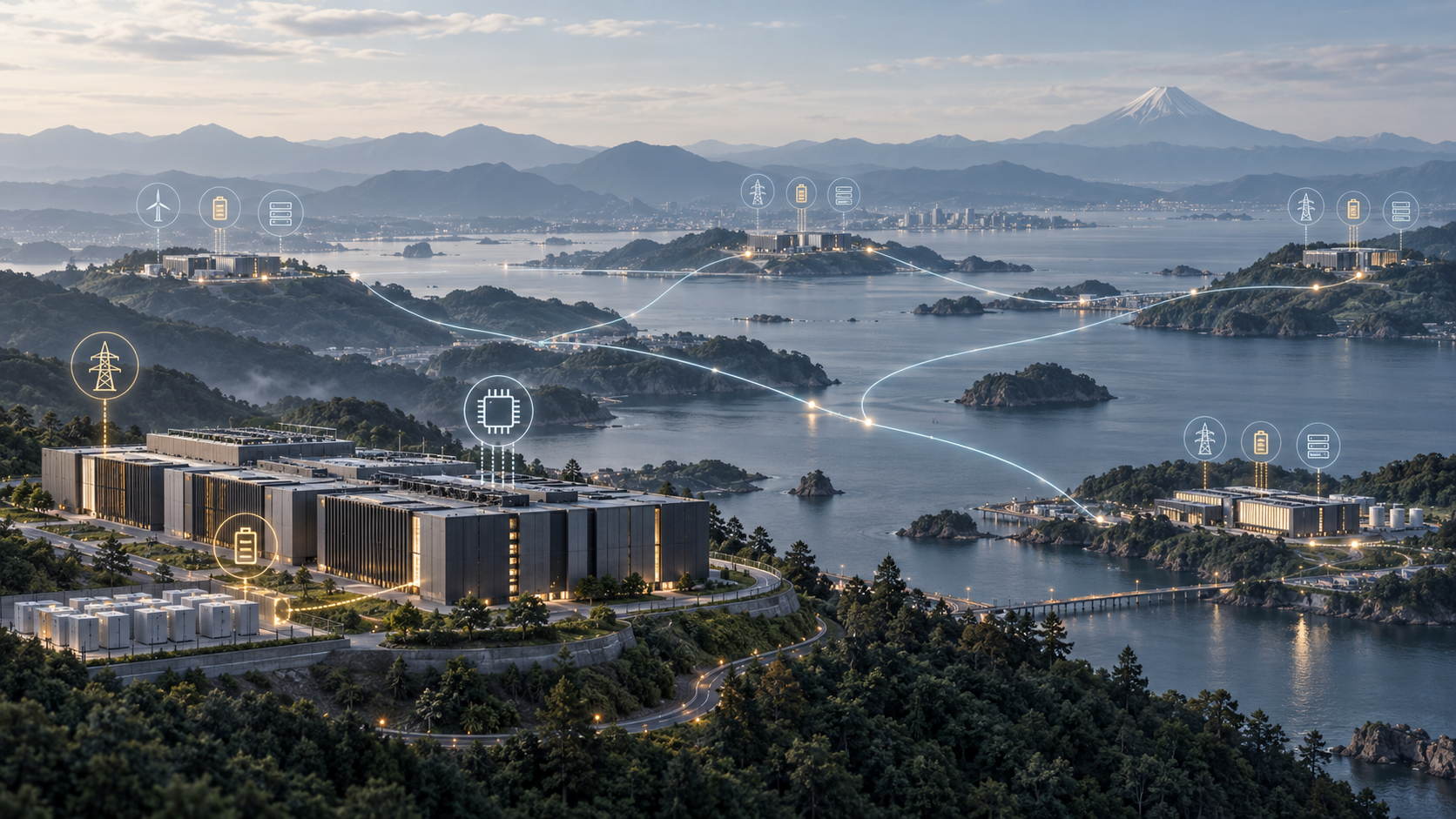
The proposed architecture is more concrete than the brand. The consortium plans to use the National Institute of Informatics’ SINET research network and TEPCO Power Grid dark fibre, with some direct all-optical connections between data-centre sections. An orchestrator is meant to weigh power supply and demand, market information, GPU use, battery condition and network status when deciding where work should run. SoftBank and Fujitsu are each assigned platform-development roles; the participants also include carriers, utilities, data-centre providers and universities. Those assets provide a test bed.
They do not yet make participating capacity interchangeable.
Workload eligibility is the first economic filter. A training job that can wait for a regional power surplus is different from a live inference request whose user expects an answer now. Even a deferrable job may carry large datasets, checkpoint state, model dependencies, residency rules or performance commitments that make a move costly. A 2026 study using one week of Alibaba cluster traces estimated that up to 22% of load could be deferred during flexibility windows under its model. That is evidence that some workloads may be flexible, not a result for Japan and not proof that the same jobs can be shifted between unrelated operators. Caprara et al., International Journal of Electrical Power & Energy Systems
The gap between a demonstration and a product appears in the consortium’s own next steps. It says participants still intend to develop an open operating model and common interfaces, and to consider business models and common rules for implementation. The announcement gives no service price, customer contract, revenue share, dispatch authority, service-level commitment or measured workload volume. It also does not report a reduction in curtailment, emissions or grid investment. Those omissions do not establish failure; they mark the commercial questions the test has not publicly answered.
A cloud customer needs more than a scheduler that finds a nominally cheaper or cleaner location. It needs to know which jobs qualify, how much delay is allowed, what happens when a destination is full, who controls the data path, and which operator remedies a missed deadline. A data-centre owner must see how revenue or avoided power cost is shared before it gives another party control over workload placement. A carrier must price capacity and protect performance. A power-market signal has to correspond to a usable location and a permission to respond, not simply a regional price displayed on a dashboard.
That is why the first product may be a rulebook and interface rather than a new cloud console. If the trial produces common workload descriptions, verified telemetry, interoperable dispatch and a settlement method that participants can accept, it could make otherwise separate capacity easier to contract. If it produces only a successful transfer between selected university or partner sites, it will have proved a technical path—not a hyperscale service or an investable market.
The February 2027 end date is therefore a checkpoint, not a launch forecast. The useful evidence will be the number and type of jobs actually eligible and completed; the delay and failure rates; the power and network conditions used in each placement; and the customer and operator terms attached to it. “Virtual” can describe a real pooled service only when the control rights, costs and promises travel with the workload.
Sources
- SoftBank Corp. and consortium members: October 7, 2026 announcement
- Japan Ministry of Economy, Trade and Industry: Energy White Paper 2025, data centres and decarbonized-power siting
- Caprara et al.: Data center workload flexibility using Alibaba traces, International Journal of Electrical Power & Energy Systems (2026)
- National Institute of Informatics: NII Overview 2025 (SINET)
Member Briefing
Deeper Profile Context
Sign in with the right membership level to unlock the full briefing and source notes.
Only for Strategic Circle
Strategic Circle
Open to all readers. Unlock profile briefings after joining and signing in.
Join Strategic CircleOnly for Leadership Alliance
Leadership Alliance
For qualified IP-asset owners and management; sign in to unlock alliance briefings.
Join Leadership Alliance