Summary
- RFC 769 described a file wrapper for Rapicom 450 fax data so organizations with compatible devices could exchange stored pages over file-transfer and other network protocols.
- Its records gave the network a way to carry setup, data and end markers. The page inside remained in the machine's own 585-bit encoding; a receiver needed that decoding procedure to make an image.
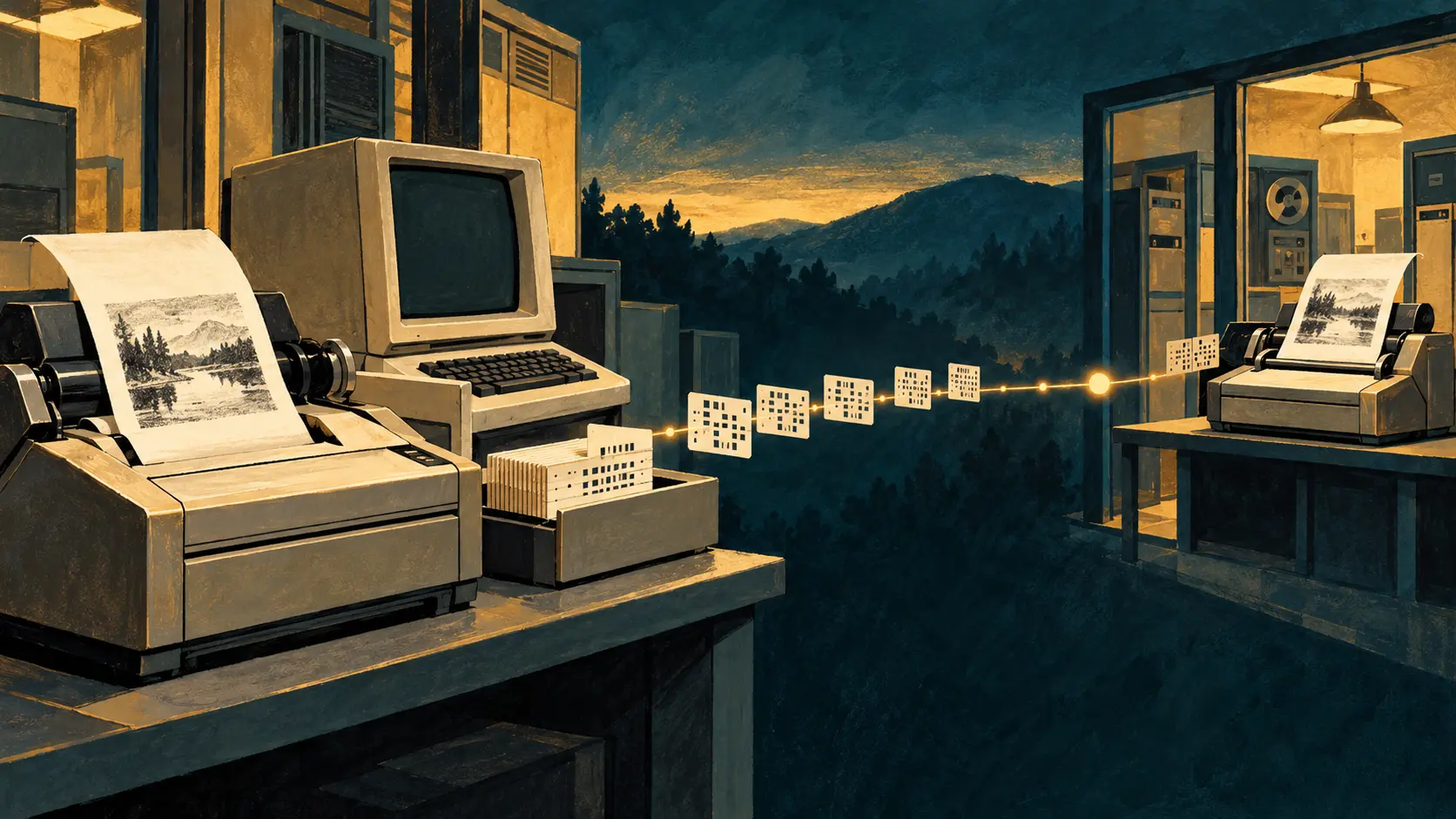
The first surprise in Jon Postel's September 1980 memo is that a fax page could become a computer file at all. Several organizations in the ARPA Internet community had Rapicom 450 facsimile machines connected to computers. A machine could put a page representation into storage; another compatible machine could produce a page from stored data. Once the bits lived in a file, ordinary file-transfer methods could move them between equipped organizations.
The second surprise is smaller and sharper. Moving the file did not teach a general-purpose computer how to read the page. Rapicom's machine had its own encoding and decoding scheme. Its output arrived in 585-bit blocks. Postel's memo specified how to package those blocks for exchange, and plainly observed that the block could not be treated as a bitmap without the machine's codec. The Internet could carry the envelope. The letter inside was still written in the appliance's handwriting.
That limitation explains why the memo existed. A nearby office with an identical device might already know the trick. A new organization joining the exchange needed a precise file grammar: where a block began, whether it prepared the machine or carried page data, and when the file ended. The RFC supplied a record made of a length byte, a command byte and data bytes. The length counted the first two bytes as well. Command 56 meant SET-UP, 57 meant DATA, and 58 meant END. The final END record could consist of just the two-byte wrapper.
The setup block reveals the difference between an operating device and an archived file. The Rapicom 450 sent or received several identical copies of that block. The stored file kept one. The machine might repeat a preparation signal over its own interface; a file did not have to preserve every repetition to carry the same setup content. Postel's record format selected what belonged in the representation that other computers would copy.
There was also the unglamorous problem of fitting 585 bits into byte-oriented storage. Seventy-three bytes held only 584 bits, so the file convention used a 74-byte data field. Add the command and length bytes and a normal record reached 76 bytes. The files described as exchanged to date put one device block into each record. They began with SET-UP, followed with DATA records and ended with END. These small numbers mattered because a receiver looking at a stream of bytes needed to know where the device's peculiar block ended. A miscount here turned a page into a very expensive strip of confetti.
The memo even recorded a 24-bit synchronization mark at the start of a block and a two-bit sequence that cycled through four values in DATA records. These details made the captured device structure easier to recognize and preserve. They did not decode the picture. A file parser could tell where a DATA record sat; the Rapicom-specific method still had to turn its coded block into pixels or marks on a page. Transport, parsing and rendering were three different jobs in the same workflow.
The purpose was practical and narrow. The RFC invited more organizations with compatible facsimile equipment into an existing exchange procedure. It offered no new universal image language. That would become a different project. In RFC 1314, published in 1992, the IETF Network Fax Working Group documented a self-contained TIFF-B file format for fax-like images. The later specification's ambition helps show the earlier one clearly: the 1980 file made one device family exchangeable; the 1992 file aimed for broader image interchange.
RFC 769 captures an early Internet moment before “send the document” sounded like one operation. A page entered a machine, became proprietary coded blocks, acquired a byte wrapper, crossed a network as a file, and waited for a compatible decoder. Each handoff had a different custodian. The marvel was real: paper could leave the office as data. The fine print was mechanical: at the other end, the right machine still had to be in the room.
Member Briefing
Deeper Profile Context
Sign in with the right membership level to unlock the full briefing and source notes.
Only for Strategic Circle
Strategic Circle
Open to all readers. Unlock profile briefings after joining and signing in.
Join Strategic CircleOnly for Leadership Alliance
Leadership Alliance
For qualified IP-asset owners and management; sign in to unlock alliance briefings.
Join Leadership Alliance